
Imagine you lend money to a friend, but instead of waiting for them to repay, you sell the loan to someone else and get your cash upfront. This is the basic idea behind Asset Backed Securities (ABS). Today, financial products like car loans or credit card debt are turned into investments. Nowadays, banks sell these loans to investors, offering a steady stream of income. So, is it right to invest in ABS? It depends. You need to understand that ABS can provide regular returns, however, they also carry financial risks.
As per reports, the market size of ABS is valued approximately $2510.83 billion in 2023 and projected to reach $3757.14 billion by 2030. It suggests that there is a great potential in Asset Backed Securities (ABS). In this blog, we will share insight on how Asset Backed Securities works.
Table of Contents
- What Are Asset Backed Securities?
- Types of Asset Backed Securities
- What Are Mortgage-Backed Securities? A Key Subset of ABS
- Types of Mortgage-Backed Securities and Their Market Impact
- How to Buy Asset Backed Securities: A Step-by-Step Guide
- How Do Asset Backed Securities Generate Profits for Investors?
- Key Benefits of Asset Backed Securities for Investors
- Advantages of Mortgage-Backed Securities in Investment Portfolios
- Asset Backed Securities vs. Mortgage-Backed Securities: Key Differences Explained
- FAQs
What Are Asset Backed Securities?
In simple words, Asset Backed Securities (ABS) are financial products that are created by bundling different types of loans. These loans consist of car loans, home loans, or credit card debts. Banks convert these loans into tradable investments. If you buy ABS, you will enjoy regular payments as borrowers repay their loans. However, there are some risks associated with it. At times, there are borrowers who default. So, as an investor, you can lose money. It is advised to understand how ABS works, their potential returns, and risks is essential before investing. When chosen wisely, they can provide passive income and diversify an investment portfolio.
Types of Asset Backed Securities
Before investing in Asset Backed Securities, you need to understand its types. Some of the popular types of ABS are explained below. Have a look:
| Type of ABS | What It Is | How It Works | Best For Investors Looking For… |
| Mortgage-Backed Securities (MBS) | – Backed by home loans.
– Most common type of ABS. |
– Banks bundle mortgages and sell them.
– Investors earn as homeowners pay loans. |
– Long-term income.
– Real estate-based investments. |
| Auto Loan-Backed Securities | – Backed by car loans.
– Shorter loan terms than mortgages. |
– Borrowers make monthly car payments.
– Investors get steady returns. |
– Short-term, predictable income.
– Safer than unsecured debt. |
| Credit Card Receivable-Backed Securities | – Backed by credit card debt.
– Higher risk than car or home loans. |
– Investors earn as people pay off credit balances.
– No physical asset backing the debt. |
– Higher returns.
– More risk due to unsecured debt. |
| Student Loan-Backed Securities | – Backed by student loans.
– Usually government or private loans. |
– Investors earn as students repay debt.
– Longer repayment periods. |
– Long-term passive income.
– Some risk if students default. |
| Equipment-Backed Securities | – Backed by loans for business equipment.
– Used for machinery, tools, etc. |
– Businesses repay loans in installments.
– Investors get steady income. |
– Business-focused investments.
– Backed by physical assets. |
| Royalties and Future Income-Backed Securities | – Backed by future earnings (movies, music, etc.).
– Linked to creative industries. |
– Investors earn a share of future revenues.
– Often used by artists, sports teams, and media companies. |
– Unique investment option.
– Income tied to entertainment or intellectual property. |
What Are Mortgage-Backed Securities? A Key Subset of ABS
Mortgage-Backed Securities are a special type of ABS created from home loans. If you buy a home with a mortgage, the bank will not keep these loans with them. Instead, they bundle thousands of them together and sell them to investors. In return, investors receive regular payments as homeowners repay their loans. This system helps banks free up money to issue new loans while giving investors a steady income.
Types of Mortgage-Backed Securities and Their Market Impact
We have learned Asset Backed Securities and Mortgage-Backed Securities. To have a better clarity, MBS are explained below:
| Type of MBS | What It Is | How It Works | Market Impact |
| Pass-Through MBS | – The most basic type of MBS.
– Investors receive direct payments from homeowners. |
– Banks bundle home loans and pass mortgage payments (principal + interest) to investors. | – Provides steady income.
– Lower risk if backed by government agencies. |
| CMO | – A more complex version of MBS.
– Divided into different risk levels. |
– Loans are split into “tranches” (segments) where some investors get paid before others. | – Offers options for different risk levels.
– Can be risky if not well-structured. |
| Agency MBS | – Backed by government agencies
– Considered safer. |
– The government guarantees payments | – Lower risk, lower returns.
– Attracts conservative investors. |
| Non-Agency MBS | – Issued by private banks and financial firms.
– No government backing. |
– Investors bear full risk if borrowers default. | – Higher returns
– Higher risks |
How to Buy Asset Backed Securities: A Step-by-Step Guide
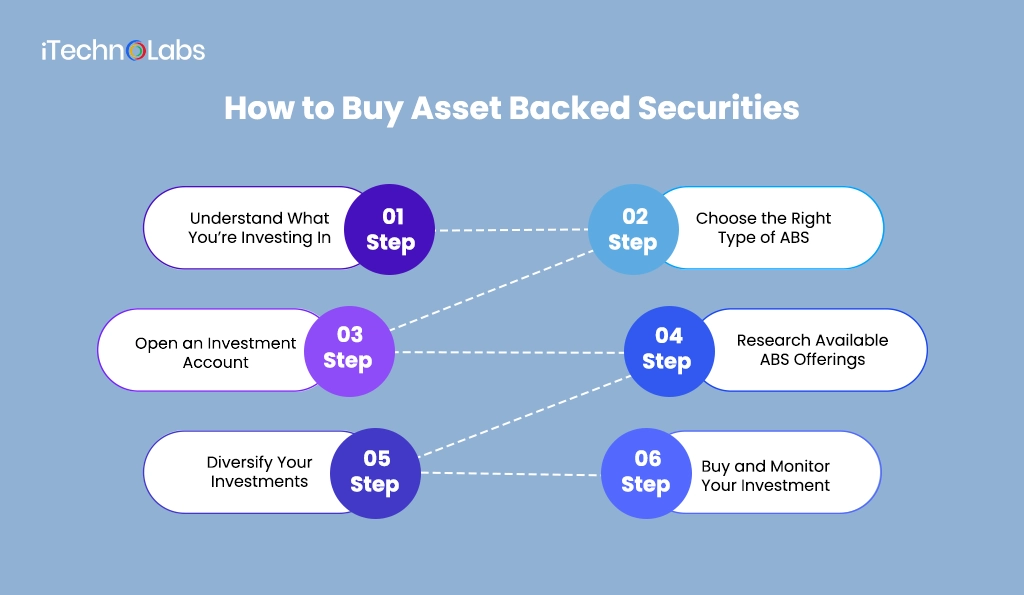
Below you can find detailed steps how to buy Asset Backed Securities:
Step 1: Understand What You’re Investing In
Before buying any ABS, you must understand how they work. ABS are created when loans are sold to the investors. If any borrower repays on time, you get a share of that payment. Moreover, if borrowers default, you might lose money.
Step 2: Choose the Right Type of ABS
Not all ABS are the same. Some, like MBS, are backed by home loans and are considered more stable. Others, like credit card receivable-backed securities, offer higher returns but come with more risk. If you prefer safety, agency-backed MBS (supported by government entities like Fannie Mae) might be a better choice.
Step 3: Open an Investment Account
To buy ABS, you need an account with a brokerage firm or financial institution. There are many investment platforms who offer ABS. In case, if you are not sure which one to choose, you can opt for a broker which offers research tools and low fees.
Step 4: Research Available ABS Offerings
Once your account is set up, explore available ABS options. Look at factors like:
- Credit Ratings – Higher-rated ABS (AAA or AA) are safer but may have lower returns.
- Interest Rates – Higher interest rates mean higher potential earnings.
- Loan Type – Auto loan-backed securities might perform differently from student loan-backed securities.
Step 5: Diversify Your Investments
Don’t put all your money into one type of ABS. You can reduce risk with diversification. So, instead of investing in MBS, you can also invest in auto loans. It will balance your portfolio.
Step 6: Buy and Monitor Your Investment
After selecting the right ABS, you can place an order through your brokerage account. Once purchased, keep track of its performance. Check economic conditions before investing in any types of loans. Your returns might be affected if borrowers struggle to repay their loans.
How Do Asset Backed Securities Generate Profits for Investors?
Today, Asset Backed Securities have become a game changer for the investors. So, if you’re planning to invest, here are some ways you can earn profit. Let’s break it down.
1. Interest Payments – Earn Money Like a Bank
You need to understand that if someone takes out a loan, they pay the principal amount along with interest. This is how banks make money. With Asset Backed Securities, investors also receive a part of that interest.
2. Principal Repayments – Get Back the Original Investment Over Time
As borrowers repay their loans, the money flows back to investors. These repayments reduce risk because investors gradually get back the money they put in.
3. Diversification – Don’t Put All Your Eggs in One Basket
The main advantage of Asset Backed Securities is that they spread risk. If a single borrower doesn’t repay, it won’t ruin the entire investment because many other loans are still performing.
4. Yield Potential – Higher Returns Than Traditional Bonds
Since Asset Backed Securities are linked to loans, they often offer better returns than regular bonds. Investors looking for higher profits choose ABS because they provide a mix of steady income and decent interest rates.
Key Benefits of Asset Backed Securities for Investors
As per reports, the investors have been able to earn high profits through Asset Backed Securities. Some of its benefits are mentioned below. Have a look:
1. Steady Income – Get Paid Regularly
One of the biggest advantages of Asset Backed Securities is consistent cash flow. Borrowers make monthly loan payments, and investors receive a portion of those payments.
2. Lower Risk Through Diversification
Putting all your money into a single stock or loan is risky. If that investment fails, you could lose everything. But Asset Backed Securities spread your investment across hundreds or even thousands of loans, reducing the risk of loss.
3. Higher Returns Than Savings Accounts
Investors often look for returns that are better than a savings account but safer than stocks. ABS typically offer higher interest rates than bank deposits because they earn money from loan interest payments.
4. Different Options for Different Risk Levels
Not all investors have the same risk tolerance. Some prefer safe investments, while others seek higher returns with more risk. ABS come in different types, allowing investors to choose what fits their needs.
5. Protection Against Market Volatility
Stock markets can be unpredictable. A company’s stock price might crash suddenly, wiping out gains. But ABS are not directly tied to the stock market—they are backed by real people repaying their loans. This makes ABS more stable during economic uncertainty.
Advantages of Mortgage-Backed Securities in Investment Portfolios
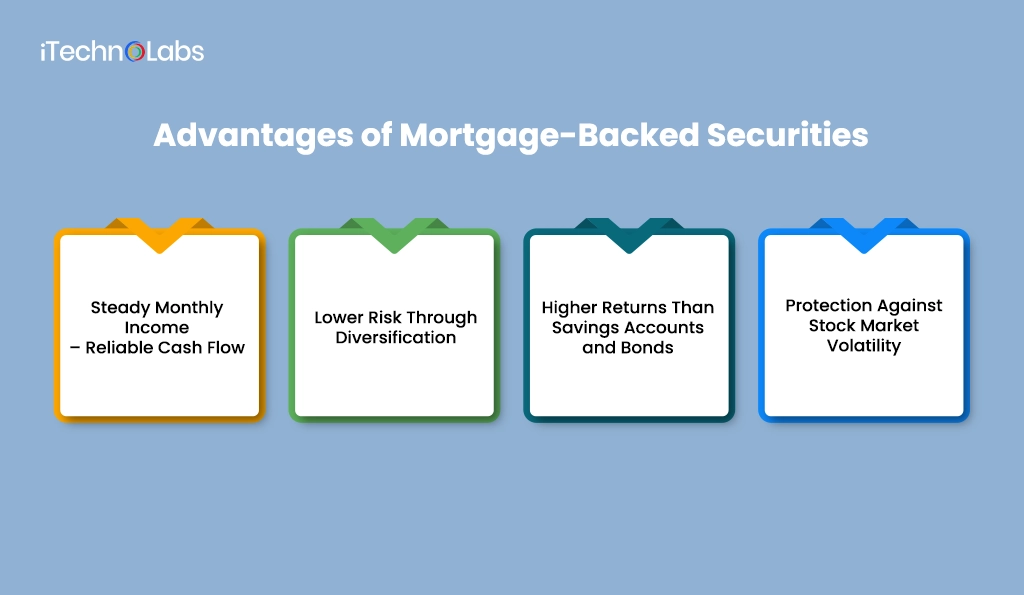
Are you planning to buy a bundle of home loans from a reputed bank? Here are the advantages of MBS you must know. Check below:
1. Steady Monthly Income – Reliable Cash Flow
Consistent income is the main advantage of MBS. You’ll receive monthly payments as homeowners pay their mortgages every month.
2. Lower Risk Through Diversification
Think if you invest in a single home loan, the chances are high that the borrower might stop paying the loan. But MBS are made up of hundreds or even thousands of mortgages, it means your risks get spread.
3. Higher Returns Than Savings Accounts and Bonds
It has been seen that most of the people invest in government bonds or keep money in their bank accounts. But these options offer low interest rates. MBS are associated with higher returns.
4. Protection Against Stock Market Volatility
MBS aren’t directly tied to stock market movements. Their value comes from homeowners paying their mortgages, which remains steady even during market downturns.
Asset Backed Securities vs. Mortgage-Backed Securities: Key Differences Explained
Asset Backed Securities and Mortgage-Backed Securities are a type of investment, but different. Its differences are mentioned below. Have a look:
| Feature | Asset Backed Securities (ABS) | Mortgage-Backed Securities (MBS) |
| Definition | – Investments backed by daily loans | – Investments backed only by home loans |
| Loan Types | – auto loans, personal loans, student loans | – Home loans are included |
| Risk Level | – Varies depending on loan type and borrower quality | – Generally lower risk, especially for government-backed MBS |
| Income Source | – Payments come from borrowers repaying various loans | – Payments come from homeowners paying their mortgages |
| Stability | – Can be more unpredictable because different loans have different risks | – More stable as home loans are long-term and backed by property |
| Government Backing | – Usually not backed by government agencies | – Backed by government entities |
| Investment Returns | – May offer higher returns due to diverse loan types and risk levels | – Returns are generally lower but more consistent over time |
| Market Sensitivity | – More affected by economic conditions and borrower behavior | – Less sensitive to short-term market changes since homeowners prioritize mortgage payments |
| Best for Investors Who Want | – Diversification across different types of loans | – Steady income with lower risk from real estate-backed securities |
Conclusion
Asset Backed Securities is a unique way of investment. You can invest in income-generating assets through ABS schemes. You can enjoy steady cash flow, portfolio diversification, and competitive returns with these schemes. It makes ABS a strong alternative to traditional investments like stocks and bonds. However, ABS comes with potential risks. The returns on your investments will depend upon quality of underlying loans, economic conditions, and borrower repayment behavior. Smart investors analyze loan quality, interest rates, and market trends before investing.
For those looking for consistent income with a balanced risk-reward ratio, Asset Backed Securities can be a valuable addition to an investment portfolio. By understanding how ABS works and choosing high-quality securities, investors can maximize returns while managing risk effectively.
FAQs
1. What is an example of an asset-backed security?
Car loans are the best examples for Asset Backed Securities. Banks sell car loans to the investors who earn when borrowers pay back the loans.
2. What is meant by Asset Backed Securities?
ABS are investments made through purchasing of loans like auto loans, credit card debt, student loans, and business loans. Investors earn money as borrowers repay these loans with interest.
3. What is the difference between ABS and MBS?
ABS consists of auto loans, credit card debt, and student loans. MBS are related to home loans and real estate mortgages. MBS is often more stable since it’s tied to real estate.
4. What happens if an ABS defaults?
If an Asset-Backed Security defaults, investors may lose part of their money. However, risk is reduced because ABS contains many loans, so a few defaults won’t wipe out the entire investment. Higher-rated ABS are less likely to default.