In the last decade, fintech firms have upended the banking sector by transforming conventional banking practices and increasing security in transactions. With digital payments and decentralized finance (DeFi) gaining popularity, blockchain technology has emerged as a central feature of contemporary financial products, with transparency, speed, and anti-fraud.
Fintech, or financial technology, are new digital innovations that enhance financial services through automated transactions, lending, investing, and others. Blockchain technology is also key in this transformation, allowing for safe, tamper-proof transactions without middlemen.
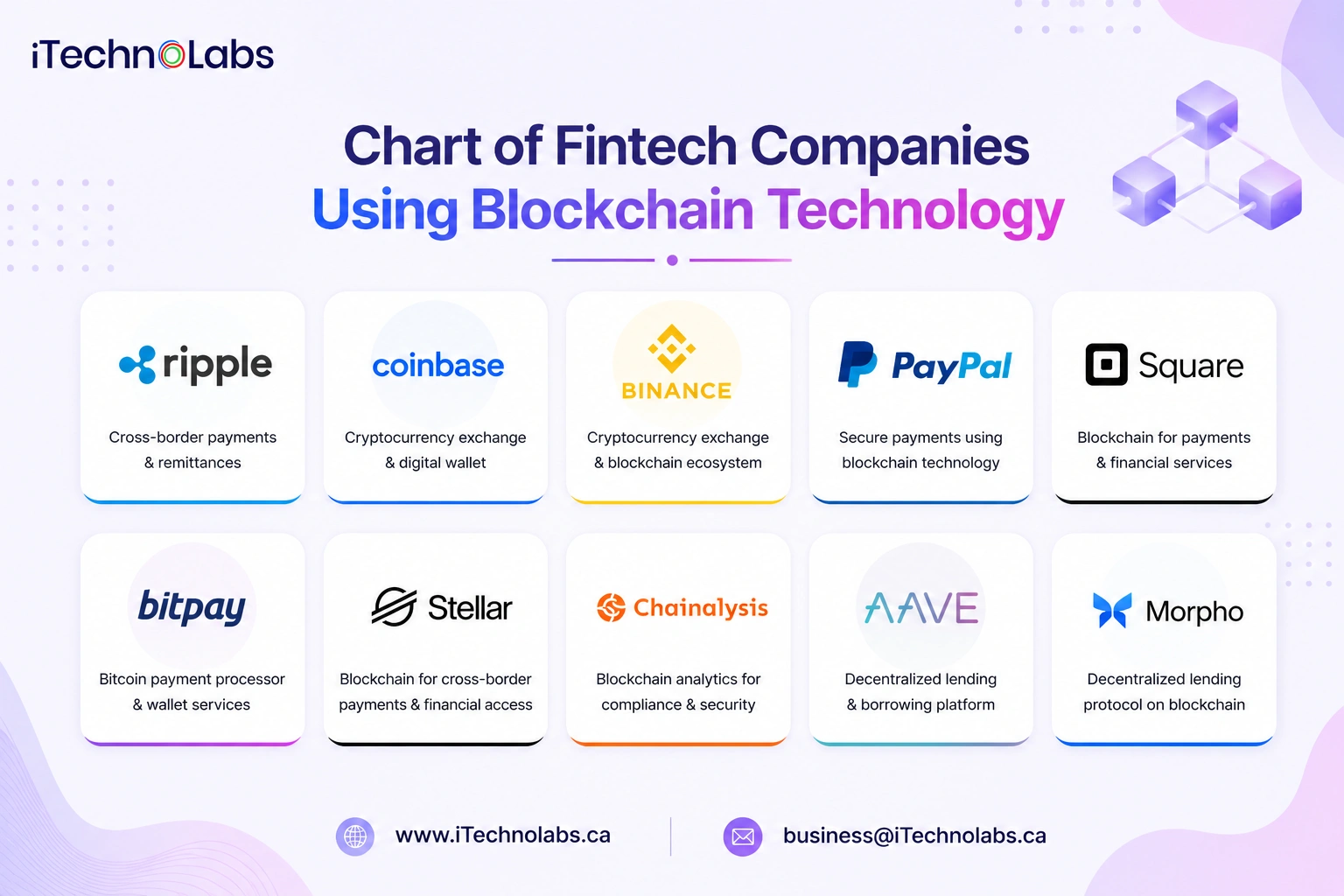
Several top companies & startups are using blockchain to revolutionize financial services. A fintech company using blockchain technology can provide decentralized payment solutions, cryptocurrency services, and smart contract-based financial applications. Let’s have a look at some of the major companies leading this fintech revolution powered by blockchain.
Table of Contents
15 Top Fintech Startups & Companies Using Blockchain Technology
Here’s a list of fintech companies & startups utilizing blockchain technology.
| Company Name | Industry | Blockchain Use Case | Key Features |
| Fireblocks | Crypto & Digital Assets | Secure wallet infrastructure for crypto transactions |
|
| ANote Music | Music & Finance | Blockchain-powered music royalties marketplace |
|
| AnChain.AI | Blockchain Security | AI-driven blockchain analytics & security |
|
| Aragon | Business & Governance | Decentralized autonomous organizations (DAOs) |
|
| Zabo | Crypto & Banking | API for linking crypto accounts with traditional finance |
|
| Horizon Blockchain Games Inc. | Gaming & Web3 | Blockchain-based gaming and NFT ecosystem |
|
| Argent | Crypto & DeFi | Ethereum-based smart wallet |
|
| Phemex | Crypto Trading | Blockchain-powered derivatives trading platform |
|
| Aurus | Precious Metals & Finance | Tokenization of gold, silver, and platinum |
|
| Bakkt | Digital Assets & Payments | Enabling crypto payments and digital asset management |
|
| Billon | Banking & Compliance | Blockchain for national currency payments & document storage |
|
| Balancer | Decentralized Finance | Automated portfolio management & liquidity provider |
|
| Circle | Payments & Stablecoins | Issuer of USDC stablecoin, blockchain-powered payments |
|
| Ripple | Cross-Border Payments | Blockchain-based real-time payment settlement |
|
| ConsenSys | Blockchain Infrastructure | Ethereum-based software solutions |
|
1. Fireblocks
Founded: 2018
Founder(s): Michael Shaulov, Pavel Berengoltz, and Idan Ofrat
Fireblocks is a fintech company using blockchain technology that deals with digital asset security for institutions, enabling financial institutions to store, handle, and transfer cryptocurrencies securely. Fireblocks offer secure wallets, transaction tracking, as well as compliance solutions to avoid cyber attacks and unauthorized access. Fireblocks has built an extremely secure Multi-Party Computation (MPC) wallet infrastructure that enables institutions to transfer assets without making private keys publicly available. Fireblocks has saved the day in crypto transactions by removing security flaws, becoming an institutionally vetted partner of banks, hedge funds, and crypto exchanges.
Key Features:
- Secure wallets to store and move cryptocurrencies
- Multi-Party Computation (MPC) protection to remove risks of key exposure
- Compliance monitoring features to avoid fraud and illegal transactions
- Support for DeFi, NFTs, and tokenization of assets
2. ANote Music
Founded: 2018
Founder(s): Marzio F. Schena, Matteo Cernuschi, Grégoire Mathonet
ANote Music is a fintech company using blockchain technology to transform the music industry through a transparent and secure marketplace for music royalties. The marketplace enables investors to invest in shares of songs and earn passive income on royalties, with artists being provided with access to alternative funding channels. With the employment of blockchain, ANote ensures ownership records cannot be changed, rendering transactions secure and free from rights disputes.
Key Features:
- A blockchain-based music investment marketplace
- Transparent and tamper-evident royalty transactions
- Direct funding channels for artists, record labels, and publishers
- Market-based valuation to determine the value of music assets
3. AnChain.AI
Founded: 2018
Founder(s): Victor Fang, Ben Wu
AnChain.AI is a fintech company using blockchain technology that provides AI-powered fraud detection and risk management solutions for the cryptocurrency and DeFi markets. The company helps crypto exchanges, government agencies, and financial institutions monitor blockchain transactions to prevent money laundering and illicit activities. AnChain.AI’s Situational Awareness Platform (SAP) leverages AI and knowledge graphs to detect suspicious behavior and strengthen compliance in digital asset transactions.
Key Features:
- AI-driven transaction analysis for fraud detection
- Regulatory compliance solutions for crypto exchanges and DeFi platforms
- Threat intelligence tools to monitor blockchain transactions
- Automated risk scoring for detecting suspicious activities
4. Aragon
Founded: 2017
Founder(s): Luis Cuende, Jorge Izquierdo
Aragon is a fintech company using blockchain technology that provides decentralized governance solutions using blockchain technology. It enables enterprises and organizations to create Decentralized Autonomous Organizations (DAOs) run without the traditional intermediation. Aragon’s smart contracts facilitate the processes of voting, money management, and automated decisions, thus providing transparency and efficiency for business governance. It has enjoyed tremendous uptake across DeFi, gaming, and Web3 projects.
Key Features:
- A blockchain-based platform for creating and managing DAOs
- Smart contracts for decentralized decision-making
- Voting and treasury management tools to enhance transparency
- Integration with Ethereum and other blockchain networks
5. Zabo
Founded: 2018 (Acquired by Coinbase in 2021)
Founder(s): Christopher Brown, Alex Treece
Zabo is a fintech startup with the mission of unifying traditional finance and cryptocurrency. It offers an API-driven platform where businesses can integrate crypto payments, transactions, and wallets into their financial solutions. Another excellent feature of Zabo is supporting users in getting their salary paid in Bitcoin to drive mainstream digital currency adoption. By streamlining the relationship between fiat and crypto banking, Zabo is facilitating more businesses to provide cryptocurrency functionality to their customers.
Key Features:
- API integration for crypto banking and financial applications
- Facilitates salary payments in Bitcoin and other cryptocurrencies
- Smooth integration between traditional finance and blockchain
- Secure platform for crypto transactions and asset management
6. Horizon Blockchain Games Inc.
Founded: 2019
Founder(s): Peter Kieltyka, William LeGate, Michael Sanders
Horizon Blockchain Games is a fintech company using blockchain technology to transform gaming and digital economies. Horizon created Sequence, an end-to-end Web3 infrastructure with a smart wallet, an NFT platform, and developer tools for creating blockchain-based applications. Horizon’s model provides an easy transition into decentralized gaming and digital asset ownership for developers and players.
Key Features:
- Sequence smart wallet for Web3, NFTs, and metaverse applications
- Game and financial application developer platform for blockchain
- Ethereum and other EVM-compatible blockchains support
- NFT trade, in-game economy, and digital asset management tools
7. Argent
Founded: 2017
Founder(s): Itamar Lesuisse, Gerald Goldstein, Julien Niset
Argent is a fintech platform that offers a smart wallet built on Ethereum with complete user control over digital funds in greater security and usability. Unlike ordinary crypto wallets, Argent eliminates the use of seed phrases and comes with social recovery capabilities, enabling more users outside the traditional community to enjoy them. Argent allows users to store, invest, and transfer crypto in non-custodian and decentralized finances.
Key Features:
- Social recovery non-custodial smart wallet
- Gasless and low transaction fee
- Smooth integration with DeFi apps
- Integrated staking, lending, and investment opportunities
8. Phemex
Founded: 2019
Founder(s): Jack Tao
Phemex is a fintech company using blockchain technology that provides a high-speed cryptocurrency trading platform with a focus on derivatives and contract trading. Designed for both retail and institutional investors, Phemex offers zero-fee spot trading, advanced risk management, and deep liquidity. The company’s security-first approach ensures that users can trade with confidence, leveraging cold storage, multi-signature wallets, and two-factor authentication for asset protection.
Key Features:
- Crypto derivatives and contract trading with high liquidity
- Zero-fee spot trading for cost-effective transactions
- Institutional-grade security with cold storage wallets
- Fast trade execution with low-latency infrastructure
9. Aurus
Founded: 2018
Founder(s): Guido Van Stijn
Aurus is a fintech company using blockchain technology to digitize bullion such as gold, silver, and platinum. It provides investors with a way of buying and selling tokenized precious metals as digital commodities, making it easier and more economical to access precious metals. The application of blockchain technology helps eradicate the use of centralized storage to allow individuals to hold and sell precious metals in tokenized format with minimal commission.
Key Features:
- Tokenized gold, silver, and platinum trading
- Decentralized ownership with blockchain-based security
- Lower transaction and storage fees than other metal investments
- Fractional ownership, making it possible for anyone to own precious metals
10. Bakkt
Founded: 2018
Founder(s): Kelly Loeffler, Jeffrey Sprecher
Bakkt’s fintech company using blockchain technology focuses on bridging the gap between traditional financing and cryptocurrencies by facilitating businesses to include digital assets in services. With the Bakkt platform, companies would be able to accept, store, and convert virtual currencies so users could spend crypto in their everyday transactions. It also provides tools for loyalty programs, gift cards, and digital payments for businesses aimed squarely at grappled customer engagement.
Key Features:
- Crypto payment processing for merchants and businesses
- Loyalty and rewards program integration using digital assets
- Crypto-fiat conversion services for seamless transactions
- Regulated and secure platform for institutional investors
11. Billon
Founded: 2015
Founder(s): Andrzej Horoszczak
Billon is a FinTech firm with a blockchain-based, DTL-enabled solution for regulated financial transactions and data storage. It is not like a regular cryptocurrency; Billon’s blockchain works within legal standards to cater to all corporate payment types, identity verification, and document management. The aim of the company is to connect the technological capabilities of blockchain with financial compliance, allowing businesses and governments to execute speedy and more affordable transactions.
Key Features:
- Regulatory-compliant blockchain for financial institutions
- Instant cross-border payments with national currencies
- Secure document storage and identity verification on blockchain
- Low-cost transactions with high-speed processing
12. Balancer
Founded: 2018
Founder(s): Fernando Martinelli, Mike McDonald
Balancer is a decentralized finance (DeFi) platform that reinvents portfolio management and automated trading using blockchain technology. Unlike traditional index funds, Balancer allows users to create custom liquidity pools, where traders rebalance assets automatically and profitably. This unique approach eliminates the need for fund managers and intermediaries, offering greater efficiency and lower costs for investors.
Key Features:
- Automated portfolio management and liquidity provisioning
- Permissionless trading platform for DeFi assets
- Liquidity bootstrapping pools (LBPs) for launching new tokens
- Dynamic fees and arbitrage opportunities for investors
13. Circle
Founded: 2013
Founder(s): Jeremy Allaire and Sean Neville
Circle is a fintech firm that leverages blockchain to provide seamless digital transactions. It is the company behind USD Coin (USDC), a stablecoin pegged to the U.S. dollar. Circle enables businesses and individuals to transact securely and transparently across borders without relying on traditional banks. By offering solutions like programmable payments, DeFi integrations, and blockchain-powered treasury services, Circle is redefining the digital economy.
Key Features:
- Issuer of USDC, a widely used stablecoin.
- Blockchain-powered B2B payment solutions.
- Integrated with Ethereum, Solana, and other blockchains.
- Focuses on stable, fast, and cost-effective transactions.
14. Ripple
Founded: 2012
Founder(s): Chris Larsen and Jed McCaleb
Ripple provides blockchain-based payment solutions that facilitate instant and low-cost cross-border transactions. Its cryptocurrency, XRP, enables banks, payment providers, and digital asset exchanges to send money across borders quickly. Ripple’s On-Demand Liquidity (ODL) solution eliminates the need for pre-funded accounts in foreign currencies, streamlining global payments.
Key Features:
- XRP Ledger for decentralized finance and smart contracts.
- Real-time gross settlement system (RTGS) for faster cross-border payments.
- Partnerships with banks and financial institutions worldwide.
- Low transaction fees compared to traditional remittance services.
15. ConsenSys
Founded in 2014 by Joseph Lubin, ConsenSys is a blockchain software technology company that develops Ethereum-based solutions for fintech and decentralized applications. It powers products like MetaMask (a popular Ethereum wallet) and Infura (a blockchain infrastructure provider). ConsenSys supports enterprise blockchain adoption with solutions that enhance finance, supply chain management, and decentralized finance (DeFi).
Key Features:
- MetaMask wallet for secure blockchain transactions.
- Ethereum development tools like Infura and Truffle.
- Supports decentralized finance (DeFi) and NFTs.
- Enterprise blockchain solutions for banks and fintech firms.
How Can A Fintech Company Using Blockchain Technology Transform the Banking Sector?
The emergence of fintech company using blockchain technology has introduced capital to the banking industry since they offer faster, safer, and cheaper financial solutions. It is the decentralization that allows for the abolishment of intermediaries, curtails operational costs, and secures transaction processing by improving its security. It is how these companies push transformation through.
-
Faster and Cost-Effective Cross-Border Transactions
Traditional international money transfers can be slow and expensive due to the multitude of intermediaries. Blockchain-enabled fintech companies allow for almost instant cross-border payments and lower transaction costs, enhancing access to global financial services.
-
The Rise of Digital-Only Banks (Neobanks)
Blockchain allows Neobanks to provide hassle-free, commission-free banking facilities, including instant sign-up, credit and debit cards with flexibility, real-time transactions, and AI-based financial tools. Neobanks offer improved security via smart contracts and decentralized ledgers.
-
Payment Infrastructure as a Service (PIaaS)
The blockchain-enabled PIaaS solutions give businesses a highly scalable, efficient method of processing digital payments. By building on decentralized finance (DeFi) platforms, companies allow for secure real-time transactions while curbing the fraud risk.
-
Embedded Finance & Decentralized Financial Services
Blockchain-based embedded finance unites banking, insurance, stock trading, and digital wallets on different platforms. Firms can provide seamless financial services without depending on conventional banking infrastructure.
-
Advanced Digital Wallets & Mobile Banking Solutions
Blockchain technology enhances mobile banking and digital wallets by enabling an un-tamperable, open, and effective system for transactions. Faster payments, stronger security, and less dependency on central financial systems benefit users.
By applying blockchain, fintech businesses are increasing banking effectiveness, availability, and user orientation, transforming the nature of financial services in the modern digital world.
Cost to Switch to Blockchain
For a fintech company running on blockchain technology, it is costly because the jump from traditional systems to blockchain usually takes a considerable sum: between $100,000 and well over $1,000,000, depending on complexity, infrastructure, and regulatory requirements. These initial outlays may seem a lot, but the long-term advantages, such as increased security, reduced operational costs, and better transaction efficiency, make the investment worthwhile. Following are the explanations of key cost factors:
Factors Affecting Blockchain Transition Costs
| Cost Factor | Description | Estimated Cost Range |
| Development & Integration | Building custom blockchain solutions or integrating existing ones into fintech services. | $50,000-$500,000+ |
| Infrastructure Setup | Setting up decentralized nodes, cloud hosting, and networking infrastructure. | $10,000-$100,000+ |
| Smart Contract Development | Writing and deploying smart contracts for secure, automated transactions. | $5,000- $50,000+ |
| Regulatory Compliance | Meeting financial regulations, KYC, AML, and legal audits. | $20,000 – $200,000+ |
| Security & Encryption | Implementing security protocols, encryption, and fraud prevention. | $30,000 – $150,000+ |
| Training & Workforce Adaptation | Training employees and hiring blockchain developers. | $5,000- $50,000+ |
| Maintenance & Updates | Ongoing maintenance, upgrades, and system improvements. | $10,000-$100,000+ |
While the cost seems high, fintech firms adopting blockchain end up operating faster, with greater transparency and savings in the longer run.
Conclusion
Fintech companies using blockchain technology are driving a major transformation in the financial industry by enhancing security, transparency, and efficiency. From decentralized finance (DeFi) to cross-border payments and digital asset management, these companies are redefining traditional banking and financial services. As blockchain adoption grows, its impact on fintech will only expand, opening new opportunities for businesses and consumers alike. Investing in or leveraging blockchain-based fintech solutions can offer a competitive edge in the evolving digital economy.
FAQ’s
1. Which fintech company uses blockchain?
Several fintech companies leverage blockchain technology to enhance security, transparency, and efficiency. Companies like Ripple, Fireblocks, and ConsenSys are leading the way by offering blockchain-based payment solutions, digital asset management, and decentralized finance (DeFi) services. These firms utilize blockchain to streamline transactions, reduce fraud, and improve financial accessibility globally.
2. How big is the fintech blockchain market?
The fintech blockchain market is rapidly expanding. According to recent reports, the global blockchain in the fintech market was valued at $9.2 billion in 2026 and is expected to grow at a CAGR of over 60%, reaching $90 billion by 2030. This growth is driven by increasing adoption of digital payments, DeFi solutions, and demand for secure financial transactions.
3. How is blockchain technology used in fintech?
Blockchain is revolutionizing fintech by enabling secure transactions, decentralized finance (DeFi), smart contracts, and fraud prevention. It ensures transparent, tamper-proof financial records, reduces costs in cross-border payments, and enhances identity verification. Companies use blockchain for tokenized assets, digital wallets, and lending platforms, creating a more efficient and inclusive financial ecosystem.