Artificial Intelligence was once something that everyone was curious to learn more about. Today, we are all seeing it become more than just a curiosity; it is now finding itself an important place in our product development processes. It’s likely you have already done some of the exploratory work of working with AI and are now producing it. You may be scaling your generative AI efforts, operationally implementing machine learning, or adding AI capabilities to an already existing SaaS platform. Whoever you are, one major observation about your AI experience is that creating AI solutions in practice is far more complex than creating them on paper.
For most of today’s rapidly moving start-ups and product teams, the development of AI solutions reaches a pivotal turning point (sometimes referred to as an inflection point). Initially, the prototypes worked after being developed, and the proof-of-concept demonstrated some level of future promise. However, as you begin to develop the AI solution using production models (i.e., real users, real data, and real infrastructure), that same complexity is often exponentially increased. The AI-related issues you experience along the way, including data pipelines, model accuracy, latency-related delays, training workflows, and infrastructure costs (among many others), can become increasingly difficult to ignore.
This is where many AI initiatives slow down. Not because the idea is wrong but because scaling AI requires a completely different level of engineering maturity. The biggest surprises don’t come from model accuracy anymore. They come from hidden costs: data readiness, MLOps, cloud burn, model monitoring, and integration complexity.
For teams already building AI, the question is no longer “Should we use AI?”
It becomes:
How do we scale it efficiently without burning time, budget, or momentum?
This is also the stage where many companies begin evaluating whether to expand in-house capabilities or partner with specialized AI development services. The right decision here can accelerate delivery by months — and save significant long-term costs.
In this guide, we break down the hidden AI development costs that emerge at the scaling stage — the ones most product teams only discover mid-build. More importantly, we’ll show you how experienced AI partners help reduce risk, optimize architecture, and turn promising AI initiatives into production-ready systems.
If you’re already building AI and looking for a smarter, faster path to scale, this breakdown will help you make more informed decisions.
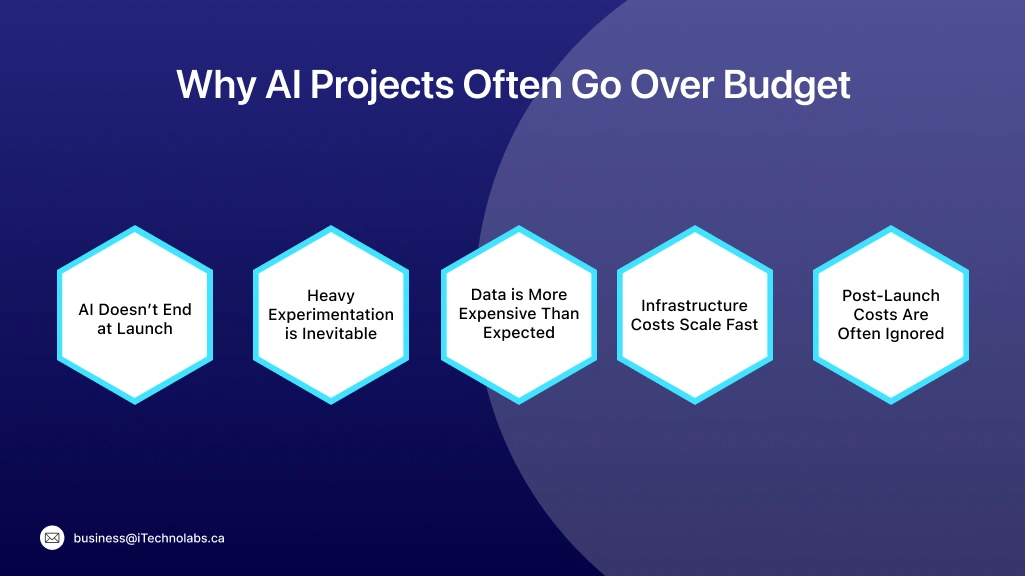
Table of Contents
Why AI Projects Often Go Over Budget
AI isn’t simply another software development initiative; rather, it is an organic system that continuously evolves. Whereas traditional applications have been built to follow specific build-and-launch cycles, AI relies upon a constant process of learning new things through trial-and-error, developing new features, and scaling those innovations. The increased complexity of these processes frequently leads many organizations to spend more money than expected as part of their AI initiatives.
Here are the main reasons AI costs spiral:
1. AI Doesn’t End at Launch
In traditional software, most costs are realized before deployment. With AI, deployment is only the beginning.
After launch, models require:
- Continuous monitoring
- Retraining with new data
- Performance tuning
- Optimization for real-world usage
As data and user behavior evolve, AI systems must evolve too — creating recurring costs.
2. Heavy Experimentation is Inevitable
AI development is highly iterative. Teams often test multiple:
- Algorithms
- Data pipelines
- Model architectures
- Training approaches
Each iteration consumes engineering time, compute resources, and cloud spend. Unlike traditional development, there’s rarely a first-time success in AI.
3. Data is More Expensive Than Expected
Many companies assume they already have AI-ready data — but reality is different.
Common data challenges include:
- Missing or incomplete datasets
- Unstructured data formats
- Inconsistent labeling
- Data silos across systems
Cleaning and preparing data can take weeks or months and often triggers repeated model retraining, increasing both cost and timelines.
4. Infrastructure Costs Scale Fast
AI systems demand significantly more infrastructure than traditional apps.
Major cost drivers include:
- GPU-intensive training
- Distributed computing
- High-performance storage
- Real-time inference environments
As usage grows, cloud costs scale rapidly. Without proper planning, infrastructure alone can exceed initial budgets.
5. Post-Launch Costs Are Often Ignored
AI systems degrade over time due to:
- Data drift
- Changing user behavior
- Market dynamics
Maintaining accuracy requires ongoing:
- Monitoring
- Retraining
- Model updates
- Performance optimization
These long-term operational costs are frequently underestimated during planning.
Companies that underestimate AI development cost often face:
- Budget overruns due to repeated experimentation and scaling
- Delayed timelines caused by data preparation and model tuning
- Poor model performance from rushed development or weak datasets
- Unexpected maintenance expenses from retraining and monitoring needs
Understanding these real cost drivers is the first step toward smarter AI investment. Businesses that approach AI as a long-term capability — rather than a one-time build — are far more likely to control costs, avoid surprises, and generate meaningful ROI.
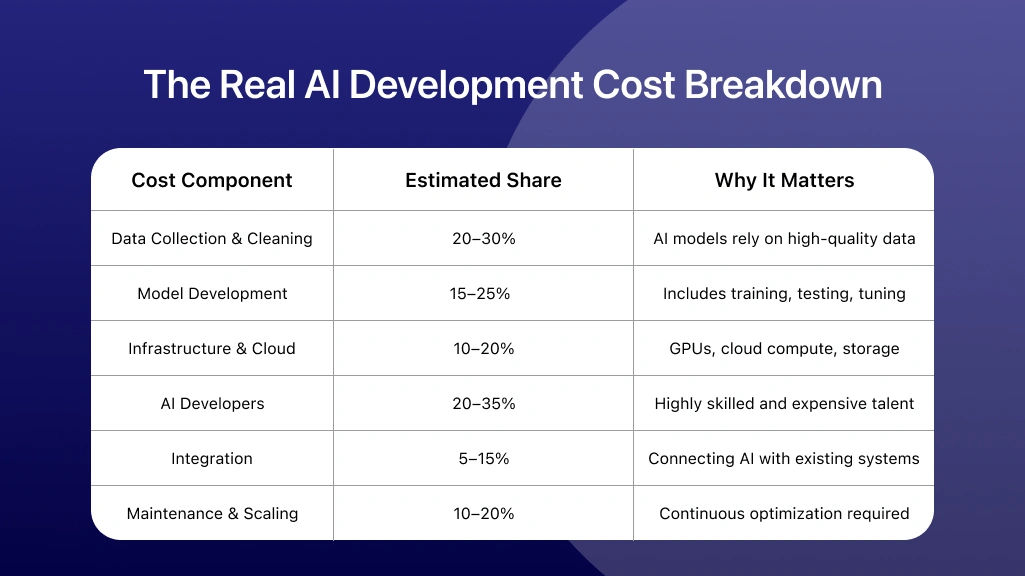
The Real AI Development Cost Breakdown
Understanding where your AI budget goes is essential for accurate planning and ROI forecasting. Many businesses assume model development consumes most of the cost, but the reality is far more complex. From data preparation to long-term maintenance, multiple cost layers contribute to the total AI development cost.
| Cost Component | Estimated Share | Why It Matters |
| Data Collection & Cleaning | 20–30% | AI models rely on high-quality data |
| Model Development | 15–25% | Includes training, testing, tuning |
| Infrastructure & Cloud | 10–20% | GPUs, cloud compute, storage |
| AI Developers | 20–35% | Highly skilled and expensive talent |
| Integration | 5–15% | Connecting AI with existing systems |
| Maintenance & Scaling | 10–20% | Continuous optimization required |
As you can see, coding the model is just one piece of the puzzle.
1. Data Preparation Costs (The Biggest Hidden Expense)
Most companies believe they’ve built a database of usable data, but in actuality, most raw datasets aren’t even close to being ready. The majority of raw data is simply not usable due to poor quality, incompleteness, excessive duplication, or unstructuredness. Machine learning models are very dependent on having high-quality datasets in order for the algorithms to work. Without data that has been prepped appropriately, no set of algorithms will ever perform well.
Once the model has begun training, it will require thorough cleaning, labeling/mark-up, standardizing, and validation of the data before any real value can be gained. This preparation phase of the project will often take weeks or months depending on dataset size and complexity. In many real-world AI initiatives, the total cost of creating an AI product will be heavily influenced by how long it takes to prepare the data before the actual AI development starts.
How to avoid it:
Audit your data quality early and allocate budget for preprocessing. Partnering with experienced AI development services can reduce labeling errors and accelerate data readiness.
2. Talent Costs: Skilled AI Developers Are Expensive
One of the largest contributors to the total cost of AI development is hiring skilled AI developers. Machine Learning and Data Engineers require a much deeper understanding of the topics of Machine Learning, Data, Optimization, and Mathematics than traditional software development positions do.
An entire AI team will consist of Data Scientists, Machine Learning Developers, AI Architects, and MLOps specialists. Because of the high demand for and low supply of AI professionals, salaries for these roles are typically much higher than the usual salary range for development positions.
Typical salary ranges:
- Junior AI developer: $40k–$80k/year
- Mid-level: $90k–$140k/year
- Senior AI specialist: $150k–$250k+/year
How to avoid it:
Adopt a hybrid hiring model — keep strategy in-house while outsourcing execution to trusted AI development services.
3. Infrastructure and Cloud Expenses
The infrastructure needed for developing AI is powerful computing systems, especially in deep learning, NLP model development, and computer vision. The GPU cluster and the high-speed storage are used in training large models, including scaling to the cloud.
The cost of cloud services can quickly add up from excess idle compute resources, repeated training cycles, and having to scale for post-launch traffic. If you don’t monitor your infrastructure closely, your total costs may exceed what you originally planned.
How to avoid it:
Use auto-scaling infrastructure, optimize training pipelines, and leverage managed AI platforms to minimize resource waste.
4. Iteration and Experimentation Costs
There are multiple iterations involved when building an AI system (it is not just a single build); there are multiple models created by the team, variations in datasets used, and A/B testing conducted, as well as multiple rounds of retraining to improve the model’s accuracy.
Each iteration has a time component associated with it (developer time, infrastructure resources, and test cycles) involved before you can complete that iteration (post-development). This is an extremely important part of the overall experiment; however, it is frequently undervalued in project planning.
How to avoid it:
Set realistic expectations and follow agile AI development methodologies with clearly defined milestones and performance benchmarks.
5. Integration with Existing Systems
Most AI-assisted technologies utilize several different data sources. For example, when working on an AI-assisted software solution like CRMs, ERPs, or legacy systems, they must typically be combined into a single application, thus creating an ecosystem of interconnected software programs.
The increased complexity of developing multiple interconnected applications requires significant additional backend programming time and can result in increased project costs if proper planning is not performed at this stage.
How to avoid it:
Design system architecture early and choose an AI development partner with strong integration expertise.
6. Compliance and Security Costs
Many AI applications will be used to process sensitive information, such as healthcare, fintech, e-commerce, and SaaS data. When using these types of applications, there are strict requirements for regulatory compliance and security.
In addition to the costs due to regulatory compliance (GDPR, HIPAA, SOC 2), there can be additional costs, such as security audits, encrypting layers, legal reviews, and governance systems.
How to avoid it:
Incorporate compliance planning from the beginning instead of retrofitting security measures later.
7. Maintenance and Continuous Learning
AI models are different from regular applications; they tend to degrade faster than traditional applications because of many reasons: Data drift, changing user behaviours and market trends. If you don’t continue to monitor and retrain your model(s), their accuracy will degrade.
There will normally be ongoing costs related to model performance monitoring, retraining pipelines, infrastructure upgrades and optimising cycles.
How to avoid it:
Allocate 15–25% of your initial AI development cost annually for maintenance and continuous improvement.
8. Underestimating Time-to-Market
For AI projects, timing is a Key factor in terms of cost. Poor quality of data, lack of skilled talent and scope creep can result in increased total costs due to extended development times. Additionally, an extended development cycle will lead to increased infrastructure costs and opportunity costs (especially in competitive industries).
How to avoid it:
Work with experienced AI development services that follow proven delivery frameworks and structured timelines.
In-House vs Outsourced AI Development Cost
Your total cost of developing AI can greatly vary based on whether you are utilizing an internal AI team or AI development services provided outside of your company. Although you have more control over the process if you hire internally, there are very significant costs associated with the employees and facilities necessary to employ internal resources. By contrast, if you outsource the services, they tend to provide a faster time to market, broader skill sets, and greater scalability, which makes outsourcing the preferred model for a growing number of today’s organizations.
| Factor | In-House AI Team | AI Development Services |
| Upfront Cost | Very High | Moderate |
| Hiring Time | 3–6 months | Immediate start |
| Scalability | Limited | High |
| Expertise Range | Narrow | Multi-domain experts |
| Long-term ROI | Medium | High (if partner is skilled) |
For many startups and enterprises, outsourcing reduces both risk and cost.
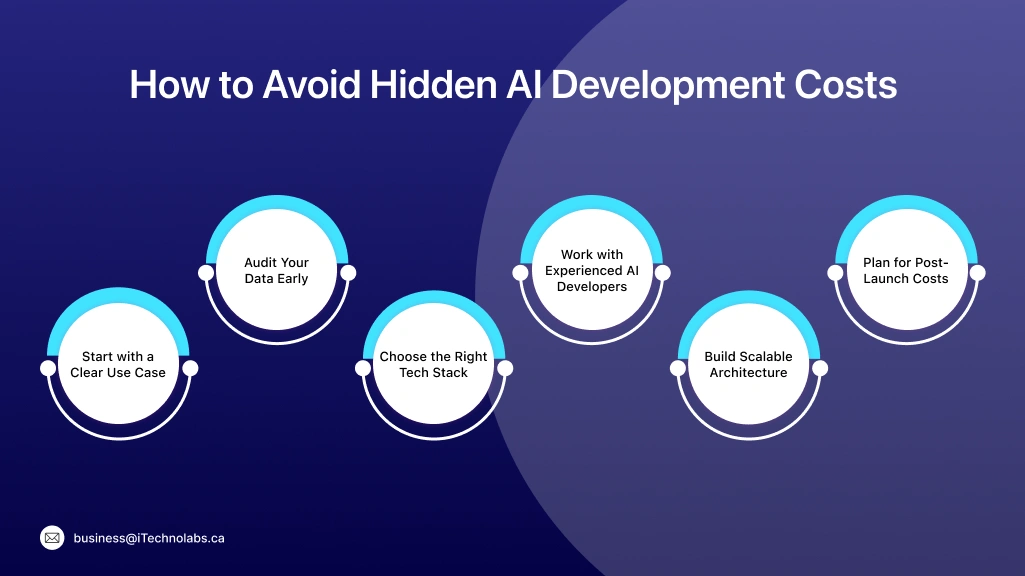
How to Avoid Hidden AI Development Costs
Hidden expenses don’t appear randomly — they usually result from poor planning, unclear goals, or unrealistic expectations. The good news is that most AI budget overruns are preventable with the right strategy. By approaching AI development with clarity and long-term thinking, businesses can control costs while maximizing ROI.
Here are proven strategies to keep your AI development cost under control:
1. Start with a Clear Use Case
One of the biggest mistakes companies make is starting with a vague goal like “we want to use AI.” Without a clearly defined use case, projects quickly lose direction, leading to wasted experimentation and rising costs.
Define measurable outcomes from day one — whether it’s reducing churn by 20%, automating support queries, or improving prediction accuracy. A clear objective keeps development focused and prevents scope creep.
2. Audit Your Data Early
Poor data quality is one of the most common causes of AI project delays. Many organizations assume their existing data is ready for AI, only to discover inconsistencies, missing labels, or fragmented datasets later.
Conduct a thorough data audit before development begins. Identifying gaps early helps you estimate preprocessing costs accurately and avoid expensive rework.
3. Choose the Right Tech Stack
Over-engineering is a silent budget killer in AI projects. Using overly complex frameworks or unnecessary infrastructure can inflate development and cloud costs.
Select a tech stack that aligns with your use case, scalability needs, and budget. In many cases, simpler architectures deliver faster ROI without sacrificing performance.
4. Work with Experienced AI Developers
AI development has a steep learning curve, and inexperienced teams often spend excessive time experimenting without meaningful progress. This leads to longer timelines and higher infrastructure expenses.
Working with experienced AI developers or established AI development services reduces trial-and-error cycles. Skilled teams bring proven frameworks, reusable components, and domain expertise that accelerate delivery.
5. Build Scalable Architecture
Many AI systems fail not because of poor models, but because they weren’t designed to scale. Rebuilding infrastructure later is far more expensive than designing it right from the start.
Adopt scalable, modular architecture that supports future growth. This ensures your AI solution can handle increasing data volumes, user traffic, and evolving business needs without major reinvestment.
6. Plan for Post-Launch Costs
Unlike traditional software, AI systems require continuous monitoring and improvement. Ignoring post-launch costs often leads to budget shocks later.
Set aside a dedicated budget for model monitoring, retraining, infrastructure scaling, and optimization. Treat AI as a long-term capability rather than a one-time build.
By following these strategies, businesses can significantly reduce hidden AI development costs and build solutions that are both scalable and financially sustainable. Smart planning today prevents expensive surprises tomorrow.
Conclusion
AI can unlock massive competitive advantages — but only when approached with the right strategy. While many businesses focus on initial pricing, the true AI development cost lies in hidden factors like data preparation, infrastructure scaling, integration complexity, and long-term optimization.
By understanding these hidden expenses and planning proactively, companies can avoid costly surprises and build AI solutions that are scalable, efficient, and future-ready. The key is simple: plan smarter, build strategically, and invest where it truly matters.
If you’re looking to turn AI from an experiment into a competitive advantage, partnering with the right experts makes all the difference. At iTechnolabs, we help businesses navigate the complexities of AI development with clarity, precision, and proven execution. From strategy and design to deployment and scaling, our team ensures your AI investment delivers real, measurable ROI — without hidden surprises.
FAQs
1. What is the average AI development cost?
AI development cost varies widely based on complexity, data requirements, and infrastructure needs. Simple AI solutions may start around $20,000–$50,000, while enterprise-grade systems can exceed $300,000+. Factors like data preparation, skilled AI developers, and long-term maintenance significantly influence the total investment required.
2. Why do AI projects become expensive?
AI projects often become expensive due to hidden costs like data cleaning, model experimentation, infrastructure scaling, and post-launch maintenance. Unlike traditional software, AI requires continuous monitoring and retraining. Poor planning, unclear goals, and underestimating long-term needs are the biggest reasons budgets spiral unexpectedly.
3. Is outsourcing AI development cheaper than hiring in-house?
In many cases, outsourcing AI development services is more cost-effective than building an in-house team. Outsourcing eliminates hiring delays, reduces infrastructure investments, and provides access to experienced AI developers. It also enables faster deployment and scalability, making it ideal for startups and growing enterprises.
4. How long does it take to build an AI solution?
AI development timelines depend on use case complexity, data readiness, and integration requirements. Simple AI models may take 6–10 weeks, while advanced enterprise solutions can take 6–12 months. Data preparation and experimentation phases typically consume the most time during the development lifecycle.
5. How can businesses reduce AI development costs?
Businesses can reduce AI development cost by defining clear use cases, auditing data early, choosing the right tech stack, and working with experienced AI development services. Planning for scalability and post-launch maintenance also prevents unexpected expenses and ensures long-term ROI from AI investments.