Planning to build a mobile app in Dubai? The first thing most founders ask is simple. “How much will it cost?” The honest answer is this. There is no fixed price tag for the mobile app development cost in Dubai because the cost moves with scope.
Many teams lock a budget too early and get surprised later. One extra feature, one more integration, or a stricter security need, and the estimate changes. Platform choice matters too. Building for one platform is different from building for both iOS and Android. Local rules around data and security can also add real work, not just paperwork.
If you are trying to plan the mobile app development cost and you are not sure where the money will go, you are not alone. This guide breaks down the real cost ranges in Dubai, what pushes the price up, and where startups usually miscalculate. You will also get a simple cost breakdown, timeline ranges, and practical tips to avoid pricing traps while building something that can scale.
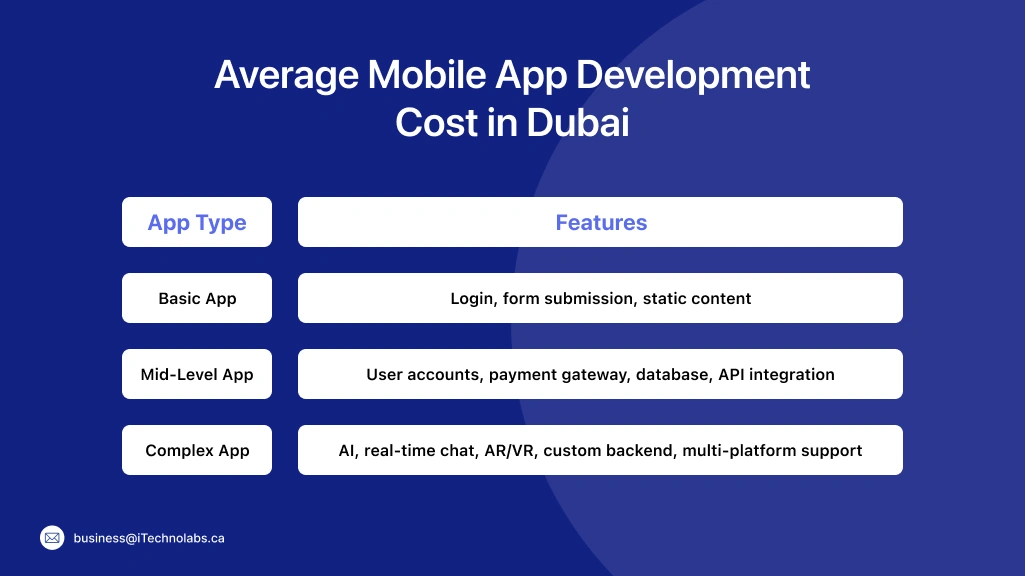
Table of Contents
- Average Mobile App Development Cost in Dubai

- Key Factors Influencing Average Mobile App Development Cost in Dubai
- How to Get an Accurate Mobile App Development Cost in Dubai
- Hidden and Ongoing Mobile App Development Cost in Dubai to Consider
- Mobile App Development Cost Optimization Strategies for Dubai Businesses
- Mobile App Development Process in Dubai
- Practical Tips to Reduce Mobile App Development Cost in Dubai
- How to Make Money From Mobile App Development in Dubai?
- Real Pricing Examples for Mobile App Development Cost in Dubai
- Conclusion
- FAQs
Average Mobile App Development Cost in Dubai
In Dubai, an app idea can generally be initiated from AED 18,000 for something very basic. When it is a bigger build, the budget can even cross AED 1.1 million+.
The leap is quite fast when you add security, integrations, or real time features. That is why the first quote often changes after workshops and wireframes.
A simple app is cheaper because it is mostly screens and a few actions. Business apps cost extra since they need dashboards, APIs, and admin access. Enterprise apps are at the top because they need checks for compliance, testing for performance, and ongoing support after launch.
Here is a realistic cost snapshot most Dubai teams see when they plan a build.
| App Type | Features | Average Cost (AED) |
| Basic App | Login, form submission, static content | 18,000 – 180,000 |
| Mid-Level App | User accounts, payment gateway, database, API integration | 180,000 – 440,000 |
| Complex App | AI, real-time chat, AR/VR, custom backend, multi-platform support | 440,000 – 1.1 million+ |
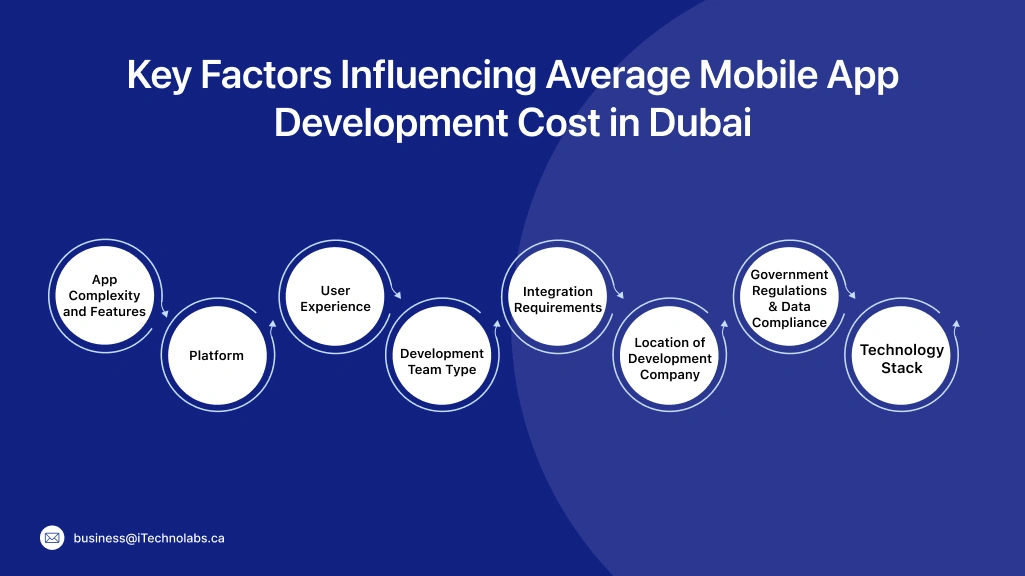
Key Factors Influencing Average Mobile App Development Cost in Dubai
Each element below has a direct bearing on the Mobile App Development Cost in Dubai. Here, a few small choices may lead to the addition of several weeks of work plus thousands of dollars. The tables keep it practical and clear.
App Complexity and Features
The more features, the more logic, testing, and edge cases can be expected. A simple app is very different in behavior from an app that, for example, handles the payment or real time data.
| Complexity Level | Average Cost (AED) |
| Basic App | AED 25,000 – AED 40,000+ |
| Medium App | AED 40,000 – AED 80,000+ |
| Complex App | AED 80,000 – AED 200,000+ |
Platform
It costs less to build for just one platform. Making mobile apps for both iOS and Android is what most businesses in Dubai do. This makes the effort and expense go higher.
| Platform Choice | Average Cost (AED) |
| Single (One Platform) | AED 35,000 to AED 150,000 |
| Native (Both Platforms) | AED 25,000 to AED 80,000 |
| Cross-Platform (Flutter/React Native) | AED 60,000 to AED 300,000 or more |
User Experience
Design is not just visuals. It controls how users move, click, and finish actions.. Poor UX increases rework costs later.
| Design Level | Average Cost (AED) |
| Basic Design Package | AED 22,020 – AED 36,700 |
| Mid-Level Custom Design Package | AED 36,700 – AED 73,400 |
| High-End/Enterprise UX UI | AED 73,400 – AED 146,800+ |
Development Team Type
Your development team type decides both speed and quality. A senior team lowers risk and rework, particularly for security, integrations, and scaling, while a junior team might quote less.
| Team Type | Estimated Cost (AED) |
| Freelancers | AED 36,700 – AED 110,100+ |
| Offshore Agency | AED 73,400 – AED 220,200+ |
| Dubai-based Agency | AED 146,800 – AED 300,000+ |
Integration Requirements
Integrations can change the budget faster than extra screens. Payments, maps, OTP, CRM, POS, or third-party APIs add backend work, error handling, and testing, thus they must be added early to avoid subsequent cost hikes.
| Integration Type | Estimated Cost (AED) |
| Basic APIs | AED 7,340 – AED 18,350+ |
| Moderate | AED 22,020 – AED 55,050+ |
| Complex | AED 73,400 – AED 183,500+ |
Location of Development Company
Where your development company is based affects rates and communication speed. Teams that work out of Dubai normally charge more, but they know what consumers want in that location. Operating from home might give lower estimates, but they need to have tougher rules to keep things on time and avoid unnecessary labour.
| Region | Average Hourly Rates (AED) |
| Asia, including India | AED 73 – AED 147/hr+ |
| Eastern Europe | AED 128 – AED 257/hr+ |
| Dubai/UAE | AED 220 – AED 550/hr+ |
Government Regulations & Data Compliance
Following the regulations and data set by the government can make you do more than just fill out forms. If your app handles payments, IDs, or sensitive user data, you may require tighter protection, unambiguous consent flows, and logs that are ready for an audit from the start.
| App Type | Regulatory Needs | Estimated Cost (AED) |
| General Apps | Basic privacy policies, terms | AED 3,670 – AED 18,350+ |
| Data-Driven Apps | PDPL compliance, legal review | AED 22,020 – AED 55,050+ |
| Regulated Industries | Health, FinTech apps need special licenses | AED 55,050 – AED 110,100+ |
Technology Stack
Your technology stack affects both build cost and future updates. There are stacks that make work go faster and stacks that make performance and scale better. You can add features later without having to rewrite half of the app if you choose a smart stack.
| Tech Level | Details | Estimated Cost (AED) |
| Standard Stack | React, Node.js, Firebase, etc. | AED 36,700 – AED 110,100+ |
| Advanced Stack | AI/ML, AR/VR, Blockchain, etc. | AED 146,800 – AED 367,000+ |
Maintenance & Post-Launch Support
App costs do not end at launch. Fixing bugs, updating the OS, adding security patches, and making incremental modifications as more people use the system are all part of maintenance. It’s crucial to have a clear support plan in place when you utilize both iOS and Android at the same time to keep your ratings safe and the app reliable.
| Support Type | Details | Estimated Annual Cost |
| Basic Maintenance | Bug Fixes, OS Updates | 10-15% of the initial cost |
| Full Support Plan | Regular Updates, New Features, Performance Tuning | 15-25% of the initial app cost |
How Fast Can You Launch an App in Dubai?
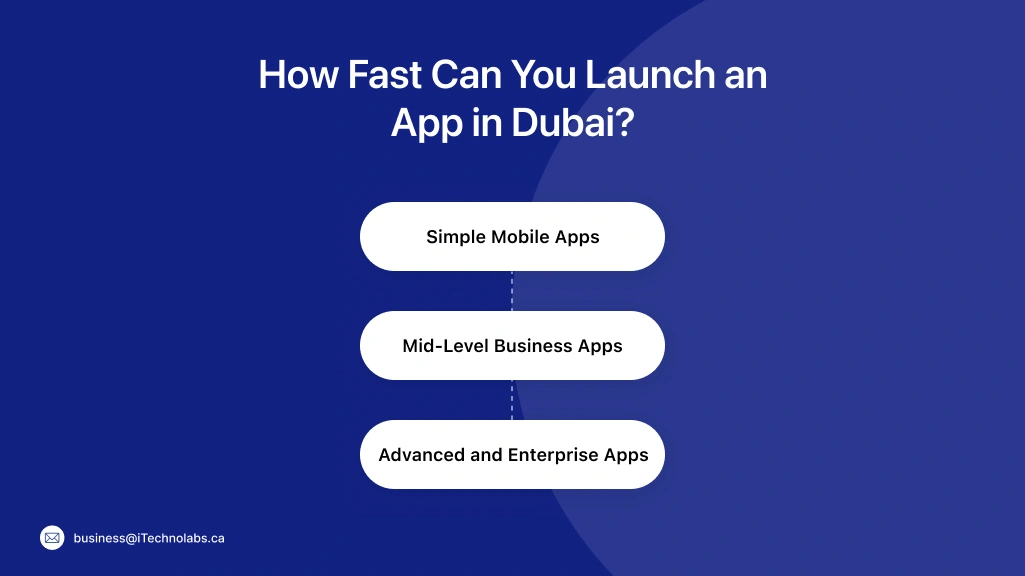
Timelines in Dubai are mainly a function of the degree of clarity, the speed of getting approvals, and the overall depth of the build. A clear scope moves fast. A changing scope slows everything. Most delays happen when features grow mid-way or compliance reviews start late. Below is a realistic timeline view businesses see on the ground.
Simple Mobile Apps
These apps solve one clear problem. Content display, bookings, or internal workflows. Few integrations. Limited user roles.
| App Scope | Typical Features | Time Required |
| Simple app | Login, forms, basic flows | 6–10 weeks |
| Single platform | Android or iOS only | Faster builds |
| Limited testing | Small user base | Short QA cycle |
These projects are common for pilots and MVPs in Dubai.
Mid-Level Business Apps
Most commercial apps fall here. They support real users, admin panels, and external systems. Often built as mobile app development for iOS and Android.
| App Scope | Typical Features | Time Required |
| Business app | APIs, dashboards, roles | 3–5 months |
| Dual platform | Android + iOS | Extra testing |
| Custom UI | Brand-focused design | Design iterations |
This is the most common timeline range linked to the Mobile App Development Cost in Dubai.
Advanced and Enterprise Apps
These apps support scale, compliance, and heavy usage. Common in healthcare, fintech, utilities, and government sectors.
| App Scope | Typical Features | Time Required |
| Enterprise app | Security, audits, scaling | 6–9 months |
| Regulated sectors | Compliance checks | Review cycles |
| Long-term roadmap | Ongoing phases | Phased launches |
These builds are treated as systems, not one-time projects.
How to Get an Accurate Mobile App Development Cost in Dubai
Getting an accurate Mobile App Development Cost in Dubai starts with clarity, not guesswork. Lock down the basics before you ask companies for quotes. In what ways does the app help people? Who will use it? What is the first version that can be released? People can agree on the same scope if you share a simple list of features, user jobs, and two or three key screens.
Also be upfront about the big cost movers. Payments, third-party integrations, admin panels, and security requirements can change pricing fast. Do not ask for a single number. Instead, ask for a split and two options: MVP and phase two. This way, your budget won’t come as a surprise after the fact. A good agency will also include timelines, testing scope, and help after the launch.
Preparing a Clear Project Brief
A clear brief is the fastest way to get a real quote. Write down the problem your app solves, your target users, and the main flow from login to the final action. Add 3–5 sample screens or a simple wireframe. When agencies see the same scope, the estimates become far more accurate.
Listing Core Features and Integrations
List only what must be in version one. Keep “nice to have” items for phase two. Also mention every integration early, like payments, maps, SMS, WhatsApp, CRM, ERP, or any third-party API. Integrations change backend effort and testing, so hiding them leads to budget jumps later.
Comparing Quotes From Multiple UAE Agencies
Do not compare quotes only on the final number. Compare scope, timelines, testing, security, and what is included in design and backend. Ask each agency to break costs into modules, like UI, backend, QA, and launch. This helps you spot missing items and unrealistic promises.
Understanding Support and Maintenance Terms
App costs do not end at launch. Ask what support covers, bug fixes, OS updates, monitoring, and small improvements. Clarify response time and how issues are handled in the first 30–90 days after release. Clear support terms prevent surprises when real users start using the app.
Evaluating the Long-Term Cost of Ownership
Think beyond build cost. Hosting, third-party tools, payment gateway charges, analytics, push notifications, and ongoing feature updates add up over time. Also factor in scaling costs when users grow. A slightly higher build budget can save money later if the app is stable and easy to update.
Hidden and Ongoing Mobile App Development Cost in Dubai to Consider
After the first quote, hidden charges in Dubai app projects often appear, and they might quickly modify your total budget. When trying to figure out how much Mobile App Development Cost in Dubai, you should think about things like hosting, third-party tools, SMS and OTP fees, setting up a payment option, making an account in the app store, and employing map or push alerts. These may not seem like much, but they build up over time.
Long-term costs are even more important after starting. Bug fixes, security patches, speed tuning, and support time for the OS keep the app stable for real users. What if you skip this step? The app might work the first day but break later. This part helps you plan for the real cost, not just the price for the work.
Annual Maintenance and Bug Fix Costs
After launch, your app still needs care. The new updates from Apple and Google can mess with little things like payments, logins, or alarms. To keep the program stable for real users, we regularly repair bugs, add security patches, and monitor the speed.
Cost of Adding New Features Post-Launch
Most apps grow after users start using them. A “small” feature like coupons, referrals, or a new payment option can touch many screens and backend rules. Post-launch changes also need fresh testing, which is why feature additions can cost more than founders expect.
Hosting, Cloud, and Infrastructure Expenses
Your app runs on servers, databases, and storage. Costs escalate when there is more traffic, uploads, real-time tracking, and backups. You could also have to spend more for superior cloud installations and monitoring tools if your app needs to be up all the time or load faster.
App Store Listing and Compliance Fees
Publishing is not always one click. Look at the app store accounts, how long it takes to check them, the privacy policy, and the permissions for your data. In industries that are regulated, it may take more time and money to make sure the app is compliant before it can go live.
Marketing and User Acquisition Costs
Users are needed for even the best apps. Paid marketing, optimising your app store, working with influencers, and referral programs all cost money. A lot of businesses forget to plan for this in their budgets and then have trouble getting downloads when they launch.
Mobile App Development Cost Optimization Strategies for Dubai Businesses
Dubai app budgets can rise fast, but smart planning can keep them under control without cutting quality. This section shares practical ways Dubai businesses reduce waste, avoid rework, and get a clearer Mobile App Development Cost in Dubai from the start. You will learn how to design an MVP in stages, employ components that have already been tested, keep “nice to have” features to a minimum, and set the scope before development starts. It also talks about how to save money on platforms, design depth, integrations, and testing so that you just pay for what you need and skip what you don’t.
Building an MVP to Reduce the Original Cost
Start with the smallest version that solves one clear problem. Choose only the screens and activities that are absolutely necessary for launch. This makes the first build lighter, faster, and easier to test with real users. You can add functionality in stages once the app shows that it is useful.
Choosing Cross-Platform Development
Cross-platform builds can reduce cost when you want iOS and Android together. You reuse most of the code and avoid building two separate apps from scratch. It works best for standard business apps with common UI and workflows. For heavy performance needs, native may still be better.
Outsourcing to Economical UAE Teams
Not every project needs a premium-priced team. Many UAE-based teams offer balanced rates with strong delivery, especially for MVPs and mid-level apps. The key is to check real work samples, QA approach, and communication style. A lower quote is fine only if quality is not skipped.
Avoiding Scope Creep and Rework
Scope creep is the silent budget killer. Small requests create new screens, new logic, and more testing. Lock the scope before development starts and keep a clear change request process. If you want extras, move them to phase two instead of mid-build.
Using Reusable Components and APIs
Reusable parts save you time and money. Use tried-and-true modules for login, payments, notifications, analytics, and maps instead of designing everything from scratch. Reliable APIs also reduce backend effort and future maintenance. This keeps the build stable and speeds up delivery.
Mobile App Development Process in Dubai
Making apps in Dubai isn’t simply about making screens. It starts with defining the scope and finishes with a stable launch. This process has a direct effect on the cost of developing mobile apps in Dubai because each step takes more time, testing, and decision-making.
This section explains the full process in simple steps, so you know what to expect from an agency. You will also see where delays and extra costs usually happen, like change requests, approvals, and QA when you build for iOS and Android.
Step 1: Discovery & Market Analysis
This is where the app becomes a real plan, not just an idea. The team learns your goals, users, and the exact problem the app will solve. They also check competitors, user flows, and basic technical needs. A good discovery phase saves money later because it reduces rework. It also helps you decide what belongs in the first version and what can wait. For Dubai startups, this step is important because scope, compliance needs, and platform choices can change the full build path.
- Define target users and core problems.
- List must-have features for MVP.
- Review competitor apps and gaps.
- Identify compliance and data needs.
Step 2: UI UX Design
Design is not only about looks. It is about how users move through the app and finish tasks without confusion. In this step, the team builds wireframes, user journeys, and clickable prototypes. This is where you catch “missing screens” early, like error states, loading screens, and confirmation pages. A strong UI UX phase reduces future changes during development. It also helps startups align fast on what the first version should feel like before spending on code.
- Create wireframes and key user flows.
- Build a clickable prototype for review.
- Finalise layouts, colours, and typography.
- Plan edge cases like errors and retries.
Step 3: App Development (Frontend & Backend)
This is the build phase where screens turn into working features. Frontend covers what users see and tap. Backend covers databases, admin panels, APIs, and the logic that powers the app. In Dubai projects, backend work often decides stability, especially for apps with payments, real-time tracking, or user roles. This step also includes integrations like SMS, email, maps, analytics, and payment gateways. The better the build quality here, the fewer issues you face after launch.
- Build frontend screens and app navigation.
- Develop backend, database, and admin panel.
- Connect third-party APIs and services.
- Set up roles, permissions, and data handling.
Step 4: Testing & Quality Assurance
Testing is where most startups either protect their launch or ruin it. QA checks the app on real devices, different screen sizes, and different network speeds. It covers bugs, crashes, slow loading, and broken flows like checkout or login. In Dubai, where many apps run on both iOS and Android, QA effort increases because platform behaviour is not always the same. Good testing also covers security checks and basic performance tracking before the app reaches real users.
- Test core flows like login and payments.
- Check performance on slow internet and older phones.
- Fix crashes, UI issues, and broken edge cases.
- Run security and permission checks.
Step 5: Deployment & Launch
Launching is not only uploading the app. The team prepares store listings, screenshots, privacy policy links, and final build settings. They also handle app store reviews, release notes, and version control. For Dubai startups, launch planning matters because one rejection from the app store can delay go-live. This step often includes a staged rollout, starting with a smaller audience before opening it to everyone. A clean launch reduces support pressure in the first week.
- Prepare App Store and Google Play listings.
- Submit builds and handle review feedback.
- Set up analytics, crash tracking, and monitoring.
- Plan a soft launch or phased release.
Step 6: Post-Launch Support & Maintenance
After launch, real users start finding real issues. Devices behave differently. OS updates break small things. You may need quick fixes, minor improvements, and performance tuning. This is also when feature requests start coming in from customers and your team. Post-launch support keeps the app stable and protects ratings. For businesses in Dubai, maintenance is also important for security patches and compliance hygiene, especially if the app handles personal data or payments.
- Fix bugs and improve stability after release.
- Support OS updates for iOS and Android.
- Monitor performance, downtime, and crashes.
- Add new features in planned phases.
Practical Tips to Reduce Mobile App Development Cost in Dubai
Reducing the Mobile App Development Cost in Dubai is not about cutting corners. It is about cutting waste. Start with a tight MVP, lock your scope early, and keep “nice to have” features for phase two. Share clear wireframes, list every integration upfront, and decide which screens are truly needed before development starts.
Also plan for iOS and Android smartly. Use reusable components for login, payments, and notifications, and test on real devices early to avoid rework later. These small habits save weeks of effort, and they protect your budget from surprise jumps.
Start With an MVP
An MVP helps you launch faster and spend less in the first phase. Instead of building every feature you can imagine, you build only what users need to complete the main action. This keeps screens, backend rules, and testing smaller, which directly lowers the cost in Dubai. It also gives you real feedback before you invest more. For Dubai startups, an MVP is the safest way to avoid building a big app that users do not adopt.
- Pick one core user journey for version one.
- Keep roles and permissions simple at first.
- Move extras like referrals, chat, and rewards to phase two.
- Plan a clear roadmap for upgrades after launch.
Use Off-the-Shelf
You do not need to custom-build everything. Many common features are already available as trusted tools or ready-made modules. Using off-the-shelf options reduces development time and lowers testing effort, which helps control the costs. It also speeds up launch, especially when your goal is to validate the product. This works well for early versions, as long as the tools are secure and reliable.
- Use ready modules for login, OTP, and notifications.
- Use standard payment gateway SDKs instead of custom payment logic.
- Use proven analytics and crash reporting tools.
- Avoid building admin panels from scratch unless needed.
Opt for Cross-Platform Development
Cross-platform development helps when you want iOS and Android without paying for two separate builds. You reuse most of the code and reduce effort for many features. It is a smart choice for startups building standard service apps, booking apps, or ordering apps. Used correctly, it can reduce the Mobile App Development Cost in Dubai without hurting user experience. For very heavy performance needs, native may still fit better.
- Use cross-platform for common UI and workflows.
- Keep device-specific features limited in phase one.
- Test early on real Android and iPhone devices.
- Go native later if performance demands grow.
Prioritize Features Using MoSCoW
MoSCoW is a simple method to stop scope creep. You label features as Must have, Should have, Could have, and Won’t have for now. This keeps the project focused and prevents “one more thing” requests from blowing up cost and timeline. It is one of the easiest ways to protect the mobile app development cost in Dubai, especially when multiple stakeholders are involved.
- Must have: core flow needed to launch.
- Should have: important, but can wait.
- Could have: nice-to-have features.
- Won’t have: phase two or later.
Choose the Right Development Partner
The cheapest quote is not always the cheapest project. A good partner helps you lock scope, plan phases, and avoid rework. They also explain risks early, like integrations, security needs, and platform differences. Choosing the right team can reduce the real cost because you spend less on fixes, delays, and rebuilds later.
- Ask for similar app case studies and references.
- Confirm what QA, support, and maintenance include.
- Check how they handle change requests and scope updates.
- Choose a team that explains trade-offs honestly.
How to Make Money From Mobile App Development in Dubai?
Dubai is a service-heavy market, so apps that save time or reduce manual work can earn well. You can make money by building apps for real business problems, like bookings, delivery, field services, payments, or customer support. Many startups also earn through subscriptions, in-app purchases, ads, or commission models, depending on the niche.
In this section, we will break down the most common revenue models in Dubai, what works best for B2B vs B2C apps, and how to price your app so it stays profitable after hosting, support, and updates.
In-App Purchases
In-app purchases work best when your app sells small upgrades inside the experience, like premium features, add-ons, or digital items. For startups, this can support steady income without charging everyone upfront. But it needs clean UX and strong payment flows, which can raise the Mobile App Development Cost in Dubai if not planned early, especially for different platforms.
- Best for apps with repeat use.
- Works well with add-ons and upgrades.
- Needs secure payment and refund handling.
Subscription Based Model
Subscriptions bring predictable revenue, which Dubai businesses like. You charge monthly or yearly for access to features or services. This model works well for SaaS-style apps, bookings, fitness, learning, or business tools. It also needs account management, renewals, and support flows, which should be included in the cost estimate.
- Predictable recurring revenue.
- Strong for B2B and service apps.
- Needs renewals, billing, and user management.
Freemium Model
Freemium lets users start free, then pay for advanced features. It is useful when you need fast adoption and social proof. The trick is designing the “free vs paid” boundary clearly, so users see value without feeling blocked. For mobile app development for iOS and Android, freemium also needs careful tracking and paywall testing across both platforms.
- Drives downloads and quick adoption.
- Monetises power users.
- Needs a clear paywall and upgrade flow.
In-App Advertising or Sponsorships
Ads and sponsorships work when your app has high traffic and long session time. You earn through ad impressions, clicks, or brand placements. This model can be simple to start, but it needs user volume to pay off. It can also affect UX, so it must be handled carefully in your product plan and cost estimate.
- Best for content and community apps.
- Revenue depends on user volume.
- Needs smart ad placement to avoid churn.
Commission-Based Model
Commission models work when your app connects buyers and sellers, like bookings, delivery, marketplace services, or on-demand platforms. You earn a cut on each transaction. This can scale well in Dubai, but it requires strong trust elements, payouts, and dispute handling. Those features can increase the Mobile App Development Cost in Dubai, so the model should be planned from day one.
- Works well for marketplaces and service platforms.
- Scales with transaction volume.
- Needs payouts, refunds, and dispute workflows.
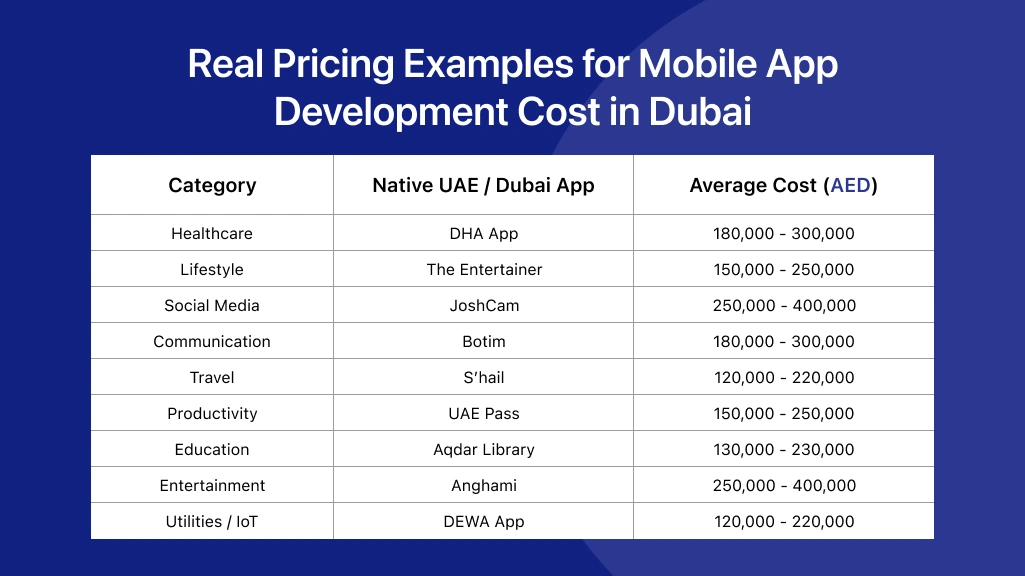
Real Pricing Examples for Mobile App Development Cost in Dubai
Looking at real Dubai apps gives better cost clarity than rough estimates. These apps were built for scale, compliance, and daily usage. Most are not MVPs.
They are long-term systems backed by government bodies or large businesses. That is why their build cost sits on the higher side of the Mobile App Development Cost in Dubai range.
These examples also show why mobile app development for iOS and Android is common in the UAE. User reach, accessibility, and service coverage matter more than saving on one platform.
| Category | Native UAE / Dubai App | Average Cost (AED) |
| Healthcare | DHA App | 180,000 – 300,000 |
| Lifestyle | The Entertainer | 150,000 – 250,000 |
| Social Media | JoshCam | 250,000 – 400,000 |
| Communication | Botim | 180,000 – 300,000 |
| Travel | S’hail | 120,000 – 220,000 |
| Productivity | UAE Pass | 150,000 – 250,000 |
| Education | Aqdar Library | 130,000 – 230,000 |
| Entertainment | Anghami | 250,000 – 400,000 |
| Utilities / IoT | DEWA App | 120,000 – 220,000 |
Conclusion
The mobile app development cost in Dubai is not random. It moves with scope. Add payments, real-time tracking, stricter security, or more integrations, and the budget climbs. That is normal in Dubai because users expect smooth apps, and many sectors cannot take risks with data.
The safest way to stay in control is simple. Start with an MVP, list integrations early, and lock priorities before code starts. Also decide early if you need mobile app development for iOS and Android, or if one platform can validate the idea first.
If you want a clear estimate and a build plan that fits your startup stage, talk to iTechnolabs. If you are ready to build an app, contact us and we will help you map scope, timeline, and cost in a practical way.
FAQs
What is the average time frame for app development in the UAE?
For most UAE projects, a simple MVP takes 6–10 weeks. A mid-level business app usually needs 3–5 months. Larger apps with compliance, heavy testing, and multiple integrations often take 6–9 months, especially when built for iOS and Android.
How to build a mobile app in Dubai?
Start with discovery, then define your MVP scope. Create wireframes and UI design next. Build frontend and backend, integrate payments or APIs, then test on real devices. Finally, publish to app stores and plan post-launch support for fixes, updates, and small improvements.
Is it better to develop apps locally in Dubai or outsource internationally?
Local Dubai teams may cost more but understand expectations, timelines, and local compliance better. International outsourcing can be cheaper, but needs strong project management, clear scope, and strict QA to avoid rework. The best choice depends on your risk tolerance and complexity.
Are mobile app businesses profitable in Dubai?
Yes, a mobile app business can be profitable in Dubai if it solves a real daily need and has a clear revenue model like subscriptions or commissions. It gets hard when you rely only on ads or build a copycat app with no unique value.
What types of apps are most in demand in Dubai?
Apps that solve daily services are most in demand in Dubai, like booking, delivery, home services, and clinic or salon scheduling. B2B apps for field staff, payments, and customer support are also popular because they save time and reduce manual work.