The evolution of artificial intelligence from a speculative occurrence into a core technology of modern businesses has happened quickly. Before this revolution in the technological marketplace, the early adoption of artificial intelligence was limited to a small number of large technology companies. With advances in cloud computing and scalable delivery models of advanced capabilities, the availability of these advanced capabilities has become democratized.
Thanks to AI as a Service (AIaaS), companies can now use smart solutions (such as predictive analytics, automation, and generative intelligence) without having to make big investments in infrastructure or having large teams of artificial intelligence experts in-house.
The momentum behind the AI-as-a-Service (AIaaS) market is undeniable. According to industry estimates cited by Statista, the global AIaaS market is projected to grow from roughly $16–17 billion in 2025 to over $22 billion by 2026, with long-term forecasts suggesting it could surpass $290 billion by 2034. This rapid growth highlights the accelerating enterprise adoption of scalable, cloud-based AI solutions worldwide.
Moreover, such rapid expansion of the AIaaS market is hardly surprising, as it is driven by the rising need for scalable, cloud-based solutions with lower technical challenges and optimized risk of deployment. Lastly, the worldwide escalating trend of making huge investments in artificial intelligence is expected to exceed $800 billion by 2030, which reflects a highly incredible demand for the technological change of various industries.
In this blog, we’ll uncover the most promising AIaaS opportunities and highlight the industries where scalable AI solutions can drive maximum profitability.
Table of Contents
Why AI-as-a-Service is Booming in the US
Analysts should first understand why AI, as a service, is considered a good fit for the U.S. market before delving into the industries that the company can enter. The U.S. market features a robust cloud ecosystem; the majority of enterprises are heavily investing in AI technologies, and there is an already established SaaS ecosystem. These factors combined provide a favorable environment where the companies can take advantage of AI in various aspects of their operations and continue to be profitable in the future.
- Advanced cloud infrastructure and widespread SaaS usage have laid the groundwork for the quick deployment of AI-powered platforms.
- Healthcare, fintech, retail, and manufacturing lead the charge in enterprise spending on AI and automation.
- A vibrant startup scene is fueled by robust venture capital investment and innovation hubs such as Silicon Valley.
- The increasing demand for scalable, affordable AI solutions that remove the need for extensive in-house infrastructure.
With traditional builds of AI requiring large amounts of upfront investment and time, there is a more flexible way of approaching the utilization of an AI service. The models offered by AIaaS allow for usage-based payment structures, which lower the barrier to entry and provide access to advanced AI development services for larger enterprises and smaller or mid-sized companies looking to adopt AI technologies as quickly as possible and cost-effectively.
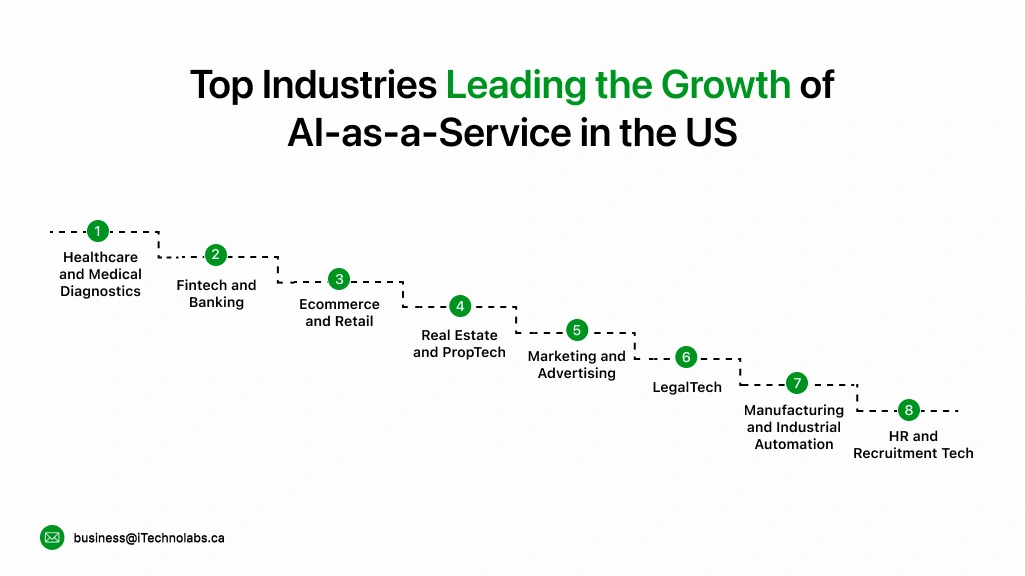
Top Industries Leading the Growth of AI-as-a-Service in the US
With AI adoption rising fast, some business areas are standing out as pioneers in using AI as a Service to scale innovation and improve operational efficiency. The healthcare, fintech, retail, and manufacturing industries are among the sectors that present high customer demand and potential for recurring revenue and are cheaper in terms of AI development costs, thus becoming great bases for profitable AIaaS companies.
1. Healthcare and Medical Diagnostics
The US healthcare industry is the top sector that generates revenue for AI as a Service providers, a market trend fueled by the enormous amount of data and the increasing demand for automation. By leveraging AIaaS, healthcare facilities and medical practitioners can integrate sophisticated intelligence into their operations without the need to develop complicated internal systems.
Opportunities
- AI radiology and medical imaging analysis
- Clinical decision support systems
- Patient triage and virtual health assistants
- AI-powered drug discovery and research
Hospitals increasingly prefer subscription-based AI solutions due to regulatory complexity and the high AI development cost of building compliant AI models internally.
Why it’s profitable
- Recurring SaaS billing models
- High switching costs due to compliance and integrations
- Massive datasets that improve AI accuracy over time
2. Fintech and Banking
Financial institutions were among the first adopters of AIaaS as a result of increasing fraud risks and stringent regulatory requirements. AI enables banks to make better decisions and, at the same time, lower the risks related to their operations.
Use Cases
- Fraud detection and risk scoring APIs
- AI-based credit scoring models
- Algorithmic trading insights
- Automated KYC and compliance monitoring
Banks often rely on external AI development services because building proprietary AI systems requires expensive data science teams and infrastructure.
Revenue potential
- Long-term enterprise contracts
- API-based pricing models
- Compliance-driven recurring demand
3. Ecommerce and Retail
Retailers are turning to AI at an unprecedented rate to improve customer experience, personalization, and conversion rate. Through AI, as a service, even mid, sized brands can reap the benefits of enterprise-grade intelligence without making a large infrastructure investment. Hence, businesses can obtain advanced analytics, automation, and personalization tools at a rapid pace without excessively increasing AI development costs.
AIaaS Opportunities
- AI recommendation engines
- Dynamic pricing optimization
- AI-powered customer support bots
- Visual search and product discovery tools
AI-as-a-service allows smaller e-commerce brands to compete with enterprise retailers without massive AI development budgets.
4. Real Estate and PropTech
AI technologies are revolutionizing property valuation, marketing, and sales within the real estate industry. PropTech startups leveraging AI as a Service can design smart, scalable platforms that improve analytics, automate workflows, and provide superior investment insights, all while maintaining low AI development costs and faster deployment.
Profitable Solutions
- AI property valuation models
- Predictive real estate analytics
- Automated listing generation
- AI-powered CRM and lead scoring
The highly fragmented US real estate market makes subscription-based AI tools extremely scalable.
5. Marketing and Advertising
Generative AI is revolutionising marketing in the present day by making it possible for companies to automate on a very large scale and have a big impact at the same time. Thanks to AI as a Service, agencies and brands are able to run campaigns more quickly, improve performance, and slash the costs of content production to a great extent, all of this without even the need for them to increase their internal teams or install more infrastructure.
AIaaS Ideas
- AI copywriting and content platforms
- AI video and ad creative generation
- Customer segmentation and personalization AI
- Predictive campaign optimization tools
Many agencies prefer white-label AI platforms instead of building in-house tools, creating a strong niche for AIaaS providers.
6. LegalTech
Legal AI adoption is accelerating as firms seek faster, more accurate case analysis. AI-as-a-Service allows law practices to automate repetitive processes, enhance document intelligence, and improve efficiency, delivering scalable legal automation without the high costs of in-house AI development.
High-Demand Tools
- AI contract analysis and risk detection
- Legal document summarization
- Compliance monitoring AI
- Litigation prediction models
Law firms prefer AIaaS because in-house AI development is costly and requires domain-specific expertise.
7. Manufacturing and Industrial Automation
Industry 4.0 is reshaping manufacturing through intelligent automation. AI-as-a-Service empowers factories to implement predictive and data-driven solutions without replacing legacy systems, enabling smarter operations, faster optimization, and scalable innovation with lower implementation risk.
AI-as-a-Service Applications
- Predictive maintenance solutions
- Computer vision-based quality inspection
- AI supply chain optimization
- Demand forecasting tools
Many industrial companies outsource AI development services to avoid long deployment cycles and large upfront investments.
8. HR and Recruitment Tech
HR automation is gaining strong momentum as an emerging AI-as-a-Service opportunity. AI-driven platforms are redefining hiring and workforce management by enabling smarter recruitment, faster screening, and data-driven talent insights that help organizations scale efficiently.
Opportunities
- AI resume screening platforms
- Candidate-job matching engines
- AI interview assistants
- Workforce analytics and retention tools
With a mature HR SaaS market, AI add-ons are becoming a natural upsell opportunity for software vendors.
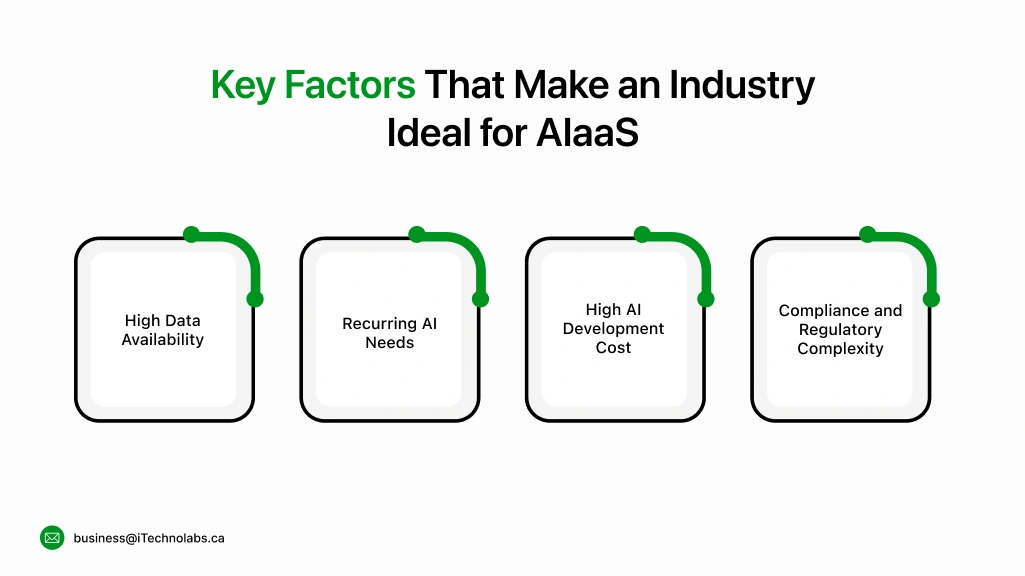
Key Factors That Make an Industry Ideal for AIaaS
Some sectors may not afford the same level of opportunity when developing and operating an AI as a Service venture. To determine which sectors can provide the best return on investment, there are several critical structural and economic factors you need to analyze. Selecting the best vertical will enable faster adoption rates, improved ability to scale quickly, higher likelihood of repeat buying behaviour, and longer-lasting profits.
1. High Data Availability
AI systems are primarily dependent on large and high-quality data sets that allow for the precision of AI systems and continually improve the results of the AI systems provided to businesses within these industries. The types of industries that provide the most massive amounts of structured and unstructured data (e.g., the healthcare, fintech, ecommerce, and marketing industries) create an ideal marketplace for AI as a service (AIaaS) solutions. The larger the amount of data available for training a model, the better the model will perform, and the more likely the model will provide long-term value to your business.
2. Recurring AI Needs
Industries that require ongoing automated processes, such as fraud detection (in FinTech), online retail recommendations, and predictive maintenance (for manufacturers), have more use cases for AI that could work on a subscription basis than other industries where there is less constant automation/decision-making requirements. Continuous monitoring and updating of your AI will create an ongoing need for billing; therefore, this is a very good fit for SaaS-style pricing because it will create a steady stream of monthly or annual revenues.
3. High AI Development Cost
As businesses recognize the high cost of developing AI internally, many choose to adopt AI-as-service (AIaaS) solutions instead. Many industries that require specialized talents, complex models, and large infrastructure investments prefer to outsource rather than take on the risks and costs associated with building their own in-house AI solutions. By providing organizations with pre-built and ready-to-use AI model implementation services, AIaaS vendors can help companies save both capital expenditure costs and access to cutting-edge technologies.
4. Compliance and Regulatory Complexity
Highly regulated industries often face strict compliance requirements related to data privacy, security, and operational transparency. Healthcare, finance, and legal sectors are prime examples. In such environments, businesses prefer partnering with specialized AI vendors that understand regulatory frameworks and can provide compliant, enterprise-grade AI solutions.
Why These Factors Matter
Essentially, when these elements come together, the industries get pretty attractive to AIaaS innovation. Plenty of data helps create powerful models, several use cases guarantee regular revenue, expensive development costs lead to outsourcing, and a complicated regulatory environment poses entry barriers; besides, all these reach a scalable and defensible AI as a Service business.
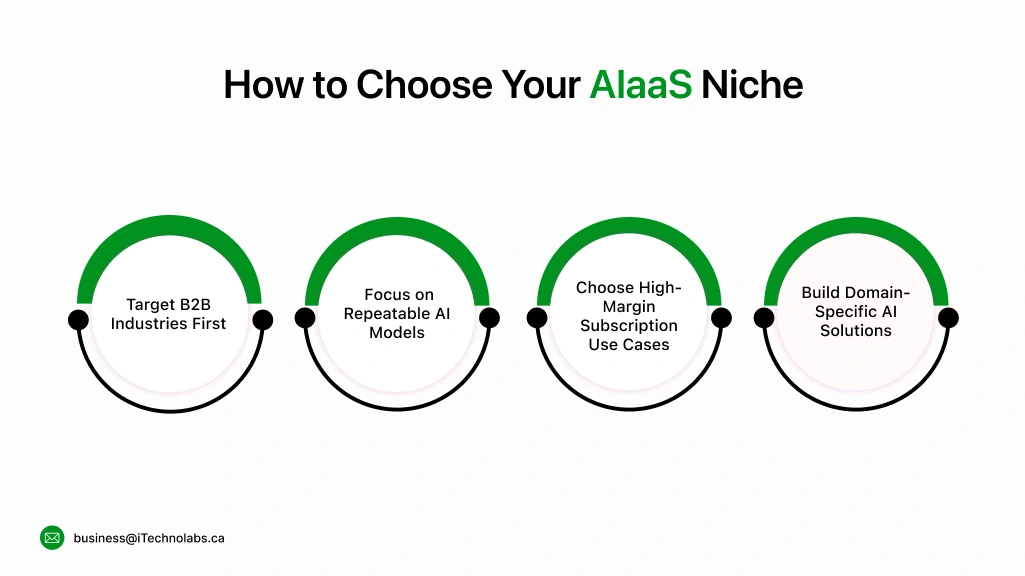
How to Choose Your AIaaS Niche
Among the most crucial decisions at the very start of the AI as a Service business is selecting the right niche. A clearly defined niche leads to fast product-market fit, which in turn makes scaling easier, results in less competition, and makes the business more profitable in the long run. Below are the points you should ponder over before determining your AIaaS niche.
Target B2B Industries First
B2B markets generally provide greater contract values, extended customer lifecycles, and more stable revenue streams than B2C segments. Large companies and mid-sized businesses are ready to use AI solutions that help them work more efficiently, cut their costs, and have a significant impact on their ROI. Hence, B2B sectors are perfect for starting and developing AIaaS products.
Focus on Repeatable AI Models
Focus on AI use cases that you can standardize and roll out to several clients without major tailoring. Repeatable models like recommendation engines, fraud detection systems, or predictive analytics tools not only help you scale more quickly but also reduce the running costs. The greater extent to which you can reuse your AI models, the more your platform will yield and scale.
Choose High-Margin Subscription Use Cases
Identify cases where potential use is in the line of recurring revenue models. Subscription pricing is a good fit for AI solutions that require continuous monitoring/optimization/updates, such as automation tools, analytics platforms, and compliance monitoring systems, since they give the company a constant flow of cash and also increase the total value of the customer over their lifetime.
Build Domain-Specific AI Solutions
Generic AI tools frequently find it difficult to differentiate themselves in competitive markets. By concentrating on a particular industry or workflow, you are able to develop greater expertise and offer more precise, high-value solutions. Besides that, domain specialization is a great way to become more distinct, secure higher trust, and get better long-term retention.
Why Niche Focus Matters
Niche specialization not only strengthens your market positioning but also reduces your own AI development cost. By focusing on a defined problem and audience, you can reuse datasets, optimize models faster, and streamline development cycles — all while building a more defensible and scalable AI-as-a-Service business.
Conclusion
AI-as-a-Service is rapidly emerging as one of the most powerful SaaS opportunities in the US, enabling businesses to adopt advanced intelligence without heavy infrastructure or upfront investment. As demand for scalable, cost-efficient AI continues to grow, companies that enter the market early have a strong advantage in building high-margin, recurring revenue platforms.
The key to long-term success lies in selecting the right industries, focusing on repeatable use cases, and delivering domain-specific AI solutions that solve real business problems. With the right strategy and execution, AIaaS can evolve into a sustainable and highly scalable business model.
For organizations looking to accelerate their AI journey, working with an experienced partner can significantly reduce risk and time-to-market. iTechnolabs empowers businesses to design, develop, and scale intelligent AI solutions tailored to real-world needs — helping transform ideas into impactful, future-ready products.
FAQ
1. What is AI-as-a-Service (AIaaS)?
AI-as-a-Service is a cloud-based delivery model that allows businesses to access AI capabilities without building infrastructure in-house. It provides ready-to-use AI tools like analytics, automation, and machine learning through APIs or platforms, making AI adoption faster, scalable, and cost-efficient.
2. How much does AI development cost for businesses?
AI development cost varies based on complexity, data requirements, and infrastructure. Basic AI solutions may start from $20,000–$50,000, while advanced enterprise systems can exceed six figures. AI-as-a-Service helps reduce upfront costs by offering subscription-based pricing and faster deployment.
3. Which industries benefit the most from AI-as-a-Service?
Industries with large datasets and recurring automation needs benefit the most from AI-as-a-Service. Healthcare, fintech, ecommerce, manufacturing, legal, and marketing are leading adopters due to high AI development costs, scalability needs, and demand for intelligent automation.
4. Why are companies choosing AI-as-a-Service over in-house AI?
Companies prefer AI-as-a-Service because it reduces infrastructure costs, speeds up deployment, and eliminates the need for large AI teams. It offers flexible pricing, regular updates, and scalability, making it ideal for businesses seeking cost-effective and low-risk AI adoption.
5. How do AI development services help businesses scale faster?
Professional AI development services help businesses design, build, and deploy intelligent solutions efficiently. They provide expertise in data modeling, AI integration, and deployment, reducing time-to-market and development risk while ensuring scalable, production-ready AI systems.