
Rockstar’s whole thing is pushing open-world games until they almost stop feeling like “games,” and they’re pitching GTA 6 as their biggest swing yet. Bigger realism, flashier visuals, smarter NPCs, a city that’s supposed to feel annoyingly alive, and yeah, the online side is clearly built to keep going for years. Not just a boxed product. A platform.
So here’s what everyone keeps asking. What did it actually cost?
Rockstar hasn’t put a real number out there. No press release. No neat little budget figure. But leaks, reporting, and industry chatter all circle the same idea: GTA 6 might end up sitting at the top of the “most expensive game ever” pile once you count marketing, servers, and years of post-launch work.
This is a breakdown of how that money likely gets burned through, why the estimates are all over the place, and why the bill gets so wild by the time you hit 2026.
How much did GTA 6 cost to make? (Estimated range)
Rockstar won’t confirm anything. That’s the annoying part.
Still, most guesses from people who follow AAA production land in this zone: development alone could cost around $500M to $1B, and if you zoom out and include marketing plus the long-haul GTA Online infrastructure, the full “project” number people throw around often jumps to $1B–$2B, depending on what they decide counts.
- Two buckets show up again and again Development only: high hundreds of millions, because the world is huge, the systems are complex, and the tech target is next-gen.
- Everything included (dev + marketing + post-launch + online ops): easily $1B+, especially if Rockstar goes full global-media-blitz and plans for years of online support.
Why do the numbers swing so hard? Because “development cost” means different things depending on who’s talking. Some people mean pure production spending, engineering, art, writing, performance capture, and QA. Others quietly in trailers launch promos, server farms, security teams, and ongoing content drops for GTA Online.
And that’s the real point. GTA 6 isn’t just “a release.” It’s a money-printing ecosystem that’s meant to stay active for years.
Estimated GTA 6 budget breakdown (concept to launch)
To keep it simple, I’m using a $1B total-project scale here (development + online infrastructure planning + production operations). Use a different big number like $1.5B? Same categories, multiply (and wince).
| Stage | What It Covers | Why It’s Expensive | Estimated Share | Estimated Amount (If Total = $1B) |
| Pre-Production (Planning & Story) | Script, characters, concept, prototypes | Years of planning and experimentation | 5% – 10% | $50M – $100M |
| Core Development (Engineering) | Gameplay systems, missions, UI, mechanics | Heavy coding and complex system integration | 20% – 30% | $200M – $300M |
| Engine Upgrades (Next-Gen Tech) | Rendering, physics, world streaming | Benchmark-level R&D and performance tech | 10% – 20% | $100M – $200M |
| Open-World Building | Map, regions, interiors, assets | Massive asset creation and world detail | 15% – 25% | $150M – $250M |
| AI & NPC Realism | NPC routines, police, traffic simulation | Complex simulation and heavy testing | 8% – 15% | $80M – $150M |
| Animations & Motion Capture | MoCap, facial scanning, animations | Actors + equipment + processing | 8% – 12% | $80M – $120M |
| Audio & Music | Voice acting, sound design, licensed tracks | Large scripts and music licensing | 5% – 10% | $50M – $100M |
| QA & Optimization | Bug testing, stability, online testing | Open-world = endless test cases | 10% – 15% | $100M – $150M |
Pre-production (planning & story)
Small on paper. Not small in real life.
Rockstar spends years shaping story beats, characters, the tone, and the basic structure of the world, then they build rough prototypes to see what’s fun and what’s a disaster, because fixing a bad idea later costs ten times more and wastes whole teams for months.
- Estimated share: 5%–10%
- Estimated amount (if total = $1B): $50M–$100M
What inside:
- Story direction and narrative planning
- Characters, dialogue drafts, early voice scripts
- Mission flow and progression outlines
- Map research and theme exploration
- Early gameplay prototypes (driving, combat, core loop)
Core development (engineering & gameplay systems)
This is where the budget starts screaming. And it doesn’t stop.
Engineers aren’t just coding missions, they’re building a giant set of interlocking systems that must behave in real time inside a chaotic open world, with players doing dumb unpredictable stuff every second, across areas that can’t hitch or break.
- Estimated share: 20%–30%
- Estimated amount: $200M–$300M
What’s inside:
- Mission scripting tools and logic systems
- Driving feel, shooting, combat tuning, balancing
- UI/UX (menus, HUD, settings, accessibility work)
- Cutscene tools and cinematic interaction systems
- Dynamic world systems (traffic, NPCs, events)
Engine upgrades (next-gen tech)
This part is expensive because it’s basically R&D disguised as “game dev.” it goes on forever.
Lighting, physics, rendering, world streaming, memory systems, Rockstar has to keep improving the tech while the game keeps changing, which means they optimize, then rebuild, then optimize again (and somebody loses a weekend, guaranteed).
- Estimated share: 10%–20%
- Estimated amount: $100M–$200M
What’s inside:
- Lighting/shadows/rendering improvements
- Dense city detail handling at scale
- Physics, collisions, destruction systems
- Faster world streaming and memory optimization
- blending and stability upgrades
Open-world building (map + environment design)
This is the content furnace. It eats money.
You don’t just build “a city.” You build neighborhoods that look different, roads that make sense, interiors, signage, clutter, lighting setups, props, stores, and activities, then you place and optimize all of it so it doesn’t tank performance when the player decides to start a five-star mess downtown.
- Estimated share: 15%–25%
- Estimated amount: $150M–$M
What’s inside:
- Neighborhoods, regions, biomes, districts
- Roads, highways, interiors, public spaces
- Landmarks and interactive locations
- Side missions, mini-games, activities
- Props, signs, weather elements, environmental detail
AI & NPC realism
People talk about “smart AI” like it’s a checkbox. It isn’t.
NPC routines, police response, traffic behavior, and crowd simulation, those systems need to look believable while staying stable, and stability gets harder the bigger the sandbox becomes; every weird player action creates another edge case you have to handle.
- Estimated share: 8%–15%
- Estimated amount: $80M–$150M
What’s inside:
- Crowd/population simulation
- NPC reactions and interaction logic
- Police AI, wanted levels, response behaviors
- Traffic simulation and driving behavior
- Random events and world interactions
Animation, motion capture, facial scanning
This is where “cinematic” turns into invoices.
Actors, mocap stages, facial capture rigs, processing pipelines, cleanup, and thousands upon thousands of animations, walking, fighting, subtle gestures, and all the small in-between stuff players don’t notice until it looks wrong.
- Estimated share: 8%–12%
- Estimated amount: $80M–$120M
What’s inside:
- Mocap sessions with performers
- Facial scanning and expression capture
- Massive animation libraries
- Cinematic story sequences
- Cleanup, polishing, final animation passes
Audio, voice, music licensing
GTA audio is a monster. Simple as that.
We’re recording piles of dialogue, building city ambience, designing weapon and vehicle sound, and mixing it all so it doesn’t turn to mush, and then there’s music; radio stations alone can turn into a licensing bonfire if Rockstar wants recognizable tracks.
- Estimated share: 5%–10%
- Estimated amount: $50M–$100M
What’s inside:
- Voice acting across a huge script
- Sound design (traffic, crowds, weapons, ambience)
- Licensed music for radio stations
- Score and cinematic music
- Mixinging and world audio optimization
QA, bug fixing, optimization
QA never ends. Ever.
Open worlds create near-infinite ways to break things: mission triggers, physics glitches, AI weirdness, streaming hiccups, crashes after long sessions, and online desync, then every fix risks breaking something else, so the testing loop keeps going until ship (and after ship).
- Estimated share: 10%–15%
- Estimated amount: $100M–$150M
What’s inside:
- Mission flow and progression testing
- exploits and collision issues
- Performance passes in dense areas
- Stability tests for long sessions
- Online load tests and security checks
Also Read : How Much Does 3D Game Development Cost in 2026?
Why Rockstar GTA 6 Development Cost Is So High
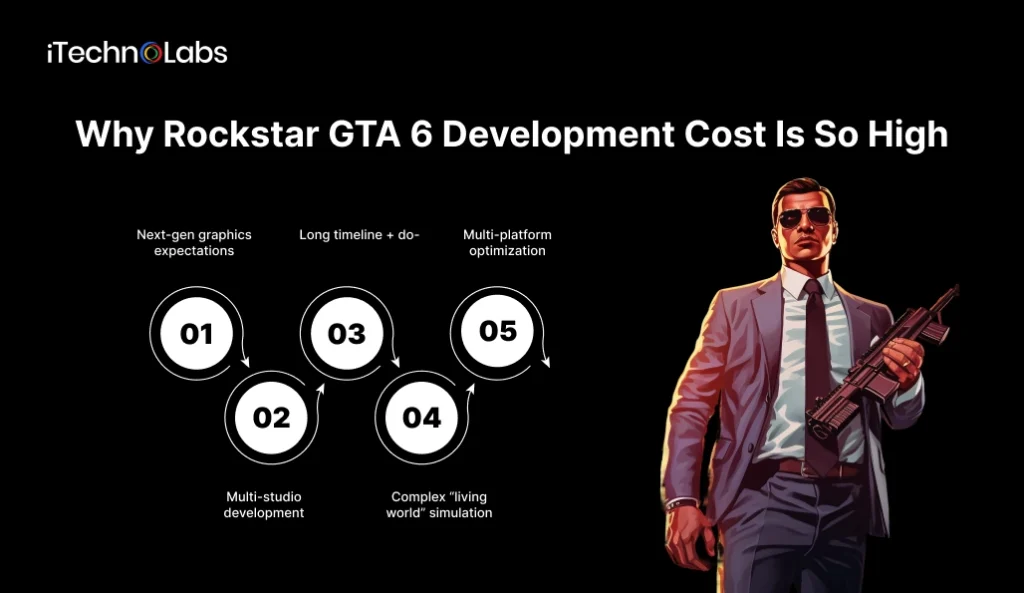
It’s not one thing. It’s a pileup.
Rockstar’s budget blows up because scope and realism stack on each other; a bigger map means more assets, more assets mean more QA, more AI systems mean more testing, new tech means more optimization, and the timeline gets longer because everything depends on everything else. That’s how you end up in “how is this even real money?” territory.
Next-gen graphics expectations
Players in 2026 won’t accept “pretty good.” They’ll expect:
- high-end lighting, reflections, textures
- densely packed environments
- better character animation realism
- advanced weather and VFX
Multi-studio development
Rockstar doesn’t build these with one team in one building. That means:
- bigger payroll
- more infrastructure
- more coordination overhead
- more years of ongoing studio cost
Long timeline + do-
GTA-sized projects don’t move in a straight line. They loop:
- build a system
- test it in the real world
- rip out what doesn’t work
- rebuild it better
- polish it until it stops breaking (mostly)
Complex “living world” simulation
It’s not just map size. Its behavior:
- NPC routines
- traffic/crowd/police simulation
- dynamic events
- physics systems that feel consistent
Multi-platform optimization
Every platform adds work. Period.
You need stable performance, cleanliness, fewer crashes, and good memory behavior, and you don’t get that in one pass; you get it after a bunch of painful rounds.
- Security and leak prevention
- Big projects attract drama. And theft.
- So Rockstar spends on:
- access control
- secure pipelines
- monitoring and data protection
- anti-leak systems and internal security
Marketing Budget of Rockstar GTA 6
GTA marketing doesn’t act like normal game marketing. It acts like a movie campaign with a global audience.
Trailers that look like short films, massive buys, PR strategy, partnerships, creator campaigns, launch-day hype machines, Rockstar turns the release into an “event,” and that kind of attention costs real money (a lot of it).
What it usually includes:
- Cinematic trailer production and teasers
- Global ads (digital, TV, outdoor)
- PR, interviews, media partnerships
- Creator/influencer/community campaigns
- Launch promos, events, collaborations
Rockstar GTA 6 Cost Comparison With Previous Rockstar Games
GTA 6 is expected to exceed GTA 5 and RDR2 in cost because it combines next-gen technology, bigger world-building, deeper realism systems, and stronger online infrastructure, all at a much larger scale.
| Game | Scale & Focus | Major Cost Drivers | Why It Matters |
| GTA 5 | Large open-world with strong story and online foundation | Open-world design, mission systems, early GTA Online build, marketing | One of the biggest-budget games of its time and became one of the most profitable entertainment products ever |
| Red Dead Redemption 2 | Cinematic realism and detailed world immersion | High-detail environments, lifelike animations, huge motion capture, long development cycle | Known for unmatched realism and considered one of the most expensive games produced |
| GTA 6 | Next-gen open world and long-term online ecosystem | Next-level AI realism, major engine upgrades, larger world scale, advanced online infrastructure | Expected to surpass both GTA 5 and RDR2 because Rockstar is building a bigger, more advanced platform for years of content |
GTA 5 (Estimated Cost):
GTA 5 was considered a record-breaking big-budget game at launch. Industry estimates commonly place its combined development + marketing cost at around $265 million. Even with that “smaller” budget compared to modern AAA standards, GTA 5 became one of the highest-earning entertainment products ever, proving Rockstar’s ability to turn high investment into massive long-term returns.
Red Dead Redemption 2 (Estimated Cost):
Red Dead Redemption 2 raised the production standard through cinematic realism, detailed world immersion, and heavy performance capture. Many reports and industry discussions estimate the total cost to be in the range of $370 million to $540 million (depending on what is included—development only vs. total spending). Its large budget reflects long development time, huge animation workload, and extreme environmental detail.
GTA 6 (Estimated Cost):
Rockstar GTA 6 is expected to surpass both GTA 5 and RDR2 due to next-gen technology upgrades, a larger open-world scale, deeper AI realism, and stronger online infrastructure. While Rockstar has not confirmed numbers, widespread industry speculation suggests GTA 6 could cost between $1 billion and $2 billion when development, marketing, GTA Online expansion, and post-launch support are included—making it one of the most expensive gaming projects ever.
Also Read : What is the AR Zone App? A Brief Guide 2026
GTA 6 vs Other Expensive Games (Budget Comparison)
Rockstar GTA 6 is often speculated to be in the $1B–$2B range, which puts it in a different league compared to most AAA titles. While many big games cost hundreds of millions, GTA 6 is expected to cross them due to its open-world scale, engine upgrades, AI realism, and long-term online support.
| Game | Genre/Type | Estimated Total Budget | Why It Was Expensive |
| GTA 6 (Rockstar) | Open-world AAA + Online ecosystem | $1B–$2B (rumored) | Next-gen engine, massive world, AI realism, online infrastructure, long post-launch support |
| GTA 5 | Open-world AAA | ~$265M | Huge map and strong marketing and early GTA Online base |
| Red Dead Redemption 2 | AAA cinematic open world | $200M–$300M (est.) | High realism, long development cycle, motion capture, environment detail |
| Cyberpunk 2077 | AAA RPG open world | ~$441M (incl. expansion/upgrade costs) | Large-scale open world, long development, major post-launch improvements |
| Call of Duty: Black Ops Cold War | AAA shooter (live-service) | ~$700M | Massive production and multiplayer/live-service operations |
| Call of Duty: Modern Warfare (2019) | AAA shooter | ~$640M | High-end production and online and marketing scale |
| Genshin Impact | Live-service open world | $900M+ (ongoing) | Continuous content pipeline and live ops scaling |
| Star Citizen | Crowdfunded MMO (ongoing development) | $793M+ | Extremely long development and huge scope and systems |
Fan Expectations vs Development Reality
Rockstar must deliver GTA 6 at an extremely high standard, but development constraints force trade-offs between realism, performance, deadlines, and hardware limitations, and that balancing act directly increases both budget and production time.
| What Fans Expect from GTA 6 | Development Reality (What Rockstar Must Manage) | Impact on Cost & Timeline |
| Extreme realism (graphics, physics, details) | Realism requires advanced tech, bigger assets, and complex systems | More engine work, longer production, higher cost |
| Massive content depth (missions, activities, exploration) | Every extra feature adds design, development, and testing time | Increased scope leads to longer timelines |
| Perfect performance (no bugs, smooth gameplay) | Open-world games have millions of possible player actions | Heavy QA and repeated optimization cycles |
| Advanced AI and NPC behavior | AI simulation is complex and must remain stable at scale | High engineering cost + difficult testing |
| Unlimited open-world freedom | Freedom creates more edge cases and bug possibilities | More time required for polish and fixes |
Risks and Rewards of a GTA 6 Budget-Like Game
Building a GTA 6 budget-level game is a high-stakes investment. While the rewards can be massive, global sales, long-term engagement, and recurring revenue, the risks are equally serious. Large budgets increase pressure to deliver perfect quality, and delays can quickly inflate costs. Success depends on strong planning, scalable tech, and a long-term monetization strategy.
Key Risks
- Budget overruns due to long development timelines
- Delays caused by technical complexity and polishing requirements
- Reputation damage if launch performance is weak
- High security risks (leaks, cheats, hacking)
- Tough ROI pressure if monetization fails
Key Rewards
- Strong launch revenue from global hype and premium editions
- Long-term earnings through live updates and GTA Online model
- Huge franchise branding and market dominance
- Community-driven growth through content creators and streams
- Multi-year profitability instead of short-term sales only
Challenges in Developing a Game Like GTA 6
Developing a game like GTA VI is one of the hardest tasks in the gaming industry because it is not just about creating missions or building a big map. Rockstar must create a world that feels alive, realistic, and interactive at every point. Every system, NPC behavior, traffic, police response, physics, missions, and open-world events must work together smoothly. This level of complexity increases production time, testing workload, and overall budget.
Major Challenges Rockstar Faces
- Building a massive open world with high detail: GTA worlds require huge environments packed with interiors, landmarks, vehicles, activities, and interactive objects. The bigger and more detailed the world becomes, the more time Rockstar must spend creating and optimizing assets.
- Creating realistic AI behavior at scale: NPCs in GTA are expected to behave naturally, walking, reacting, driving, and responding to events realistically. Designing AI for crowds, police, and traffic is extremely difficult because small issues can break immersion and create unexpected gameplay problems.
- Maintaining strong performance across the entire map: Dense cities, busy traffic, and high-detail areas can cause performance drops. Rockstar must optimize the game so it stays stable with smooth loading, good frame rates, and minimal crashes, even in the most complex areas.
- Preventing mission-breaking bugs and open-world glitches: Open-world games create endless possibilities. Players can approach missions in unexpected ways, which increases the chance of bugs. Rockstar must test thousands of scenarios to avoid broken mission triggers or exploits.
- Supporting online systems safely and reliably: If GTA VI expands online like GTA Online, Rockstar must maintain secure servers, fair matchmaking, anti-cheat systems, and stable updates. Online modes require continuous monitoring and constant fixes, making development and maintenance even more challenging.
How GTA 6 Will Earn Back Its Massive Development Budget
Rockstar GTA 6 is not designed to earn revenue only during launch week. It is built as a long-term platform that can generate income for years through multiple revenue streams. Rockstar combines traditional game sales with ongoing online monetization, paid expansions, and long-term content updates. This layered revenue model is the reason Rockstar can justify investing such a massive budget into GTA 6.
| Revenue Stream | How It Works | Why It Matters |
| Base Game Sales | Revenue from standard, deluxe, and premium editions | Drives massive launch earnings and sets the foundation for player base growth |
| GTA Online Expansion | Online gameplay with multiplayer features and evolving economy | Keeps players active long-term, creating recurring revenue opportunities |
| Microtransactions & Digital Currency | In-game purchases using virtual currency (skins, items, upgrades) | Generates continuous income beyond the initial purchase |
| DLC Expansions & New Missions | Paid story expansions, new maps, missions, characters | Adds fresh content to extend the game lifecycle and increase sales |
| Live Updates & Long-Term Engagement | Events, updates, seasonal content, patches | Maintains interest, improves retention, and increases monetization potential |
Also Read : AI in Fitness: How Smart Devices Are Changing Everyday Healthcare
How Rockstar GTA 6 Is Raising the Bar for AAA Games?
GTA 6 looks like Rockstar’s way of saying, “Yeah, this is the new baseline.” Big statement. And if even half the talk around it is true, huge budget, years and years of work, more detailed systems, then other AAA studios are going to feel the heat, because players won’t forget what “next-gen” looked like once they’ve seen it.
But here’s the thing: it’s not just prettier graphics. It’s the whole package, denser worlds, smarter NPC behavior, more believable reactions, more stuff happening at once, and online support that isn’t a side mode but basically a long-running product on its own (which changes how publishers think about money, timelines, and risk).
What this probably means for the rest of the industry
- Bigger budgets. Like, “normal” bigger. And that’s going to sting.
- Longer development cycles for open-world games, because you can’t fake scale and polish at the same time anymore.
- More emphasis on ongoing updates and live content, players expect it, even if they complain about it.
- Higher expectations for realism, AI behavior, and world simulation. People notice the little stuff now.
- More pressure to ship quality, not just hype, because comparisons are inevitable and they’re brutal.
Build a High-Impact Game Like Rockstar GTA 6 with iTechnolabs
GTA 6 kind of proves modern AAA games aren’t a one-and-done anymore. They’re more like living platforms, tech-heavy, update-driven, and built to keep people around for years, not weeks. So if you’re trying to make an open-world title, a multiplayer product, or anything that needs “wow” visuals plus systems that don’t fall apart under load, picking a dev partner isn’t a minor detail. It’s the whole bet.
And iTechnolabs positions itself as the team that helps get that bet across the finish line. They claim they’ll take you from early prototyping all the way through engineering, AI features, launch, and the messy part after launch, patches, scaling, support, and the stuff that actually keeps a game alive.
Why iTechnolabs:
- End-to-end game work: concept, design, build, testing, and release. All of it.
- AI and multiplayer know-how: gameplay systems, matchmaking/networking, and analytics (the “what are players doing?” side).
- Cross-platform builds: setups meant for mobile, PC, and console paths without starting from scratch each time.
- Art + performance pipeline: UI/UX, 3D assets, animation, and optimization, because performance is part of the experience.
- Long-term operations: live updates, content growth, and server security. The boring stuff that matters.
So, what are you trying to ship? A huge open world, a multiplayer-first title, or a revenue-focused gaming app, those are different goals, but they all need a solid technical base if you don’t want to spend the next year putting out fires.
Conclusion
People throw around giant numbers because it makes a good headline. But the real reason the price tag looks wild is simpler: Rockstar isn’t treating GTA 6 like a single release. They’re building a next-gen open-world platform with engine upgrades, realism systems, cinematic presentation, and a massive world that needs to hold together without feeling stitched up.
And the online angle is a big part of that cost. Continuous updates and expansion over time keep players engaged for years, none of that is cheap, and it’s not optional if you’re planning to run a giant online ecosystem. Put “next-gen” production together with long-term live infrastructure, and, yeah, the budget balloons fast. That’s the point.
FAQs
Did GTA 6 really cost $2 billion?
No one official has confirmed that number. Rockstar and Take-Two haven’t stamped “$2B” on anything, and most of what you see online is rumor math. A more believable take It could push past $1B once you count marketing and years of support.
Why is GTA 6 so expensive to make?
Because it’s not just one thing. You’ve got next-gen visuals, more advanced AI, engine work, a huge open world, long testing and polish cycles, plus marketing and security and online infrastructure. It adds up fast, especially at Rockstar scale.
How long did Rockstar spend developing GTA 6?
A long time. That’s how these AAA open-world games go: planning, full production reworking systems, polishing, then endless QA. When the world is massive and online systems have to behave, you don’t “finish” quickly, you iterate until it finally holds together.
Will GTA 6 be the most expensive game ever made?
Maybe, but nobody can prove it without real numbers. Still, if the upper estimates are even close, it’s in that top tier. The combination of huge scope and long-term online spending is what puts it in record territory.
How does Rockstar make that money back?
They don’t rely on launch day alone. Think base sales, premium editions, online monetization, DLC/expansions, microtransactions, and updates that keep revenue coming in over years. That’s the model, slow recovery, long runway, huge lifetime value.