Phones do not wait. When call volume spikes, customers sit on hold, agents rush, and simple questions eat up the whole queue. That is where AI voice chatbots fit in. They can answer routine queries, collect basic details, and route the caller to the right person, without making everyone wait for the next free agent.
Building one takes more than adding a mic icon to a chat app. Voice brings real-world mess. People talk over the bot. They call from traffic. Names get misheard. Calls drop. And even a small delay feels awkward on a phone call.
This shift is also backed by market numbers. Market Research Future says the Voice Assistant Market was worth around USD 4.85 billion in 2024 and could reach USD 25.01 billion by 2035, growing at 16.08% CAGR from 2025 to 2035.
This article provides detailed, practical guidance and a general overview of how to estimate costs to develop an AI Voice Chatbot. You will also see how everything you want to include will affect your budget.
Table of Contents
AI Voice Chatbot Development Cost Breakdown
AI Voice Chatbot Development usually has two buckets of cost. One is the one-time build cost. The other cost is the running cost that shows up every month, mainly from voice minutes, hosting, and ongoing tuning.
Based on published estimates for building AI Chatbots in 2026, the costs of building AI Chatbots will range from thousands of dollars for very simple bots to several hundred thousand dollars for large enterprise systems, depending on how complex they are and how much integration and compliance may be required.
A voice-first bot typically lands toward the higher side because speech adds extra testing and reliability work.
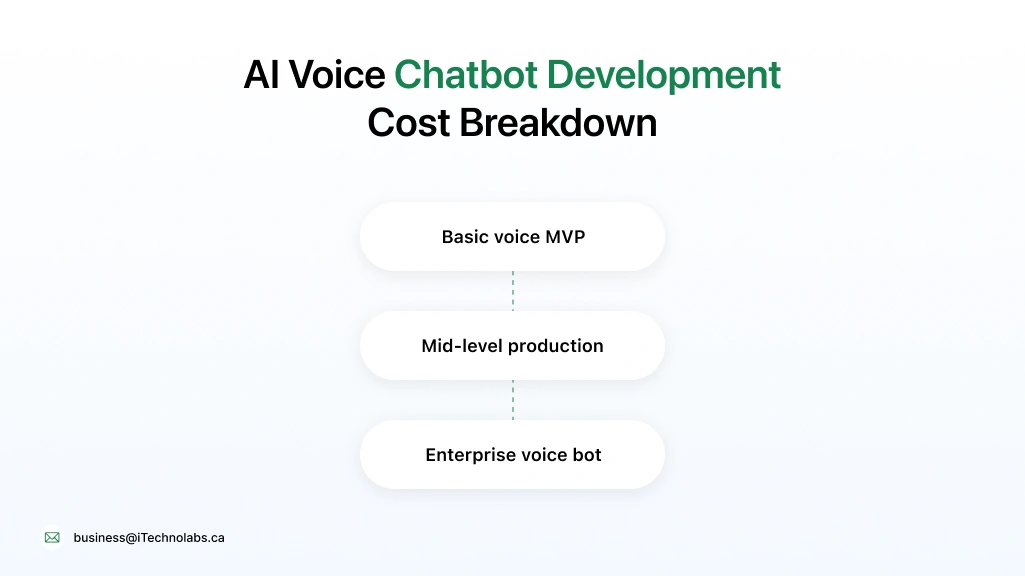
Here is a simple way to think about cost levels.
| Level | Typical goal | What is usually included | Typical build range (USD) |
| Basic voice MVP | Prove the flow on real calls | 1–2 intents, one language, simple handoff, basic dashboard | ~$25,000–$60,000 |
| Mid-level production | Run real support at scale | 10–30 intents, call routing, CRM/ticket integration, analytics, QA | ~$60,000–$200,000 |
| Enterprise voice bot | High volume and strict controls | Security reviews, compliance, multi-language, high availability, MLOps, deep integrations | ~$200,000–$500,000+ |
Factors Influencing AI Voice Chatbot Development Cost
Cost changes the moment you move from text to voice. AI Voice Chatbot Development includes speech-to-text, text-to-speech, call handling, and extra testing for real-world audio. This is why AI voice chatbots usually need a bigger budget than a simple chat widget.
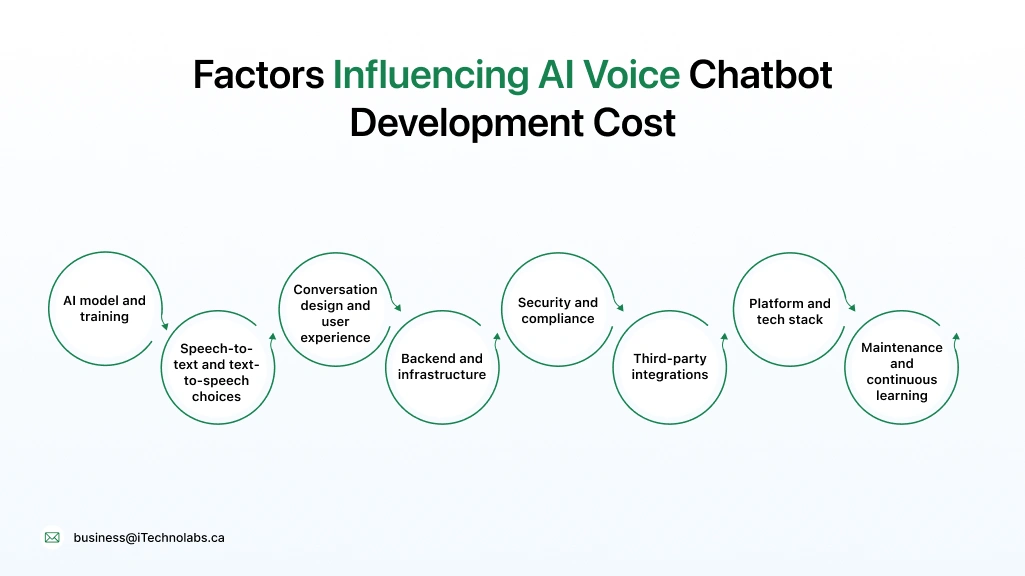
AI model and training
If you use a ready model with prompt rules, you ship faster. If you train for your domain, like insurance terms or product SKUs, you pay more for data prep, testing, and ongoing tuning.
Speech-to-text and text-to-speech choices
Voice cost depends on minutes and characters. For example, Google Cloud Speech-to-Text pricing shows paid tiers like $0.016 per minute after the free limit.
Google Cloud Text-to-Speech shows pricing like $30 per 1 million characters for “Chirp 3: HD voices” after the free limit.
AWS Transcribe also lists tiered pricing starting at $0.024 per minute for the first usage tier.
Conversation design and user experience
Voice flows need tighter scripting than text. You must handle interruptions, silence, confirmations, and re-tries, so users do not feel stuck in loops. This adds time in design and QA.
Backend and infrastructure
Your bot still needs a reliable backend for routing, user lookup, and logging. If you need low latency and high uptime, you pay more for stronger hosting, monitoring, and failover.
Security and compliance
If the bot handles personal data, you need access controls, audit logs, and storage rules. Regulated industries also need extra reviews and documentation, which increases effort.
Third-party integrations
Each integration adds cost because it needs mapping, error handling, and testing. Common examples are CRM, ticketing, payments, and knowledge bases.
Platform and tech stack
A bot that works on one channel is cheaper. The same bot across phone, app, web, and WhatsApp needs more work, because each channel has different limits and user behavior.
Maintenance and continuous learning
After launch, you will spend on tuning intents, updating prompts, and improving accuracy from real call logs. You also need routine checks when models or vendor pricing changes, so performance does not quietly drop.
Detailed Breakdown of AI Voice Chatbot Features and Capabilities
When people budget for AI voice chatbots, they often think the “voice” is the main feature. In reality, the cost moves based on what the bot can do during a call, how well it recovers from mistakes, and how cleanly it hands off to a human. This section lists the features that usually matter in AI Voice Chatbot Development, and it also shows which ones increase effort the most.
Basic features
A basic voice bot is built to handle a small set of common calls without breaking. It focuses on clarity and safe routing, not fancy intelligence.
It usually includes:
- Speech recognition and playback. The bot listens, converts speech to text, then speaks back with a selected voice.
- Intent handling. The bot can understand a limited set of user goals, like “check order status” or “book an appointment.”
- Fallback and retry. If the bot is unsure, it asks again in a different way instead of guessing.
- Human handoff. The bot transfers the call to an agent when it reaches a limit, and it passes the call summary.
- Basic analytics. You get logs like call count, top intents, and where users drop off.
These basics keep the bot stable, even when the audio quality is not great.
Advanced features
Advanced features are where budgets grow because they need more testing, more edge-case handling, and stronger systems behind the bot.
Common advanced features include:
- Barge-in handling. The bot can handle users who interrupt mid-sentence, which is very common on calls.
- Noise and accent robustness. The bot is tuned to handle background sounds and regional speech patterns better.
- Context memory. The bot remembers details inside a call, like name, address, last order, and earlier answers.
- Personalisation. The bot changes responses based on customer type, account status, and past issues.
- Secure identity checks. The bot can verify a caller with OTP, KBA, or voice checks, depending on your risk level.
- Live integrations. The bot can read and write data to CRM, ticketing, order systems, and calendars in real time.
- Agent assist mode. Even during handoff, the bot can keep summarising, suggesting steps, and filling forms.
- Multi-language support. This is not only translation. It needs separate testing, prompts, and voice tuning per language.
This is the point where the bot starts behaving like a real call agent, which also means your quality bar must go up.
Feature impact at a glance
Here is a clean way to judge what adds the most cost. Use it like a checklist during planning.
- Higher impact on cost: real-time integrations, identity checks, multi-language, high availability, detailed analytics, and quality monitoring.
- Medium impact on cost: context memory, personalisation, barge-in, and better handoff.
- Lower impact on cost: a small intent set, basic dashboards, and simple routing rules.
If you choose too many “higher impact” items in the first release, your timeline usually slips. A staged rollout works better.
Building what really matters
Start with what protects user trust. A voice bot can survive a small knowledge base, but it cannot survive confusion. You should prioritise features that reduce wrong answers and messy handoffs.
A practical first release often looks like this:
- A short list of intents that match real call volume.
- Strong fallback, retry, and a fast handoff path.
- One or two key integrations that remove manual work, like ticket creation or order lookup.
- Call summaries that help agents, so users do not repeat everything.
Then you expand. Add more intents. Add deeper integrations. Improve the speech layer. This is also the safest way to scale AI Voice Chatbot Development without spending on features that nobody uses.
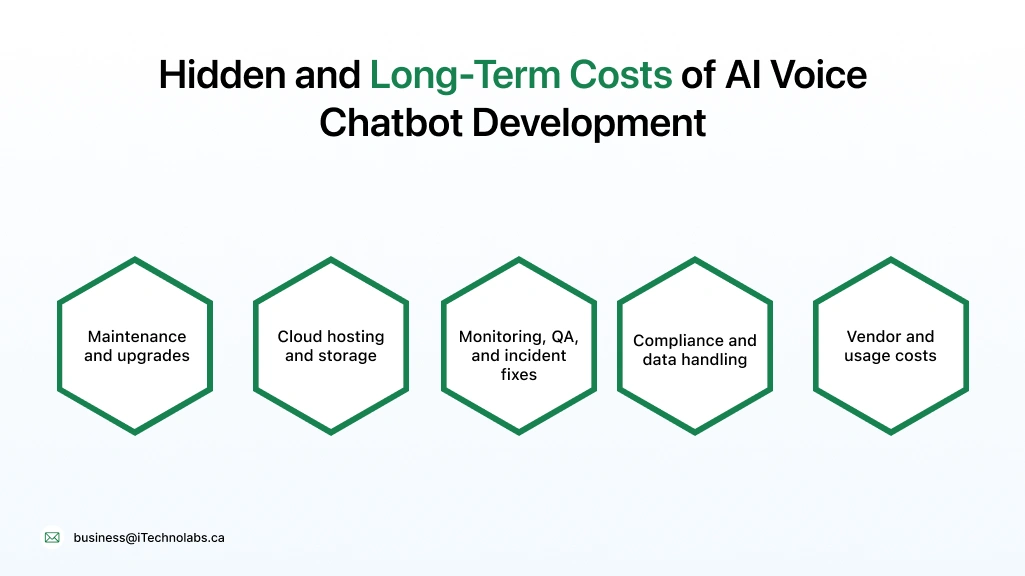
Hidden and Long-Term Costs of AI Voice Chatbot Development
Many teams plan the build budget and forget the “after launch” bills. For AI voice chatbots, the long-term spend is often tied to voice minutes, reliability work, and ongoing fixes. If you ignore these, the first month feels fine, and month three feels expensive.
Maintenance and upgrades
A voice bot needs regular tuning because real callers do not speak like test scripts. You will update intents, prompts, and fallback rules as new questions show up. You may also need periodic upgrades when your speech or model provider updates versions.
Cloud hosting and storage
Call flows run on servers, and those servers must stay fast during peak hours. Storage grows because you keep logs, transcripts, call summaries, and error traces for debugging. If you keep call audio for quality checks, storage and access controls become a bigger line item.
Monitoring, QA, and incident fixes
Voice bots need monitoring like any customer-facing system. You track latency, dropout rate, handoff failures, and repeated retries. When something breaks, fixes are not only code, they are often conversation changes and retesting with real audio.
Compliance and data handling
If your bot handles personal data, you need clear rules for consent, how long you keep transcripts or recordings, and who is allowed to access them. Security reviews, audits, and legal checks also take time and add cost, especially in healthcare, finance, and insurance.
Vendor and usage costs
This is the surprise that hits most teams. Speech-to-text is usually billed by minutes, and text-to-speech is often billed by characters. So when call volume grows, the monthly bill grows with it. If your bot starts doing well, your usage goes up, and your running cost goes up too.
What to plan for, so it does not hurt later
A simple rule helps. Budget for ongoing work as a real part of AI Voice Chatbot Development, not as a small add-on. Plan for tuning, monitoring, and a monthly review of the top failure cases, so the bot improves instead of slowly drifting.
Smart Strategies to Reduce Your AI Voice Chatbot Development Cost
You can reduce AI Voice Chatbot Development cost by limiting rework and paid voice minutes. Start with one high-volume call use case, one language, and one integration that removes manual work. Use strong fallback and quick human handoff to protect customer trust. Test speech quality on noisy calls before choosing vendors. Keep prompts short to cut STT and TTS usage. Then expand using real call logs weekly, not guesses for AI voice chatbots.
- Pick one call flow first, and launch it before adding more intents.
- Keep the first release to one channel, and add others only after stability is proven.
- Choose STT and TTS after testing accents, noise, and interruptions on real samples.
- Write short prompts and confirmations, because long turns increase voice usage costs.
- Add integrations in layers, and start with the one that saves agent time the most.
- Review top failure cases weekly, and fix them before you scale volume.
- Set clear handoff rules, so complex calls move to humans instead of looping.
Conclusion
AI voice chatbots help when your phones stay busy all day. They take care of the common stuff, like order status, booking, and basic FAQs, so your team can focus on tricky calls. The price mainly depends on scope, the number of systems you plug into, and how strict your security and quality checks need to be. Voice also needs extra testing because real callers interrupt, speak fast, and call from noisy places.
For a clean estimate, keep the first version tight. Pick one use case, lock the must-have features, and budget for both the build and the monthly running costs. Run a small pilot, listen to real call failures, fix the top issues, then scale. When you follow this approach, AI Voice Chatbot Development stays under control, and AI voice chatbots feel more like a reliable support layer.
If you want a partner to plan features, budget, and rollout without guesswork, iTechnolabs can help you build and launch it.
FAQs
What is the cheapest way to start with an AI voice chatbot?
Start with one use case that gets the most calls, like order status or appointment booking. Keep it to one language and one channel in the first release. Add a quick human handoff so callers do not get stuck in loops. This keeps the first build small and easier to test.
What makes the cost go up the fastest?
Integrations push cost up quickly because each system needs mapping, error handling, and testing. Multi-language support also raises effort because you must tune and test each language separately. Security and compliance work adds time when you store transcripts or handle personal data. High uptime requirements increase hosting and monitoring work.
What monthly costs should I expect after launch?
Most monthly costs come from voice usage and hosting. Speech-to-text is often billed by minutes, and text-to-speech is often billed by characters, so higher call volume means a higher bill. You also pay for monitoring, logs, and ongoing tuning. Even a stable bot needs regular updates based on real call issues.
How do I know which features to include in version one?
Pick features that stop callers from getting frustrated. Strong fallback, clear retry, and fast human handoff matter more than fancy add-ons. Add only one or two integrations that help complete the task, like ticket creation or order lookup. This approach keeps AI Voice Chatbot Development focused and avoids rework later.
How do I prevent wrong answers and repeated loops?
Set strict rules for when the bot should stop and transfer to an agent. Keep prompts short and ask one question at a time, because people interrupt on calls. Review call logs weekly and fix the top failure cases first, because a few issues usually cause most problems. That is how AI voice chatbots stay reliable as volume grows.