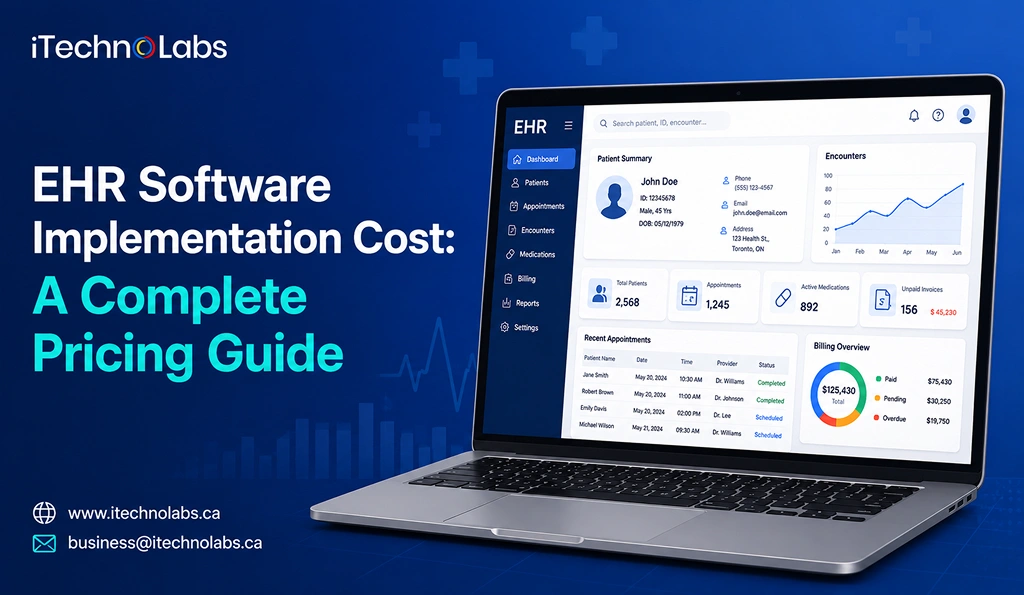
The digital revolution is speeding up in the healthcare industry, and EHR Software is a necessary component that every hospital, clinic, and health organization needs. Electronic health record software helps manage patient records, coordinate care, maintain compliance with regulations, and improve overall operations.
But one of the questions many healthcare organizations often have is, “What does EHR software implementation cost in 2026?” In reality, it varies with practice size, deployment option, level of customization needed, required integrations, and continued maintenance fees. Industry estimates place EHR software implementation costs from tens of thousands for a small clinic to millions for large healthcare systems.
Here is a blog detailing EHR software implementation cost, influencing price factors and hidden costs, and how to make the best investment.
TL;DR
- EHR Software costs vary based on organization size and complexity.
- Cloud-based solutions offer lower upfront implementation expenses.
- Data migration and integrations significantly impact project budgets.
- Customization increases functionality but raises overall development costs.
- Proper planning helps maximize EHR Software implementation ROI.
Key Points
- The cost of implementing EHR software can range from thousands to millions, depending on factors like the size of the health organization, the deployment model, the functionalities the health organization requires, and the complexity of the system.
- The cost-benefit of the cloud-based EHR Software lies in that it reduces the need to invest in infrastructure while providing better scalability and flexibility, and allowing for automatic software updates and simplified maintenance.
- Data migration, third-party integration, and customization of the workflows are the key cost components that have an impact on the EHR implementation duration and cost.
- Hidden costs that organizations must take into account are training expenses, compliance costs, maintenance costs, cybersecurity costs, and temporary dips in productivity.
- Modern EHR software has investment benefits for organizations by allowing them to deliver better patient care, increase organizational productivity, enhance compliance requirements, and improve business success.
Table of Contents
- What is EHR Software?
- Average EHR Software Implementation Cost in 2026
- Major Cost Components of EHR Software Implementation
- Hidden Costs of EHR Software Implementation
- Factors That Influence EHR Software Costs
- How to Reduce EHR Software Implementation Costs
- Future Trends Shaping EHR Software in 2026 and Beyond
- Why Choose iTechnolabs for EHR Software Development
- Conclusion
- FAQs
What is EHR Software?
Electronic Health Record Software (EHR Software) is a digital healthcare system used for storing, managing, updating, and sharing patient health information in healthcare settings. A sophisticated EHR Software system takes the place of the paper-based medical chart and allows medical providers access to a patient’s health records in real-time to enhance clinical workflow and patient care.
Physicians, nurses, specialists, and administrators using advanced EHR Software can effectively track patient history, prescriptions, laboratory results, treatment plans, medical images, and clinical documentation through the central system. The use of EHR Software benefits healthcare settings by improving coordination of care, preventing medical errors, increasing regulatory compliance, and increasing administrative efficiency.
Modern EHR Software typically includes:
- Patient record management
- Appointment scheduling
- E-prescribing
- Billing and revenue cycle management
- Clinical decision support
- Telehealth integration
- Patient portals
- Analytics and reporting
- Interoperability with healthcare systems
- Secure data storage and access controls
The implementation of reliable EHR software is now a must for healthcare organizations to be part of the ongoing transformation of the healthcare system, to enhance patients’ outcomes, to simplify their internal processes, and to aid clinical decisions with data.
Average EHR Software Implementation Cost in 2026
The overall EHR Software implementation costs depend greatly on factors such as the size of the health organization, implementation needs and configurations desired, amount of customizations required, and the complexity of the project itself. When choosing the option between the implementation of cloud-based EHR software and the development of custom EHR Software, health organizations should carefully consider their available budget and long-term operational needs. The cost of implementing EHR Software varies greatly, from as low as $25,000 to as high as $10+ million, depending on implementation scope, required features, integrations, and compliance. Small clinics may invest $25K to $100K, while large hospitals or an entire health network might spend multiple million dollars on sophisticated EHR Software packages.
| Healthcare Organization | Estimated Cost Range |
| Small Clinic (1–5 Providers) | $25,000 – $100,000 |
| Medium Practice (5–20 Providers) | $100,000 – $500,000 |
| Large Multi-Specialty Practice | $500,000 – $2 Million |
| Hospital or Enterprise Network | $1 Million – $10 Million+ |
Generally, implementation of EHR Software consists of software licensing, hardware infrastructure, data migration, system integration, customization, employee training, compliance, and post-implementation support. Medium-sized clinics and individual medical practices can implement an off-the-shelf EHR Software with a smaller implementation cost, while large hospitals and enterprise health networks can invest more heavily in implementation.
Industry experts suggest that custom development and large-scale EHR implementations cost millions or tens of millions when it involves integrated functionalities, AI-based clinical applications, telehealth, data analytics, and complicated healthcare workflows. In light of continued investment in digital healthcare, modern EHR Software is undoubtedly one of the most crucial technology investments for enhancing patient outcomes, streamlining operations, and regulatory compliance.
Major Cost Components of EHR Software Implementation
In addition to the actual price for EHR Software licenses, other associated expenses will arise during EHR Software implementation. Each of these significant expenses will be a factor for each health organization. The six main cost elements are: Infrastructure, Data migration, System integration, customization, Training of employees, and Ongoing support. Knowledge of these specific elements can assist providers with accurate budget planning and help avoid surprises with EHR Software implementation costs.
1. Software Licensing Costs
Software licensing is often the largest portion of the EHR Software implementation budget. Depending on the vendor and deployment model, licensing costs can range from $200 to $1,000+ per provider per month for cloud-based solutions, while enterprise licensing agreements may cost tens of thousands to millions of dollars annually.
Common pricing models include the following:
- Subscription-based cloud pricing
- Per-provider licensing
- Per-user licensing
- Enterprise licensing agreements
- Custom software ownership models
Cloud-based EHR Software generally requires a lower upfront investment, while on-premise systems involve larger initial licensing and infrastructure costs.
2. Infrastructure and Hardware
Healthcare organizations implementing on-premise EHR Software may need to invest between $10,000 and $500,000+ in infrastructure and hardware, depending on the organization’s size and requirements.
Infrastructure expenses may include:
- Servers
- Networking equipment
- Workstations
- Tablets and mobile devices
- Backup systems
- Cybersecurity tools
Cloud-based EHR Software significantly reduces infrastructure expenses because the vendor manages hosting, storage, and system maintenance.
3. Data Migration
Data migration is one of the most critical aspects of EHR Software implementation. Migration costs typically range from $5,000 to $100,000+, depending on the volume and complexity of healthcare data.
Migration costs depend on the following:
- Historical data volume
- Data quality
- Number of source systems
- Data mapping requirements
- Validation and testing processes
Poor data quality and outdated records often increase migration timelines and overall project costs.
4. System Integration
Integrating EHR Software with existing healthcare systems can cost anywhere from $10,000 to $250,000+, depending on the number of third-party systems involved.
Common integrations include:
- Laboratory systems
- Pharmacy platforms
- Medical devices
- Insurance providers
- Billing systems
- Telehealth applications
Integration complexity is one of the most significant cost drivers in modern EHR implementation projects.
5. Customization and Workflow Configuration
Customization costs for EHR Software can range from $10,000 to over $500,000, depending on the level of personalization required.
Customization may include:
- Specialty-specific templates
- Clinical workflows
- Custom dashboards
- Reporting modules
- Automated documentation processes
Advanced customization improves usability and efficiency but increases both development and implementation costs.
6. Employee Training
Training is essential for successful EHR Software adoption and can cost between $1,000 and $50,000+, depending on organization size and training scope.
Training expenses often include the following:
- Staff onboarding
- Clinical training sessions
- Administrator training
- Ongoing education programs
- User support resources
Organizations that invest in comprehensive EHR Software training typically achieve faster user adoption, improved productivity, and fewer implementation challenges.
Also, read: The Complete Guide to Healthcare App Development in 2026
Hidden Costs of EHR Software Implementation
While it’s common for organizations to set aside funds for EHR Software licenses and installation, not all factor in the indirect costs of EHR Software implementation. These unanticipated expenses may have a substantial effect on a company’s overall cost of ownership and affect the project timeline if not carefully considered early in the planning process. From decreased productivity to legal implications, there are indirect costs, like these, that need to be calculated before a comprehensive budget can be developed.
1. Productivity Loss During Transition
One of the most frequently overlooked costs associated with EHR Software implementation is the productivity loss that staff may encounter during the transition period. Doctors, nurses, and support staff often experience temporary dips in output as they adjust to the system and modified workflows, and as a result, clinics and other organizations may find that processing times increase and operational efficiency decreases. This lost productivity can take a toll on revenue and patient satisfaction.
2. Compliance and Security Costs
Healthcare organizations must see to it that the EHR Software they utilize is compliant with legislation such as HIPAA and other local healthcare rules. Additional expenditures for security features and compliance management may be incurred to adapt the EHR Software.
Security-related expenses may include:
- Encryption
- Multi-factor authentication
- Audit logging
- Risk assessments
- Penetration testing
- Compliance audits
These measures are essential for protecting sensitive patient data and minimizing cybersecurity risks.
3. Ongoing Maintenance
The expenditure for EHR Software doesn’t end with the deployment of the same. With recurring yearly maintenance costs that may constitute a large part of your EHR ownership investment, you can secure the system and enhance its performance and security.
Maintenance costs typically include the following:
- Software updates
- Security patches
- Technical support
- Infrastructure management
- System monitoring
Organizations should factor these recurring expenses into their long-term technology budgets.
4. Vendor Support Services
Many healthcare providers underestimate the cost of ongoing vendor support. While some support services are included in licensing agreements, advanced assistance often comes at an additional cost.
Additional vendor services may include:
- Dedicated support teams
- Implementation consulting
- Performance optimization
- Workflow redesign
These services can improve system performance and user adoption but may increase the overall cost of EHR Software implementation beyond the initial purchase agreement.
Factors That Influence EHR Software Costs
Implementing an EHR Software solution will cost differently across various healthcare organizations, as a multitude of factors will determine the budget that needs to be met, such as organization size, deployment methods, and feature and customization needs, as well as system integration complexity. Taking the above into consideration allows healthcare providers to gauge their costs more precisely and adopt an EHR Software system best fitted to their operational and budgetary requirements.
1. Organization Size
One of the key factors that determines the cost of an EHR Software implementation is the size of the healthcare organization. Generally, the size of an organization plays an immense role in the amount of resources and the sophisticated functionality needed, as well as system scalability.
Larger healthcare organizations often require:
- More user licenses
- Greater infrastructure investments
- Complex clinical workflows
- Extensive third-party integrations
As the number of providers, staff members, and patients increases, the overall implementation cost of EHR Software rises accordingly.
2. Deployment Type
The chosen deployment model plays a major role in determining the total cost of EHR Software.
Cloud-Based EHR Software
Cloud-based solutions are becoming increasingly popular due to their affordability and flexibility. Benefits include:
- Lower upfront costs
- Subscription-based pricing
- Reduced IT infrastructure requirements
- Faster deployment timelines
On-Premise EHR Software
On-premise deployments offer greater control over data and system management but require a larger initial investment.
Key characteristics include:
- Higher upfront implementation costs
- Greater control and customization
- Increased maintenance responsibilities
- Dedicated hardware and IT resources
Healthcare organizations must weigh cost considerations against operational requirements when selecting a deployment model.
3. Feature Requirements
The quantity and sophistication of the features included within the EHR Software greatly affect the implementation price. Basic systems are typically cheaper; with more sophisticated features, extra development and setup will need to occur, in addition to ongoing maintenance costs
Advanced features may include:
- AI-powered clinical decision support
- Predictive analytics
- Voice recognition
- Telemedicine capabilities
- Population health management
These advanced capabilities can substantially increase both development and implementation budgets, but often provide long-term operational and clinical benefits.
4. Integration Complexity
Modern healthcare organizations rely on multiple digital systems that must work seamlessly together. As a result, integration complexity is a major cost driver for EHR Software projects.
Common integrations include:
- Laboratory information systems
- Pharmacy management platforms
- Medical devices
- Insurance and payer systems
- Billing and revenue cycle software
- Telehealth solutions
The higher the number of external systems that require an interface, the more time is required for implementation and testing, and therefore, the more expensive the project will be. Effective interface planning ensures that data can be communicated seamlessly and enables the EHR Software to return value.
Suggested Article: A Quick Guide to Healthcare Software Development in 2026
How to Reduce EHR Software Implementation Costs
EHR Software can be a substantial expenditure; however, healthcare providers can still control costs with proper planning and thoughtful decision-making. Through a narrow focus on essential features, minimization of customization, and selection of an appropriate implementation model, providers can still be successful in their digital transformation with minimized upfront costs. Below are a variety of ways that a healthcare organization can maximize the return on investment of an EHR.
1. Start with Core Features
Organizations should avoid implementing EHR Software in one big step and consider rolling out core modules first. Base functionality and benefits like patient records, scheduling, billing, and e-prescribing may be beneficial in the short term; advanced features should be phased in as the business needs arise.
2. Choose Cloud-Based Solutions
Cloud-based EHR Software generally offers better financial benefits over on-premise solutions. Cloud-based EHRs usually offer smaller initial capital requirements and bypass several infrastructure costs.
Benefits of cloud-based EHR software include:
- Reduced hardware costs
- Lower maintenance expenses
- Automatic software updates
- Scalable subscription pricing
- Faster implementation timelines
3. Prioritize Data Cleanup
Costs associated with data migration occur when health organizations use old, duplicate, or corrupted data for the migration of files. Performing an initial cleansing and organization of legacy data can contribute to reducing the complexity and cost of implementation and to higher data quality.
4. Standardize Workflows
However, extensive customization, though it may enhance usability, leads to increased development expenses and project delays. Healthcare facilities ought to standardize workflows as much as they can and customize only EHR Software capabilities, where a defined, measurable impact can be shown in workflow or clinical areas.
5. Select an Experienced Development Partner
Another method for controlling EHR Software costs is to select an experienced healthcare technology vendor. The right development partner can keep you from making expensive errors and will assist you in deployment, regulatory compliance, and system optimization.
Benefits of working with an experienced EHR Software development partners include the following:
- Reduced implementation risks
- Faster deployment timelines
- Better integration capabilities
- Improved user adoption
- Higher long-term return on investment (ROI)
By following these strategies, healthcare organizations can successfully implement EHR Software while minimizing costs, improving operational efficiency, and maximizing long-term value.
Future Trends Shaping EHR Software in 2026 and Beyond
In short, as technology further evolves in the medical field, the EHR Software will begin to develop even further in areas of smarter technology, connectivity, and the patient experience. Trends such as these are having a substantial effect on the way providers deal with their patients’ information, increasing efficiency and personalizing patient treatment. Businesses wishing to receive updated EHR Software will need to take note of these approaching trends so that the software they do end up purchasing can remain current and up-to-date.
1. AI-Powered Clinical Decision Support
Artificial intelligence is revolutionizing EHR Software, enabling healthcare professionals to assist in the diagnostic process, suggest clinical interventions, identify health hazards, and refine clinical decision-making through real-time access to this information.
2. Predictive Analytics for Better Patient Outcomes
Advanced analytical functionality allows EHR Software to interpret huge amounts of patient information, find associations and trends, prognosticate about likely health threats, and enable proactive interventions.
3. Telehealth and Remote Patient Monitoring Integration
As the utilization of virtual care continues to expand, current EHR software is also incorporating telemedicine applications, wearable technologies, and remote patient monitoring services to further increase access to and continuity of care.
4. Enhanced Interoperability
In the future, EHR software will feature more effective integration among hospitals, clinics, laboratories, pharmacies, insurers, etc., to facilitate a more synchronized patient care system.
5. Voice Recognition and AI Documentation
AI-enabled voice recognition tools are being implemented by medical professionals to create notes automatically from patient-physician encounters. Such solutions can streamline the creation of documentation within the EHR Software as well as diminish physician administrative work.
6. Cloud-Native EHR Software Solutions
Cloud-based EHR Software will remain popular, as it is scalable, economical, more secure, and will update automatically. It is much easier to maintain.
7. Advanced Cybersecurity and Compliance
As cybersecurity threats increase, future EHR Software will become more secure and include more advanced security features like zero-trust architecture, better encryption, multi-factor authentication, and ongoing compliance monitoring.
8. Personalized Patient Engagement
The EHR Software used today is increasingly offering patient engagement functionality, such as patient self-service portals, individual health recommendations, appointment scheduling and booking, secure patient messaging, and mobile health applications.
9. Population Health Management
Organizations are now utilizing EHR Software to analyze community health patterns, improve preventative medicine, lower healthcare costs, and promote well-being for all people in the community.
10. Integration with Emerging Healthcare Technologies
Next-generation EHR Software will work hand in hand with wearables, the IoMT (Internet of Medical Things), artificial intelligence healthcare applications, and the next generation of digital health systems.
With these changes, healthcare organizations can truly leverage their EHR Software investments to enhance productivity, improve the patient experience, and adapt to future digital health demands.
Why Choose iTechnolabs for EHR Software Development
Selecting the correct development partner plays a very crucial role in the overall success of the EHR Software implementation project. iTechnolabs builds safe, scalable, and highly advanced healthcare solutions for healthcare providers, which enable them to run their healthcare facilities in an efficient manner with improved patient care and adherence to various regulations. With a vast expertise in the development of healthcare solutions, iTechnolabs builds personalized EHR Software solutions according to the needs of different hospitals, clinics, and healthcare facilities.
1. Proven Expertise in Healthcare Technology
iTechnolabs brings extensive experience in developing advanced EHR Software solutions that help healthcare organizations streamline workflows, improve patient care, and achieve digital transformation goals efficiently.
2. Tailor-Made EHR Software Solutions
Every healthcare organization has unique requirements. iTechnolabs builds custom EHR Software designed around your clinical processes, specialty-specific workflows, operational objectives, and growth plans.
3. Security-First and Compliance-Focused Development
Patient data security is a top priority. iTechnolabs develops EHR Software with robust security protocols, data encryption, role-based access controls, and compliance-ready frameworks to meet industry regulations.
4. Seamless Integration with Healthcare Ecosystems
The team ensures your EHR Software integrates effortlessly with laboratories, pharmacies, medical devices, billing systems, telehealth platforms, and other third-party healthcare applications for smooth data exchange.
5. End-to-End Support and Future-Ready Innovation
From strategy and development to deployment, maintenance, and upgrades, iTechnolabs provides complete lifecycle support while incorporating emerging technologies such as AI, analytics, and automation to keep your EHR Software competitive and scalable.
Also, read: HIPAA-Compliant App Development: Complete Guide for Healthcare Businesses in 2026
Conclusion
The cost of adopting EHR Software in 2026 will vary greatly depending on the size of the organization, implementation approach, level of customization needed, integrations, and compliance regulations. A smaller clinic could expect to pay tens of thousands of dollars, while a large healthcare system may spend millions on a complete EHR implementation.
By recognizing the primary cost factors, hidden costs, and long-term benefits, organizations can properly budget and decide on the technology to use. A successful EHR Software implementation leads to increased efficiency, better patient outcomes, compliance, and future medical innovation.
FAQs
1. How much does EHR Software implementation cost in 2026?
Costs for EHR Software can vary widely from $25,000 for smaller practices to over $10 million for large hospital networks, depending on features, customization, integrations, deployment, and compliance requirements.
2. What is the biggest cost factor in EHR Software implementation?
The main factors influencing EHR Software implementation project costs and timelines are typically software licensing, customization, integrations with third-party products, and data migration.
3. Is cloud-based EHR Software cheaper than on-premise solutions?
Yes, cloud-based EHR Software often comes with a smaller upfront cost, less infrastructure and maintenance burden, and automatic updates, which tends to be a more affordable choice for many healthcare providers.
4. How long does EHR Software implementation take?
EHR Software implementation typically takes between 3 and 6 months for small practices and 12 to 24 months for larger healthcare organizations with complex requirements and integrations.
5. What hidden costs should healthcare organizations consider?
Organizations involved in health care should remember the intangible costs that an EHR Software may carry, such as staff training, productivity loss in the transition period, compliance costs, information security, maintenance, vendor support, and future updates to the software.