Sports betting has ever been a game of gut, pundits, and luck—but suppose you could have more accurate foresight? AI sports betting is changing the sport by scanning gigantic amounts of data, identifying invisible patterns, and generating data-backed forecasts in real-time.
From match results forecasts to bet optimization, AI does away with uncertainty and provides an advantage for bettors. Whether you’re a recreational bettor or a high-roller, AI-based models can assist you in placing better, quicker, and more lucrative bets. Are you ready to see how AI is transforming sports betting? Let’s get started!
Table of Contents
- Market Stats: AI Usage in Sports Betting
- How AI Works in Sports Betting
- AI Sports Betting Predictions:
- AI Sports Betting Strategy
- Best AI Sports Betting Apps
- Ethical & Legal Considerations in AI Sports Betting
- Challenges & Limitations of AI in Sports Betting
- Future of AI in Sports Betting
- Conclusion:
- Frequently Asked Questions About AI Sports Betting
Market Stats: AI Usage in Sports Betting
- Market Growth: According to Statista, the global sports betting market is projected to reach US$77.87 billion by 2026, with an expected annual growth rate (CAGR) of 5.09% from 2026 to 2029.
- AI in Sports Market: As per Mordor Intelligence, the AI market in sports is anticipated to grow from USD 7.63 billion in 2026 to USD 26.94 billion by 2030, reflecting a CAGR of over 28.69%.
- Virtual Sports Betting: This segment is expected to surge, with projections indicating it will reach USD 110.5 billion by 2034, up from USD 14.4 billion in 2024, as per Market.us Scoop, at a CAGR of 22.60%.
AI’s influence is evident in various aspects of sports betting, from enhancing predictive analytics to personalizing user experiences. As the industry evolves, AI-driven tools are becoming indispensable for operators aiming to stay competitive and offer innovative solutions to bettors.
How AI Works in Sports Betting
-
Data Collection & Analysis
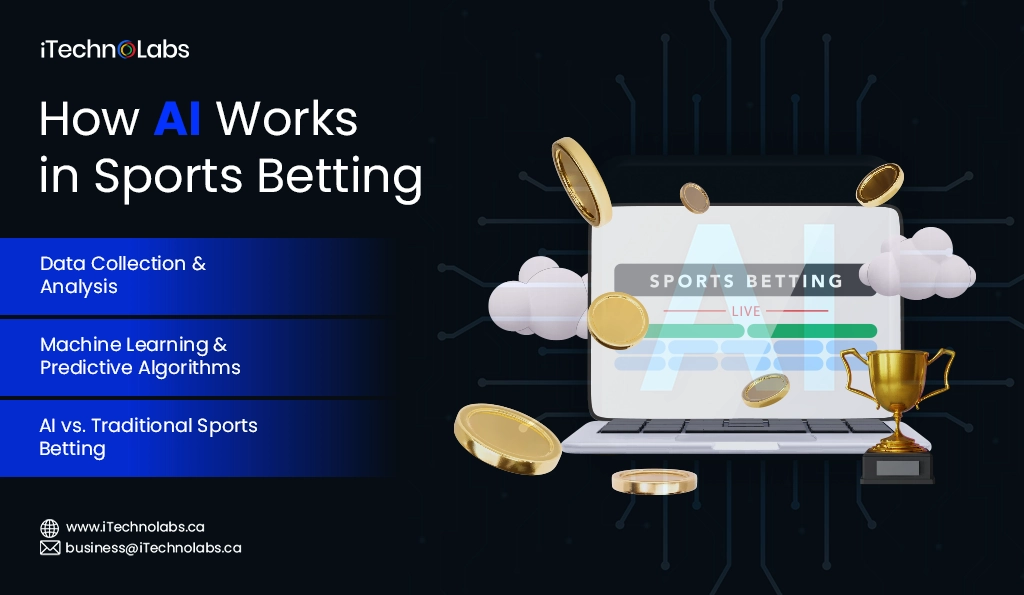
AI sports betting is based on massive amounts of real-time and historical data such as player statistics, team performances, weather, and the odds of betting. AI algorithms collect and process this data from various sources, determining trends and patterns that a human bettor may fail to notice.
-
Machine Learning & Predictive Algorithms
Machine learning algorithms analyze this information to make probability-based predictions. Through constant learning from previous results, AI improves its accuracy, enhancing odds calculation, risk management, and betting strategy. Sophisticated models can identify subtle, game-altering factors that affect outcomes.
-
AI vs. Traditional Sports Betting
Unlike regular sports wagering, depending on gut and professional opinion, AI eliminates human bias and feelings. It makes data-driven decisions that recommend the most profitable wagers, real-time odds adjustments, and even imitate possible game scenarios. Through this, AI betting is quick, precise, and efficient, and provides bettors with an edge over the traditional approach.
AI Sports Betting Predictions:
AI is revolutionizing the process of sports betting with enhanced prediction efficiency, optimized odds, and minimal risks. The following are some ways AI-based sports betting forecasts are changing the future:
-
Role of AI in Predicting Match Outcomes
AI sports betting models make use of humongous databases, such as player performance, team stats, injury reports, and even meteorological conditions, to forecast match outcomes. Using hidden patterns and correlations that it discovers, AI offers data-driven forecasts that increase the odds of making accurate bets over conventional analysis.
-
AI-Driven Odds Calculation
Bookies and online gambling sites employ AI to determine real-time odds based on analyzing market movements, betting volumes, and past statistics. AI assists in changing odds dynamically with live game progress, providing more accurate betting lines that approximate genuine chances.
-
Machine Learning & Historical Data Analysis
AI betting models learn from historical betting outcomes, updating their models to identify patterns that affect results. Machine learning algorithms identify game-altering variables, including team form, tactical changes, or referee bias, resulting in more precise betting tips.
-
Accuracy of AI Betting Predictions
AI can achieve high accuracy in predictions, sometimes exceeding 70-80% in specific sports with well-documented data (e.g., football, basketball). However, sports remain unpredictable due to unexpected events like injuries, referee decisions, or last-minute changes, limiting AI’s effectiveness in every scenario.
-
Limitations & Ethical Considerations
Though efficient, there are limitations with AI sports betting, such as data biases, excessive dependence on past trends, and uncontrollable game variables. In addition to that, concerns about the ethics involved in detecting match-fixing, along with playing responsibly, warrant AI operating within regulatory regulations responsibly.
AI Sports Betting Strategy
Artificial intelligence in sports betting is transforming the way bettors formulate and implement strategies. AI sports betting strategy targets data analysis, risk management, and automation for maximizing betting decision-making and profitability. Here’s how AI refines betting strategies:
-
Data-Driven Betting Approaches
Conventional sports betting tends to be based on gut feelings, pundits’ predictions, and history. AI is different, using a data-based approach to look at huge amounts of structured and unstructured data from various sources. By running team performance, player statistics, historical match results, injury news, and even social media sentiment through its systems, AI algorithms can spot patterns and correlations that may elude human punters. These predictions enable punters to make higher-probability bets with increased confidence.
-
AI-Powered Bankroll Management
Effective bankroll management is one of the greatest challenges of sports betting. AI-based bankroll management systems review a bettor’s history of bets, risk appetite, and profit objectives to suggest optimal bet sizes. Machine learning models dynamically adjust the stakes of bets in real time based on odds, market direction, and betting patterns to maximize returns and limit losses. AI prevents bettors from making rash and emotional betting decisions.
-
Risk Assessment with AI Models
Risk assessment is a necessary component of any successful AI sports betting strategy. AI models use advanced statistical techniques, including probabilistic models and Monte Carlo simulations, to calculate the probabilities of certain outcomes. Predictions are made not only for match results but also for the expected values of bets, guiding the bettor to an assessment of whether a specific wager has a risk worth taking. AI can also identify overpriced and underpriced odds in the market that give an edge to bettors over bookmakers.
-
Real-Time Odds Optimization
Odds are variable and can be dynamically adjusted in nature based on team news, injuries, market trends, and happenings during the live event. AI invests lots of resources in continuously monitoring the odds in real-time on multiple sportsbooks and identifying discrepancies and inefficiencies that bettors can capitalize on. AI-driven algorithms could also indicate the most opportune time to place bets by analyzing market movements, such as predicting changes in odds. This could give an edge to bettors in picking value bets and improving long-term profitability.
-
Automated Betting Bots
The advent of AI-powered betting bots is a game-changer in sports betting. Betting bots are computer programs designed to analyze data, track odds, and place bets automatically based on predefined algorithms and risk parameters. Unlike human bettors, AI bots operate round-the-clock, analyze a mass of information in the blink of an eye, and execute trades in a mechanical, unemotional way. Automated betting systems work especially well in arbitrage betting, allowing bettors to lock up a guaranteed profit based on small changes in odds across various sportsbooks.
With the strategic use of AI sports betting, bettors can edge ahead of the pack, become more accurate, and overcome the other risk-taking betting stakeholders throughout the betting industry.
Best AI Sports Betting Apps
| App Name | USP | User Ratings |
| BetSmartAI | – 80% accuracy in match outcome predictions
– Real-time odds comparison from 100+ sportsbooks – Identifies positive expected value (EV) bets |
4.8/5 |
| BetSense | – AI-powered personalized betting recommendations
– Enhances user engagement through tailored betting offers – Integrates seamlessly with sportsbook platforms |
4.5/5 |
| AiOdds | – AI-driven sports odds data APIs for operators
– Covers 50+ countries with real-time betting data – Offers trading solutions and engagement tools |
4.4/5 |
| SmartBettor | – Uses AI for pattern analysis and predictive modeling
– Identifies profitable betting opportunities – Leverages statistical and machine learning expertise |
4.6/5 |
| Pinnacle | – AI-based risk management and odds optimization
– Competitive odds with advanced betting strategies – Industry leader in data-driven sports betting |
4.7/5 |
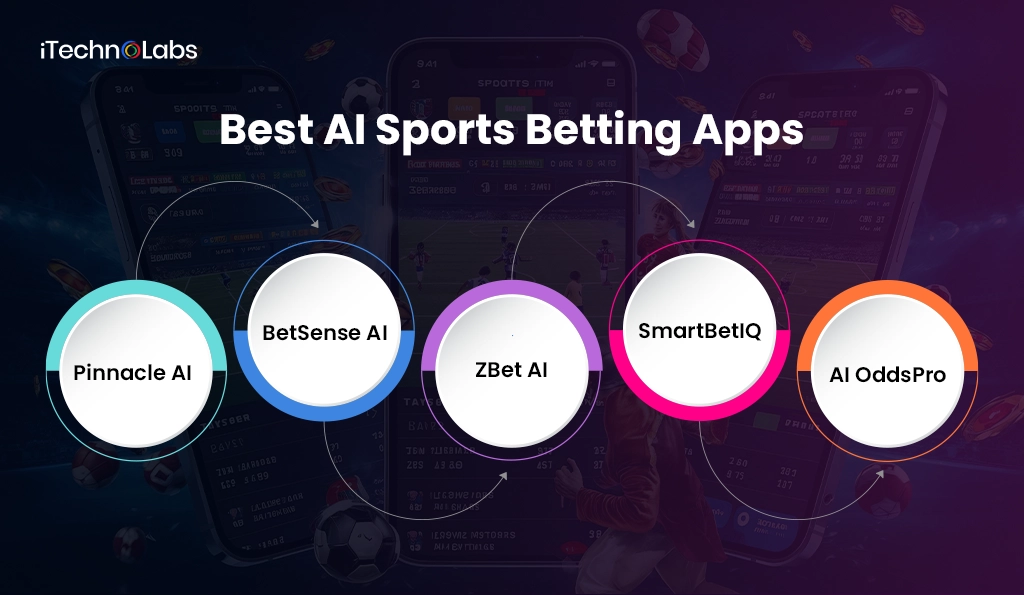
Artificial intelligence is revolutionizing the sports betting industry by providing bettors with data-driven insights and personalized experiences. Here are some of the top AI-powered sports betting apps:
BetSmartAI
- Founded: 2026
- Founded By: A team of PhD mathematicians, data scientists, and MIT graduates
BetSmartAI uses cutting-edge machine learning algorithms to provide extremely accurate match result predictions with an 80% accuracy rate in top North American sports leagues. BetSmartAI provides live odds comparison across more than 100 sportsbooks, allowing users to spot the best value wagers. BetSmartAI also detects positive expected value (EV) bets, allowing users to make informed betting choices.
BetSense
- Founded: 2023
- Founded By: SharpLink Gaming
BetSense is a personalization and recommendation AI engine that is set to transform user interaction in sports betting. Through an individual’s betting preferences and interests, BetSense personalizes betting offers and content, optimizing the overall user experience. In testing with SaharaBets, BetSense will blend into current sportsbook platforms to offer customized interactions.
AiOdds
- Founded: 2024
- Founded By: A global team of technology and sports enthusiasts
AiOdds is committed to delivering premium yet cost-effective sports odds data APIs for operators through the use of digital and AI technology. Based in more than 50 countries, AiOdds delivers full odds services, trading solutions, and betting engagement tools. AiOdds aims to enable the sports market with data, creating a rich platform for operators and punters alike.
SmartBettor
- Founded: 2026
- Founded By: Experts in statistics, mathematics, and machine learning
SmartBettor works to transform the world of sports betting using artificial intelligence technology. Their sophisticated algorithms scan patterns and trends to seek out profitable positive expected value wagering opportunities. Using knowledge in statistics and machine learning, SmartBettor works to exceed the capabilities of conventional betting platforms, giving bettors a valuable advantage in their betting endeavors.
Pinnacle
- Founded: 1998
- Founded By: Not publicly disclosed
Pinnacle is a renowned online sports betting and casino platform that has integrated AI for risk management and odds optimization. By utilizing AI technologies, Pinnacle enhances its betting offerings, providing users with competitive odds and a comprehensive betting experience.
These AI-driven platforms are at the forefront of transforming the sports betting landscape, offering users enhanced accuracy, personalized experiences, and innovative tools to make informed betting decisions.
Read Also: Mobile Sports Betting App Development Guide
Ethical & Legal Considerations in AI Sports Betting
With increasing AI use in sports betting, there are ethical and legal issues involved that need stringent regulation and careful gambling practices. Here’s the way AI is being regulated and its effect on fair play.
-
Regulations on AI in Betting
Whatever the level of sports betting, it is highly regulated traditionally, with AI caught in a framework of specific regulations that keep on evolving. Regulations are being made by government and regulatory bodies like the UK Gambling Commission (UKGC), Malta Gaming Authority (MGA), and US gambling control boards to keep AI-based betting transparent and fair. The main issues are data privacy, algorithms that introduce bias, and preventing AI from exploiting vulnerabilities in betting markets. A few jurisdictions have limited the use of automated betting bots so that human judgments remain at the heart of gambling.
-
Fair Play & Responsible Gambling
Whereas AI improves gambling strategies, it also creates moral issues. With the potential for AI to guess outcomes very accurately, it has the risk of giving a form of unfair privilege to some players, and the potential for manipulating the market follows. Furthermore, AI-based personal betting advice could lead to binge gambling. This can be checked by the measures of responsible gambling by betting operators, including AI-based self-exclusion mechanisms, betting limits, and real-time behavior analysis for identifying unhealthy betting patterns.
As AI sports betting evolves, fairness, transparency, and responsible use of AI will be important to sustain industry integrity.
Challenges & Limitations of AI in Sports Betting
Although AI has immensely improved sports betting strategies, it is still beset by various challenges and limitations that affect its accuracy, reliability, and ethical application.
1. Unpredictability of Sports Events
AI models study historical data to foretell match results, but sports are unpredictable in nature. All these variables can significantly change the outcome of the game: last-minute injuries, referee decisions, team morale, and sudden weather changes. Therefore, AI forecasting is uncertain. No AI tool can promise 100% betting success.
2. Algorithmic Bias & Data Limitations
AI models depend on past data, but biased or incomplete data can result in wrong predictions. For instance, AI may overestimate some teams based on previous performance patterns and overlook present game-day considerations. Moreover, lesser leagues or newer sports usually have limited data, making AI less effective.
3. Ethical & Regulatory Concerns
The application of AI in gambling raises responsible gambling and fairness concerns. AI-based betting robots can take advantage of market inefficiencies, forming unfair benefits for particular gamblers. Regulators are applying tighter controls to the use of AI, restricting automated gambling, and demanding transparency in AI-calculated odds.
4. Risk of Over-Reliance on AI
Many bettors may become overly dependent on AI, ignoring personal analysis and strategic decision-making. AI should be used as a tool to enhance betting strategies, not as a guaranteed way to win. A balanced approach combining AI insights with human judgment remains essential for long-term success in sports betting.
Future of AI in Sports Betting
The future of AI in sports betting is going to be revolutionary, with improved machine learning, real-time data analysis, and automation driving better betting strategies and user experiences. AI will keep on fine-tuning prediction models, making them more accurate by processing larger sets of data, such as biometrics of players, live game situations, and even psychological data.
One of the significant developments is the emergence of AI-driven personalized betting sites, where AI makes recommendations based on unique betting habits. Real-time odds optimization and AI betting bots will also facilitate faster and more efficient wagering.
Regulatory agencies will put stricter compliance measures in place, ensuring AI-driven betting is fair and responsible. With blockchain implementation, AI can also enhance transparency, minimizing fraud and guaranteeing data integrity.
Whereas AI can never eradicate uncertainty in sports, its application in intelligent, data-led betting will persist to expand, increasing the market’s competitiveness and innovation.
Also, read: How to Make Dofu Sports like Live Streaming App?
Conclusion:
AI is reshaping the sports betting landscape by offering data-driven insights, predictive analytics, and automated betting strategies. While AI enhances accuracy and efficiency, it is not without challenges, including regulatory concerns, ethical considerations, and the unpredictability of sports. A balanced approach—leveraging AI tools while applying human judgment—remains crucial for long-term success.
If you’re looking to develop an AI-powered sports betting platform, partnering with an experienced AI app development company is essential. iTechnolabs, a leading AI-driven software development firm, specializes in building highly scalable, secure, and innovative betting solutions. Our expert team leverages machine learning, predictive modeling, and real-time data analytics to create AI-powered betting platforms that provide a seamless and competitive edge.
Ready to take your sports betting app to the next level? Contact iTechnolabs today, and let’s turn your AI sports betting vision into reality!
Frequently Asked Questions About AI Sports Betting
1. What is AI sports betting?
AI sports betting refers to the use of artificial intelligence and machine learning technologies to analyze sports data, predict game outcomes, and support smarter betting decisions. By processing large volumes of information quickly, AI helps bettors identify patterns and opportunities that may not be visible through traditional analysis.
2. How does AI work in sports betting?
AI-powered sports betting systems collect and analyze vast amounts of data to generate probability-based predictions. These systems continuously learn from historical and real-time information to improve forecasting accuracy.
Key data sources include:
- Historical match data
- Team performance statistics
- Player metrics
- Injury reports
- Weather conditions
- Betting odds movements
Machine learning models analyze these factors to identify patterns and estimate the likelihood of different outcomes.
3. Is AI sports betting legal?
The legality of AI sports betting depends on the regulations in your country, state, or region. While AI-powered analytics tools are generally legal to use, placing sports bets must comply with local gambling laws and licensing requirements. Users should always verify the legal status of sports betting in their jurisdiction before wagering.
4. Can AI guarantee winning bets?
No, AI cannot guarantee winning bets. Although artificial intelligence can improve data analysis and prediction accuracy, sports events remain unpredictable. Factors such as injuries, referee decisions, player performance fluctuations, and unexpected circumstances can significantly affect outcomes. AI should be viewed as a decision-support tool rather than a guaranteed profit generator.
5. What types of AI models are used in sports betting?
Several AI and machine learning models are commonly used in sports betting to analyze data and predict outcomes.
These include:
- Regression models
- Neural networks
- Decision trees
- Random forest algorithms
- Reinforcement learning
Each model serves different purposes depending on the sport, available data, and prediction goals.
6. What sports can AI betting models analyze?
AI betting models can analyze virtually any sport that generates reliable statistical data. The effectiveness of predictions generally improves when more historical and real-time information is available.
Popular sports analyzed by AI include:
- Football (Soccer)
- Basketball
- Baseball
- Tennis
- Cricket
- Esports
Data-rich sports typically provide the best environment for machine learning-based predictions.
7. What are the benefits of using AI in sports betting?
AI offers several advantages that can help bettors make more informed decisions and reduce emotional bias.
Key benefits include:
- Faster data processing – Analyzes thousands of data points within seconds.
- Objective decision-making – Relies on data rather than emotions or assumptions.
- Advanced pattern recognition – Identifies trends that may be difficult for humans to detect.
- Bankroll optimization – Helps manage betting strategies and risk more effectively.
These capabilities can improve consistency and efficiency in sports betting analysis.
8. What are the risks of AI sports betting?
Despite its advantages, AI sports betting also comes with several risks that users should understand before relying on automated predictions.
Common risks include:
- Overfitting historical data
- Unexpected events
- Market efficiency
- Financial losses
Responsible betting and proper risk management remain essential when using AI tools.
9. Can I use AI for sports betting?
Yes, AI can be used for sports betting to analyze large datasets, identify trends, and predict outcomes with greater efficiency. AI-powered tools can provide real-time insights, odds analysis, risk assessment, and betting recommendations. However, AI should complement human judgment rather than replace it, as sports outcomes are influenced by many unpredictable factors.
10. Is there any AI for gambling?
Yes, AI is widely used across various forms of gambling, including sports betting, poker, and online casinos. AI-powered platforms help analyze betting patterns, optimize odds, detect fraud, and personalize user experiences. Some advanced systems also automate betting strategies, although their use may be restricted by regulations in certain jurisdictions.
11. How accurate is sports AI?
Sports AI can achieve impressive prediction accuracy, particularly in data-rich sports such as football, basketball, and baseball. In some cases, advanced models report accuracy rates of 70–80% under specific conditions. However, no AI system can predict outcomes with complete certainty because sports involve human performance, randomness, and unforeseen events. AI is best used as a tool to improve decision-making rather than as a guarantee of success.