Software development is speeding up nowadays, and companies require tools to assist their software delivery pipeline to meet the rapidly increasing demand for releases. Doing the build, test, and deployment of the software manually may be very lengthy, prone to errors, and the scalability aspect is limited. So, automating has become a vital element of the success of software development, and Jenkins is one of the main players in making that happen.
Jenkins, an automation server, is a helping hand for software developers when it comes to building, testing, and deploying software tasks. Developers can easily find bugs, improve code, and launch new releases in shorter times by using Continuous Integration (CI) and Continuous Delivery (CD) approaches fully supported by Jenkins.
CI/CD importance is going to be even greater. As stated in the 2024 State of DevOps Report, by adopting mature DevOps and CI/CD practices, companies are able to deliver software at faster speeds, have deployment reliability at a higher level, and at the same time reduce the failure rate. Besides that, the Continuous Delivery Foundation has pointed out Jenkins as one of the two most popular automation tools this year for building and managing the CI/CD pipeline.
Being an individual developer, or a DevOps engineer, a QA person, or even a business executive, Jenkins knowledge can be an eye-opener in automating monotonous tasks, boosting productivity, and delivering software in record time. We will thoroughly cover the concept of Jenkins, its mode of operation, architecture, prominent features, advantages, examples of deployment, and a few selected best practices in our all-inclusive guide.
TL;DR
- Jenkins automates software building, testing, and deployment processes.
- Supports Continuous Integration and Continuous Delivery pipelines.
- Integrates seamlessly with thousands of development and DevOps tools.
- Improves software quality through automated testing and validation.
- Scales efficiently for startups and enterprise development teams.
Key Points
- Jenkins is an open-source automation server that streamlines software development by automating builds, testing, deployments, and continuous integration workflows efficiently.
- Its extensive plugin ecosystem enables seamless integration with Git, Docker, Kubernetes, cloud platforms, testing tools, and monitoring solutions.
- Jenkins Pipelines automate the complete software delivery lifecycle, reducing manual effort while improving code quality, deployment speed, and team collaboration.
- Distributed builds, scalable architecture, and customizable workflows make Jenkins suitable for projects ranging from small applications to enterprise systems.
- Partnering with iTechnolabs helps businesses implement secure, scalable Jenkins CI/CD pipelines tailored to their development goals and DevOps strategies.
Table of Contents
What is Jenkins?
Jenkins is an open-source automation server that is mainly used to automate different phases of the software development lifecycle, such as building, testing, and deploying software. It is first and foremost written in Java but supports other platforms like Windows, Linux, and macOS as well as containerized environments, allowing it to be a go-to choice for teams using various platforms.
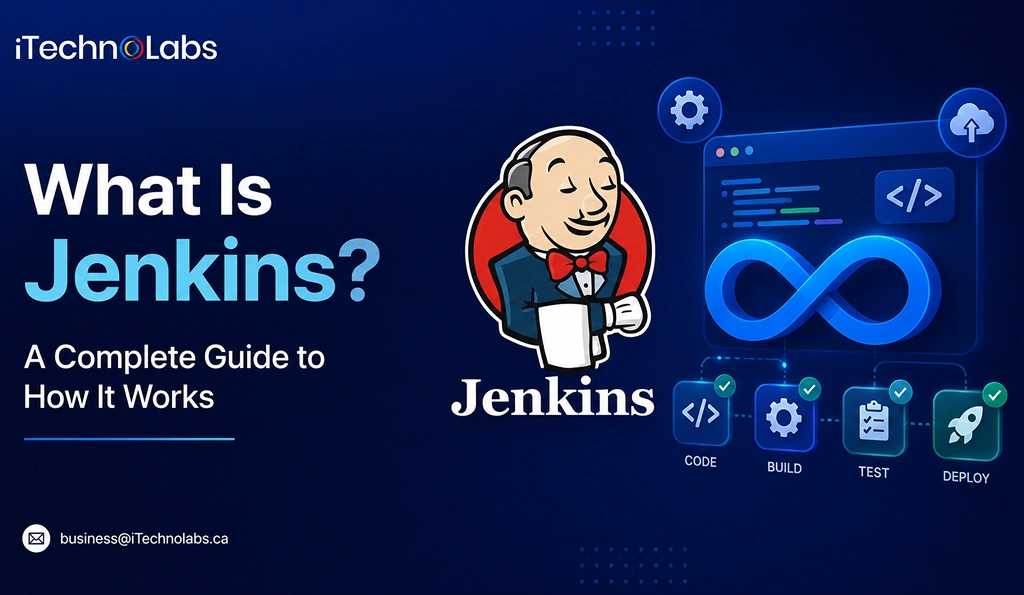
Instead of manually doing tasks that are repetitive, Jenkins automates them through jobs and pipelines that can be configured. For example, when a developer commits code to a version control system like Git, Jenkins can pre-empt the change, build the application, run the tests, create the reports, and deploy the application if all the quality criteria are met.
Jinkens can also integrate with hundreds of development tools, and because of this becoming the center automation hub for today’s DevOps workflow.
Key Highlights
- Free and open source
- Written in Java
- Supports Continuous Integration (CI)
- Supports Continuous Delivery (CD)
- Cross-platform compatibility
- Highly extensible through plugins
- Supports distributed builds
- Integrates with Git, Docker, Kubernetes, Maven, Gradle, SonarQube, Slack, and more
How Does Jenkins Work?
Jenkins is a server-based application that continuously monitors your software’s source code check repository and triggers preset events every time a check-in event or a change in the code has been detected. To sum it up, at any fast and ready-deployable way, teams engaged in the development process utilize the Jenkins software toolkit in order to test and deploy an application.
Step 1: Code Commit
Developers produce new code, repair bugs, or extend programs, and then upload their modifications to a version control system like GitHub, GitLab, or Bitbucket. This code commit serves as the initial trigger for the Jenkins pipeline.
Step 2: Build Trigger
By using webhooks or scheduled polling, Jenkins can automatically discover the new code. When it finds a change, it will trigger a build and get the latest source code from the repo.
Step 3: Build and Compile
Jenkins uses build tools like Maven, Gradle, or Ant to compile the application’s source code. Besides that, at this point, it also fetches the dependencies of the project and gets the application ready for testing.
Step 4: Automated Testing and Quality Checks
Once the build has finished, Jenkins executes automated tests covering unit, integration, and performance tests. It also has the capability to connect with other tools like SonarQube to carry out code quality and security analysis. If issues arise, the pipeline halts, and developers are given an opportunity to address the problems before proceeding.
Step 5: Package and Deploy
If tests pass smoothly, Jenkins zips the application into deployable files. These files might include JAR, WAR, ZIP, or Docker images. Then Jenkins automatically deploys them in development, stage, and Production environments based on their settings
Step 6: Reports and Notifications
Once the deployment is complete, Jenkins generates build reports and sends notifications through email, Slack, Microsoft Teams, or other communication tools. This keeps the entire team informed about the build status and any issues that require attention.
How to Install Jenkins
Getting started with Jenkins is quick and easy. Follow these five simple steps to install Jenkins and set up your first automated CI/CD pipeline.
Step 1: Install Java
Jenkins is built on Java, so you must install Java 17 or another supported Long-Term Support (LTS) version before installing Jenkins. Once installed, verify the Java installation by running:
java -version
This ensures your system is ready to run Jenkins.
Step 2: Download and Install Jenkins
Download the latest Jenkins LTS (Long-Term Support) release from the official Jenkins website. Run the installer for your operating system and follow the installation wizard to complete the setup.
Step 3: Launch Jenkins and Complete the Initial Setup
After installation, start the Jenkins service and open your browser. Visit:
http://localhost:8080
Unlock Jenkins using the administrator password generated during installation. Then, select “Install Suggested Plugins” to automatically install the essential plugins needed for your CI/CD environment.
Step 4: Configure Jenkins
Set up your administrator account by filling in your username, password, and e-mail address. Once you have signed in, adjust the primary options, like the URL of Jenkins, security measures, and any other plugins that your work may need.
Step 5: Create and Run Your First Pipeline
Create a Pipeline project from the Jenkins dashboard and link it to your Git repository. Put a Jenkinsfile in your repo that specifies your steps for building, testing and deploying. Commit the change. Configure the pipeline in Jenkins to point to your repository and the Jenkinsfile. Run it and see if Jenkins can automate your software delivery processes successfully.
Understanding Jenkins Architecture
Jenkins employs a distributed system that enables software development automation by allocating build and testing tasks between different machines. Such system architecture leads to better performance, higher scalability, and simultaneous execution of multiple jobs. The key elements of Jenkins architecture collaborate to provide an uninterrupted and effective CI/CD flow.
1. Jenkins Controller
The Jenkins Controller (also called the Master in the past) is a control center for all the activities in a Jenkins installation. The controller is in charge of organizing and deploying build jobs, storing the configuration of the project, distributing and managing plugins and agents, and managing the history of the builds.
Key Responsibilities:
- Schedules and manages build jobs
- Stores project configurations and build history
- Controls Jenkins pipelines
- Manages plugins and system settings
- Handles user authentication and security
- Assigns tasks to Jenkins agents
2. Jenkins Agents
These are the machines that are connected to the controller and which build tests and deploy builds. We could configure an agent to run on various OS, such that a project can be built on an OS and could be tested on another OS.
Benefits of Jenkins Agents:
- Run multiple builds in parallel
- Speed up the CI/CD process
- Support platform-specific builds and testing
- Optimize system resources and workload distribution
Example: A Windows agent can build a .NET application while a Linux agent builds a Java application at the same time.
3. Executors
A worker process on a Jenkins agent executing a single build job. There may be zero to many executors per agent, allowing Jenkins to execute several jobs simultaneously on the same agent and reducing overall build times.
Key Benefits:
- Execute multiple jobs simultaneously
- Reduce the build waiting time
- Improve resource utilization
- Increase pipeline performance
4. Jenkins Jobs
A Jenkins job means a task or any process executed by Jenkins automatically. Jenkins jobs specify tasks that should execute as per a software life cycle, and jobs can be configured via the User Interface of Jenkins. Also, Jenkins job can be configured via Jenkinsfile.
Common Jenkins Jobs Include:
- Building applications
- Running automated tests
- Generating build reports
- Deploying applications
- Performing code quality checks
5. Jenkins Pipelines
A Jenkins Pipeline connects multiple stages of the software delivery process to automate the entire workflow. Pipelines are coded as text files, with a file called a Jenkinsfile, which helps ensure they are versionable and reusable.
A typical Jenkins Pipeline includes the following stages:
- Source Code Checkout
- Build
- Automated Testing
- Security and Quality Scanning
- Package Creation
- Deployment
- Notifications and Reporting
By automating these stages, Jenkins ensures faster software delivery, improved code quality, and a more reliable CI/CD process.
Core Components of Jenkins
Jenkins operates on a variety of components that work in synergy to automate your software development lifecycle. Every piece of these building blocks has a different purpose while building your app, testing them & deploying it. By knowing all these, you can make a stable, dependable & scalable CI/CD pipeline.
1. Jenkins Server
The Jenkins Server: the orchestrator of automated builds. This is the head chef in our recipe book. The Jenkins Server is responsible for triggering builds, storing project configs, holding build history, and overseeing communication between master and nodes (agents).
Key Functions:
- Manages build and deployment jobs
- Stores project configurations
- Tracks build history and logs
- Coordinates connected agents
- Controls pipeline execution
2. Jenkins Jobs
Jenkins job (automated task): It’s essentially an automated routine in Jenkins that executes some configuration or automatically gets triggered, whether through manual initiation, scheduling, or code pushes in a repository.
Common Jenkins jobs include:
- Building source code
- Running automated tests
- Generating reports
- Packaging applications
- Deploying software
3. Jenkins Pipeline
A pipeline refers to the entire process of CI/CD, which can also be defined in a Jenkinsfile. Through this, you automate the whole workflow in the pipeline, and these pipelines are more portable and reusable across different applications.
A typical Jenkins pipeline includes:
- Source code checkout
- Build
- Automated testing
- Code quality and security checks
- Package creation
- Deployment
- Notifications
4. Jenkins Agents
Jenkins agents are the servers/machines that run jobs designated by the Jenkins server. They run on different operating systems and thus can execute various builds or tests in parallel in order to maximize build throughput and decrease build time.
Benefits of Jenkins Agents:
- Parallel build execution
- Faster software delivery
- Better resource utilization
- Cross-platform testing and deployment
5. Jenkins Plugins
Another perk Jenkins has in store is a vast plugin ecosystem. By means of thousands of available plugins, Jenkins can readily connect to your code repositories, cloud environments, testing applications, and deployment solutions, enabling your team to tailor a specific CI/CD pipeline workflow for their projects.
Popular plugin categories include:
- Git and GitHub integration
- Docker and Kubernetes
- Maven and Gradle
- SonarQube
- Slack and Email notifications
- AWS, Azure, and Google Cloud integrations
Key Features of Jenkins
Jenkins is among the most popular continuous integration and continuous delivery (CI/CD) tools for its flexibility, scalability, and potent automation capabilities. These features, among many others in Jenkins, help development teams not only to ease the software delivery process but also to deliver high-quality code and quicken the release cycle. The main features that make Jenkins the first option for DevOps teams are listed below.
1. Open-Source and Free to Use
It is a free and open-source automation server, hosted and developed by a worldwide community. It gets updated often, including security updates and a community of volunteers to provide add-on features (plugins).
2. Extensive Plugin Ecosystem
A significant part of what makes Jenkins so popular is the large number of plugins available, which goes beyond two thousand and makes integration with other common development tools, like those used in development, testing, deployment, and cloud environments, effortless.
3. Pipeline as Code
You can automate your builds, test cycles, and deployments by codifying your CI/CD workflow with Jenkinsfile and committing it to version control. CI/CD pipeline becomes portable, shareable, and testable when written using Jenkinsfile.
4. Cross-Platform Compatibility
Jenkins works on Windows, Linux, macOS, and Unix-based systems. It also offers compatibility with the cloud and containers, which can cater to your project depending on where your project is hosted.
5. Distributed Builds
Jenkins supports building a distributed configuration and will assign many jobs to many agents to work. They significantly shorten building times, enhance resource usage, and increase productive effectiveness.
6. Automated Testing and Deployment
When any code change is found in the system, Jenkins auto run unit, regression, integration, and performance testing. It also deploys the application in the dev, stag, or prod environment after a successful test run if required.
7. Security and Access Control
Strong Jenkins Security Features: Protect Sensitive data with the included role-based control, credential management, authentication, and integration with business security management tools for Jenkins.
8. Easy Integration with DevOps Tools
Jenkins easily integrates with version control systems, container platforms, cloud services, monitoring tools, and testing frameworks, enabling organizations to build a complete and efficient DevOps ecosystem.
Suggested Article: DevOps Automation Tools: Top 25 Tools and Features
Jenkins Pipeline Explained
A pipeline in Jenkins Pipeline automates your entire delivery process that flows the application from the code integration stage to the production release stage. It helps you avoid most manual work as you will be automating CI/CD operations with Jenkinsfile, thus resulting in consistent, quick releases with fewer errors.
Jenkins supports two main types of pipelines, each designed to meet different development needs.
1. Declarative Pipeline
Declarative Pipeline provides a straightforward syntax that makes it readable and easy to write. They are the best practice for most pipeline designs because it is predictable and easier to govern due to its structured syntax.
Key Benefits:
- Easy to understand and maintain
- Ideal for beginners and most development teams
- Uses a clean, structured syntax
- Simplifies pipeline creation and management
2. Scripted Pipeline
For more flexibility, consider using A Scripted Pipeline where developers create all pipeline logic in a Groovy script. Use A Scripted Pipeline to configure very sophisticated projects with custom logic, conditions, and pipeline behaviors.
Key Benefits:
- Highly customizable and flexible
- Supports advanced scripting and logic
- Suitable for complex CI/CD workflows
- Ideal for experienced DevOps engineers
The benefit of these types of pipelines is that they support software builds, tests, and checks along with deployment. In general terms, Declarative vs Scripted Pipeline: the first is chosen by projects that are simpler in structure, whereas the latter is a more comprehensive set.
Advantages of Jenkins
Jenkins is built to simplify the process of automated delivery of software for dev teams, encourage efficient development collaboration, and reduce time on production releases. With simplified automated development procedures and support for CI/CD, Jenkins facilitates the creation of better-quality apps in a faster manner.
| Advantage | Description |
| Faster Development | Automates repetitive tasks such as building, testing, and deployment, allowing developers to focus on writing quality code. |
| Continuous Integration | Automatically integrates code changes into a shared repository, helping teams identify and resolve issues early. |
| Improved Software Quality | Runs automated tests and code quality checks throughout the development process to reduce bugs and improve reliability. |
| Reduced Manual Effort | Eliminates time-consuming manual processes by automating the entire software delivery workflow. |
| Seamless Tool Integration | Integrates with thousands of development, testing, cloud, and DevOps tools through its extensive plugin ecosystem. |
| Scalable Architecture | Supports distributed builds using multiple agents, making it suitable for projects of any size. |
| Cost-Effective Solution | Being free and open source, Jenkins helps organizations reduce software automation costs without compromising functionality. |
| Faster Software Releases | Automates CI/CD pipelines to shorten development cycles and deliver new features and updates more quickly. |
Future Trends of Jenkins
Now more than ever, Jenkins adapts with us as we shape modern software by evolving with DevOps. With cloud-native AI-fueled software and DevOps, Jenkins plays and will continue to play an essential role in CI/CD.
1. Greater Adoption of Cloud-Native CI/CD
Applications are rapidly making a move into the cloud, with Jenkins increasingly being implemented alongside cloud platforms and orchestrators like Kubernetes and Docker to manage application development in a cloud-native world.
2. AI-Powered Automation
What will be new and changing for DevOps with AI? Smarter test, predictive analysis, build optimization, and detection of errors automatic error detection with AI is DevOps. We anticipate Jenkins will gain AI capability via smart plugins and integrations, which will augment its current smart features for the CI/CD pipeline.
3. Stronger DevSecOps Integration
Security will be moving front and centre into the software development cycle of the future. Expect Jenkins pipeline in the future to continue evolving in a DevSecOps fashion, incorporating security code scans, vulnerability identification, policy enforcement, and compliance checks within all workflows.
4. Enhanced Kubernetes and Container Support
With containers becoming the industry standard, Jenkins will continue to deepen the integration with Kubernetes and Docker, giving the possibility to perform dynamic scaling, faster deployments, and resource optimization.
5. Smarter Plugin Ecosystem
Jenkins is expected to broaden their ecosystem of plugins, offering a wider range of integration with contemporary DevOps tools, cloud services, monitoring services, and even those driven by AI technologies to deliver more business value.
Why Choose iTechnolabs for Jenkins Development and DevOps Solutions?
Proper Jenkins installation is the prerequisite for smooth execution; you will need to configure a robust, scalable CI/CD pipeline, plug in third-party software, and streamlining your deployments. That’s when iTechnolabs comes in.
1. Experienced DevOps Engineers
Our DevOps specialists have extensive experience implementing Jenkins-based CI/CD pipelines for startups, SMBs, and enterprise organizations.
2. End-to-End Jenkins Implementation
From installation and configuration to pipeline development and deployment automation, we manage every stage of your Jenkins implementation.
3. Custom CI/CD Pipeline Development
We build tailored Jenkins pipelines that align with your development process, automate repetitive tasks, and improve release efficiency.
4. Seamless Tool Integration
Our team integrates Jenkins with GitHub, GitLab, Bitbucket, Docker, Kubernetes, SonarQube, Maven, Gradle, AWS, Azure, Google Cloud, and other essential DevOps tools.
5. Security-Focused DevOps
We implement secure credential management, role-based access control, and automated security testing to protect your software delivery pipeline.
6. Ongoing Support and Maintenance
We provide continuous monitoring, performance optimization, plugin management, troubleshooting, and maintenance to ensure your Jenkins environment runs efficiently.
7. Scalable Automation Solutions
Whether you’re managing a single application or a complex enterprise ecosystem, we design Jenkins solutions that scale with your business needs.
Also, read: 5 Perfect Tools for AWS DevOps Developers to Build Software
Conclusion
Jenkins is still one of the top automation servers that software developers use for developing modern software. With its modularity, an enormous number of plugins, and solid CI/CD support, it has earned a lot of industrial confidence. It is even widely considered the best way for companies to rethink their entire development pipeline and release software much quicker.
For both small and large apps, Jenkins serves you by automating monotonous tasks, increasing the quality of code, and most importantly, delivering the software quicker and with enhanced reliability.
If Jenkins is on your mind either as a new tool or as a way to upgrade your DevOps environment, surrounded by skilled people, you will worry less and get more effective results. iTechnolabs is a one-stop shop for Jenkins-related software development, automation of CI/CD pipelines, and DevOps consulting. We help businesses build secure, scalable, and highly efficient software delivery pipelines that meet their needs.
FAQ
1. What is Jenkins used for?
Jenkins is an open-source automation server that enables you to automate the building, testing, and deployment of software projects. The practice of CI (Continuous Integration) and CD (Continuous Delivery) in development teams becomes easy by utilizing Jenkins.
2. Is Jenkins free to use?
Yes. Jenkins is completely free and open source. Organizations of all sizes can use and customize it without licensing costs.
3. Is Jenkins a CI or CD tool?
It facilitates both Continuous Integration (CI) and Continuous Delivery/Continuous Deployment (CD) of an application. It streamlines the entire Software Delivery life cycle right from code commit to deployment.
4. Can Jenkins integrate with Docker and Kubernetes?
Yes. It integrates directly with GitHub, GitLab, Docker, Kubernetes, AWS, Azure, Slack, SonarQube, Maven, Gradle, etc through several thousand available plugins.
5. Does Jenkins require programming knowledge?
Basic programming experience is a great foundation for creating Jenkins Pipelines with Groovy or configuring build scripts, but you don’t need to know it all to start configuring your own Jenkins jobs by utilizing the user-friendly graphical interface.