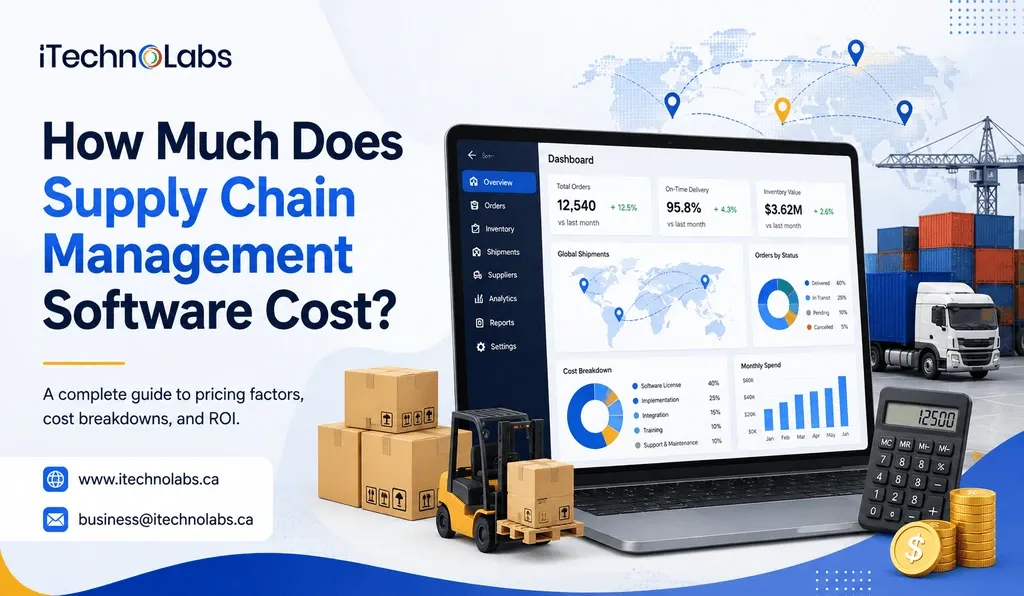
Modern supply chains demand precision, speed, and complete visibility across every stage of operations. From inventory planning and procurement to logistics and warehouse management, businesses are increasingly investing in digital solutions that simplify complex workflows and improve decision-making. As adoption grows, one question consistently comes up: what is the supply chain management software price, and what factors determine the overall investment?
The answer depends on several variables, including the software’s functionality, deployment model, level of customization, integrations, and business requirements. A basic platform designed for a growing company will have a very different budget than an enterprise-grade solution built to manage global supply networks.
This guide explores the price of supply chain management software in detail, breaking down development costs, pricing factors, implementation approaches, and ongoing expenses to help you plan your budget with confidence. The insights shared in this article are based on our hands-on experience designing and developing custom supply chain management software for businesses across diverse industries, providing practical guidance backed by real-world projects.
TL;DR
- Supply chain management software helps businesses improve visibility, streamline operations, and reduce inefficiencies across the supply chain.
- The cost of developing supply chain management software typically ranges from $30,000 to $500,000+, depending on project requirements.
- Software pricing is influenced by business size, development approach, customization, integrations, and ongoing operational expenses.
- Careful planning and selecting the right development strategy can maximize return on investment while controlling costs.
Key Points
- Supply chain management software centralizes procurement, inventory, warehouse, logistics, and supplier management to improve operational efficiency.
- Businesses invest in SCM software to address challenges such as poor visibility, inventory inaccuracies, supplier coordination issues, and rising logistics costs.
- Development costs vary based on software complexity, required features, integrations, security, deployment model, and customization.
- Small businesses, mid-sized organizations, and enterprises have different budget requirements because their operational needs and system complexity vary significantly.
- Businesses can choose from off-the-shelf software, low-code platforms, white-label solutions, or fully custom development, each offering different levels of flexibility and investment.
- Ongoing expenses such as maintenance, cloud hosting, security, technical support, and future enhancements should be included when estimating the total cost of ownership.
- Starting with an MVP, prioritizing essential features, leveraging cloud infrastructure, and choosing an experienced development partner can help reduce development costs.
- The timeline for building supply chain management software generally ranges from 3 to 15+ months, depending on the scope and complexity of the project.
Table of Contents
- What is Supply Chain Management Software?
- Why Businesses Invest in Supply Chain Management Software
- How Much Does Supply Chain Management Software Cost
- Supply Chain Management Software Cost by Business Size
- Supply Chain Management Software Price by Development Approach
- Hidden and Ongoing Costs to Consider
- How to Reduce Supply Chain Management Software Development Costs
- How Long Does It Take to Build Supply Chain Management Software?
- Typical Development Timeline
- Why Choose iTechnolabs for Supply Chain Management Software Development?
- Final Words
- FAQs
What is Supply Chain Management Software?
Supply chain management software is a digital solution that helps businesses plan, coordinate, and manage every stage of their supply chain from a single platform. It connects essential operations such as procurement, inventory management, warehouse activities, production, transportation, order fulfillment, and supplier collaboration, allowing organizations to maintain better control over the movement of goods and information.
Instead of relying on disconnected systems or manual processes, businesses can use supply chain management software to gain real-time visibility into their operations. This enables faster decision-making, improves inventory accuracy, reduces operational delays, and helps teams respond quickly to changes in customer demand or supply disruptions.
Modern supply chain management solutions often incorporate advanced technologies such as artificial intelligence, machine learning, predictive analytics, and IoT to forecast demand, optimize inventory levels, automate routine tasks, and identify potential risks before they affect business performance. These capabilities help organizations improve efficiency while maintaining high service standards across their supply chain.
Whether a company operates locally or manages a global distribution network, supply chain management software provides the foundation for smarter planning, streamlined collaboration, and scalable growth. As businesses continue to expand and customer expectations evolve, investing in the right SCM solution has become an essential step toward building a more resilient and data-driven supply chain.
Why Businesses Invest in Supply Chain Management Software
Managing a supply chain has become increasingly complex. Businesses often deal with multiple suppliers, warehouses, transportation partners, distributors, and customers, all while trying to meet rising expectations for faster deliveries and greater operational efficiency. When these processes rely on disconnected systems or manual coordination, even small disruptions can lead to inventory shortages, delayed shipments, inaccurate forecasting, and unnecessary costs.
Supply chain management software addresses these challenges by bringing every critical operation into a centralized platform. Instead of reacting to issues after they occur, businesses gain the visibility and insights needed to make informed decisions, optimize resources, and keep operations running smoothly.
Here are some of the most common challenges businesses face and how supply chain management software helps solve them:
1. Limited Visibility Across Operations
Many organizations struggle to track inventory, shipments, and supplier performance across different locations. Without accurate data, delays and stock discrepancies often go unnoticed until they impact customers.
How SCM software helps: It provides real-time visibility into inventory, orders, warehouses, and logistics, enabling teams to monitor operations and respond proactively.
2. Inaccurate Demand Forecasting
Predicting customer demand using spreadsheets or historical estimates often results in overstocking or stockouts, both of which affect profitability.
How SCM software helps: Advanced forecasting tools analyze historical trends, seasonal patterns, and market data to improve demand planning and maintain optimal inventory levels.
3. Inefficient Inventory Management
Poor inventory control leads to excess storage costs, expired products, or insufficient stock during peak demand periods.
How SCM software helps: Automated inventory tracking helps businesses maintain accurate stock levels, optimize replenishment cycles, and reduce unnecessary carrying costs.
4. Poor Supplier Coordination
Managing supplier communications through emails and manual records can create delays, missed deadlines, and inconsistent procurement processes.
How SCM software helps: A centralized supplier management system improves collaboration, tracks vendor performance, automates purchase orders, and strengthens procurement efficiency.
5. Rising Transportation and Logistics Costs
Unoptimized delivery routes, inefficient fleet utilization, and limited shipment tracking can significantly increase logistics expenses.
How SCM software helps: Route optimization, shipment monitoring, and transportation management capabilities help reduce fuel consumption, improve delivery accuracy, and control operational costs.
6. Slow Decision Making
When business data is scattered across multiple systems, managers spend valuable time gathering information instead of solving problems.
How SCM software helps: Interactive dashboards and real-time analytics consolidate operational data, allowing decision-makers to identify risks, monitor performance, and act quickly.
7. Difficulty Scaling Operations
As businesses expand into new markets or add more suppliers and distribution centers, manual workflows become harder to manage and more prone to errors.
How SCM software helps: A scalable platform supports growing business requirements by automating workflows, integrating with existing enterprise systems, and adapting to increasing operational complexity.
By solving these operational challenges, supply chain management software enables businesses to improve efficiency, reduce costs, strengthen supplier relationships, and deliver a better customer experience. Rather than simply managing logistics, it becomes a strategic platform that supports sustainable growth and smarter business operations.
How Much Does Supply Chain Management Software Cost
The supply chain management software cost typically ranges from $30,000 to $500,000+, depending on the project’s complexity, feature set, deployment model, integrations, security requirements, and level of customization. A basic solution for a small business requires a significantly lower investment than an enterprise platform designed to manage multiple warehouses, suppliers, logistics partners, and global operations.
The final budget is influenced by every stage of development, from initial planning and UI/UX design to software engineering, third-party integrations, testing, deployment, and ongoing maintenance. Businesses should evaluate the total investment rather than focusing solely on the development phase, as post-launch support and infrastructure also contribute to the overall cost.
The table below provides an estimated breakdown of the typical investment required throughout the complete supply chain management software development lifecycle.
| Development Stage | Estimated Cost (USD) | Description |
| Business Analysis & Requirement Gathering | $2,000 to $8,000 | Identifying business objectives, defining workflows, gathering technical requirements, and preparing project documentation. |
| UI/UX Design | $4,000 to $15,000 | Designing intuitive dashboards, inventory views, logistics workflows, supplier portals, and responsive user interfaces. |
| Backend Development | $12,000 to $80,000 | Building business logic, APIs, databases, inventory management, procurement, warehouse, and logistics modules. |
| Frontend Development | $8,000 to $45,000 | Developing web portals and user dashboards for administrators, suppliers, warehouse staff, and managers. |
| Mobile Application Development (Optional) | $10,000 to $60,000 | Building Android and iOS applications for inventory tracking, warehouse operations, delivery management, and approvals. |
| Third-Party Integrations | $5,000 to $35,000 | Integrating ERP, CRM, accounting software, payment gateways, GPS tracking, IoT devices, barcode scanners, and shipping providers. |
| AI & Advanced Analytics (Optional) | $10,000 to $70,000 | Implementing demand forecasting, predictive analytics, intelligent inventory optimization, and automated decision support. |
| Quality Assurance & Testing | $5,000 to $25,000 | Functional testing, security testing, performance optimization, and bug fixing before deployment. |
| Cloud Infrastructure & Deployment | $3,000 to $15,000 | Configuring cloud hosting, databases, servers, CI/CD pipelines, security settings, and production deployment. |
| Training & Documentation | $2,000 to $8,000 | Preparing user manuals, technical documentation, and onboarding teams to the new platform. |
Estimated Cost by Software Complexity
| Software Type | Estimated Cost (USD) | Suitable For |
| Basic SCM Software | $30,000 to $70,000 | Startups and small businesses requiring inventory management, procurement, order tracking, and reporting. |
| Mid-Level SCM Software | $70,000 to $180,000 | Growing businesses needing warehouse management, supplier collaboration, analytics, integrations, and automation. |
| Enterprise SCM Software | $180,000 to $500,000+ | Large organizations requiring AI-driven forecasting, multi-warehouse management, advanced security, global logistics, ERP integration, and highly customized workflows. |
These estimates serve as a practical benchmark for budgeting a custom SCM solution. The actual supply chain management software price depends on your business goals, operational complexity, number of users, technology stack, compliance requirements, and the extent of customization required to support your supply chain processes.
Supply Chain Management Software Cost by Business Size
The supply chain management software price varies considerably based on the size of the business and the complexity of its operations. A startup with a single warehouse and limited inventory management needs will require far fewer features than a multinational enterprise managing suppliers, manufacturing facilities, distribution centers, and logistics networks across multiple regions.
As businesses grow, they often require greater automation, stronger security, advanced analytics, third-party integrations, and the ability to handle higher transaction volumes. These additional capabilities directly influence the overall development cost.
The table below outlines the estimated investment based on business size.
| Business Size | Estimated Cost (USD) | Typical Features |
| Startup | $30,000 to $70,000 | Inventory management, purchase orders, supplier management, order tracking, reporting dashboard, role-based access |
| Small Business | $70,000 to $120,000 | Multi-warehouse management, procurement automation, demand forecasting, accounting integration, inventory alerts, analytics |
| Mid-sized Business | $120,000 to $250,000 | Advanced warehouse management, transportation management, ERP and CRM integrations, supplier portals, workflow automation, predictive reporting |
| Enterprise | $250,000 to $500,000+ | AI-driven forecasting, global supply chain visibility, IoT integration, multi-location inventory, advanced security, compliance management, custom workflows, real-time analytics |
1. Startup
Estimated Cost: $30,000 to $70,000
Startups typically need a focused SCM solution that simplifies inventory tracking, supplier coordination, and order management without adding unnecessary complexity. The primary objective is to establish an efficient operational foundation while keeping development costs under control.
2. Small Business
Estimated Cost: $70,000 to $120,000
Small businesses often manage increasing order volumes, multiple suppliers, and expanding inventories. At this stage, companies usually invest in automation, warehouse management, reporting dashboards, and integrations with accounting or eCommerce platforms to improve operational efficiency.
3. Mid-Sized Business
Estimated Cost: $120,000 to $250,000
As businesses continue to grow, supply chain operations become more sophisticated. Managing multiple warehouses, procurement processes, transportation, and supplier relationships requires a highly customized platform capable of integrating with existing enterprise systems and delivering actionable business insights.
4. Enterprise
Estimated Cost: $250,000 to $500,000+
Large enterprises operate highly complex supply chains involving global suppliers, manufacturing units, distribution centers, and logistics partners. These organizations require enterprise-grade software with advanced technologies such as artificial intelligence, predictive analytics, IoT connectivity, high availability architecture, robust security, and compliance management.
Selecting the right solution depends on your organization’s operational scale, growth plans, and digital transformation goals. Rather than choosing software based solely on budget, businesses should evaluate the features, scalability, and customization required to support future expansion. Investing in a solution that aligns with long-term operational needs often delivers greater efficiency, improved visibility, and stronger returns over time.
Suggested Article: 6 Important Steps for Software Development Procedure You Need to Know 2026
Supply Chain Management Software Price by Development Approach
The cost of supply chain management software can swing a lot, depending on the development approach a company decides to take. Some organizations, they lean toward less money paid at the start and a quicker go-live, but others really want flexibility with room to grow, plus full control and ownership of the software. Every way to build has its own kind of edge, constraints, and a different pricing model, so it matters to look at both the near-term needs and the upcoming business aims before landing on a choice.
The table below compares the most common development approaches and their estimated costs.
| Development Approach | Estimated Cost (USD) | Best For | Key Considerations |
| Off-the-Shelf Software | $50 to $500 per user/month | Small businesses with standard requirements | Quick deployment but limited customization and recurring subscription costs |
| Low Code or No Code Development | $15,000 to $60,000 | Startups and businesses building internal tools | Faster development with limited flexibility for complex supply chain processes |
| Custom SCM Software Development | $30,000 to $500,000+ | Businesses requiring tailored workflows and scalability | Higher initial investment with complete ownership and extensive customization |
| White Label SCM Solution | $20,000 to $80,000 | Companies looking for faster market entry | Lower development effort but restricted control over core architecture and features |
1. Off-the-Shelf Software
Estimated Cost: $50 to $500 per user per month
Off-the-shelf supply chain management software is a ready-made solution that includes standard features commonly required by businesses, such as inventory management, procurement, order processing, warehouse monitoring, and reporting. Since the platform is already built, businesses can deploy it quickly without investing in a lengthy development cycle.
This approach works well for companies with relatively straightforward supply chain operations that do not require extensive customization. However, as the business expands, adapting the software to unique workflows or integrating it with specialized systems may become difficult.
Key Benefits
- Fast implementation with minimal setup.
- Lower initial investment compared to custom development.
- Regular updates and technical support from the software provider.
- Suitable for businesses with standard operational processes.
Limitations
- Limited flexibility for custom workflows.
- Ongoing subscription and licensing expenses.
- Dependence on the vendor for new features and updates.
- Additional costs for premium modules or advanced integrations.
2. Low Code or No Code Development
Estimated Cost: $15,000 to $60,000
Low code and no code platforms simplify software creation through drag-and-drop components, visual interfaces, and prebuilt modules. Instead of writing extensive code, businesses can develop internal supply chain applications much faster, making this approach attractive for startups or organizations with limited technical resources.
Although development is quicker, these platforms may struggle to support highly specialized logistics operations, enterprise integrations, or advanced automation as business requirements become more sophisticated.
Key Benefits
- Faster development and deployment.
- Lower development costs for simple applications.
- Easy workflow modifications without extensive coding.
- Suitable for prototypes, MVPs, and internal operational tools.
Limitations
- Restricted customization for complex supply chain processes.
- Limited scalability for rapidly growing businesses.
- Integration capabilities may vary between platforms.
- Performance constraints when handling large datasets.
3. Custom Supply Chain Management Software Development
Estimated Cost: $30,000 to $500,000+
Custom development involves building a supply chain management platform from the ground up based on a company’s unique operational requirements. Every feature, workflow, dashboard, and integration is designed specifically to support existing business processes rather than forcing teams to adapt to generic software.
Although the initial supply chain management software cost is higher, this approach delivers greater flexibility, stronger security, easier scalability, and complete ownership of the solution. It is particularly valuable for businesses with complex logistics networks, multiple warehouses, international suppliers, or industry-specific compliance requirements.
Key Benefits
- Fully customized features and business workflows.
- Seamless integration with ERP, CRM, WMS, accounting, and logistics systems.
- High scalability to support business expansion.
- Greater security, performance, and control over data.
- Complete ownership without recurring licensing fees.
Limitations
- Higher upfront investment.
- Longer development timeline.
- Requires continuous maintenance and feature enhancements.
- Dedicated technical expertise is needed for ongoing support.
4. White Label SCM Solution
Estimated Cost: $20,000 to $80,000
A white label solution is a pre-developed software platform that businesses can customize with their own branding, selected features, and user interface before launching it for internal use or commercial distribution. This approach combines the speed of prebuilt software with a moderate level of customization.
It is often chosen by companies that need a faster deployment timeline but still want more branding flexibility than a traditional off-the-shelf solution. However, customization remains limited by the underlying platform architecture.
Key Benefits
- Faster implementation than custom development.
- Lower overall investment.
- Custom branding and interface modifications.
- Reduced development effort and project risk.
Limitations
- Limited control over the core system architecture.
- Feature customization depends on the platform provider.
- Potential vendor dependency for future updates.
- Less flexibility compared to fully custom software.
Choosing the right development approach requires balancing budget, operational complexity, customization needs, and future scalability. While ready-made solutions can reduce initial investment and accelerate deployment, businesses with specialized workflows and long-term growth plans often achieve greater value by investing in custom supply chain management software that evolves alongside their operations.
Hidden and Ongoing Costs to Consider
The initial development budget is only one part of the overall supply chain management software cost. After deployment, businesses should also account for recurring expenses that keep the software secure, reliable, and aligned with changing operational needs. Planning for these costs early helps avoid unexpected expenses and ensures consistent system performance.
1. Software Maintenance: Regular maintenance keeps the platform running smoothly by fixing bugs, improving performance, and introducing feature updates.
Estimated Annual Cost: 15% to 25% of the initial development cost
2. ICloud Hosting: Cloud infrastructure supports data storage, application performance, and system availability. Costs increase as users, transactions, and storage requirements grow.
Estimated Cost: $500 to $10,000+ per month
3. Third-Party Integrations: Many SCM solutions rely on external services such as ERP platforms, accounting software, shipping providers, and payment gateways that may charge recurring fees.
Estimated Cost: $100 to $5,000+ per month
4. Security and Compliance: Ongoing security measures protect sensitive business data and help meet industry regulations.
Estimated Annual Cost: $2,000 to $30,000+
5. Technical Support: Dedicated support ensures quick issue resolution and minimizes operational disruptions.
Estimated Cost: $500 to $8,000+ per month
6. Future Enhancements: Businesses often add new features and integrations as operations expand or market requirements change.
By considering these ongoing expenses alongside the initial development investment, businesses can estimate the total supply chain management software cost more accurately and build a solution that continues to deliver value as the organization grows.
How to Reduce Supply Chain Management Software Development Costs
Developing a custom SCM solution does not always require an excessive budget. With the right planning, technology choices, and development strategy, businesses can significantly reduce the supply chain management software cost without compromising quality, scalability, or performance. The following practices can help maximize your investment while keeping development expenses under control.
1. Start with an MVP: Instead of building every feature at once, begin with a Minimum Viable Product that includes only the essential functionalities. Launching an MVP allows businesses to validate their processes, collect user feedback, and prioritize future enhancements based on actual operational needs, reducing unnecessary development expenses.
2. Prioritize Core Features: Focus on features that directly improve supply chain efficiency and business operations. Adding advanced capabilities too early can increase both development time and costs. Prioritizing high-impact functionalities ensures resources are invested where they generate the greatest business value.
3. Choose Scalable Architecture: Building the software on a scalable architecture prevents expensive redevelopment as the business grows. A flexible system can accommodate additional users, warehouses, integrations, and features without requiring major structural changes, resulting in lower costs over time.
4. Leverage Cloud Infrastructure: Cloud platforms eliminate the need for costly on-premises infrastructure while offering flexibility, reliability, and better resource management. Businesses only pay for the computing resources they use, making cloud deployment a more cost-effective option for growing organizations.
5. Integrate Existing Business Systems: Rather than replacing every operational system, integrate the SCM platform with existing ERP, CRM, accounting, and logistics software. Reusing established systems reduces implementation costs, minimizes operational disruptions, and improves overall efficiency.
6. Select the Right Technology Partner: An experienced development company can recommend the most suitable technologies, identify potential risks early, and follow efficient development practices. This helps reduce costly rework, shortens development timelines, and ensures the software aligns with both technical and business objectives.
7. Automate High-Value Processes: Focus automation efforts on repetitive and time-consuming tasks such as inventory updates, purchase order processing, shipment tracking, and reporting. Automating critical workflows reduces manual effort, improves operational accuracy, and delivers measurable savings throughout the software’s lifecycle.
8. Plan for Future Expansion: A well-defined roadmap helps businesses introduce new features gradually instead of investing in everything during the initial release. This phased approach distributes development costs over time while ensuring each enhancement supports evolving business requirements and delivers meaningful value.
Reducing the supply chain management software cost is not about choosing the cheapest option. It is about making strategic decisions that maximize business value while eliminating unnecessary development expenses. A well-planned approach helps businesses launch faster, control costs, and create a reliable solution that supports growth for years to come.
How Long Does It Take to Build Supply Chain Management Software?
The time required to build supply chain management software depends on the project’s scope, feature set, integrations, customization level, and overall technical complexity. A basic solution can be completed within a few months, while an enterprise platform with advanced automation, AI capabilities, and multiple third-party integrations requires a much longer development cycle.
Careful planning, clear requirements, and an experienced development team can significantly improve delivery timelines without compromising software quality.
| Software Complexity | Estimated Timeline | Typical Features |
| Basic SCM Software | 3 to 5 months | Inventory management, supplier management, order tracking, reporting, user authentication |
| Mid-Level SCM Software | 5 to 8 months | Warehouse management, procurement automation, analytics, multi-user access, ERP integrations |
| Enterprise SCM Software | 8 to 15+ months | AI-powered forecasting, multi-warehouse management, logistics optimization, IoT integration, advanced security, custom workflows |
Typical Development Timeline
-
Discovery and Planning
Duration: 2 to 4 weeks
The project begins with business analysis, requirement gathering, workflow mapping, and technology selection. This phase establishes the foundation for successful development.
-
UI/UX Design
Duration: 3 to 6 weeks
Designers create wireframes, user journeys, dashboards, and interactive prototypes that simplify complex supply chain operations while improving usability.
-
Software Development
Duration: 8 to 24 weeks
Developers build the core platform, including inventory management, procurement, warehouse operations, logistics modules, APIs, and business logic.
-
Integration and Testing
Duration: 3 to 6 weeks
The software is integrated with external systems such as ERP platforms, accounting software, shipping providers, and payment services. Comprehensive testing ensures reliability, security, and performance.
-
Deployment and Launch
Duration: 1 to 3 weeks
After final validation, the software is deployed to the production environment, configured for users, and prepared for day-to-day business operations.
What Can Affect the Development Timeline?
Several factors can either accelerate or extend the project schedule, including:
- Number of features and modules.
- Level of customization required.
- Third-party integrations.
- AI and automation capabilities.
- Compliance and security requirements.
- Number of supported users and locations.
- Client feedback and approval cycles.
While development timelines vary from one project to another, most businesses can expect a custom supply chain management solution to take 3 to 15+ months, depending on its complexity. Defining clear requirements, prioritizing essential features, and collaborating with an experienced development partner are the most effective ways to keep the project on schedule while delivering a scalable and high-quality solution.
Why Choose iTechnolabs for Supply Chain Management Software Development?
Choosing the right development partner is just as important as selecting the right technology. At iTechnolabs, we build custom supply chain management software that helps businesses simplify operations, improve visibility, and adapt to changing market demands. Our team focuses on creating scalable, secure, and high-performing solutions tailored to each client’s unique workflows rather than relying on one-size-fits-all software.
From initial strategy and system architecture to deployment and ongoing support, we work closely with businesses to deliver solutions that improve operational efficiency and support sustainable growth.
- Custom Solutions Built Around Your Business: Every supply chain operates differently. We design software that aligns with your processes, business goals, and operational requirements.
- Industry-Experienced Development Team: Our developers, designers, and business analysts have extensive experience building enterprise software with modern technologies and best development practices.
- Seamless System Integrations: We integrate your SCM platform with ERP systems, CRM software, accounting platforms, warehouse management systems, logistics providers, and other business applications to create a connected digital ecosystem.
- Scalable Architecture: Our solutions are designed to support increasing users, expanding operations, additional warehouses, and future feature enhancements without requiring a complete system rebuild.
- Advanced Technologies: We leverage technologies such as artificial intelligence, machine learning, predictive analytics, cloud computing, and automation to develop intelligent supply chain solutions that improve decision-making and operational efficiency.
- Enterprise-Grade Security: Security is integrated into every stage of development. We implement data encryption, role-based access control, secure authentication, and industry-standard security practices to protect critical business information.
- Transparent Development Process: We maintain clear communication throughout the project with regular progress updates, milestone reviews, and collaborative planning to ensure the final product meets your expectations.
- Post-Launch Support: Our commitment continues after deployment. We provide ongoing maintenance, performance optimization, technical support, and feature enhancements to ensure your software continues to deliver value as your business evolves.
At iTechnolabs, we combine technical expertise with a deep understanding of supply chain operations to build software that solves real business challenges. Whether you are developing a new SCM platform or modernizing an existing system, our team delivers reliable, scalable, and future-ready solutions that help your business operate more efficiently and stay competitive.
Also, read: Top 13 Real-World Applications of Blockchain Technology
Final Words
The supply chain management software cost can range from $30,000 to $500,000+, depending on factors such as business size, software complexity, customization, integrations, and deployment approach. While the initial investment may seem significant, a well-designed SCM solution helps businesses streamline operations, improve inventory accuracy, strengthen supplier collaboration, and make faster, data-driven decisions that deliver lasting value.
Before starting your project, it is important to evaluate your operational requirements, prioritize essential features, and choose a development approach that supports both your current needs and future growth. Planning for ongoing expenses such as maintenance, cloud infrastructure, and system upgrades will also help you build a realistic budget and maximize your return on investment.
If you are looking to develop a custom supply chain management solution, iTechnolabs can help you turn your vision into a scalable, secure, and high-performing platform. Our team works closely with businesses to build tailored software that improves efficiency, supports growth, and delivers measurable business outcomes.
FAQs
1. How Much Does Supply Chain Management Software Cost?
The supply chain management software cost typically ranges from $30,000 to $500,000+. A basic solution generally costs $30,000 to $70,000, a mid-level platform ranges from $70,000 to $180,000, while enterprise-grade software with advanced integrations, AI, and automation can exceed $500,000, depending on business requirements and customization.
2. What Is the Supply Chain Management Software Cost for Small Businesses?
For small businesses, the supply chain management software cost usually falls between $30,000 and $120,000. The final investment depends on features such as inventory management, supplier coordination, warehouse management, reporting, and third-party integrations. Starting with an MVP can help reduce upfront costs while allowing future expansion.
3. What Factors Influence Supply Chain Management Software Development Costs?
Several factors determine the overall development cost, including software complexity, number of features, UI/UX design, custom workflows, cloud infrastructure, AI capabilities, third-party integrations, security requirements, and deployment model. Businesses requiring highly customized enterprise solutions should expect a larger investment than those implementing standard functionality.
4. Is Investing in Custom Supply Chain Management Software Worth It?
Yes. Custom supply chain management software is a valuable investment for businesses with unique operational processes or growth plans. Unlike generic platforms, it is designed around your specific workflows, integrates with existing systems, improves operational efficiency, and scales as your business expands, delivering greater value over time.
5. Can AI and IoT Reduce Supply Chain Management Costs Over Time?
Yes. AI and IoT technologies help reduce operational expenses by improving demand forecasting, optimizing inventory, monitoring shipments in real time, and automating repetitive tasks. Although these technologies increase the initial development investment, they often lower inventory costs, reduce delays, and improve overall operational efficiency over time.
6. How Long Does It Take to Develop Supply Chain Management Software?
The development timeline typically ranges from 3 to 15+ months. A basic solution usually takes 3 to 5 months, a mid-complexity platform requires 5 to 8 months, and an enterprise solution with AI, advanced integrations, and multiple modules generally takes 8 to 15+ months, depending on project complexity.
7. Can Supply Chain Management Software Integrate with Existing Business Systems?
Yes. Modern SCM software can integrate with ERP platforms, CRM systems, accounting software, warehouse management systems, shipping providers, payment gateways, and other third-party applications. These integrations improve data accuracy, eliminate manual work, and create a unified operational ecosystem across the business.
8. What Features Should Businesses Prioritize in Supply Chain Management Software?
Businesses should prioritize features that directly improve operational efficiency, including inventory management, procurement, warehouse management, supplier management, order tracking, demand forecasting, analytics, reporting dashboards, and real-time notifications. Additional features such as AI-powered forecasting and logistics optimization can be introduced as business requirements evolve.