Key Takeaways
- Staff augmentation means outside developers join your team and take direction from your people. Outsourcing means you hand a whole project to another company, and they deliver the finished result.
- The biggest deciding factor isn’t price. It’s whether you have someone in-house who can guide developers every day.
- Adding developers keeps decisions and know-how inside your company. The trade-off is more work for your managers.
- Outsourcing takes work off your plate, but it gets expensive when the plan keeps changing.
- Many companies use both. They outsource clear side projects and add developers to the main product.
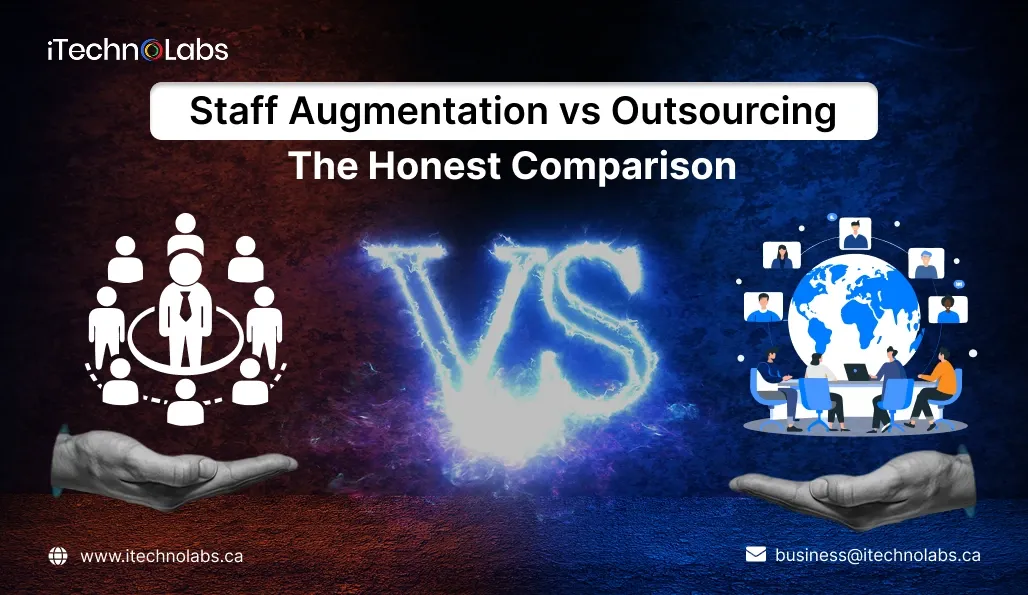
Staff augmentation vs outsourcing comes down to one question: who runs the work? With staff augmentation, you add outside developers to your own team, and your people tell them what to build each day. With outsourcing, you hand a project to another company, and they manage it until it’s done.
Both options exist for the same reason. Good developers are hard to hire. In ManpowerGroup’s 2026 Talent Shortage Survey, 72% of employers said they struggle to fill roles. Companies in the information sector had it worst, at 75%. And for the first time, AI skills topped the list of the hardest skills to find.
For most tech leaders, this isn’t really a hiring question. It’s about who gets to make the calls on your product. The CEO wants new features out soon, and hiring your own people takes months. Both options fill the gap. But one keeps the decisions with your team, and the other hands them to an outside company. Pick the wrong one and you won’t notice right away. You’ll notice four months in, when you’re paying people who sit waiting for work, or paying extra every time the plan changes.
Table of Contents
- What Is the Real Difference Between Adding Developers and Outsourcing?
- How Do Staff Augmentation and Outsourcing Compare Side by Side?
- When Does Staff Augmentation Make Sense?
- When Is Outsourcing the Better Call?
- What Does Each Model Really Cost Once You Count Everything?
- Where Does Each Model Go Wrong, and How Can You Spot It Early?
- How Do Security and Code Ownership Differ Between the Two?
- Can You Use Both at the Same Time?
- How Do You Choose in Five Questions?
- Why Choose iTechnolabs for Staff Augmentation or Outsourcing?
- Conclusion: So, Which Model Should You Pick?
- Frequently Asked Questions
What Is the Real Difference Between Adding Developers and Outsourcing?
One model rents you people. The other sells you a finished result. Everything else, from cost to risk, follows from that.
Think of a busy restaurant. Staff augmentation is hiring two extra cooks for the season. They work in your kitchen, follow your recipes, and your head chef tells them what to make. Outsourcing is ordering from a caterer. You agree on the menu and the price, and the food shows up. How they cook it is their business.
That difference shapes how you pay, too. With added developers, you pay for each person’s time, by the hour or by the month. With outsourcing, you usually pay a set price for the project, often split into stages.
It also decides who takes the blame when something slips. If your added developers build the wrong thing, that’s on your team, because your team gave the instructions. If an outsourced project runs late on an agreed plan, the outside company carries that.
How Do Staff Augmentation and Outsourcing Compare Side by Side?
The table below covers the eight points that matter most. Read the “best for” row first if you’re short on time.
| Staff Augmentation | Outsourcing | |
| Who gives daily direction | Your team | The outside company |
| Work for your managers | High. You plan, check, and guide the work. | Low. You approve results at set points. |
| How you pay | Per developer, by the hour or month | Per project or per stage |
| How fast work starts | Often faster, since you only need to find the right people | Slower, since the plan must be written and priced first |
| Changing the plan | Easy. You tell the team what’s next. | Harder. Changes usually mean a new quote. |
| Where the know-how stays | With your team | Mostly with the outside company |
| Who carries the risk of delays | You | The outside company, as long as the plan doesn’t change |
| Best for | Ongoing products with a strong in-house lead | Clear, one-time projects |
Notice the pattern. Staff augmentation gives you control and asks for your time in return. Outsourcing saves your time and asks you to give up control. Neither is better on its own.
When Does Staff Augmentation Make Sense?
It works when someone on your side can lead the extra people. Without that person, you’re paying for developers with no direction.
Start with what we call the team lead test. Do you have someone who can spend part of every day telling new developers what to build, checking their work, and answering their questions? If yes, adding developers is usually the better fit.
It tends to work well in a few situations:
- Your list of planned features grows faster than your team can build it.
- You need a rare skill for a few months, like AI features, and can’t justify a full-time hire.
- A big launch is coming and you need extra hands for a short stretch.
- You want to try working with someone before offering them a permanent job.
In each case, the plan lives with you. The added developers speed things up without changing who’s in charge. If that sounds right, you can hire dedicated developers who join your daily routine, or hire AI developers for a short project where the skill is hard to find locally.
Here’s the honest limitation. If nobody on your side has time to lead, added developers will guess. Some will guess well. Many won’t. If your team lead test comes back “no,” a part-time technical leader, often called a fractional CTO, can fill that gap before you add anyone else.
When Is Outsourcing the Better Call?
Outsourcing shines when the plan is clear and won’t move much. It struggles when you’re still figuring out what you want.
Outsourcing makes sense when you can write down exactly what you need and trust it to stay mostly the same. It’s also the practical choice when you don’t have anyone in-house who can guide developers at all.
Good fits include an internal tool your staff will use, a new customer portal with a clear list of features, or a one-time job like moving old data into a new system. These are projects with a clear finish line. You know what “done” looks like before work starts.
It also suits projects that sit to the side of your main business. Your team stays focused on the core product while an outside company handles the rest. For that kind of work, custom software development services let you hand off the build and review it at set points.
But be clear-eyed about one thing. A fixed price is only fixed while the plan stays fixed. Every change after the contract is signed usually means a new quote and a new date. If you expect to learn and adjust as you go, outsourcing will cost more than it first appears.

What Does Each Model Really Cost Once You Count Everything?
The hourly rate or project price is only part of the bill. Each model hides different costs, and they show up at different times.
Comparing a developer’s monthly rate to a project quote tells you very little. The real cost includes the time, delays, and rework that come with each model.
With staff augmentation, watch for these:
- Your managers’ time. Someone has to plan the work, review it, and answer questions every day. That time comes out of other work.
- The learning period. New developers need a few weeks to learn your product and your tools before they work at full speed.
- People leaving. If an added developer moves on, you spend time bringing the next one up to speed.
With outsourcing, the hidden costs look different:
- Changes to the plan. Each change usually comes with a new price, and small changes add up fast.
- Upfront planning. Writing requirements clear enough to price takes real time from your team.
- The handover. When the project ends, your team has to learn code it didn’t write. Poor notes make that slow and costly.
- Fixes after launch. Problems found after the project closes may fall outside the contract.
A simple way to compare honestly: ask each provider to price a six-month period, including one realistic change to the plan. The answer will tell you more than any rate card. It’s one of several questions to ask before signing with a development company.
Where Does Each Model Go Wrong, and How Can You Spot It Early?
Both models fail in predictable ways. The warning signs usually appear within the first month.
Staff augmentation tends to go wrong quietly. Watch for developers waiting around for tasks. Watch for work that nobody on your side reviews. And watch for features that get built on guesses because the person who could answer was in meetings all week. The fix is almost always the same. Give one person clear ownership of the added team, and protect their time.
Outsourcing tends to go wrong in the other direction. Things look fine in updates, then fall apart near the deadline. Warning signs include seeing only slideshows or demos instead of working software you can try yourself. Another is every question turning into a price discussion. A third is being unable to see the code until the very end.
The fix here is to ask for a working version you can click through every few weeks, plus regular copies of the code. A good outside company won’t mind. A company that resists is telling you something.
How Do Security and Code Ownership Differ Between the Two?
With added developers, you control access. With outsourcing, you depend on the other company’s setup. Either way, the contract decides who owns the work.
When you add developers, outside people get access to your systems, and sometimes to customer data. That puts the job of controlling access on you. Give each person only what they need, and remove it the day they leave. The good news is that the code lives in your own systems from day one.
With outsourcing, the work usually happens in the other company’s setup. So ask direct questions. Where will your data be stored? Who at their company can see it? What happens to it when the project ends? And make sure the contract hands over all code, designs, and ownership rights once you’ve paid.
If your product holds personal information about Canadians, Canada’s private-sector privacy law (PIPEDA) applies, and the Office of the Privacy Commissioner of Canada oversees it. Any outside company handling that data needs to follow those rules as carefully as you do. A security certification like ISO 27001, an international standard for how a company protects information, is a useful sign that they take this seriously.
Can You Use Both at the Same Time?
Yes, and plenty of companies do. The trick is matching each piece of work to the right model.
A common setup looks like this. Your core product stays with your team, boosted by a few added developers. Meanwhile, a clear side project, like an internal reporting tool, goes to an outside company at a fixed price. Your leads guide the work that matters most and don’t get pulled into everything else.
There’s also a middle option called a dedicated team. The outside company provides a full group, often with its own lead, that works only on your product. You set the goals and priorities. They handle the day-to-day running. It suits companies that need steady long-term help but don’t have the time to manage each developer themselves.
How Do You Choose in Five Questions?
Answer these honestly before you talk to any provider. Your answers will point clearly to one model, or to a mix.
- Do you have someone who can guide developers every day?
- Is the plan written down, and is it unlikely to change much?
- Is this your main product, or a side project?
- Do you want the know-how to stay inside your company after the work ends?
- Would you rather pay for time, or pay for a finished result?
If you said yes to questions 1 and 4, and this is your main product, staff augmentation is likely the better fit. If you said yes to question 2, it’s a side project, and you’d rather pay for a result, outsourcing makes more sense. Mixed answers usually point to a dedicated team, or to using both models for different pieces of work.
Why Choose iTechnolabs for Staff Augmentation or Outsourcing?
We offer both models, so our advice doesn’t depend on which one you pick. Our credentials are ones you can check.
iTechnolabs holds ISO 27001:2013 certification for information security and ISO 9001:2015 certification for quality management. We’re also an approved supplier under the Government of Canada’s Supply Arrangement CW2395301.
Our team of 300+ developers has delivered 500+ apps used by more than 50,000 people. We work from offices in Markham, Calgary, and Ottawa in Canada, and Sheridan, Wyoming, in the US.
Because we run both staff augmentation and full project delivery, we can start with one and switch to the other if your needs change. If you’d like a straight answer on which fits your situation, you can talk to iTechnolabs’ team directly.
Conclusion: So, Which Model Should You Pick?
Pick based on who will lead the work, not on which rate looks lower. The right answer can change as your company grows.
The choice between these two models is less about money than it first appears. It’s really about control, time, and where you want the knowledge to live once the work is done.
If you have a strong in-house lead and a product that keeps changing, adding developers usually wins. You keep the decisions, you can change direction any day, and everything your added developers learn stays close to your team. The price is your managers’ time, and that price is real.
If the plan is clear, the project sits to the side of your main business, and nobody in-house has time to guide developers, outsourcing is often the smarter move. You trade some control for fewer daily headaches. Just go in knowing that changes will cost extra.
And if neither fits cleanly, that’s normal. Many teams use both, or settle on a dedicated team in between. Whatever you choose, test it early. Check the warning signs in the first month, not the fourth. Ask for honest total costs, not just rates. And make sure the contract spells out who owns the work.

Frequently Asked Questions
1. Is staff augmentation cheaper than outsourcing?
Not always. Staff augmentation often costs less when plans change a lot, because you only pay for time. Outsourcing can cost less for a clear, fixed project. The real difference shows up in hidden costs, like your managers’ time spent guiding added developers, or extra charges when an outsourced plan changes.
2. Who owns the code in each model?
You should own it in both, but only if the contract says so. With staff augmentation, the code sits in your own systems from day one. With outsourcing, make sure the contract hands over all code, designs, and rights when the project ends, and ask for regular copies along the way.
3. How quickly can added developers start working?
It depends on the skill you need and the provider. Common skills are usually quicker to fill than rare ones, like AI. After they join, expect a few weeks before they work at full speed, since they need time to learn your product, your tools, and how your team works.
4. Can I switch from one model to the other mid-project?
Yes, but plan the handover. Moving from outsourcing to your own team means your people must learn code they didn’t write, so ask for clear notes and a walkthrough first. Moving the other way means writing the plan down in detail so the outside company can price it fairly.
5. Is a dedicated team the same as staff augmentation?
No. With staff augmentation, individual developers join your team and your leads guide them. With a dedicated team, the outside company gives you a full group, often with its own lead, that works only on your product. You set the goals, and they handle the day-to-day running.
6. Which model works better for AI projects?
It depends on how clear the goal is. AI work often changes as you test and learn, which suits staff augmentation, since you can change direction without new quotes. If the AI feature is small and well defined, like adding a support chatbot, outsourcing it as a fixed project can work well.
7. What should the contract include?
For both models, the contract should cover who owns the work, how your data is protected, and how either side can end the deal. For staff augmentation, add rules for replacing a developer who leaves. For outsourcing, add how changes are priced and exactly what the final handover includes.
8. Do added developers need to work in my time zone?
Not fully, but some overlap helps. Developers who share at least a few working hours with your team can join daily check-ins and get quick answers. With no overlap, a small question can take a full day to resolve, which slows everything down. Outsourced projects need less overlap.