Key Takeaways
- Build an MVP when your biggest uncertainty is whether customers want the product, which features matter, or whether the business model works.
- Build the full product when demand is already validated, and the product requires complex architecture, integrations, security, compliance, or a broad feature set from launch.
- An MVP should not mean building a fragile product. The technical foundation should support the next stage of development.
- The right decision depends on market validation, product complexity, funding, risk, integrations, and how expensive future rework would be.
- The goal is not to build less. The goal is to build the right amount of product for what you know today.
MVP vs. full product development is ultimately a decision about what you need to prove before making a larger investment, particularly when custom software development is involved. Build an MVP when market demand, product fit, or feature priorities are still uncertain. Build the full product when demand is validated, and the product requires broader functionality, integrations, security, or complex architecture from the start.
The challenge is knowing where to draw that line. Building too much too early can consume capital before you understand what users actually need. Building too little can produce a product that fails to test the core idea or support real users.
The right choice depends on what is known, what remains uncertain, and what would be expensive to change later.
Table of Contents
- MVP vs Full Product Development: What Is the Difference?
- When Should You Build an MVP?
- When Should You Build the Full Product?
- MVP vs. Full Product Development: The Decision Factors
- What Should an MVP Include?
- How to Avoid Turning an MVP Into a Disposable Prototype
- A Simple Framework for Choosing Between an MVP and Full Product
- How iTechnolabs Can Help You Scope the Right First Release
- Conclusion
- FAQs
MVP vs Full Product Development: What Is the Difference?
MVP vs full product development comes down to what you need to prove before making a larger investment. An MVP focuses on validating the core product idea with a limited feature set and real users. A full product is built when the market, requirements, and business case justify a broader initial release.
An MVP is useful when important assumptions are still untested. You may know the problem you want to solve, but you may not know which features customers will actually use, whether they will pay, or which workflow should become the centre of the product.
A full product makes more sense when those uncertainties are already lower, and the product needs a wider set of capabilities to operate effectively from launch.
Atlassian describes an MVP as a basic version designed to validate an idea, gather user feedback, and guide future development.
The decision, therefore, should not be based simply on budget or speed. It should start with one question.
What is still uncertain about your product?
If the answer is market demand or product fit, an MVP can reduce unnecessary investment. If the answer is mainly execution, a fuller product may be justified.
When Should You Build an MVP?
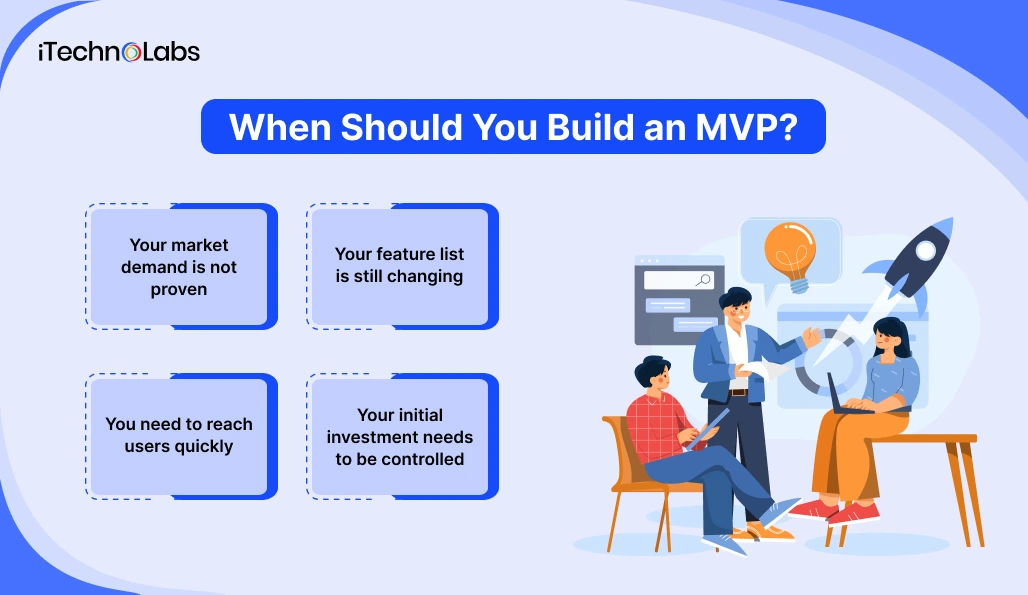
If market demand is still uncertain, an MVP development approach can help you validate the core product before committing to the full roadmap.
Your market demand is not proven.
If you have identified a customer problem but have limited evidence that customers will use or pay for your solution, building every planned feature creates unnecessary exposure.
An MVP lets you test the core value proposition with real users. Their behaviour can reveal which features solve the problem, where users drop off, and what should change before the roadmap expands.
This is particularly useful for funded startups entering a market where the product concept is new or where several possible customer segments could use the solution differently.
Your feature list is still changing.
A long feature list is not the same as a validated product roadmap.
If stakeholders are still debating dashboards, integrations, automation, user roles, reporting, or advanced workflows, the product may not be ready for a full build.
Start with the smallest release that allows users to complete the central job the product is designed to solve. Use feedback to decide which capabilities deserve further investment.
You need to reach users quickly
An MVP can shorten the distance between product assumptions and real market feedback because development is focused on the core experience rather than the complete roadmap.
AWS describes MVP development as a way to test assumptions, gather feedback, and iterate before expanding the product.
Speed matters most when learning quickly can materially change what you build next.
Your initial investment needs to be controlled
An MVP can limit the amount of functionality developed before there is evidence supporting broader investment. Understanding the likely scope and MVP development cost can also help determine how much to include in the first release.
That does not mean removing essential security, usability, data handling, or architectural decisions. It means separating what the first users genuinely need from what can wait.
A useful MVP is small in scope but complete enough to test the central product hypothesis.
When Should You Build the Full Product?
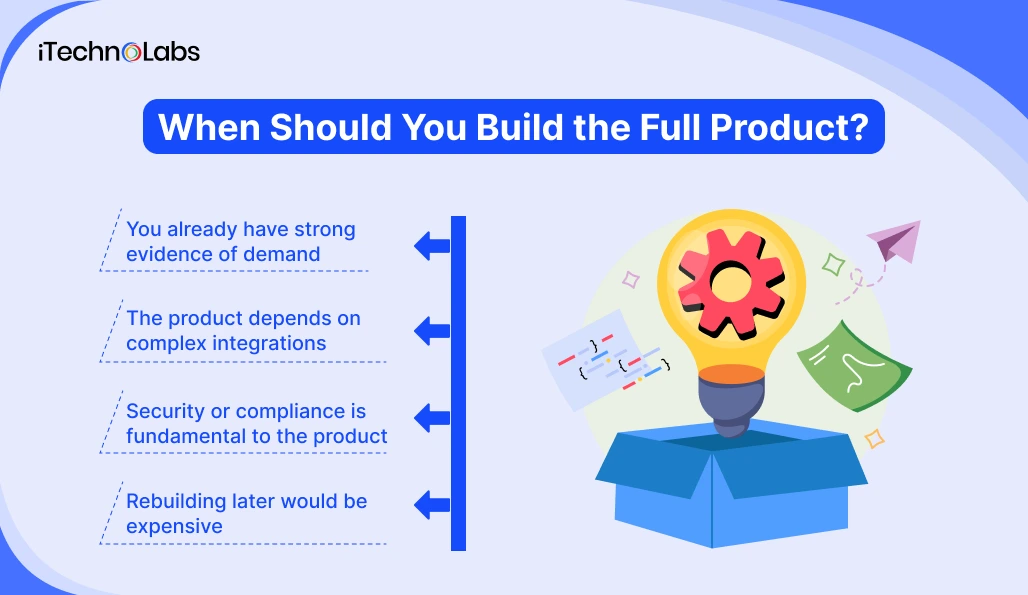
A full product can be the better choice when the major product assumptions have already been validated or when the nature of the product makes a narrow MVP impractical.
You already have strong evidence of demand
If you have paying customers, an established customer base, validated workflows, or contractual commitments, the main uncertainty may no longer be whether the product is wanted.
In that situation, building an artificially limited MVP may create an unnecessary intermediate stage.
The better approach may be to build the capabilities customers already require while keeping the roadmap focused on the highest value workflows.
The product depends on complex integrations
Some products cannot deliver meaningful value without several systems working together.
Consider a business platform that depends on payment processing, identity management, accounting software, CRM data, logistics systems, or enterprise APIs.
Removing those dependencies may produce a technically simple MVP that does not actually test the real product proposition.
If the core value depends on the integration itself, that integration belongs in the first release.
Security or compliance is fundamental to the product
Products handling sensitive business or customer information may require security controls, permissions, auditability, data handling processes, and other safeguards from the beginning.
In these situations, the minimum viable product still needs an appropriate production foundation.
The word minimum should describe the scope of the product, not an excuse to remove requirements that are fundamental to operating it safely.
Rebuilding later would be expensive
An MVP can evolve into a larger product, but that does not mean every technical shortcut is harmless.
Technical debt increases the effort required to modify and extend software. Martin Fowler explains this through the idea that poorly structured systems create additional effort when new functionality is added.
If the product has demanding architecture, data, performance, or integration requirements, those constraints should influence the initial technical design even if the first release remains limited.
MVP vs. Full Product Development: The Decision Factors
There is no universal feature count that defines an MVP. The right boundary depends on what the business needs to learn and what the product must support from day one.
| Decision factor | MVP approach | Full product approach |
| Market validation | Demand still needs testing | Demand is already supported by evidence |
| Feature uncertainty | High | Lower |
| Customer base | Early users or pilot group | Established or committed users |
| Product complexity | Core workflow can stand alone | Value depends on broader functionality |
| Integrations | Only essential integrations | Multiple required integrations |
| Security requirements | Core requirements included | Broader production requirements |
| Funding | Capital needs to be deployed carefully | Larger investment is justified |
| Roadmap | Expected to change through feedback | Requirements are relatively established |
| Rework risk | Acceptable within planned boundaries | Rework could be costly or disruptive |
The most important distinction is not whether the product has ten features or fifty. It is whether reducing the scope still allows you to test or deliver the product’s actual value.
For example, removing an advanced analytics dashboard from a workflow product may be sensible if the core workflow can operate without it. Removing the payment system from a marketplace where transactions are the central value would defeat the purpose of the first release.

What Should an MVP Include?
A useful MVP should contain everything required to test the central product hypothesis. That normally means four layers.
- Core user journey: Users should be able to complete the main task the product promises to solve.
- Essential product functionality: Include the features required to deliver that value. Avoid adding secondary workflows simply because they appear on the long-term roadmap.
- Required technical foundations: Authentication, data handling, security controls, integrations, analytics, and infrastructure should be included where the product requires them.
- Feedback mechanisms: You need a way to understand what users are doing and where the product is failing to meet expectations. Feedback can come from usage data, interviews, support interactions, surveys, or direct observation.
The goal is to create a release that produces useful evidence. A product that launches quickly but generates no meaningful learning is not necessarily a useful MVP.
How to Avoid Turning an MVP Into a Disposable Prototype
The biggest mistake is treating an MVP as something that will automatically be thrown away.
An MVP can become the foundation for the full product if the team separates limited scope from poor engineering.
You can keep the first release focused while making deliberate decisions about architecture, data models, APIs, security, testing, and deployment.
AWS recommends designing MVP infrastructure with future growth in mind so teams can iterate and scale without unnecessary rearchitecture.
The practical approach is to identify which decisions are temporary and which are likely to remain.
For example, an early reporting interface may change completely after user feedback. The underlying data model may need a more deliberate design because later product features will depend on it.
This distinction helps control initial scope without creating avoidable technical debt.
A Simple Framework for Choosing Between an MVP and Full Product
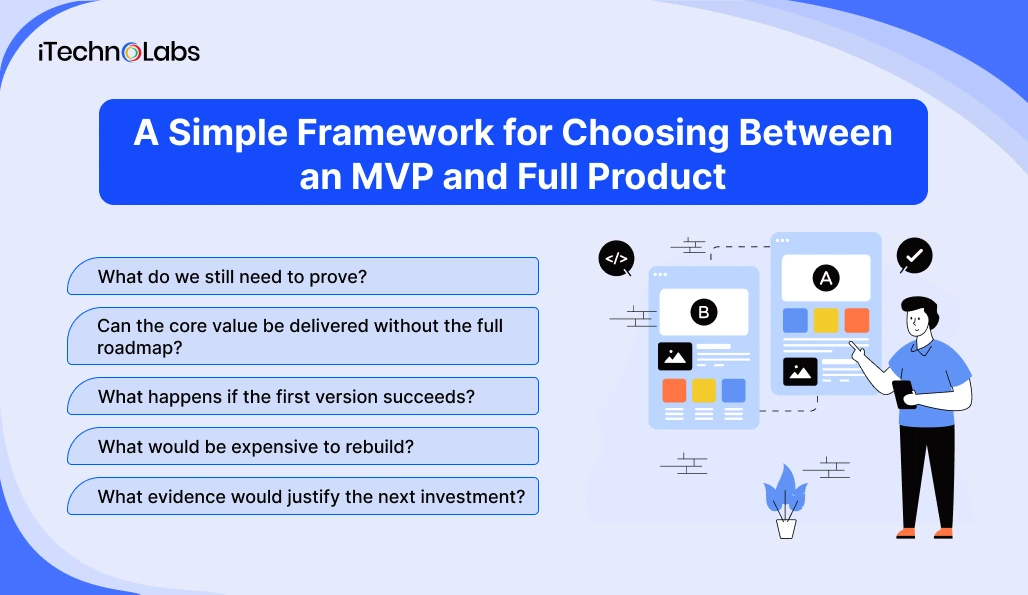
Before development starts, answer these five questions.
1. What do we still need to prove?
If the answer involves customer demand, pricing, product fit, or feature priorities, an MVP may be appropriate.
2. Can the core value be delivered without the full roadmap?
If yes, identify the smallest useful product. If no, determine which capabilities are genuinely fundamental rather than optional.
3. What happens if the first version succeeds?
The technical foundation should account for the likely next stage, particularly when planning a SaaS product development roadmap. A successful MVP can generate users faster than expected, so architecture and infrastructure should not ignore foreseeable growth.
4. What would be expensive to rebuild?
Identify data structures, integrations, security controls, APIs, and architectural decisions that would be difficult to replace later.
5. What evidence would justify the next investment?
Define the signals that matter before launch. These could include active usage, retention, customer feedback, conversion, revenue, or completion of a critical workflow.
This turns the MVP decision into a measurable product strategy rather than a debate about how many features to build.
How iTechnolabs Can Help You Scope the Right First Release
The first development decision should not be MVP versus full product in isolation. It should be based on what your business already knows, what remains uncertain, and what the product must support technically.
iTechnolabs helps startups turn product ideas into defined development scopes through software development services that cover the core user journey, feature priorities, technical requirements, integrations, architecture, and future roadmap.
The objective is to avoid both extremes.
Building too little can produce a release that does not meaningfully test the business idea or support real users.
A structured discovery process can help determine what belongs in the first release, what should wait, and which technical decisions need to account for future product growth.

Conclusion
Choosing between an MVP and a full product should not come down to simply building fewer features or spending less money. The decision should reflect how much you already know about your customers, how complex the product is, what it needs to operate from day one, and how costly future changes could become.
An MVP makes sense when validation is the priority and the core product value can be delivered through a focused first release. A fuller product may make more sense when demand is established, customers need broader functionality, or integrations, security, compliance, and architecture are fundamental to the product.
The strongest approach is to define what must be built now, what can wait, and which technical decisions need to support the next stage. That gives you a clearer development scope without overbuilding or creating avoidable rework.
FAQs
1. Is an MVP always better than building a full product?
No. An MVP is useful when important product assumptions still need validation. A full product can make more sense when demand is established, customers require broader functionality, or the product depends on integrations, security, compliance, or architecture that cannot be meaningfully reduced without affecting its core value.
2. How do I know if my startup is ready for a full product?
Look at the evidence behind your product assumptions. Existing customers, validated demand, established workflows, clear requirements, and committed use cases can support a fuller build. If major questions about the target user, core value, pricing, or feature priorities remain unresolved, an MVP may provide useful evidence before larger investment.
3. Can an MVP become a full product?
Yes. An MVP can evolve into a full product when its architecture and technical foundations support future development. The key is to keep the initial scope narrow without treating security, data design, APIs, or other foundational requirements as disposable. Planning the likely next stage can reduce avoidable rework as the product grows.
4. What should not be removed from an MVP?
Do not remove anything essential to delivering the core product value or operating it responsibly. Depending on the product, that can include authentication, security controls, required integrations, data handling, analytics, testing, and reliability measures. The goal is to reduce unnecessary scope, not remove essential product or technical requirements.
5. Is an MVP cheaper than a full product?
An MVP can require less initial development because it contains a narrower feature scope, but the total investment depends on product complexity, platforms, integrations, security requirements, and the amount of iteration after launch. A smaller initial build is not automatically cheaper over the entire product lifecycle.
6. Should I build an MVP if I already have paying customers?
Not necessarily. Paying customers provide evidence that demand exists, so a highly limited MVP may not be the most useful next step. The better approach may be a focused first product that includes the workflows those customers need while leaving lower-priority functionality for later releases and iterations.