

Key Takeaways
- An on-demand app needs to support both customer demand and service fulfilment.
- The right feature set depends on the industry, business model, user roles, geography, and operational workflow.
- Most platforms need customer, provider, and admin capabilities, even when these are delivered through separate applications or dashboards.
- Real-time location, payments, notifications, scheduling, and third-party integrations can significantly affect development complexity.
- A focused MVP should support the core transaction before advanced features are introduced.
- AI can improve search, recommendations, support, dispatch, and operations when the underlying data and workflows are ready.
On-demand apps let customers request products or services through a digital platform and complete the transaction based on provider availability, location, scheduling, or other business rules. Food delivery, transportation, home services, healthcare, grocery delivery, logistics, and professional services can all use this model.
The complexity depends on what happens after a customer submits a request. A platform may need to match the request with a provider, confirm availability, process payment, track fulfilment, send status updates, and give administrators control over exceptions and disputes.
This on demand app development guide covers the main decisions involved in building such a platform, including app types, essential features, development stages, architecture, cost drivers, security, AI use cases, and MVP planning.
Table of Contents
- What Is On Demand App Development
- Types of On Demand Apps Businesses Can Build
- Essential Features of an On-Demand App
- How to Build an On-Demand App
- Technology Architecture for an On-Demand App
- What Affects On Demand App Development Cost
- AI Features for On-Demand Apps
- Security and Compliance Considerations
- How to Plan the MVP
- How iTechnolabs Can Help With On Demand App Development
- Final Thoughts
- FAQs
What Is On Demand App Development
On demand app development involves creating a digital platform that lets users request products or services and receive them based on location, availability, preferences, or a selected schedule.
The exact workflow varies by business.
A food delivery app matches customers with restaurants and delivery partners. A home services platform connects customers with professionals. A ride booking platform matches passengers with drivers. A healthcare platform may connect patients with doctors, clinics, or care providers.
The common structure is a marketplace or service workflow where the application manages the interaction between demand and fulfilment.
A typical on-demand transaction can follow this flow:
- Customer discovers a product or service
- Customer selects requirements and submits a request
- The platform identifies an available provider
- Provider accepts or confirms the request
- Both sides receive status updates
- Payment is processed according to the business model
- The service is completed
- Customer provides feedback or rating
The app therefore becomes part of the operating system of the business rather than simply acting as a customer-facing interface.
Types of On Demand Apps Businesses Can Build
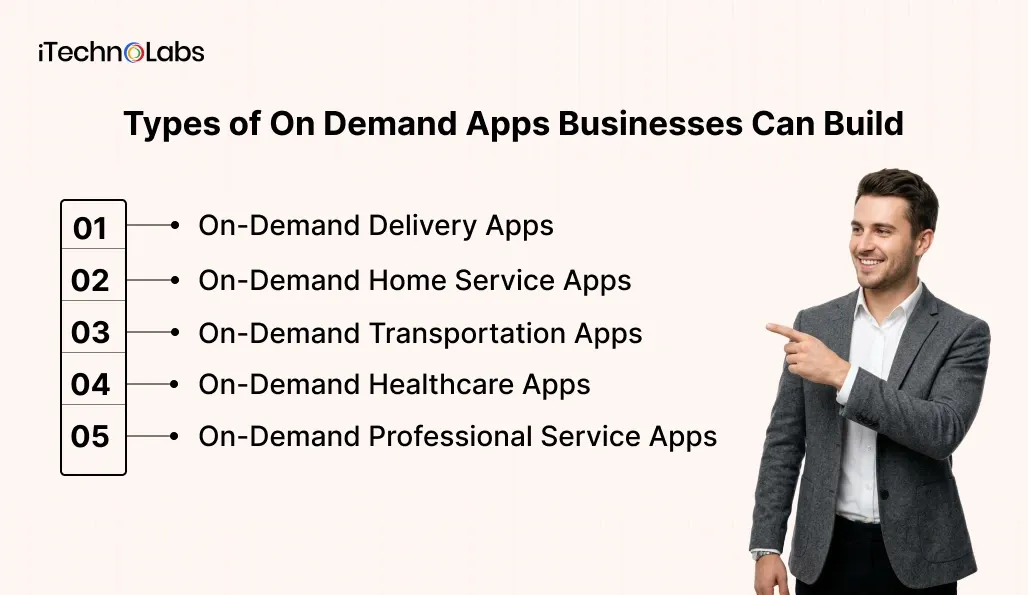
The business model should be defined before the feature list. A delivery marketplace, a scheduled home service platform, and a ride booking application may all be on-demand products, but their matching, scheduling, location, payment, and fulfilment workflows are different.
On-Demand Delivery Apps
These apps coordinate customers, merchants, and delivery personnel. Common examples include food, groceries, medicines, packages, and retail products.
Core capabilities include order management, delivery assignment, location tracking, payment processing, notifications, and delivery status updates.
On-Demand Home Service Apps
These platforms connect customers with professionals for services such as cleaning, plumbing, electrical work, beauty treatments, repairs, and maintenance.
The product usually needs service catalogues, professional profiles, availability management, scheduling, location support, payments, reviews, and provider verification.
On-Demand Transportation Apps
Ride booking and transportation applications require location services, driver availability, trip management, navigation, fare calculation, payment processing, and real-time status updates.
The technical requirements can become more demanding when the platform needs dynamic pricing, complex dispatch logic, or large-scale location tracking.
On-Demand Healthcare Apps
Healthcare platforms can support appointment booking, teleconsultation, home healthcare, medicine delivery, or other healthcare services.
The feature set must account for the applicable privacy, security, identity, and regulatory requirements.
On-Demand Professional Service Apps
Businesses can also create platforms for legal services, tutoring, consulting, photography, fitness, repairs, and other professional services.
These applications often depend more heavily on provider profiles, availability, scheduling, communication, document exchange, and service-specific workflows.
Essential Features of an On-Demand App
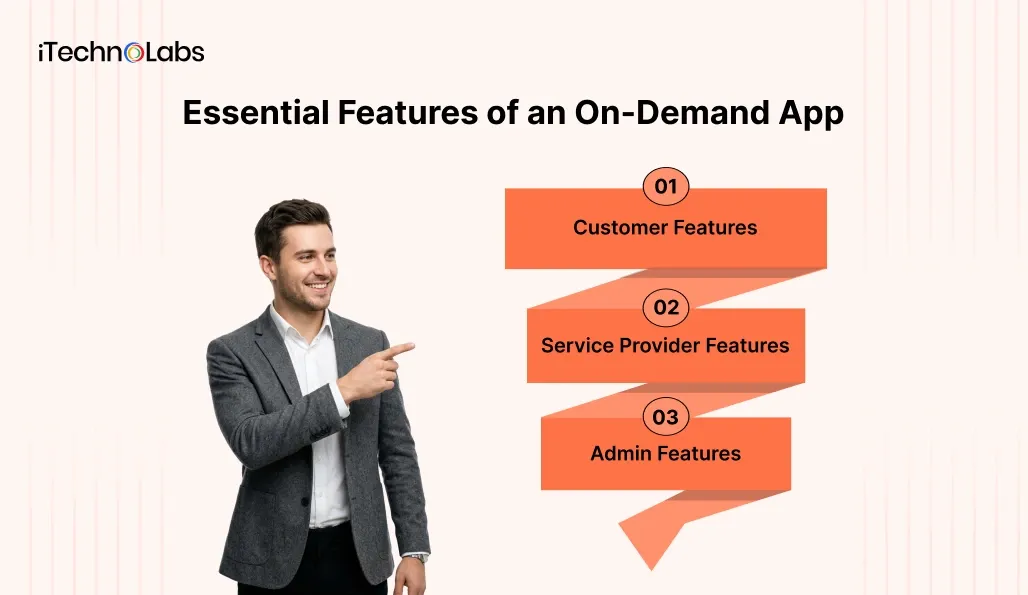
There is no universal feature checklist because the right functionality depends on the service being delivered. Still, most platforms need capabilities across three areas.
Customer Features
Customers typically need:
- Account registration and secure login
- Service or product discovery
- Search and filters
- Service provider profiles
- Booking or order placement
- Location selection
- Scheduling
- Real-time status updates
- Secure payments
- Push notifications
- Order or booking history
- Ratings and reviews
- Customer support
The customer journey should remain simple. Every unnecessary step between selecting a service and completing a booking can create friction.
Service Provider Features
Providers need a separate workflow for managing the work they receive.
Common capabilities include
- Provider registration and verification
- Profile management
- Service and pricing management
- Availability settings
- Booking or order requests
- Request acceptance and rejection
- Navigation and location sharing
- Earnings information
- Notifications
- Customer communication
- Booking history
- Ratings and reviews
The provider application should be designed around completing the service efficiently rather than simply replicating the customer interface.
Admin Features
The administration layer controls the marketplace and operating rules.
A typical dashboard may include
- Customer management
- Provider management
- Verification workflows
- Service and category management
- Booking and order management
- Payment monitoring
- Commission management
- Promotions and discounts
- Dispute management
- Notifications
- Reports and analytics
- Content management
- Access and permission controls
For a marketplace, the admin system is not an optional add-on. It gives the business the ability to manage activity, resolve issues, and maintain service quality.
How to Build an On-Demand App
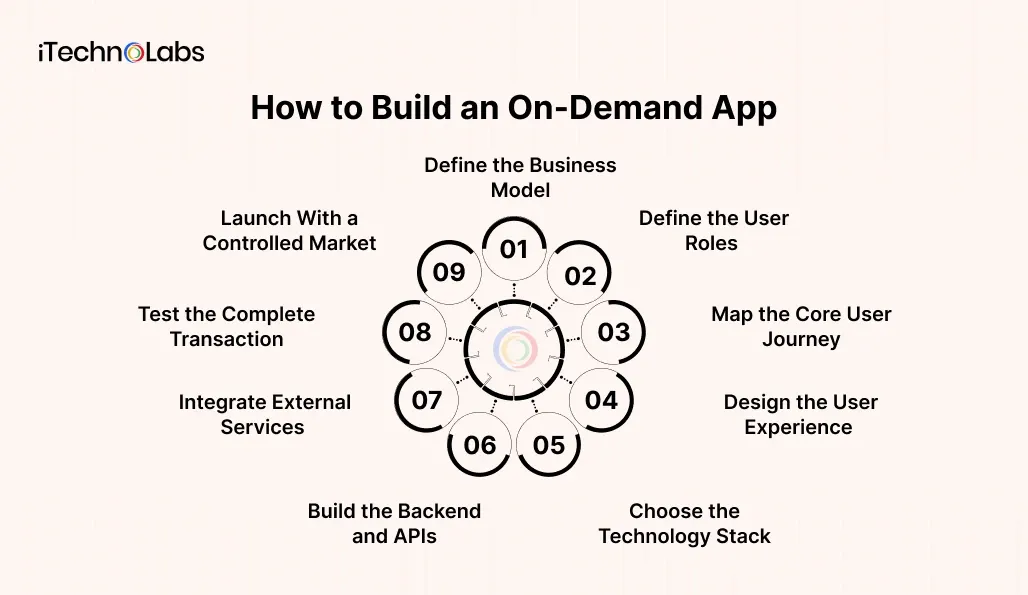
A successful project starts with the business workflow rather than the technology stack.
1. Define the Business Model
Identify who pays, who fulfils the service, how the platform earns revenue, and what happens when a booking is cancelled or disputed.
Common revenue models include commissions, service fees, subscriptions, listing fees, delivery charges, or combinations of these approaches.
2. Define the User Roles
Map every participant in the transaction.
For example, a home services platform may have customers, service professionals, support staff, and administrators.
Do not create separate roles simply because they seem useful. Each role adds screens, permissions, workflows, testing requirements, and backend logic.
3. Map the Core User Journey
Document the complete transaction from discovery to fulfilment.
For example
Customer searches for a service → selects a provider → chooses a time → confirms the booking → pays → receives updates → service is completed → customer rates the provider.
The first release should make this journey work reliably before adding secondary functionality.
4. Design the User Experience
Create wireframes and prototypes for the main customer and provider journeys.
Focus on discovery, booking, payment, status updates, cancellation, communication, and support.
The design should also account for different operating conditions. A delivery professional may use the app outdoors with limited connectivity, while a customer may use it on a large screen at home.
5. Choose the Technology Stack
Technology decisions should follow the product requirements.
A technology stack may include Flutter or React Native for cross-platform mobile development, Swift or Kotlin for native applications, Node.js or Python for backend services, PostgreSQL or another suitable database for transactional data, and a cloud platform such as AWS, Microsoft Azure, or Google Cloud. The final choice should follow the required integrations, performance characteristics, team expertise, security requirements, and expected scale.
The right choice depends on performance requirements, platform-specific functionality, integrations, team expertise, expected scale, and long-term maintenance.
6. Build the Backend and APIs
The backend manages accounts, bookings, service availability, payments, notifications, provider matching, permissions, and business rules.
On-demand platforms need particular attention to concurrent activity. A provider may receive several requests at nearly the same time, a customer may cancel while a provider is accepting a request, or a payment may fail after a booking has been created.
The backend should therefore define clear states for orders or bookings and handle concurrency, cancellations, payment failures, availability changes, retries, and other operational exceptions consistently.
7. Integrate External Services
On-demand apps commonly rely on third-party services for
- Maps and geolocation
- Payment processing
- Push notifications
- SMS or email
- Identity verification
- Analytics
- Cloud storage
- Customer support
Each integration introduces dependency, testing, security, and maintenance considerations.
8. Test the Complete Transaction
Testing should cover the entire workflow rather than individual screens.
Test successful bookings, cancellations, refunds, provider rejection, payment failures, poor connectivity, location errors, notification delays, and simultaneous requests.
Real device testing is particularly important for apps that depend on GPS, cameras, notifications, or mobile connectivity.
9. Launch With a Controlled Market
Launching in one city, service category, or customer segment can make operational problems easier to identify.
A controlled launch also gives the business useful data about demand, provider availability, cancellation rates, service times, repeat usage, and support requirements.
Technology Architecture for an On-Demand App
A typical architecture contains several connected layers.
- Mobile applications: Customer and provider applications handle discovery, booking, order management, notifications, location features, and communication.
- Backend services: Backend systems manage authentication, business rules, bookings, provider availability, matching, payments, notifications, and integrations.
- Database: The data layer stores users, providers, services, bookings, payments, locations, reviews, and other operational records.
- Admin dashboard: The administrative layer provides tools for managing users, providers, transactions, content, disputes, reports, and operational exceptions.
- Cloud infrastructure: Cloud services provide computing, storage, monitoring, security, backups, and scaling capabilities.
For larger platforms, individual services can be separated when there is a clear scaling or operational reason. A smaller MVP does not automatically require a complex microservices architecture.
What Affects On Demand App Development Cost
There is no reliable single price for developing an on-demand app. A basic booking application has a very different scope from a multi-sided marketplace that manages customers, providers, real-time dispatch, payments, location tracking, and multiple service categories.
The main factors that influence development effort include:
- Number of user roles and applications
- iOS, Android, web, or cross-platform requirements
- Booking, ordering, or scheduling workflows
- Provider availability and matching logic
- Real-time location and tracking
- Payment, refund, commission, and payout workflows
- Third-party integrations
- Backend and database requirements
- Admin and operational tools
- Security and compliance requirements
- AI or machine learning functionality
- Localization and multi-region requirements
- Testing and quality assurance scope
A focused MVP can be substantially simpler than a platform designed for multiple cities, multiple service categories, advanced analytics, and complex provider operations.
The most dependable estimate comes after the user journeys, feature scope, integrations, platforms, and technical requirements have been defined.
AI Features for On-Demand Apps
AI can add value to an on-demand platform when it improves a measurable customer or operational workflow. It is most useful when the platform already has reliable transaction data and clearly defined business rules.
Useful applications include
- AI Search and Recommendations: AI can understand natural language requests and recommend relevant services or products based on user preferences and previous activity.
- Intelligent Customer Support: AI assistants can handle common questions, explain booking status, guide users through cancellations, and route complex cases to support staff.
- Demand Forecasting: Historical booking data can help businesses identify demand patterns and plan provider availability, staffing, inventory, or delivery capacity.
- Provider Matching: AI or machine learning models can help rank providers based on location, availability, service requirements, historical performance, and other business rules.
- Fraud and Risk Detection: Models can help identify unusual transactions, suspicious account activity, or patterns that require manual review.
The quality of these features depends on the data available to the platform. Adding AI before the underlying workflows and data are reliable usually creates more complexity than value.
Security and Compliance Considerations
On-demand apps often handle personal information, location data, payment information, and business records.
Security should therefore be considered throughout development.
Important areas include:
- Secure authentication
- Role-based access control
- Encryption
- Secure API design
- Payment processing through appropriate providers
- Data retention policies
- Audit logging
- Secure cloud configuration
- Vulnerability testing
- Backup and recovery
- Incident response procedures
Regulatory requirements depend on the industry and markets served. Healthcare, financial services, identity verification, and other regulated use cases may require additional controls.
How to Plan the MVP
The first release should support the complete transaction without trying to reproduce every capability of a mature marketplace.
For example, a home services MVP may need customer registration, service discovery, provider profiles, availability, booking, payment, notifications, provider acceptance, and basic administration.
A delivery MVP may instead require order placement, merchant management, delivery assignment, location tracking, payment, status updates, and operational controls.
The right MVP therefore depends on the service model. Features such as advanced recommendations, loyalty programs, complex analytics, conversational AI, and multi-region support can be evaluated after the core transaction is working reliably.
A useful test is simple. If removing a feature prevents the primary transaction from being completed, it belongs closer to the MVP. If the transaction still works without it, evaluate it for a later release.
How iTechnolabs Can Help With On Demand App Development
iTechnolabs helps businesses plan and build custom on-demand applications around their specific customer journeys, service models, technology requirements, and growth plans.
The development scope can include customer and provider applications, backend systems, admin dashboards, booking workflows, payment integration, location services, notifications, third-party integrations, analytics, and AI capabilities.
The team can also support discovery, UI and UX design, development, testing, deployment, and post-launch improvements.
The right starting point is a clearly defined product scope. Once the user roles, core workflow, platforms, integrations, and business rules are understood, the development roadmap becomes much easier to estimate and execute.
Final Thoughts
An on-demand app succeeds when technology and operations work together.
Customers need a simple way to find and request a service. Providers need clear tools for accepting and completing work. The business needs visibility into bookings, payments, service quality, and operational performance.
That makes the development process more involved than building a conventional mobile application.
The strongest approach is to define the business model first, map the core transaction, build the essential customer and provider workflows, establish the backend foundation, and then expand based on actual usage.
If you are planning an on-demand product, share your target users, service model, required platforms, and core workflow with iTechnolabs to determine the right development scope and technology approach.
FAQs
1. What is on demand app development?
On demand app development involves building an application that lets customers request products or services when they need them. The platform typically connects customers with providers while managing booking, payments, notifications, communication, and service fulfilment.
2. What features should an on-demand app have?
Core features usually include registration, service discovery, booking, scheduling, payments, notifications, provider management, order or booking tracking, ratings, support, and an admin dashboard. The exact feature set should be based on the primary transaction and user roles.
3. Should an on-demand app have separate customer and provider apps?
Usually, separate customer and provider experiences are useful because each user has different tasks. Customers focus on discovery and booking, while providers need availability, requests, navigation, service status, and earnings management.
4. Is AI useful for an on-demand app?
Yes. AI can support search, recommendations, customer support, demand forecasting, provider matching, fraud detection, and operational analytics. The best use cases depend on the data available and should be introduced after the core workflows are reliable.
5. Should I build a native or cross-platform on-demand app?
Both approaches can work. Cross-platform development can be suitable when a business wants to support iOS and Android from a shared codebase. Native development may be preferable when the product has demanding platform-specific functionality, performance requirements, or hardware integrations.
6. How do I start an on-demand app development project?
Start by defining the target customer, service provider, business model, primary transaction, launch market, user roles, and required platforms. A discovery phase can then turn those requirements into feature priorities, technical architecture, development milestones, and a project estimate.











