

Key Takeaways
- Building a taxi app like Uber requires more than a passenger booking interface. The platform needs rider, driver, dispatch, payment, safety, and administration workflows.
- The core transaction is request, match, accept, track, complete, and pay. The architecture should support this flow reliably before advanced features are added.
- Real-time location, driver matching, fare calculation, navigation, payments, notifications, and operational dashboards are among the biggest sources of development complexity.
- A focused MVP can start with one city, a limited number of ride types, essential payment methods, and a smaller set of dispatch rules.
- The development cost depends on platforms, user roles, real-time functionality, integrations, security requirements, and the level of customization.
- AI can improve demand forecasting, driver matching, support, fraud detection, and pricing analysis once the underlying transaction data is reliable.
The global ride-hailing services market was valued at USD 47.6 billion in 2025 and is projected to reach USD 181.5 billion by 2033, growing at an 18.6 percent CAGR from 2026 to 2033. E-hailing accounted for 57.9 percent of the market in 2025, according to Grand View Research.
That growth creates opportunities for businesses planning taxi platforms, but building an app like Uber involves much more than designing booking screens. The platform must coordinate riders, drivers, location tracking, dispatch, pricing, payments, notifications, safety, and operational workflows.
This guide explains how to approach taxi app development like Uber, including essential features, technology architecture, development costs, and MVP planning.
Table of Contents
- What Does It Mean to Build a Taxi App Like Uber?
- How a Taxi Platform Like Uber Works
- Taxi App Business Models to Consider
- Essential Features of a Taxi App Like Uber
- How to Build a Taxi App Like Uber
- Taxi App Development Cost Estimate
- Security and Compliance Considerations
- AI Features for a Taxi App
- How iTechnolabs Can Help Build a Taxi App Like Uber
- Final Thoughts
- FAQs
What Does It Mean to Build a Taxi App Like Uber?
A taxi app like Uber is a multi-sided transportation platform that connects passengers with available drivers and manages the complete ride transaction.
A basic taxi booking app may allow customers to request a vehicle and receive a booking confirmation. An Uber-like platform goes further by managing driver availability, automated matching, real-time tracking, dynamic pricing, digital payments, ratings, safety features, promotions, driver earnings, and operational controls.
Uber itself describes a ride flow that includes account creation, destination selection, nearby driver matching, driver and vehicle identification, ride tracking, payment, and ratings. Its current platform also supports upfront pricing and several safety capabilities.
The distinction matters because each additional workflow adds backend logic and testing requirements.
For example, the platform must decide what happens when two riders request the same driver, when a driver accepts a trip while another driver is closer, when a rider changes the destination, or when payment fails after the trip has already ended.
How a Taxi Platform Like Uber Works
A typical ride transaction follows this sequence
- The rider creates an account and provides the required information.
- The rider enters the pickup and destination locations.
- The system calculates the route, estimated travel time, and applicable fare.
- The platform identifies eligible nearby drivers.
- A driver receives the trip request.
- The driver receives the request and accepts or declines it based on the platform workflow.
- The rider receives driver and vehicle information.
- Both sides receive location and trip status updates.
- The driver completes the ride using the navigation workflow.
- The final fare is calculated.
- Payment is processed.
- The rider and driver can rate each other.
- The platform records the transaction for reporting, support, and driver earnings.
The development architecture should be designed around this transaction rather than around a list of app screens.
Taxi App Business Models to Consider
Before development begins, decide how the platform will make money and who controls the vehicles.
Fleet-Based Taxi Platform
- The business owns or manages the vehicles and assigns drivers to bookings.
- This model gives the operator greater control over pricing, driver availability, service quality, and fleet operations.
Driver Marketplace
- Independent drivers use their own vehicles and accept trips through the platform.
- This is closer to the marketplace structure used by major ride-hailing platforms. The technology therefore needs driver onboarding, verification, availability, earnings, payouts, and marketplace payment workflows.
Hybrid Taxi Platform
- A hybrid model can combine company-owned vehicles with independent drivers or third-party fleets.
- This can be useful when a business wants to maintain service coverage while expanding supply without purchasing every vehicle.
The business model affects the feature set. A fleet-based platform may need stronger vehicle and shift management, while a driver marketplace needs more extensive onboarding, verification, commission, and payout workflows.
Essential Features of a Taxi App Like Uber
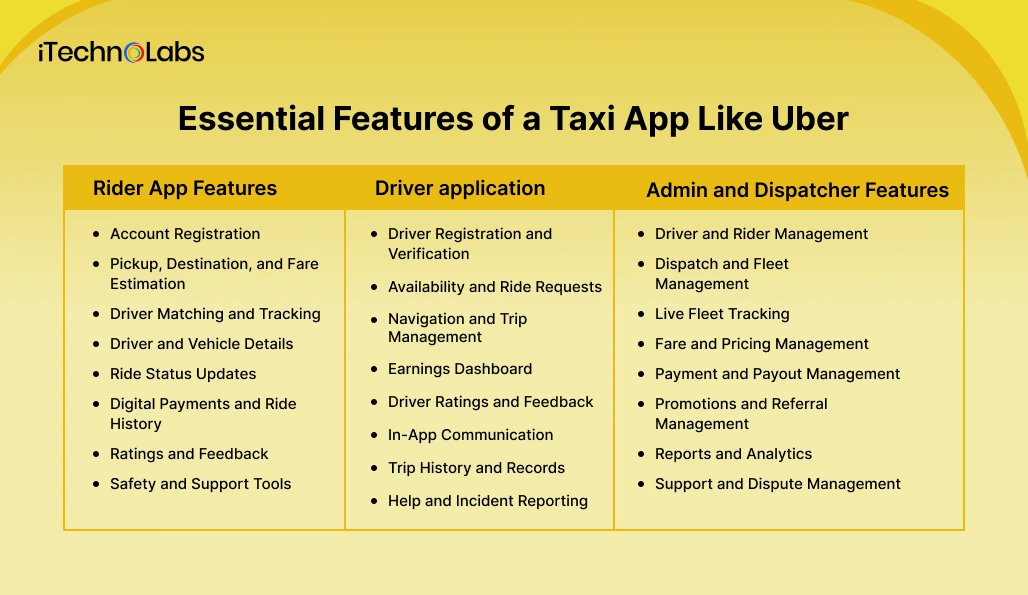
A scalable taxi platform usually has three main product surfaces
- Rider application
- Driver application
- Admin and dispatch platform
The features should be planned separately because the users have different goals.
Rider App Features
The rider app simplifies booking, tracking, payments, communication, and safety throughout every trip.
- Account Registration: Allow riders to register securely using phone, email, social sign-in, or other options.
- Pickup, Destination, and Fare Estimation: Let riders select locations, view estimated fares, and choose suitable vehicle categories before booking.
- Driver Matching and Tracking: Match riders with suitable drivers based on location, availability, vehicle type, and dispatch rules.
- Driver and Vehicle Details: Display driver identity, vehicle information, licence plate, profile, rating, and relevant verification details.
- Ride Status Updates: Show clear trip stages from booking confirmation and driver arrival through completion.
- Digital Payments and Ride History: Support relevant payment methods while allowing riders to access receipts and previous trip records.
- Ratings and Feedback: Allow riders to rate drivers, submit feedback, and report concerns after completed trips.
- Safety and Support Tools: Provide emergency assistance, trip sharing, incident reporting, support access, and driver verification features.
Driver App Features
The driver application should be designed around accepting and completing trips efficiently.
- Driver Registration and Verification: Allow drivers to submit identity, licence, vehicle, insurance, and payment information for verification.
- Availability and Ride Requests: Let drivers manage availability and receive trip requests with relevant pickup and earnings information.
- Navigation and Trip Management: Provide route guidance while allowing drivers to manage pickup, trip progress, and completion.
- Earnings Dashboard: Display completed trips, commissions, bonuses, adjustments, earnings, and payout information clearly.
- Driver Ratings and Feedback: Allow drivers to review ratings and feedback based on the platform’s chosen policies.
- In-App Communication: Enable secure rider communication through calling or messaging without unnecessarily exposing personal contact details.
- Trip History and Records: Give drivers access to previous trips, earnings records, cancellations, and relevant transaction information.
- Help and Incident Reporting: Provide access to support, safety assistance, incident reporting, and issue resolution during operations.
Admin and Dispatcher Features
The administration layer manages the marketplace and operational exceptions.
- Driver and Rider Management: Manage profiles, verification status, documents, availability, ride history, account restrictions, and support cases.
- Dispatch and Fleet Management: Monitor requests, available drivers, active rides, service areas, and manual or automated assignments.
- Live Fleet Tracking: View active vehicles, driver locations, current trips, availability, and operational activity through maps.
- Fare and Pricing Management: Configure base fares, distance rates, service fees, cancellation charges, minimum fares, and promotions.
- Payment and Payout Management: Manage customer payments, platform fees, driver payouts, refunds, verification, and transaction records.
- Promotions and Referral Management: Create promotional codes, discounts, referral offers, eligibility rules, and campaign limits.
- Reports and Analytics: Track rides, revenue, driver utilisation, cancellations, pickup times, retention, and other operational metrics.
- Support and Dispute Management: Handle fare disputes, cancellations, complaints, refunds, lost items, and reported safety incidents.
How to Build a Taxi App Like Uber
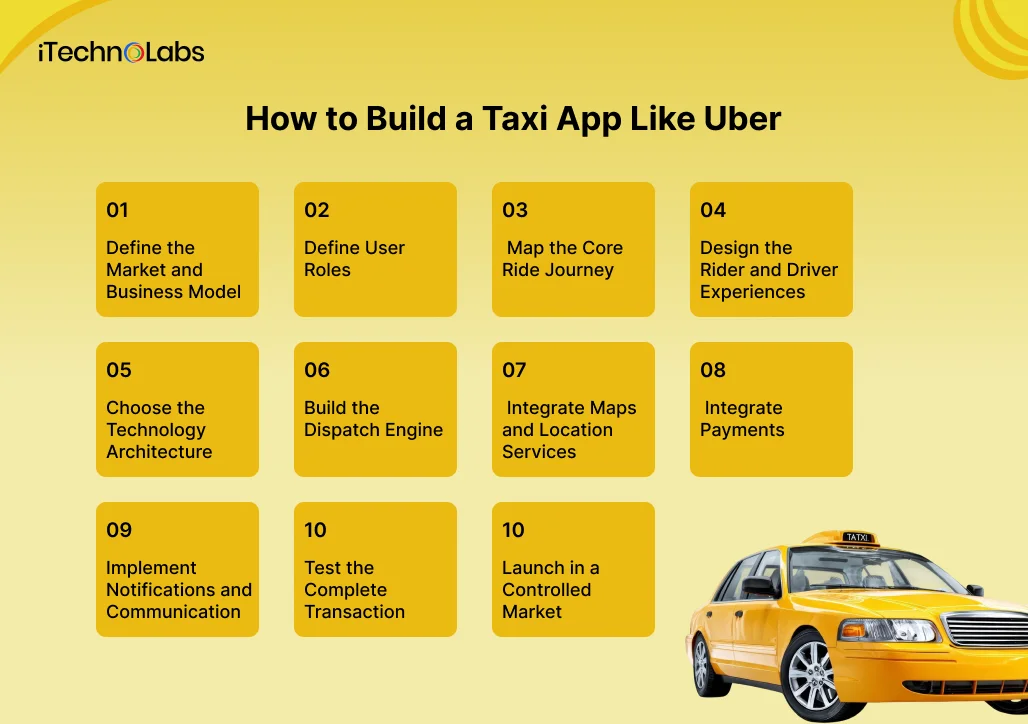
The development process should begin with the operating model rather than the technology stack.
1. Define the Market and Business Model
Decide where the platform will operate, who will provide the vehicles, who pays, how drivers earn, and how the platform generates revenue.
Local transportation regulations, insurance requirements, licensing rules, taxes, payment methods, and driver verification requirements should be identified before development begins.
2. Define User Roles
Map the people who interact with the platform.
At minimum, this may include riders, drivers, administrators, and support staff.
A larger operation may also need fleet managers, dispatchers, corporate customers, finance teams, and regional administrators.
Every additional role introduces permissions, workflows, screens, and testing requirements.
3. Map the Core Ride Journey
Document the complete ride from request to completion.
A useful first flow is
Rider enters pickup and destination → fare is calculated → eligible drivers are identified → driver accepts → rider tracks arrival → driver starts trip → route is tracked → driver completes trip → payment is processed → both sides rate the trip.
The MVP should make this transaction reliable before adding secondary functionality.
4. Design the Rider and Driver Experiences
Create separate user journeys for riders and drivers.
The rider experience should prioritize quick booking and visibility.
The driver experience should prioritize trip acceptance, navigation, ride status, and earnings.
The dispatcher and admin experience should prioritize operational visibility and exception handling.
5. Choose the Technology Architecture
The technology stack should follow the product requirements.
A cross-platform framework such as Flutter or React Native can be suitable when the business wants shared development across iOS and Android.
Native development can make sense when the application depends heavily on platform-specific functionality, demanding location behaviour, specialised hardware, or other native capabilities.
The backend can use technologies such as Node.js, Python, or Java with PostgreSQL or another database suited to the transaction model.
The architecture may include
- Rider mobile application
- Driver mobile application
- Backend APIs
- Dispatch and matching service
- Pricing service
- Location and routing services
- Payment service
- Notification service
- Admin and dispatcher dashboard
- Analytics and reporting layer
- Cloud infrastructure
A smaller MVP does not automatically need microservices. Separate services should be introduced when there is a clear operational or scaling reason.
6. Build the Dispatch Engine
The dispatch system is one of the most important technical components of an Uber-like taxi platform.
It needs to maintain driver availability, evaluate eligible drivers, send requests, process acceptances, handle rejection or timeout, and prevent conflicting assignments.
The system also needs clear ride states so that concurrent actions do not create duplicate bookings or inconsistent trip records.
7. Integrate Maps and Location Services
Location is fundamental to taxi app development.
The platform may need maps, geocoding, place search, route calculation, estimated travel time, navigation, driver tracking, and location-based dispatch.
Google Maps Platform provides APIs and SDKs for maps, places, geocoding, routes, navigation, and other geospatial functions.
The exact provider should be selected based on coverage, pricing, technical requirements, licensing, and target markets.
8. Integrate Payments
The payment architecture should support the complete money flow.
That may include rider charges, platform commissions, driver earnings, refunds, cancellation charges, promotions, taxes, and payouts.
For marketplace models, payment infrastructure needs to account for money movement between multiple parties rather than treating the platform as a simple merchant.
9. Implement Notifications and Communication
The platform needs timely updates for ride requests, driver acceptance, driver arrival, trip status, payment completion, cancellations, and support events.
Firebase Cloud Messaging supports notification and data messaging across platforms including Android and iOS, making it one option for application notification infrastructure.
The notification layer should also handle delivery failures, token management, user preferences, and important transactional messages.
10. Test the Complete Transaction
Testing should cover the full ride lifecycle rather than individual screens.
Important scenarios include
- Two drivers accepting the same request
- A driver rejecting or ignoring a request
- A rider cancelling before pickup
- A driver cancelling after acceptance
- GPS inaccuracies
- Weak network connectivity
- Background location updates
- Payment failure
- Refund processing
- Destination changes
- Driver going offline during a trip
- Notification delays
- Duplicate requests
- Incorrect fare calculations
- Simultaneous bookings
Real device testing is particularly important because location, GPS, notifications, network connectivity, and background behaviour cannot be evaluated reliably through interface testing alone.
11. Launch in a Controlled Market
Launching in one city or service area can make operational issues easier to identify.
It also gives the business useful data about ride demand, driver availability, average pickup time, cancellations, trip duration, pricing, customer retention, and support volume.
The platform can then expand its service area and feature set based on actual usage.
Taxi App Development Cost Estimate
For internal planning, a custom taxi platform can be grouped into three broad scope levels based on feature scope and technical complexity.
| Taxi app scope | Estimated development cost | Typical scope |
| Focused MVP | USD 40,000 to USD 80,000 | Rider app, driver app, booking, basic dispatch, maps, payments, notifications, admin |
| Standard marketplace | USD 80,000 to USD 180,000 | Advanced dispatch, live tracking, driver management, promotions, analytics, support workflows |
| Advanced platform | USD 180,000 to USD 350,000+ | Multi-region support, complex pricing, scheduled rides, ride sharing, advanced analytics, AI, corporate features |
These are iTechnolabs planning estimates, not fixed market prices. The actual budget depends on product scope, development model, platforms, integrations, technical architecture, testing requirements, and launch market.
The most reliable estimate should come after the core workflows, user roles, platforms, integrations, and first release requirements have been defined.
Security and Compliance Considerations
A taxi app handles sensitive information including identity details, payment information, location data, vehicle information, and trip history.
Important controls include
- Secure authentication
- Role-based access control
- Encryption in transit and at rest
- Secure API design
- Payment processing through appropriate providers
- Driver identity and document verification
- Audit logging
- Data retention policies
- Secure cloud configuration
- Backup and recovery
- Vulnerability testing
- Incident response procedures
- Privacy controls
- Location permission management
Local transportation regulations should also be reviewed before launch.
The requirements can vary significantly between countries, states, provinces, and cities, so compliance should be treated as part of product planning rather than a post-launch task.

AI Features for a Taxi App
AI can become useful once the platform has reliable ride and operational data.
- Demand Forecasting: Predict demand by location and time to help operators plan driver supply.
- Driver Matching: Use historical data and real-time conditions to rank suitable drivers while keeping business rules in control.
- Route and ETA Prediction: Improve travel time estimates using historical trip information, traffic conditions, and route data.
- Customer Support: AI assistants can answer common questions, explain ride status, help with straightforward requests, and route complex cases to human agents.
- Fraud Detection: Models can identify unusual booking, payment, account, or driver activity for further review.
- Driver Performance Insights: AI can help identify operational patterns such as unusually high cancellation rates, long pickup times, or areas where driver supply is consistently low.
AI should be introduced where it improves a measurable part of the transportation workflow. The core dispatch and transaction system should remain reliable even without an AI layer.
How iTechnolabs Can Help Build a Taxi App Like Uber
iTechnolabs develops custom taxi and ride-hailing applications around the business model, operating market, user roles, and required workflows.
The development scope can include rider applications, driver applications, dispatcher dashboards, admin systems, booking workflows, live location tracking, navigation, payment integration, notifications, driver verification, analytics, and AI capabilities.
The team can also support product discovery, UI and UX design, mobile development, backend engineering, testing, deployment, and post-launch improvements.
Final Thoughts
Building a taxi app like Uber requires more than a ride booking interface. The platform must connect riders and drivers while managing dispatch, pricing, payments, safety, support, and daily operations.
Start by defining your target market, ride model, user workflows, and core transaction. Build the essential rider, driver, and admin features first, then expand based on business needs and user feedback.
Advanced capabilities such as dynamic pricing, scheduled rides, corporate accounts, AI support, and demand forecasting can follow after the core platform is reliable. A focused MVP can help validate the business before larger investments.
FAQs
1. How much does it cost to build a taxi app like Uber?
A focused taxi app MVP can require roughly USD 40,000 to USD 80,000, while a standard marketplace can reach USD 80,000 to USD 180,000 and advanced platforms can exceed USD 180,000. The actual cost depends on platforms, dispatch complexity, location tracking, payments, integrations, security, and feature scope.
2. What are the must-have features of an Uber-like taxi app?
The core features include rider registration, pickup and destination selection, fare estimation, ride booking, driver matching, live tracking, driver details, payments, ride history, ratings, driver availability, navigation, earnings, and an admin or dispatcher dashboard.
3. Do I need separate rider and driver apps?
Separate rider and driver applications are often preferred because their workflows and priorities differ significantly. Riders focus on requesting and tracking trips, while drivers need ride requests, navigation, trip status, availability, and earnings tools. A shared application with role-based experiences can also work for some MVPs.
4. How does driver matching work in a taxi app?
The dispatch system identifies eligible available drivers based on factors such as location, vehicle type, service area, availability, and configured business rules. More advanced platforms can also consider estimated arrival time, demand, scheduled trips, driver performance, and other constraints.
5. What technology is used to build an Uber-like taxi app?
A typical platform may use Flutter or React Native for cross-platform mobile applications, a backend built with technologies such as Node.js, Python, or Java, a transactional database such as PostgreSQL, cloud infrastructure, mapping and routing services, payment infrastructure, and push notification services. The final stack should follow the product requirements.
6. How does real-time tracking work in a taxi app?
The driver application collects location updates and sends relevant information to backend services. The backend processes those updates and delivers appropriate trip information to the rider and operational dashboard. The implementation must also account for location permissions, background execution, battery consumption, network conditions, and update frequency.
7. Should I build a native or cross-platform taxi app?
Both approaches can work. Cross-platform development can be suitable when the product needs iOS and Android support from a shared codebase. Native development can be preferable when the application requires extensive platform-specific functionality or demanding location and hardware behaviour.
8. What payment features does a taxi app need?
The platform may need rider payment processing, saved payment methods, refunds, cancellation charges, promotional credits, driver earnings, platform commissions, and payouts. A marketplace model also needs a payment architecture that can manage money movement between riders, the platform, and drivers.
9. Can AI be added to an Uber-like taxi app?
Yes. AI can support demand forecasting, driver matching, customer support, fraud detection, route and ETA prediction, and driver performance analysis. These capabilities are most useful after the platform has reliable operational data and clearly defined business rules.
10. How should I plan the MVP for a taxi app?
Start with one market and one primary ride type. Build the complete transaction from rider request through driver assignment, pickup, trip completion, payment, and rating. Add advanced pricing, scheduled rides, ride sharing, corporate accounts, AI, and loyalty features after the core workflow is reliable.











