

Key Takeaways
- A successful 30-day MVP project depends on making the right decisions before development begins, not simply asking developers to work faster.
- Define one customer problem and one core workflow before choosing features.
- Use the first week for discovery, validation, design, and technical planning.
- Prioritise essential functionality and postpone features that do not support the first release.
- Test continuously rather than leaving quality assurance until the final days.
- Treat launch as the beginning of customer learning, with clear success measures and a plan for iteration.
Building a minimum viable product (MVP) in 30 days may seem challenging, but with the right strategy, focused planning, and clear priorities, it can be achievable. For businesses looking to validate a product idea, test market demand, or streamline operations, an MVP offers a practical way to turn concepts into working solutions without overinvesting upfront.
This guide explores how to plan your MVP development journey, prioritise essential features, manage timelines, estimate costs, and launch a functional product that delivers value and supports future growth.
Table of Contents
- How to Build an MVP in 30 Days
- What Should Your MVP Include?
- The 30 Day MVP Development Roadmap
- How to Keep a 30 Day MVP on Track
- What Can Prevent an MVP From Launching in 30 Days?
- How Much Does a 30 Day MVP Cost?
- Should You Build In-House or Work With a Development Partner?
- Build Your MVP With iTechnolabs
- Conclusion
- FAQs
How to Build an MVP in 30 Days
To build an MVP in 30 days, define a narrow product scope, validate the core customer problem, finalise essential features, and organise design, development, and testing around a fixed delivery plan. This timeline is most realistic for a focused product with clear requirements, available decision-makers, limited dependencies, and a team that can begin work without lengthy delays.
For an established small or medium-sized business, a minimum viable product can help test a new digital service, automate a specific workflow, or explore a product opportunity before committing to a larger development budget.
The important distinction is between a limited product that delivers real value and an unfinished product that simply has fewer features. An MVP should allow a target user to complete a meaningful task and give the business useful evidence about what to build next.
A 30-day plan is a delivery target, not a universal guarantee. Products involving complex integrations, sensitive data, regulated workflows, or substantial infrastructure may need more time.
What Should Your MVP Include?
A minimum viable product is a functional version of a product designed to test its central value proposition with real users. Atlassian describes the MVP approach as a way to validate ideas, collect feedback, and inform subsequent product decisions.
For an SMB, the best starting point is usually a single business outcome rather than a long list of requested features.
Consider a business that wants to replace manual appointment scheduling. Its first release might allow customers to view available slots, book an appointment, and receive confirmation. Advanced reporting, loyalty features, automated marketing campaigns, and complex staff management could wait until there is evidence that the central booking workflow works.
Before development begins, answer three questions:
- Who will use the product first?
- What important problem will it solve for them?
- What observable result would demonstrate that the first release is useful?
Put every proposed feature into one of three categories: essential for the first release, useful after validation, or outside the current scope. Require a clear business reason before moving a deferred feature into the initial build.
The 30 Day MVP Development Roadmap
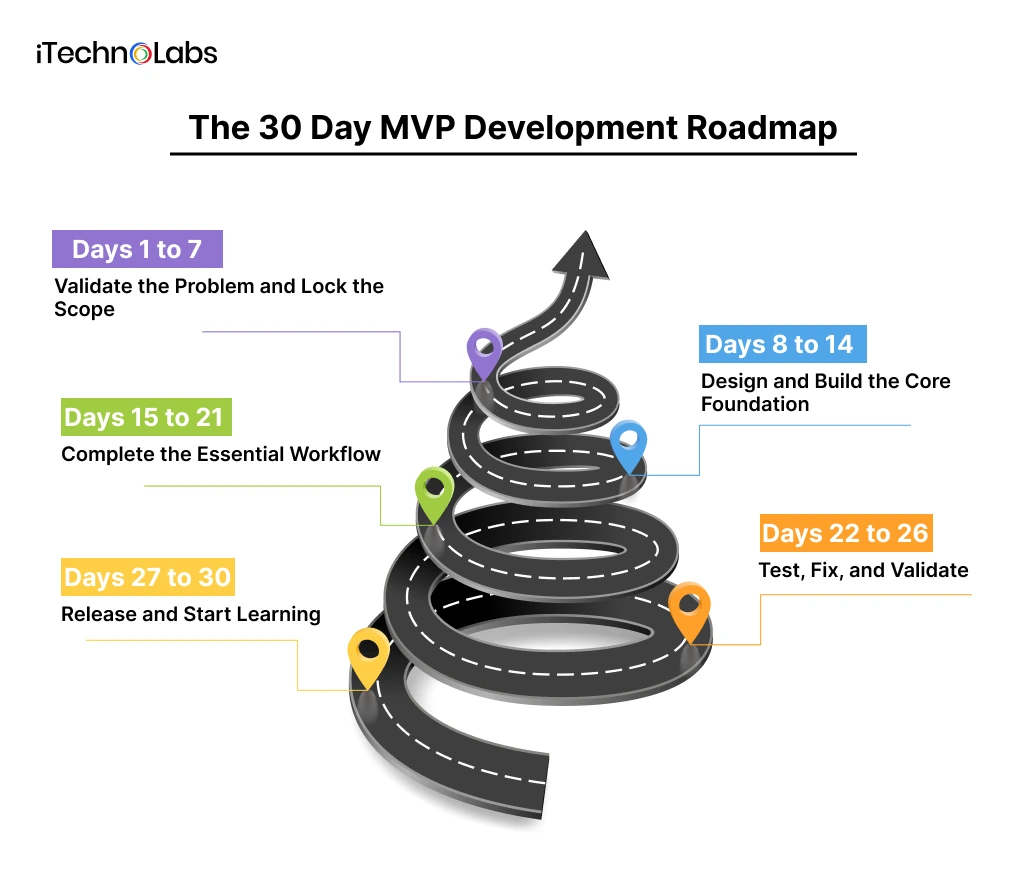
The following schedule is a proposed planning model for a tightly scoped MVP. It is not a verified delivery benchmark. The schedule assumes that stakeholders are available, requirements can be resolved quickly, and the product does not require unusually complex integration or compliance work.
Days 1 to 7: Validate the Problem and Lock the Scope
Start by understanding the users, the business problem, and the workflow the MVP needs to support.
Speak with prospective users or existing customers. Review how they currently solve the problem, where they experience friction, and what would make a new product worth adopting. Separate confirmed needs from internal assumptions.
Next, define the first release. Write down the core user journey, required screens, essential data, user permissions, and any third-party systems the product must connect to.
Create a prioritised backlog and agree on acceptance criteria. Each essential feature should have a clear definition of what it means to work correctly.
By the end of the first week, aim to have:
- A defined target user and problem statement.
- A prioritised MVP feature list.
- Initial user flows and wireframes.
- An agreed technical direction.
- A delivery plan with owners, dependencies, and acceptance criteria.
Delays in decisions can consume a short development window as quickly as coding challenges. Assign one person to make scope decisions and resolve questions promptly.
Days 8 to 14: Design and Build the Core Foundation
With the scope agreed, turn the essential workflows into usable interface designs and begin implementation.
The team should establish the application structure, data model, authentication approach where required, development environments, and deployment pipeline. Frontend and backend work can proceed in parallel when dependencies are understood.
Keep the design focused on clarity and task completion. Users should be able to understand what the product does, what action to take next, and whether that action succeeded.
Choose technology according to the product’s actual requirements. An existing platform, a managed service, or a cross-platform framework may reduce unnecessary work when it fits the intended product. The choice should account for security, maintainability, integration requirements, and the team’s ability to support the product after launch.
By day 14, review a working demonstration of the primary workflow. Do not rely only on screenshots or progress reports.
Days 15 to 21: Complete the Essential Workflow
The third week should focus on making the main user journey work from beginning to end.
Complete the core functionality, connect necessary services, and verify how information moves through the system. Check error handling, permissions, empty states, and the situations in which a user cannot complete an action.
For example, a booking MVP should do more than display a calendar. It should prevent invalid bookings, save appointment details correctly, and communicate confirmation or failure clearly.
Hold regular demonstrations and review progress against the agreed acceptance criteria. If the team falls behind, reconsider optional features before reducing essential testing or security work.
By the end of the third week, the product should be feature complete for its agreed MVP scope, with remaining work concentrated on verification, fixes, and release preparation.
Days 22 to 26: Test, Fix, and Validate
Testing should begin during development, but this period provides a focused opportunity to verify the complete product.
Run functional tests across the main workflows. Check usability with representative users, review common failure scenarios, and confirm that important data is stored and handled correctly.
Security checks should reflect the product’s risks. For example, applications handling customer information need appropriate access controls and protection against unauthorised disclosure. Payment flows, sensitive records, and external integrations may require additional verification.
Record defects by severity. Fix issues that prevent core tasks, expose data, corrupt information, or undermine basic reliability before considering cosmetic improvements.
A product that works in a developer demonstration is not necessarily ready for customers. Realistic test conditions help expose problems that happy path demonstrations can miss.
Days 27 to 30: Release and Start Learning
Use the final days for release readiness, deployment, monitoring, and initial user feedback.
Confirm that the production environment is configured, access permissions are correct, essential analytics are working, backups and recovery arrangements are appropriate, and the team knows how to respond to release issues.
Prepare a small group of initial users who match the intended audience. Give them a clear way to report problems and share feedback. Monitor whether they can complete the core workflow without assistance.
At launch, measure the behaviours that relate directly to the product hypothesis. Depending on the product, these might include successful task completion, repeat usage, booking completion, or the time needed to complete a workflow.
End the month with a review of what users actually did, what failed, and which assumptions need revisiting. Use that evidence to prioritise the next development cycle rather than automatically expanding the feature list.
How to Keep a 30 Day MVP on Track
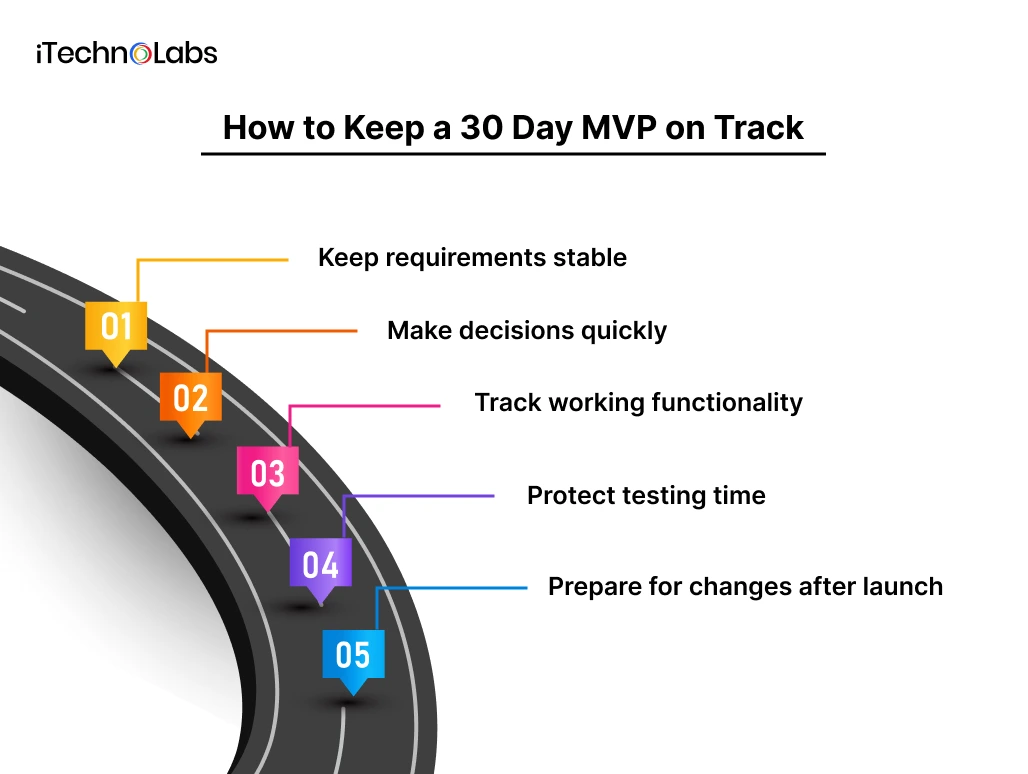
A clear schedule helps, but the delivery process also needs practical controls.
1. Keep requirements stable
Agree on the first release before development starts. When a new request appears, evaluate whether it is essential to the core workflow or can wait until after launch. This prevents scope expansion from silently consuming time reserved for testing.
2. Make decisions quickly
Assign a decision maker who can approve designs, clarify requirements, and resolve priority conflicts. Establish a regular review schedule so questions do not remain unanswered for several days.
3. Track working functionality
Measure progress through completed, tested features rather than hours spent or tasks marked as nearly finished. Demonstrate the main workflow regularly and raise technical blockers as soon as they appear.
4. Protect testing time
Include testing and defect correction in the original plan. Do not treat quality assurance as optional work that can be removed when development runs late.
5. Prepare for changes after launch
An MVP creates a starting point for learning, not a final specification for the entire product. Budget for maintenance, hosting, user support, and subsequent improvements when assessing the full business commitment.
What Can Prevent an MVP From Launching in 30 Days?
Most compressed delivery plans become difficult when the actual scope is larger than the team initially recognises.
Common risks include:
- Unclear requirements. Teams begin coding before agreeing on the user problem or acceptance criteria.
- Expanding scope. Stakeholders continue adding features without removing existing commitments.
- Complex dependencies. External APIs, legacy systems, data migration, or third-party approvals introduce work outside the team’s direct control.
- Late feedback. Designs and working functionality are reviewed only after substantial implementation.
- Insufficient testing. The team prioritises a launch date over essential verification.
- Unresolved security requirements. Access controls, privacy obligations, or compliance needs are discovered too late.
Assess these risks during discovery and make them visible in the delivery plan. If the scope cannot be reduced safely, extend the schedule or divide the work into releases. A realistic launch is more useful than meeting an arbitrary date with a product that cannot support its intended users.

How Much Does a 30 Day MVP Cost?
MVP development can cost $15,000 to $150,000 or more, depending on the product’s features, design requirements, technology choices, integrations, team composition, and security or compliance needs.
Basic MVP:
$15,000 to $30,000.
Suitable for idea validation, internal tools, and applications focused on a single core feature.
Mid-level MVP:
$30,000 to $70,000.
Suitable for SaaS products, marketplaces, and consumer applications that need more functionality or third-party integrations.
Advanced MVP:
$70,000 to $150,000 or more.
Suitable for complex applications involving AI, fintech, regulated workflows, or more demanding technical requirements.
These are estimated development budget ranges, not fixed quotes or guaranteed prices for a 30-day project.
A 30-day target does not automatically make an MVP inexpensive. A tightly scoped product with straightforward workflows may cost less than an application involving multiple systems, complex permissions, or sensitive data, even when both are described as MVPs.
Should You Build In-House or Work With a Development Partner?
The right delivery model depends on whether your business already has the product, design, engineering, and testing skills needed to execute the plan.
An internal team may be suitable when the required expertise is available, and existing priorities allow people to focus on the MVP. A development partner can help when your business needs additional engineering capacity or specialist support without first recruiting a full team.
Before choosing a partner, assess how it handles discovery, scope definition, technical decisions, testing, project communication, and ownership of the finished software.
Clarify who owns the source code, how credentials and documentation are handed over, how deployment is managed, and who supports the product after release. These questions matter just as much as the proposed development schedule.
Build Your MVP With iTechnolabs
Have a software idea but need a clear plan to turn it into a working product? iTechnolabs helps businesses plan and develop custom software solutions around their goals, users, and technical requirements.
Building a market-ready MVP starts with defining the right scope, prioritising essential features, and setting realistic delivery milestones. The right development partner can help you evaluate technical options, identify dependencies, and plan a first release around your business needs.
Whether you want to validate a new product idea, streamline an existing business process, or develop a digital solution for your customers, iTechnolabs can discuss your requirements and help you identify a practical starting point.
Conclusion
Building an MVP in 30 days is achievable when your business starts with a clearly defined problem, a focused feature set, and a realistic development plan. The key is not to build as many features as possible, but to deliver a functional product that solves a meaningful user problem and helps you validate your idea.
Prioritise discovery and planning in the first week, focus development on the core user journey, and reserve time for testing, deployment, and early user feedback. Keep requirements under control, address technical risks early, and use real user behaviour to guide future improvements.
A successful MVP is not measured by how quickly it launches alone. Its value comes from what your business learns and how effectively that learning informs the next stage of development.
FAQs
1. Is it really possible to build an MVP in 30 days?
Yes, some narrowly scoped MVPs can be delivered within 30 days, provided requirements are clear, the team is available, and technical dependencies are limited. More complex products may need longer. The schedule should include discovery, implementation, testing, and release preparation rather than counting development days alone.
2. What features should an MVP include?
Include the smallest set of features that allows a target user to complete the main task the product exists to solve. Authentication, payments, reporting, or integrations should be included when the core workflow requires them. Features that do not support the first release should remain outside the initial scope.
3. How much does MVP development cost?
There is no single price that applies to every MVP. Costs depend on product complexity, design, platforms, integrations, security requirements, and the delivery team. Review the MVP development cost guide and request a scope-based estimate before committing to a budget.
4. Should I launch an MVP before every feature is complete?
Launch when the agreed core workflow is functional, tested, and suitable for the intended users. Optional roadmap features can wait, but essential security, privacy, reliability, and business requirements cannot. The goal is to release a useful product, not an incomplete version that creates avoidable risk.
5. What technology should I use to build an MVP?
Choose technology according to the product’s requirements, the team’s skills, integration needs, security obligations, and expected maintenance. Existing platforms and managed services can reduce implementation work when appropriate. A technology choice should support the intended release without creating unnecessary complexity or preventable rework.
6. What should happen after the MVP launches?
Track whether users complete the core workflow, collect feedback, review defects, and compare observed behaviour with the original product hypothesis. Use these findings to decide what to improve next. Continue investing in features that address demonstrated needs rather than expanding the product solely because new ideas emerge.











