

Key Takeaways
- The software development lifecycle (SDLC) is a structured process for planning, designing, building, testing, deploying, and maintaining software.
- A defined development process helps business owners understand what they are paying for, when decisions are needed, and how delivery risks will be managed.
- Waterfall, Agile, and iterative development follow different approaches to planning, feedback, and change.
- Evaluate a development partner on requirements management, testing, security, communication, documentation, and post-launch support, not just coding ability.
- Before approving a project, agree on scope, milestones, acceptance criteria, ownership, and how changes will affect the budget.
The software development lifecycle (SDLC) is a structured process for planning, designing, developing, testing, deploying, and maintaining software. For business owners, understanding the SDLC helps clarify project costs, delivery timelines, quality expectations, and responsibilities at every stage. It also provides a practical framework for evaluating development partners before investing in custom software.
Whether you are building a customer management system, automating business operations, or modernizing an existing application, the development process matters as much as the final product. Without clear requirements, defined milestones, and consistent testing, projects can face scope changes, unexpected expenses, and delays.
Understanding the SDLC helps you ask the right questions, make informed decisions, and maintain better visibility throughout your software project.
Table of Contents
- What Is the Software Development Lifecycle?
- Why Does the SDLC Matter to Your Business?
- What Are the Main SDLC Phases?
- Which Software Development Life Cycle Model Should You Choose?
- How Does the SDLC Affect Software Development Costs?
- How to Evaluate a Software Development Partner
- Start Your Software Project with iTechnolabs
- Conclusion
- FAQs
What Is the Software Development Lifecycle?
The software development lifecycle (SDLC) is a structured process that guides software from its initial idea through planning, design, development, testing, deployment, and ongoing maintenance. For a business owner, it provides a way to understand project costs, track progress, manage risks, and assess whether a development team is building software that meets business requirements.
If your business needs a custom CRM, inventory management platform, customer portal, or workflow automation tool, understanding the SDLC helps you ask better questions before committing your budget. You do not need to write code or manage developers yourself. You need to understand the decisions, deliverables, and approvals that keep a project on track.
Why Does the SDLC Matter to Your Business?
Software projects involve more than development hours. Requirements can change, existing systems may be difficult to integrate, and a feature that looks straightforward on paper may require additional design or testing.
A defined software development process gives both parties a shared way to manage these challenges.
- Budget visibility: You can see which activities the project budget covers and where additional costs might arise.
- Clear accountability: You know who approves requirements, reviews deliverables, and makes decisions.
- Earlier risk identification: Technical constraints, security requirements, and integration problems can be investigated before they become expensive surprises.
- Quality control: Testing and acceptance criteria establish how the team will determine whether the software works as intended.
- Long-term ownership: Documentation, deployment procedures, and maintenance arrangements help your business manage the software after launch.
Treat the SDLC as a decision-making framework, not just an internal workflow for developers. Your involvement at key checkpoints can help prevent misunderstandings about what is being built and what constitutes a successful delivery.
What Are the Main SDLC Phases?
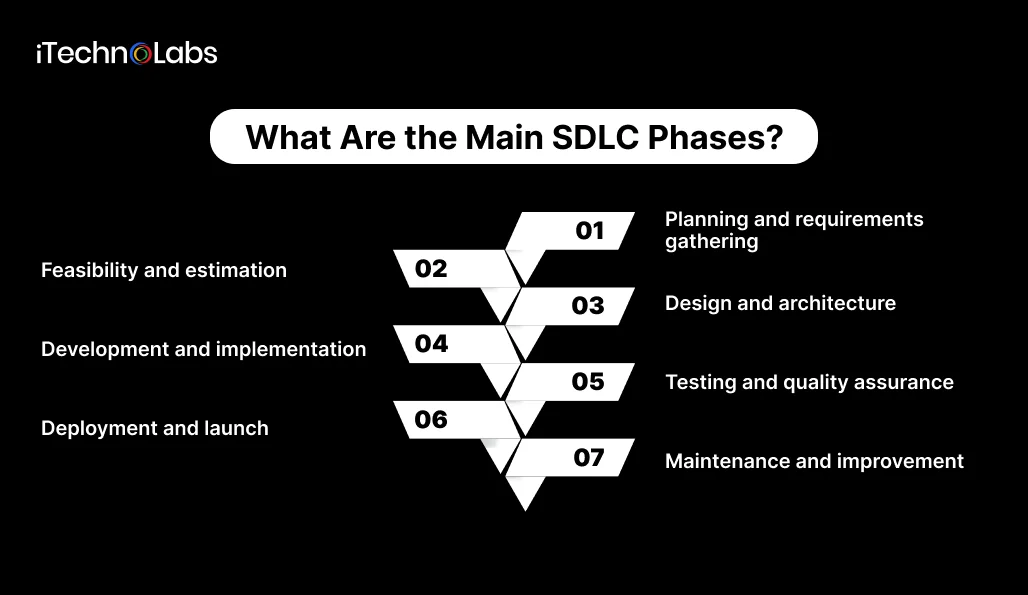
Teams may combine or rename lifecycle stages depending on their methodology, but most software projects include the following activities.
- Planning and requirements gathering
Planning defines the business problem, intended users, project objectives, scope, constraints, and expected outcomes. The team gathers requirements and identifies dependencies such as existing software, data sources, user permissions, and regulatory obligations.
Consider a business that wants to automate order processing. The initial request might be to replace spreadsheets with a custom application. Requirements gathering should uncover the actual workflow, approval rules, reporting needs, and connections to accounting or inventory systems.
Before development begins, ask for a documented scope, a prioritised feature list, major assumptions, and clear success criteria. Decide what belongs in the first release and what can wait.
- Feasibility and estimation
Feasibility analysis examines whether the proposed software is practical within the available budget, schedule, technology, and operational constraints. Estimation translates the agreed scope into projected effort, resources, milestones, and costs.
An estimate is only as useful as the assumptions behind it. Unclear requirements, third-party integrations, data migration, security controls, and late changes can all affect the final cost.
Ask your development partner to explain what the estimate includes, what it excludes, which assumptions could change it, and how additional work will be approved. A range with clear assumptions can be more useful than a precise figure unsupported by a defined scope.
- Design and architecture
During design, the team determines how the software will work and how its components will fit together. This may include user interface designs, system architecture, database structures, integrations, access controls, and deployment decisions.
Design is where business requirements become a practical blueprint. Reviewing screens and workflows before extensive coding begins can reveal misunderstandings while changes are still easier to discuss.
Request design reviews and ask how the proposed architecture supports your current requirements, expected growth, security needs, and existing systems. Confirm that business stakeholders approve the key workflows before implementation proceeds.
- Development and implementation
Developers turn approved requirements and designs into working software. They write code, configure services, connect integrations, and use version control and code review practices to manage changes.
Visible progress matters more than a stream of technical activity reports. Business owners need to understand which features are complete, which remain in progress, and whether anything threatens the agreed scope or milestones.
Establish a regular demonstration or review cadence. Ask for access to a project tracker, a record of decisions, and a clear escalation process when requirements or technical constraints change.
- Testing and quality assurance
Testing checks whether the application behaves as expected and identifies defects before and after release. Depending on the project, it may include unit testing, integration testing, system testing, security testing, performance testing, and user acceptance testing.
An application can appear to work during a demonstration but still fail when multiple users access it, real business data is introduced, or an external system responds unexpectedly.
Agree on acceptance criteria before testing begins. Define who tests each business workflow, how defects are prioritised, what must be fixed before launch, and who gives final acceptance.
- Deployment and launch
Deployment makes the software available in its intended environment. The process may involve configuring hosting, transferring data, setting up permissions, training users, monitoring the release, and preparing a rollback plan.
A successful deployment is not simply the moment the application goes live. Employees must be able to use it, important data must remain reliable, and the business needs a way to respond if something goes wrong.
Confirm the launch checklist, backup and recovery arrangements, user training, support contacts, and responsibility for resolving release issues before approving the launch.
- Maintenance and improvement
The SDLC continues after release. Software may need security updates, bug fixes, compatibility changes, performance improvements, and new features as business needs evolve.
Maintenance affects the total cost of ownership. The initial build budget does not necessarily cover ongoing hosting, third-party licences, monitoring, support, or future enhancements.
Before signing a development agreement, clarify what support is included, how incidents are handled, who maintains dependencies, and how your business receives source code, documentation, and deployment access.
Which Software Development Life Cycle Model Should You Choose?
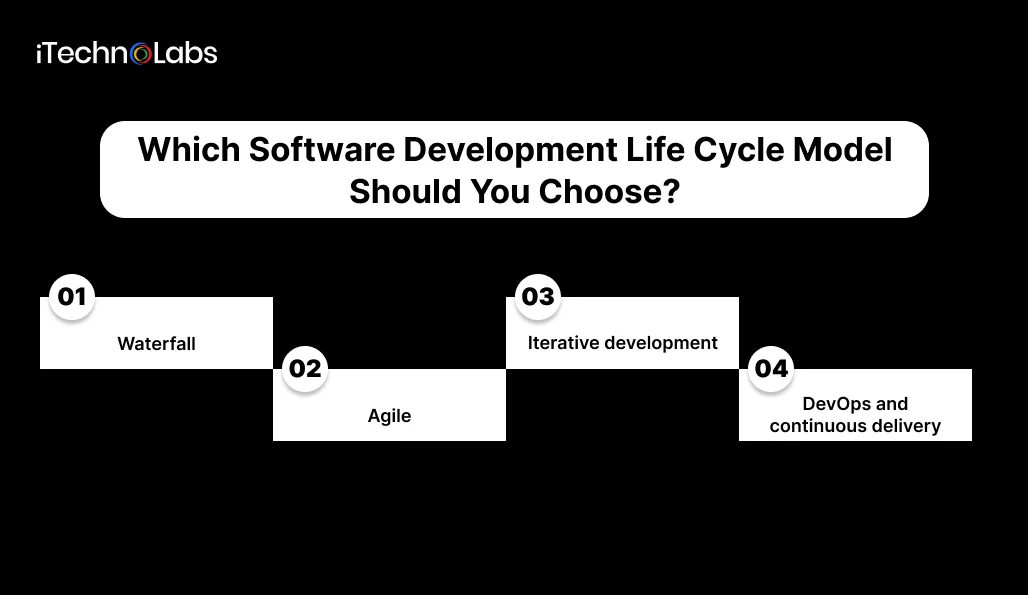
A lifecycle model describes how a team organises development activities, feedback, approvals, and changes. The right choice depends on how clearly requirements are defined, how much uncertainty exists, and how the business needs to review progress.
Waterfall
Waterfall follows a largely sequential approach, with phases progressing through planned stages. It can suit projects with stable requirements, clearly defined deliverables, and formal approval checkpoints.
Its main limitation for a changing business project is that substantial new requirements can disrupt plans after earlier stages have been completed.
Consider Waterfall when the scope is well understood and changes are expected to be limited.
Agile
Agile organises development around iterative delivery, frequent feedback, and prioritised work. Rather than waiting until the entire application is finished, stakeholders can review increments and adjust priorities as the project evolves.
Agile can help businesses refine an unfamiliar workflow or launch a product whose requirements will become clearer through use. It still requires disciplined scope management, decision-making, and budget oversight.
Consider Agile when regular feedback and changing priorities are important. Agree on how work is prioritised, how progress is reported, and how budget decisions are made.
Iterative development
Iterative development builds and improves software through repeated cycles. Each cycle uses feedback or test results to refine the product.
This approach can be useful when the business wants to validate assumptions, test a workflow, or improve an existing application without defining every future detail at the beginning.
Consider iterative delivery when learning from earlier versions is important, while keeping clear goals for each cycle.
DevOps and continuous delivery
DevOps brings development and operations practices closer together, supporting automation, testing, deployment, monitoring, and feedback across the software lifecycle.
For a business that depends on frequent software updates, automated checks and controlled releases can make changes easier to manage. The value depends on how well the practices fit the system and team.
Ask how your development partner handles deployment automation, production monitoring, security updates, and recovery when a release causes problems.
How Does the SDLC Affect Software Development Costs?
The software development lifecycle does not determine a fixed project price or timeline. Cost and delivery time depend on the agreed scope, technical complexity, integrations, design requirements, security and compliance needs, team composition, testing effort, and ongoing support arrangements.
Clutch’s 2026 software development pricing guide reports that many reviewed custom software projects fall between US$10,000 and US$49,999, with an average project cost of approximately US$132,480 and a typical timeline of about 13 months across its reviewed projects. These figures represent a broad market benchmark, not a quote or a forecast for every small business project.
For practical planning, a smaller internal tool may require a different budget and schedule from a multi-module business application or an enterprise platform. Projects with complex integrations, extensive data migration, strict security requirements, or multiple user roles generally require more work.
Before comparing proposals, ask each provider to identify:
- Included features and excluded work: Confirm exactly what the quoted price covers.
- Milestones and delivery dates: Request a phase-by-phase schedule covering discovery, design, development, testing, and launch.
- Third-party costs: Clarify whether licences, hosting, APIs, and other external services are included.
- Change management: Ask how new requirements will affect the budget and delivery date.
- Testing and launch: Confirm who handles quality assurance, deployment, documentation, and user training.
- Ongoing costs: Check maintenance, support, monitoring, and future enhancement fees.
A low initial quote can be difficult to compare with a more detailed proposal if the two cover different deliverables. One provider may include data migration, user training, and post-launch support, while another may charge extra for these services.
Request an estimate based on your documented requirements, with assumptions, exclusions, milestones, and acceptance criteria stated clearly. Treat early cost and timeline figures as estimates until the scope has been reviewed and agreed upon.
The objective is not to choose the lowest number. It is to understand what you will receive, when you can reasonably expect delivery, which risks remain with your business, and how the project will be managed if circumstances change.
How to Evaluate a Software Development Partner
Use the SDLC to evaluate the working process before committing to a provider. Ask these questions during discovery and proposal reviews.
| What to evaluate | Question to ask |
| Requirements | How will you document and confirm our business requirements? |
| Estimation | What assumptions support the proposed budget and timeline? |
| Communication | How often will we review progress and approve decisions? |
| Quality | What testing is included, and how are defects handled? |
| Security | How are access controls, dependencies, and security risks managed? |
| Change management | What happens when we request a new feature? |
| Ownership | What code, documentation, credentials, and intellectual property will we receive? |
| Support | Who handles maintenance and incidents after launch? |
The US National Institute of Standards and Technology publishes the Secure Software Development Framework (SSDF), which recommends integrating secure development practices into software lifecycle models. Its guidance is useful when discussing security responsibilities with a potential supplier.
Start Your Software Project with iTechnolabs
Choosing a software development partner means choosing how your project will be planned, built, tested, and maintained. iTechnolabs works with businesses to develop custom software that addresses operational challenges, supports business objectives, and meets defined project requirements.
Whether you need a custom business application, workflow automation, an integrated CRM or ERP system, or an upgrade to an existing platform, the right starting point is a clear understanding of your requirements, priorities, and budget.
iTechnolabs provides software and mobile app development services, supported by experience across 500+ delivered apps and a team of 300+ developers. The company also holds ISO 27001:2013 and ISO 9001:2015 certifications.
Conclusion
The software development lifecycle gives business owners a clearer way to plan projects, manage expectations, and evaluate software delivery. From defining requirements and estimating costs to testing, deployment, and ongoing maintenance, every phase contributes to the quality and long-term value of the final product.
The right development model depends on your business goals, project complexity, budget, and how frequently your requirements may change. More importantly, your development partner should explain the process clearly, establish measurable milestones, communicate risks early, and define what happens after launch.
Before committing to a software project, make sure you understand the scope, deliverables, acceptance criteria, ownership arrangements, and ongoing support requirements. These details help you compare proposals on more than price alone.
The next step is to turn your business requirements into a clearly defined development plan. With the right process and partner, you can make more informed technology investments and build software that supports your operational goals.
FAQs
- What does SDLC stand for?
SDLC stands for software development lifecycle, also written as software development life cycle. It describes the activities involved in taking software from initial planning through design, development, testing, deployment, and maintenance. Businesses use the lifecycle to organise work, define responsibilities, manage risks, and evaluate whether the delivered software meets agreed requirements.
- What are the seven phases of the SDLC?
A common seven-phase structure includes planning, feasibility analysis, design, implementation, testing, deployment, and maintenance. Teams may combine or rename stages depending on the project and methodology. What matters to a business owner is that requirements, quality checks, launch readiness, and ongoing support have clear owners and agreed deliverables.
- Which SDLC model is best for a small business?
There is no single best model for every small business. Waterfall can suit stable requirements, while Agile or iterative development can help when priorities may change, or users need to review working software. Choose based on project uncertainty, stakeholder availability, risk, and budget controls. Ask the development partner to explain the trade-offs before deciding.
- What should a business owner receive before software development starts?
Request a documented scope, prioritised requirements, proposed solution design, budget and timeline assumptions, milestone plan, acceptance criteria, communication arrangements, and change control process. The agreement should also clarify intellectual property ownership, source code access, security responsibilities, deployment, and post-launch support so both parties understand their obligations before work begins.
- Does the SDLC end when the software launches?
No. Maintenance and improvement continue after launch. Software may need security patches, defect resolution, compatibility updates, monitoring, and new functionality. Before release, confirm who provides support, how incidents are prioritised, what service commitments apply, and how your business can access the code and documentation needed to maintain the application over time.
- How can I tell whether a development partner follows a good SDLC?
Look for evidence of a documented process, clear deliverables, regular demonstrations, meaningful testing, security practices, transparent change management, and defined ownership. Ask for a walkthrough of how the provider would manage a project like yours. Verify relevant experience and references independently rather than relying on broad claims about quality or delivery speed.











