- The General Data Protection Regulation (GDPR) establishes requirements for how organisations process personal data, including principles of data minimisation, purpose limitation, security, and accountability.
- Build privacy requirements into product discovery, architecture, development, testing, and maintenance rather than leaving them until launch.
- Map every personal data field to a purpose, lawful basis, retention rule, access policy, and deletion or correction workflow where applicable.
- A data protection impact assessment (DPIA) is required before processing when the planned processing is likely to result in a high risk to individuals’ rights and freedoms.
- Evaluate third-party SDKs, cloud services, analytics tools, and AI integrations as part of the application’s data flow, not as isolated technical dependencies.
GDPR compliant app development means designing an application to process personal data lawfully, transparently, securely, and only for defined purposes. Developers and product teams must translate these obligations into architecture, access controls, consent management where required, retention policies, and workflows for user rights. Compliance is an ongoing responsibility, not a one-time launch approval.
Table of Contents
Why GDPR Compliance Must Start in the Architecture
The GDPR’s territorial scope is not limited to companies established in the European Union. It can also apply to organisations outside the EU that offer goods or services to people in the EU or monitor their behaviour there, subject to the conditions in Article 3.
For enterprise CTOs, this means compliance cannot be reduced to adding a privacy policy or consent banner. A product may collect personal information through its mobile interface, transmit it to several APIs, store it in cloud databases, and share it with analytics or customer support providers. Every step can affect the organisation’s compliance position.
Treat privacy as an architecture requirement alongside performance, availability, and security. Assign clear ownership across product, engineering, security, legal, and data protection stakeholders before implementation begins.
The Developer’s Checklist for GDPR Compliant App Development
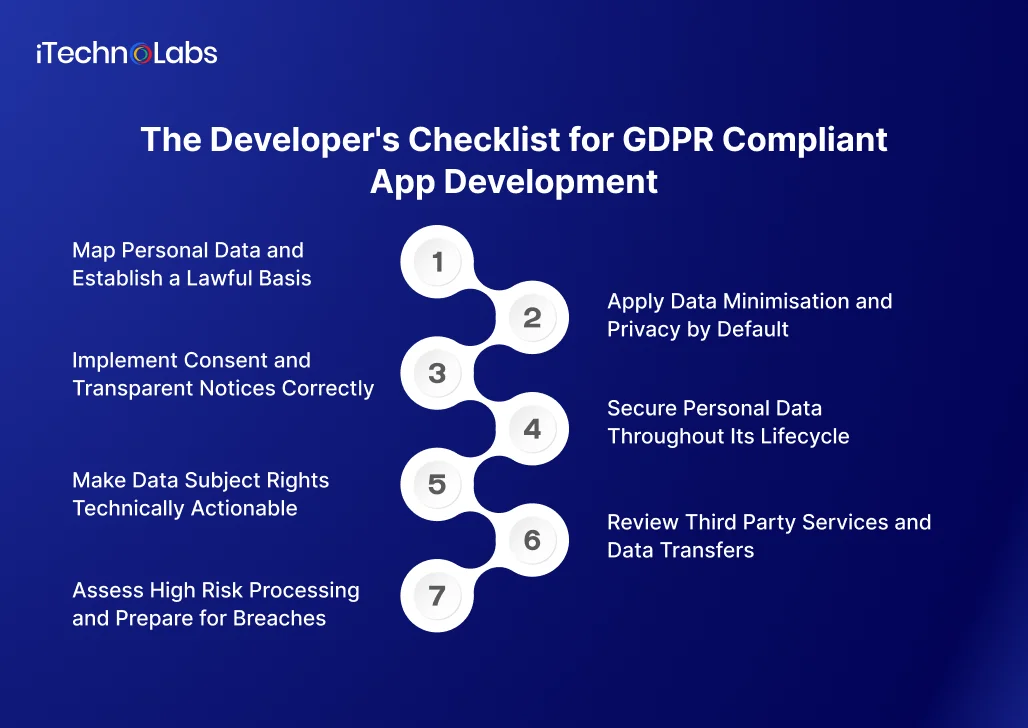
- Map Personal Data and Establish a Lawful Basis
Article 5 of the GDPR requires personal data to be processed lawfully, fairly, and transparently, for specified purposes, and in a manner that limits collection to what is necessary. Article 6 sets out the lawful bases for processing, including consent, contractual necessity, legal obligations, vital interests, public tasks, and legitimate interests where applicable.
Create a data inventory before building the feature. Record what information the application collects, why it needs it, where it travels, who receives it, and how long it is retained.
For every processing activity, document:
- The data categories involved, such as account details, contact information, location, or usage events.
- The purpose of processing and the applicable lawful basis, confirmed with the organisation’s privacy or legal team.
- The systems, APIs, vendors, and storage locations that receive the information.
- The retention period and the process for deletion or anonymisation.
- The business owner responsible for approving changes to the processing activity.
A data inventory also makes technical changes easier to assess. When a team introduces a new analytics event or adds an AI feature, it can evaluate the change against documented purposes rather than discovering hidden data flows after deployment.
- Apply Data Minimisation and Privacy by Default
Article 25 requires appropriate technical and organisational measures that implement data protection principles effectively and integrate necessary safeguards into processing. It also addresses data protection by default.
Collect the minimum information required for each feature. Do not request location access, contact permissions, demographic details, or other sensitive information merely because it could be useful later.
Developers should:
- Make optional fields genuinely optional.
- Disable nonessential tracking by default where appropriate.
- Limit the information displayed in dashboards, exports, notifications, and logs.
- Use pseudonymisation or anonymisation where suitable for the intended purpose.
- Review whether test environments can use synthetic or appropriately anonymised data instead of production records.
Privacy by default is an architectural decision. If a system collects unnecessary information at the start, removing it later can require changes to databases, analytics pipelines, reporting tools, and vendor integrations.
- Implement Consent and Transparent Notices Correctly
Consent is one lawful basis for processing, but it is not the only one. Where consent is the selected basis, it must meet the GDPR’s requirements, including being freely given, specific, informed, and unambiguous. The organisation must also be able to demonstrate consent where required.
Do not treat a consent banner as a universal compliance mechanism. Establish the lawful basis for each processing activity and implement consent controls where consent is appropriate or legally required.
A practical implementation should:
- Explain what data is collected and why in clear, accessible language.
- Separate distinct purposes when separate choices are needed.
- Record relevant consent details, including the choice, timestamp, and notice version.
- Provide a workable withdrawal mechanism when processing relies on consent.
- Ensure that withdrawing consent triggers the appropriate downstream processing changes.
Consent records are useful only when the application can act on them. If a user withdraws consent but an analytics SDK continues collecting data, the interface and the underlying processing have diverged.
- Secure Personal Data Throughout Its Lifecycle
Article 32 requires controllers and processors to implement technical and organisational security measures appropriate to the risk. Depending on the circumstances, these may include encryption, pseudonymisation, ongoing confidentiality and availability, and processes for testing security measures.
Build security controls into the application and its infrastructure.
Use this implementation checklist:
- Enforce authentication and role-based access control, following least privilege.
- Protect sensitive data in transit and at rest using appropriately configured encryption.
- Store credentials and secrets in managed secret storage rather than source code.
- Avoid logging passwords, access tokens, payment details, or unnecessary personal information.
- Review API authorisation, session handling, dependency vulnerabilities, and administrative access.
- Test backup restoration, incident response, and recovery procedures.
- Maintain access logs and security monitoring with appropriate retention and access restrictions.
Encryption alone does not establish compliance. Access permissions, key management, system configuration, monitoring, and operational processes also influence whether personal data is adequately protected.
- Make Data Subject Rights Technically Actionable
The GDPR provides individuals with rights that include access, rectification, erasure in applicable circumstances, restriction of processing, data portability where the legal conditions are met, and objection in specified circumstances. Requests generally require a response without undue delay and, in principle, within one month.
Design user rights workflows before they become urgent support tickets.
Your application should support the relevant requirements through:
- A way to locate personal data associated with a verified individual.
- A controlled process for correcting inaccurate information.
- Deletion or restriction workflows that account for relevant legal retention obligations and exceptions.
- Data exports in an appropriate, structured format when portability applies.
- A process for recording requests, tracking deadlines, and documenting decisions.
Deletion is rarely just a database operation. Copies may exist in caches, search indexes, analytics systems, backups, or third-party services. Define how each system responds, and document any justified limitations rather than promising immediate universal erasure.
- Review Third Party Services and Data Transfers
Under Article 28, organisations using processors must engage processors that provide sufficient guarantees for appropriate technical and organisational measures. Processing by a processor must be governed by the required contract or other legal act. Transfers of personal data outside the EU and European Economic Area may also require an assessment of the applicable transfer rules and safeguards.
Maintain a vendor register covering cloud infrastructure, analytics, crash reporting, customer support, payment services, advertising tools, and AI APIs.
For each provider, verify:
- What personal data the provider receives and for which purpose.
- Whether a data processing agreement is required and in place.
- The provider’s subprocessors and relevant data locations.
- Applicable international transfer mechanisms and safeguards.
- Retention, deletion, incident notification, and access arrangements.
An SDK can introduce data collection outside the main application code. Review its configuration, permissions, network traffic, and documentation before approval, then repeat the review when its behaviour or version changes.
- Assess High Risk Processing and Prepare for Breaches
Article 35 requires a DPIA before processing likely to result in a high risk to individuals’ rights and freedoms. A DPIA examines the planned processing, its necessity and proportionality, associated risks, and measures intended to address those risks.
Involve privacy and security stakeholders when designing features involving large-scale sensitive data, systematic monitoring, or other processing that may create high risks. Determine whether a DPIA is required based on the actual processing, not merely the technology label.
Under Article 33, a controller must notify the competent supervisory authority of a personal data breach without undue delay and, where feasible, within 72 hours of becoming aware of it, unless the breach is unlikely to result in a risk to individuals’ rights and freedoms. A processor must notify the controller without undue delay after becoming aware of a breach.
Prepare an incident runbook that identifies decision makers, escalation paths, evidence preservation procedures, affected data categories, and the information needed to assess notification obligations. Test the runbook before an incident occurs.

A Practical Prelaunch Compliance Gate
Before approving a release, ask the team to demonstrate the following:
| Area | Release gate |
| Data inventory | Processing purposes, data flows, and lawful bases documented |
| Privacy design | Unnecessary collection removed and default settings reviewed |
| Transparency | Privacy notices and applicable consent controls tested |
| Security | Access controls, secrets, encryption, and security testing reviewed |
| User rights | Relevant access, correction, deletion, and export workflows tested |
| Vendors | Processor agreements and transfer requirements reviewed |
| Risk assessment | DPIA requirement assessed and completed where required |
| Incident readiness | Escalation, evidence capture, and notification assessment tested |
| Accountability | Decisions, approvals, and evidence recorded |
Passing this checklist is evidence of a structured engineering process, not a legal certification or guarantee of compliance. Requirements depend on the application’s purposes, data, users, jurisdictions, and operating model.
Build Secure, Privacy-Conscious Applications with iTechnolabs
Planning a new enterprise application or modernising an existing platform? GDPR requirements should be considered from the architecture stage, not added as a last-minute compliance task.
At iTechnolabs, we develop mobile applications and custom software for businesses that need to build, modernise, and scale digital products. Our development approach can incorporate privacy-focused architecture, access control design, secure data handling, and integration reviews based on your project’s requirements.
Our team can work with your stakeholders to assess technical requirements, identify potential implementation risks, and plan the development work needed to support your privacy and security objectives.
Conclusion
GDPR compliance requires more than a privacy policy or a security review before launch. It depends on how an application collects, processes, stores, shares, and protects personal data throughout its lifecycle. From privacy by design and access controls to data subject rights and third-party integrations, every technical decision can affect an organisation’s ability to meet its obligations.
For enterprise CTOs and IT directors, the priority is to make compliance a shared responsibility across engineering, security, product, and legal teams. Building privacy requirements into the architecture from the start can also reduce avoidable rework and make future changes easier to assess.
Use this developer checklist as a starting point for reviewing your application’s data flows, security controls, vendor dependencies, and privacy workflows. Then validate the implementation against the GDPR requirements that apply to your specific processing activities, with guidance from qualified privacy counsel.
FAQs
- What is GDPR compliant app development?
GDPR compliant app development incorporates the GDPR’s requirements into application design, data collection, processing, storage, security, and ongoing operations. It includes lawful processing, transparency, data minimisation, appropriate safeguards, and mechanisms for applicable user rights. The exact measures depend on the processing activities and the organisation’s role.
- Does every app need a consent banner?
No. Consent is one lawful basis for processing personal data, not a universal requirement for every activity. Other lawful bases may apply. Separate rules can govern cookies and similar technologies. The appropriate controls depend on the processing, technology, jurisdiction, and applicable law.
- Is encryption enough to make an app GDPR compliant?
No. Encryption can be an important security safeguard, but GDPR compliance also involves lawful processing, transparency, purpose limitation, data minimisation, retention, accountability, and other appropriate technical and organisational measures. Security controls must be assessed against the application’s risks.
- What is privacy by design?
Privacy by design means integrating data protection safeguards into processing activities from the design stage and throughout their lifecycle. Article 25 also addresses privacy-friendly default settings. In practice, teams minimise collection, restrict access, document decisions, and build relevant privacy controls into application workflows.
- When does an app require a DPIA?
A DPIA is required before processing when the planned processing is likely to result in a high risk to individuals’ rights and freedoms. New technology alone does not automatically make every project subject to a DPIA. The organisation must assess the nature, scope, context, purposes, and risks of its processing.
- What should developers do when a user requests data deletion?
Verify the request through an appropriate process, locate the relevant data, assess applicable retention duties and exceptions, execute the required deletion or restriction, and record the outcome. Check connected systems and processors as well. The right to erasure is not absolute, so the response must reflect the applicable legal conditions.
- Can an app built outside the EU fall under GDPR?
Yes, in certain circumstances. Article 3 can apply to organisations outside the EU that offer goods or services to individuals in the EU or monitor their behaviour there. Whether the GDPR applies depends on the specific circumstances and the regulation’s territorial scope.
- How often should GDPR compliance be reviewed?
Review compliance when the application introduces new data uses, vendors, AI capabilities, markets, or significant architecture changes, and periodically as part of governance. Reassess risks, access controls, retention, vendor arrangements, and incident procedures. The review schedule should reflect the application’s risk and regulatory obligations.