Key Takeaways
- Onshore development places your development partner in the same country as your business. Offshore development uses a team in a more distant country.
- Offshore delivery can reduce direct development expenses, but coordination, management, rework, and travel can affect the final cost.
- Compare complete project costs, including discovery, development, testing, deployment, maintenance, and internal management time.
- Onshore teams can suit projects that require frequent collaboration, while offshore teams can suit well-defined projects with clear documentation and strong delivery governance.
- Evaluate communication practices, security controls, intellectual property terms, and delivery accountability alongside price.
Onshore vs offshore development is a decision about more than hourly rates. Onshore teams work in your country, while offshore teams work in a distant country, often with different time zones. Onshore delivery can simplify communication and oversight, while offshore delivery may reduce direct labour costs. The right choice depends on your project’s complexity, management capacity, security needs, and total cost of ownership.
Table of Contents
- What Is the Difference Between Onshore and Offshore Development?
- Onshore vs Offshore Development Costs
- The Hidden Costs Businesses Should Calculate
- How to Calculate Total Cost of Ownership
- Which Development Model Is Better for Your Business?
- How to Reduce Risk When Choosing a Development Partner
- Why Choose iTechnolabs for Your Software Development Needs?
- Conclusion
- FAQs
What Is the Difference Between Onshore and Offshore Development?
Onshore software development means working with a software development provider located in the same country as your business. Offshore development means engaging a provider in a distant country, often across several time zones.
Neither model guarantees better quality. Results depend on the provider’s engineering capability, project management, technical processes, and understanding of your requirements.
Onshore development
An onshore team can make collaboration easier when your project requires frequent discussions with business stakeholders. Shared working hours can support live planning, faster clarification, and closer oversight.
The trade-off is that local development rates and recruitment costs may be higher in some markets. You may also face a smaller available talent pool or longer recruitment timelines if you need specialist skills.
Offshore development
Offshore development gives businesses access to engineering talent in other countries. Depending on the location, skills, and engagement model, the direct cost of development may be lower than a comparable local engagement.
However, distance can introduce coordination challenges. Requirements may need more documentation, feedback can cross working days, and managers may need to plan handoffs carefully. These costs are not inevitable, but they should be assessed before selecting a partner.

Onshore vs Offshore Development Costs
A useful comparison starts with the complete cost of delivering and operating the software, rather than the quoted hourly rate alone.
| Cost factor | Onshore development | Offshore development |
| Development rates | May be higher in high-cost local markets | May be lower depending on location and skills |
| Communication | Often easier during shared working hours | May require planned overlap and asynchronous updates |
| Project management | Coordination may be simpler for local stakeholders | Requires clear ownership and deliberate coordination |
| Recruitment | Local hiring can take time and involve employment costs | External providers can expand access to talent |
| Travel | May be lower for local meetings | Travel may be needed for selected workshops |
| Rework | Depends on requirements, engineering, and QA quality | Depends on the same factors, plus how effectively teams clarify requirements |
| Maintenance | Depends on the contract, team continuity, and support terms | Depends on the contract, team continuity, and support terms |
There is no universal cost figure that accurately represents every onshore or offshore project. Pricing varies with geography, seniority, team composition, technology, project scope, delivery model, and contractual terms.
Request comparable proposals with the same requirements, deliverables, milestones, testing standards, and support expectations. Without a shared scope, a lower quote may simply exclude work that another provider has included.
The Hidden Costs Businesses Should Calculate
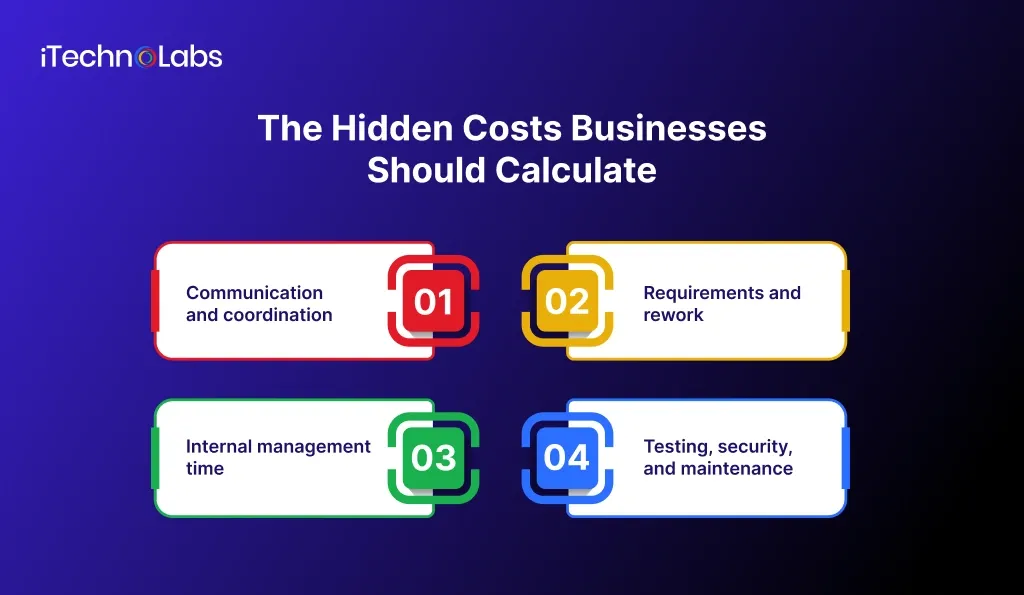
The biggest budgeting mistake is treating development labour as the entire project cost. A realistic estimate should include the costs of getting the product specified, built, accepted, launched, and maintained.
1. Communication and coordination
Teams working in different time zones may need scheduled overlap hours, written handoffs, recorded decisions, and additional planning. This does not automatically make offshore work inefficient. The financial effect depends on how often decisions are blocked and how well the teams manage dependencies.
Ask providers to explain their meeting schedule, response expectations, escalation process, and approach to urgent production issues.
2. Requirements and rework
Ambiguous requirements can create rework in any delivery model. Distance can make early clarification more important when stakeholders and developers have limited opportunities to resolve questions in real time.
Budget for discovery, requirements documentation, design approval, acceptance criteria, and regular demonstrations. These activities help expose misunderstandings before they become expensive changes.
3. Internal management time
Outsourcing does not eliminate the need for internal ownership. Someone must set priorities, answer business questions, review deliverables, approve changes, and coordinate releases.
Include the estimated hours of your internal product owner, operations lead, and technical reviewer in your cost comparison. Use the same assumptions for every proposal.
4. Testing, security, and maintenance
The National Institute of Standards and Technology recommends incorporating secure development practices into the software development life cycle. Its Secure Software Development Framework guides preparing teams, protecting software, producing secure releases, and responding to vulnerabilities.
A low initial quote can be misleading if testing, security reviews, deployment, documentation, or post-launch support are excluded.
Confirm who is responsible for code review, automated testing, vulnerability remediation, backups, deployment, monitoring, and ongoing maintenance. Put the agreed responsibilities in the contract and statement of work.
How to Calculate Total Cost of Ownership
Use a consistent calculation to compare both proposals over the same period.
Total cost of ownership = initial development + internal management + coordination + rework and change costs + infrastructure and tools + security and compliance + maintenance and support.
This is a planning framework, not a universal accounting formula. Your business may need additional categories, such as migration, training, licensing, or regulatory assessment.
For example, suppose an offshore proposal has a lower development fee but requires additional internal coordination. The onshore proposal costs more upfront but includes more frequent collaboration and a defined support arrangement. You cannot determine the better value from the initial fee alone. You need comparable estimates for the remaining cost categories and an agreed definition of successful delivery.
Build three scenarios for each provider.
- Expected case: The team meets agreed milestones and delivers within the approved scope.
- Risk case: Requirements change, dependencies delay delivery, or additional testing is needed.
- Support case: The product requires fixes, updates, and operational assistance after launch.
These scenarios make uncertainty visible without pretending that future costs are known precisely. Record assumptions and ask each provider to explain how changes affect fees and timelines.

Which Development Model Is Better for Your Business?
The right model depends on the work you need done, the level of collaboration required, and the amount of delivery oversight your business can provide.
Choose onshore development when
- Your project requires frequent working sessions with local business stakeholders.
- You have strict expectations for working hour availability or in-person collaboration.
- Your team needs close coordination across complex business systems or operational workflows.
- Local contracting, data handling, or jurisdictional requirements are important to your selection.
Choose offshore development when
- Your scope and acceptance criteria are clearly documented.
- You can manage a distributed team through defined milestones, written decisions, and regular reviews.
- Your provider can demonstrate the skills, delivery process, security controls, and support coverage the project requires.
- Your budget benefits from a broader international talent pool, and the complete proposal remains competitive after coordination and management costs are included.
Consider a hybrid approach
Some businesses use a hybrid model, with local product leadership and business analysis supported by a distributed engineering team. This can balance collaboration and access to specialist talent, but it adds coordination between teams and requires clear ownership.
Consider this approach when stakeholder access and technical delivery have different location requirements. Evaluate the combined cost and accountability model rather than assuming a hybrid team is automatically cheaper.
How to Reduce Risk When Choosing a Development Partner
Use the same evaluation checklist for every shortlisted provider.
- Scope and estimates: Ask for deliverables, assumptions, dependencies, exclusions, milestones, and a documented change request process.
- Technical capability: Review relevant project experience, architecture decisions, testing practices, and the skills of the proposed team.
- Communication. Confirm working hour overlap, meeting frequency, reporting, response expectations, and escalation routes.
- Security and intellectual property: Review access controls, data handling, confidentiality, ownership of source code, and responsibility for vulnerabilities.
- Quality assurance: Establish acceptance criteria, code review expectations, test coverage requirements, and release approval procedures.
- Ongoing support: Define maintenance scope, incident response, service levels where applicable, documentation, and team transition arrangements.
Evaluate any provider, including iTechnolabs, against your documented requirements and request a proposal that clearly separates included work, optional services, assumptions, and ongoing costs.
Why Choose iTechnolabs for Your Software Development Needs?
Choosing between onshore and offshore development is only part of the decision. The right development partner should offer clear cost estimates, defined deliverables, reliable communication, and accountability throughout the software development lifecycle.
iTechnolabs provides custom software development, mobile app development, and dedicated developer services to help businesses build and modernize digital products.
For SMBs, the best engagement model is one that balances development costs with technical expertise, project visibility, security requirements, and long-term maintenance. A clear scope and transparent delivery process can help you evaluate the real value of a development partnership beyond the initial quote.
How iTechnolabs can help:
- Custom software development: Plan and build business applications around your operational requirements and workflows.
- Mobile app development: Develop applications for iOS, Android, and cross-platform environments using technologies such as Flutter and React Native.
- Dedicated development teams: Access additional engineering capacity to support ongoing development and product improvements.
- Security and quality focus: iTechnolabs identifies ISO 27001:2013 and ISO 9001:2015 among its certifications. Confirm the applicable certification scope and current validity during vendor evaluation.
Conclusion
The best choice in onshore vs offshore development is the model that fits your budget, operating requirements, technical needs, and capacity to manage delivery. A lower quote can be attractive, but the business case should account for the full project lifecycle and the risks that could affect the outcome.
Before committing, compare your requirements against a documented cost model, identify the assumptions that matter most, and confirm how each provider will manage delivery, quality, and support.

FAQs
1. Is onshore development more expensive than offshore development?
Onshore development may have higher direct labour costs in high-cost markets, while offshore providers may offer lower rates depending on location and team composition. The total difference depends on project scope, coordination, rework, management time, and support. Compare like-for-like proposals rather than relying on hourly rates alone.
2. Is offshore software development worth the cost savings?
Offshore development can be worthwhile when the provider has the right skills, clear delivery processes, reliable communication, and appropriate security controls. The savings are less meaningful if unclear requirements, delayed decisions, or excluded services increase the final cost. Assess the full engagement rather than the initial estimate.
3. What is the highest hidden cost of offshore development?
There is no single hidden cost that affects every offshore project. Common areas to investigate include internal coordination, delayed clarification, rework, travel, security requirements, and support exclusions. Estimate each category using your own delivery needs and confirm which costs the provider includes in its proposal.
4. How can an SMB compare software development quotes fairly?
Give each provider the same project brief, feature list, acceptance criteria, timeline assumptions, security requirements, and support expectations. Ask for itemised pricing, exclusions, payment milestones, and change request rates. Compare the expected total cost of ownership and delivery risks, not just the quoted development fee.
5. Is onshore development better for complex software projects?
Onshore delivery can simplify collaboration when a complex project requires frequent stakeholder decisions, but location alone does not determine success. Technical experience, architecture, product ownership, quality assurance, and communication practices remain important. An offshore team can also deliver complex systems when responsibilities, governance, and technical standards are well managed.
6. What should a software development contract include?
Define the scope, deliverables, milestones, payment terms, acceptance criteria, change control, confidentiality, intellectual property ownership, security obligations, defect handling, support arrangements, and termination or transition terms. Have qualified legal counsel review the agreement for your jurisdiction and the sensitivity of your project.