Key Takeaways
- Validate the customer problem before investing heavily in product development.
- Define a focused minimum viable product (MVP) around one core user outcome.
- Choose your SaaS architecture, technology stack, and development partner based on actual requirements.
- Build security, tenant isolation, testing, billing, and monitoring into the product plan from the beginning.
- Launch with clear success criteria, learn from early users, and prioritize improvements using evidence.
SaaS product development involves turning a business idea into a subscription-based software product that solves a real customer problem. For startups, success depends on validating the idea, defining a minimum viable product (MVP), choosing the right technology stack, and planning a secure, reliable launch. A structured development process helps founders control costs, reduce technical risks, and build a product that meets customer needs while leaving room for future growth.
Table of Contents
What is SaaS Product Development?
SaaS product development is the process of turning a validated customer problem into a subscription-based software product that users can access over the internet. It involves market research, product planning, MVP development, architecture, security, testing, launch, and continuous improvement. For startup founders, the objective is to deliver useful software while controlling development risk and learning from real customers.
Building a SaaS product involves more than shipping an application. You need to establish who will use it, why they need it, how it will generate revenue, and what technical foundation it requires. These decisions influence the product scope, development budget, launch strategy, and future maintenance.
Complete SaaS Product Development Process
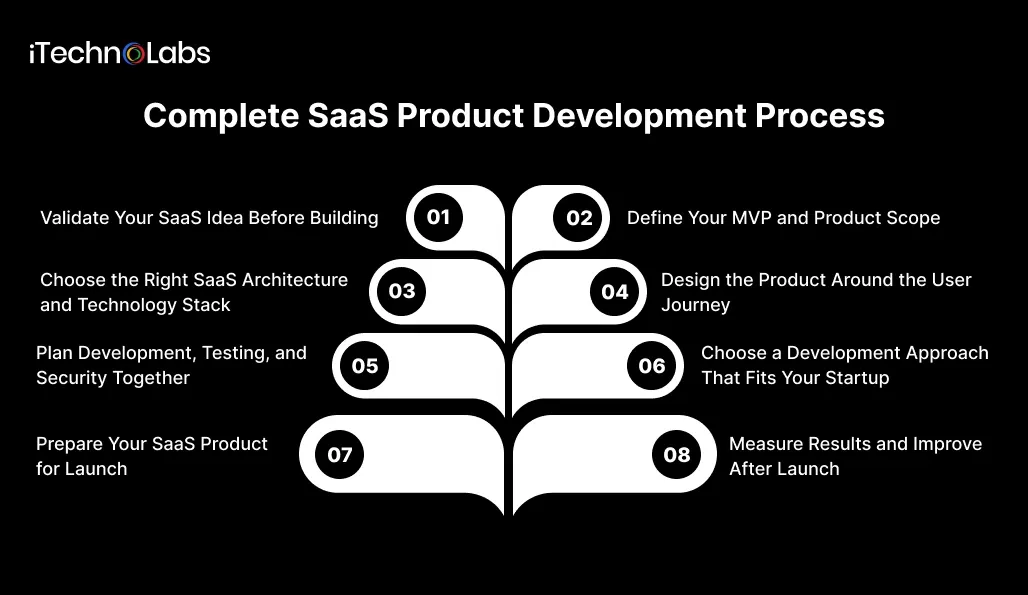
1. Validate Your SaaS Idea Before Building
Start with the problem, not the feature list.
Identify a specific audience and investigate how its members currently handle the problem. Speak with potential customers, review existing alternatives, and look for recurring frustrations that your proposed product could address.
Ask questions such as:
- Who experiences this problem most frequently?
- How do they solve it today?
- What limitations do existing tools create?
- Who would approve or pay for a better solution?
- What would convince a customer to switch?
Do not treat positive feedback as proof of demand. People may like an idea without being willing to use it or pay for it.
Test your assumptions through customer interviews, a clickable prototype, a landing page, or a small pilot. Where appropriate, ask prospective customers to make a meaningful commitment, such as joining a pilot or agreeing to test a defined workflow.
Decision gate: Proceed when you have credible evidence of a recurring problem, a reachable customer segment, and a plausible reason for users to adopt your product.
2. Define Your MVP and Product Scope
A minimum viable product is the smallest useful version of a product that allows you to test important business assumptions with real users.
An MVP is not an unfinished application. It should deliver its intended core outcome and include the security, reliability, and data handling controls required for its use.
Write down the primary user journey before selecting features. For example, a project management SaaS product might need account creation, project setup, task assignment, and basic progress tracking before it needs advanced reporting or complex automation.
Divide proposed features into three groups:
- Required for launch: Features necessary to deliver the main product value safely.
- Useful after validation: Enhancements that improve the experience but do not prevent initial use.
- Unvalidated additions: Features that sound attractive but lack evidence of customer demand.
Define acceptance criteria for every essential workflow. Specify what a user should be able to do, how the application should respond, and what constitutes successful completion.
Decision gate: Approve the MVP scope when the team can explain exactly what the first release will deliver, what it will exclude, and how you will evaluate its usefulness.
3. Choose the Right SaaS Architecture and Technology Stack
Your architecture should support the product you need to build today while allowing for reasonable future changes.
A typical SaaS application may include a frontend, backend services, a database, authentication, cloud infrastructure, integrations, billing, and monitoring. The requirements of your product determine how these components should be designed and connected.
Evaluate the following areas before choosing a stack.
- Frontend: Select a framework that supports your interface requirements and fits the team’s experience.
- Backend: Choose technologies that suit your business logic, API requirements, integrations, and maintenance plans.
- Database: Consider data relationships, transaction requirements, query patterns, and expected workloads.
- Cloud infrastructure: Evaluate hosting, deployment, backups, monitoring, availability, and operating costs.
- Third-party integrations: Identify dependencies on payment providers, communication tools, external APIs, and customer systems.
There is no universally correct technology stack. A familiar, maintainable architecture that meets your requirements may be a better choice than a more complex design intended for hypothetical future demand.
Plan for multi-tenant security
SaaS products often serve multiple customers through shared application infrastructure. Your architecture must prevent one customer from accessing another customer’s data or resources.
Decide how tenant identity will be established, how permissions will be enforced, and how customer data will be separated. Test authorization boundaries rather than relying on the interface to hide information from unauthorized users.
Decision gate: Approve the architecture when it addresses the product’s functional requirements, data protection needs, operational responsibilities, and realistic growth expectations.
4. Design the Product Around the User Journey
Good product design helps users understand what to do and reach the product’s main value without unnecessary friction.
Map the journey from signup to the first meaningful outcome. Identify the information users need, the decisions they must make, and the steps that could confuse.
For an early SaaS release, prioritize:
- A clear onboarding experience.
- An understandable interface for the primary workflow.
- Helpful validation messages and error handling.
- Accessible navigation and readable content.
- Feedback mechanisms that reveal where users struggle.
Test the design with representative users before committing to extensive development. A prototype can help expose unclear workflows and missing requirements earlier than a fully implemented product.
Design should also account for different user roles, permissions, account settings, and empty states where relevant. These details are easier to plan deliberately than to retrofit after customers begin relying on the application.
Decision gate: Move into implementation when the main user journey has been reviewed, essential screens are defined, and the team agrees on the expected user outcome.
5. Plan Development, Testing, and Security Together
Once the scope and design are approved, translate the requirements into manageable development milestones.
Break work into deliverables that can be reviewed regularly. Agree on acceptance criteria, responsibilities, dependencies, and a process for handling changes. This gives founders visibility into progress and creates opportunities to resolve misunderstandings before they affect later work.
Testing should cover more than whether individual features work.
Include:
- Functional testing of essential user journeys.
- Authentication and authorization testing.
- Validation of tenant data separation.
- Integration and payment workflow testing where applicable.
- Performance testing against expected usage.
- Backup, recovery, and error handling checks.
- Accessibility and browser compatibility checks.
Security must be part of development rather than a final checklist. The appropriate controls depend on the data processed, the product’s risk profile, and the obligations that apply to the business.
Prepare a release process that includes deployment checks, monitoring, rollback procedures, and responsibility for addressing defects. Decide who will investigate production incidents and how users will receive support.
Decision gate: Release only when the critical workflows work as intended, security checks are complete, and the team is prepared to support the product.
6. Choose a Development Approach That Fits Your Startup
Founders without an internal engineering team generally have several options. Each comes with different trade-offs.
| Approach | Best suited for | Main consideration |
| Internal engineering team | Startups with technical leadership and ongoing engineering needs | Recruitment, management, and team costs |
| External development partner | Founders who need product and engineering support | Clear scope, communication, ownership, and delivery governance |
| No-code or low-code tools | Prototypes and workflows that fit the platform’s capabilities | Customization, integrations, and long-term limitations |
Before selecting a partner, ask who will own the source code, how intellectual property will be handled, what documentation will be delivered, and how post-launch support will work.
Request a clear explanation of the proposed architecture, project milestones, testing approach, and assumptions behind the estimate. Confirm which services are included and which may create additional costs.
A development partner should help you understand the trade-offs, not simply agree to every feature request.
7. Prepare Your SaaS Product for Launch
Launching means more than making the application available online. You need a clear plan for onboarding, customer support, billing, product monitoring, and feedback.
Before release, confirm that:
- The core workflow is tested and documented.
- Sign-up, authentication, and account recovery work correctly.
- Subscription and payment flows work if applicable.
- Privacy information and applicable terms are ready.
- Monitoring and error reporting are configured.
- Support responsibilities are assigned.
- A rollback or recovery plan is available.
Choose an initial audience that matches the problem you set out to solve. Early access can help you observe how users interact with the product and identify issues before expanding distribution.
Do not define launch success by registrations alone. Consider whether users reach the intended outcome, return when they need the product, and demonstrate a willingness to pay.
Pricing also deserves deliberate testing. Subscription tiers, usage-based pricing, and other models create different expectations for customers and different revenue patterns for the business.
Decision gate: Expand distribution when the product is operating reliably, customers can reach its core value, and the team has a process for responding to feedback.
8. Measure Results and Improve After Launch
Your first release should help you answer important product questions. Use a small set of measures connected to the business model rather than tracking every available metric.
| Measure | What it helps you understand |
| Activation | Whether users reach the first meaningful outcome |
| Retention | Whether users return and continue receiving value |
| Conversion | Whether users move from trial or free access to paid plans |
| Churn | Whether customers cancel or stop renewing |
| Support requests | Which problems prevent successful product use |
| Operating costs | What it takes to run and maintain the service |
Interpret these measures in context. A drop in retention, for example, could reflect poor onboarding, an infrequent customer need, missing functionality, or a mismatch between the product and its target audience.
Talk to users and compare their feedback with observed behavior. When several users request the same feature, investigate the underlying problem before committing to a specific implementation.
Keep the product roadmap focused on changes that address validated needs, reduce meaningful risk, or improve the business model.
The aim is not to build every possible feature. It is to develop a product that customers can use, trust, and justify paying for.
How iTechnolabs Can Help With SaaS Product Development
Founders who need external engineering support should look for a partner that can connect product discovery, technical planning, development, testing, and post-launch improvement.
iTechnolabs provides software development services for startups and custom software projects. The appropriate engagement depends on your product requirements, available internal expertise, and the support you need.
A discovery discussion can help establish the initial scope, identify technical dependencies, evaluate the proposed MVP, and clarify the next steps.
Conclusion
Building a successful SaaS product requires more than a good idea. It takes customer validation, focused MVP planning, informed technology decisions, secure development, and continuous improvement after launch. For startup founders, the priority should be to solve one clear problem, test the product with real users, and use feedback to guide future development.
If you are ready to turn your SaaS idea into a working product, book a discovery call with iTechnolabs to discuss your requirements, define your MVP, and plan your development journey.
FAQs
1. How do I start SaaS product development?
Start by identifying a specific customer problem and researching how your target users solve it today. Validate demand through interviews, prototypes, or pilot commitments. Then define a focused MVP, establish the essential technical requirements, and create a development plan with clear acceptance criteria and launch objectives.
2. How much does it cost to build a SaaS product?
The cost depends on product scope, design, integrations, security requirements, architecture, and the development team’s approach. A focused MVP and a multi-feature platform require different levels of effort. Define the core workflows and technical requirements first, then request an estimate based on that scope.
3. How long does SaaS MVP development take?
There is no universal timeline for an MVP. Delivery depends on the number of essential workflows, integration complexity, design requirements, team availability, and testing needs. A defined scope and timely product decisions can make planning more reliable, but a realistic schedule requires reviewing the actual requirements.
4. What features should a SaaS MVP include?
An MVP should include the minimum functionality required to deliver its core value safely. Depending on the product, this may include user accounts, access controls, data management, and the primary workflow. Add billing, reporting, integrations, or administrative features when they are necessary for the initial business model or user experience.
5. Should I use no-code tools or custom SaaS development?
No-code tools can help test simple workflows and product assumptions. Custom development may be more appropriate when the product requires specialized business logic, complex integrations, detailed access controls, or greater control over its architecture. Compare both approaches against your actual requirements, budget, maintenance capacity, and roadmap.
6. How do I choose a SaaS development partner?
Evaluate a partner’s technical approach, communication process, testing practices, security planning, and experience with similar product requirements. Clarify source code ownership, intellectual property, documentation, milestones, change requests, and post-launch support. Ask for verifiable evidence of relevant work rather than relying only on broad capability claims.