Key Takeaways
- A technical co-founder is a long-term business partner who shares ownership, technical decisions, and responsibility for the company’s future.
- A development agency provides a team to design, build, test, and maintain your product under an agreed commercial arrangement.
- A co-founder may be the better choice when technology is central to the business and continuous technical leadership is essential.
- An agency may be the better fit when you have a validated product direction, funding, and a defined scope to build.
- You do not have to treat the choice as permanent. Some startups begin with an agency and hire technical leadership as the product and team mature.
Choosing a startup technical co-founder or hiring a development agency depends on your product goals, available funding, and need for long-term technical leadership. A co-founder shares ownership and helps shape technical strategy, while an agency provides a development team to build your product under an agreed scope. The right choice depends on what your startup needs now and as it grows.
For a funded startup, this decision affects more than the initial product launch. It influences how quickly you can respond to users, how technical decisions are made, how you manage your runway, and who remains accountable as the product grows.
Neither option is automatically right for every founder. The important question is whether your biggest current gap is permanent technical leadership or the capacity to build and ship a product.
Table of Contents
- What Is a Technical Co-Founder?
- What Does a Development Agency Do?
- Technical Co-Founder vs. Development Agency: Key Differences
- When Should You Find a Startup Technical Co-Founder?
- When Should You Hire a Development Agency?
- Which Option Costs Less for a Funded Startup?
- A Third Option: Start With an Agency and Add Technical Leadership
- How to Make the Right Decision
- Why Choose iTechnolabs for Your Startup Development Needs?
- Conclusion
- FAQs
What Is a Technical Co-Founder?
A technical co-founder is a founding partner who takes meaningful responsibility for the company’s technology and product development. Depending on the business, that person may lead architecture, engineering, infrastructure, product decisions, hiring, security, and future technical strategy.
Unlike a contractor, a co-founder typically receives equity in exchange for an agreed combination of work, risk, expertise, and long-term commitment. Compensation, responsibilities, and ownership should be documented clearly.
Equity arrangements vary. Carta’s research on startup founder ownership shows that founders consider factors such as contribution, commitment, and responsibilities when deciding how to allocate ownership. There is no universal split that suits every founding team.
A technical co-founder is especially valuable when the company needs someone to keep making difficult technical decisions as its product, customers, and business model evolve.
However, finding the right person can take time. You need more than someone who can code. You need a partner whose judgment, commitment, communication style, and appetite for risk align with your own.
What Does a Development Agency Do?
A software development agency supplies the people, processes, and technical skills needed to build or improve a product under a defined engagement.
Depending on the agreement, the team may include software engineers, product designers, project managers, quality assurance specialists, and technical leads. The scope can range from an initial minimum viable product (MVP) to a larger application with integrations, cloud infrastructure, and ongoing maintenance.
iTechnolabs lists software product development, startup software development, and dedicated development teams among its offerings. These are relevant options for founders evaluating an external engineering partner.
An agency does not automatically replace a co-founder. It can execute a product plan and provide technical input, but the startup still needs to make business decisions, validate the market, prioritize features, and retain control over its intellectual property and product direction.
That distinction matters. You can hire a team to build your product, but you still own the responsibility for deciding what is worth building.
Technical Co-Founder vs. Development Agency: Key Differences
| Decision factor | Technical co-founder | Development agency |
| Ownership | Usually receives company equity | Usually paid through a commercial agreement |
| Initial financial commitment | Depends on salary, equity, and working arrangement | Depends on scope, team composition, and engagement model |
| Long-term leadership | Can own technical strategy as a founding partner | Provides leadership within the agreed scope |
| Product execution | Builds or leads the internal engineering function | Supplies a team to execute the agreed work |
| Product iteration | Can work continuously alongside the founding team | Depends on team continuity, scope, and feedback arrangements |
| Hiring responsibility | May recruit and manage an internal engineering team | Supplies agreed personnel and delivery management |
| Accountability | Shares founding responsibilities and business risk | Accountable for contracted responsibilities and deliverables |
| Best fit | Long-term technical ownership and leadership | Defined development needs and access to engineering capacity |
The biggest difference is not simply whether you pay cash or give away equity. It is the kind of relationship your startup needs. A co-founder becomes part of the ownership and leadership structure. An agency becomes a delivery partner whose responsibilities should be defined in a contract.

When Should You Find a Startup Technical Co-Founder?
A technical co-founder deserves serious consideration when engineering decisions will shape the company’s competitive advantage for years.
1. Technology is the core of your competitive advantage
If your business depends on proprietary algorithms, complex AI systems, specialized infrastructure, or continuous technical experimentation, you may need a leader who develops deep knowledge of the product and its long-term direction.
An agency can build sophisticated systems, but a startup whose differentiation depends on ongoing technical discovery may benefit from permanent engineering leadership.
2. Your product requirements are still changing
Early products rarely have every requirement settled. Customer interviews, usability tests, and initial launches can reveal that your original idea needs significant changes.
A technical co-founder can participate in those decisions continuously, balancing user needs against architecture, engineering effort, and business priorities.
This does not mean an agency cannot support iterative development. It means you should confirm that the proposed engagement supports changing requirements rather than assuming it does.
3. You need to build an internal engineering organization
If your roadmap requires hiring engineers, establishing technical standards, managing infrastructure, and planning multiple product releases, an internal technical leader may be necessary.
A co-founder can help recruit the team, establish development practices, and retain technical knowledge inside the business.
4. You want a partner who shares the company’s long-term risk
A co-founder may be appropriate when you want someone invested in the broader outcome, including product strategy, fundraising preparation, team building, and difficult business decisions.
The trade-off: finding a suitable partner can take time, and equity creates a lasting ownership relationship. Do not choose someone simply because they are available to start coding.
When Should You Hire a Development Agency?
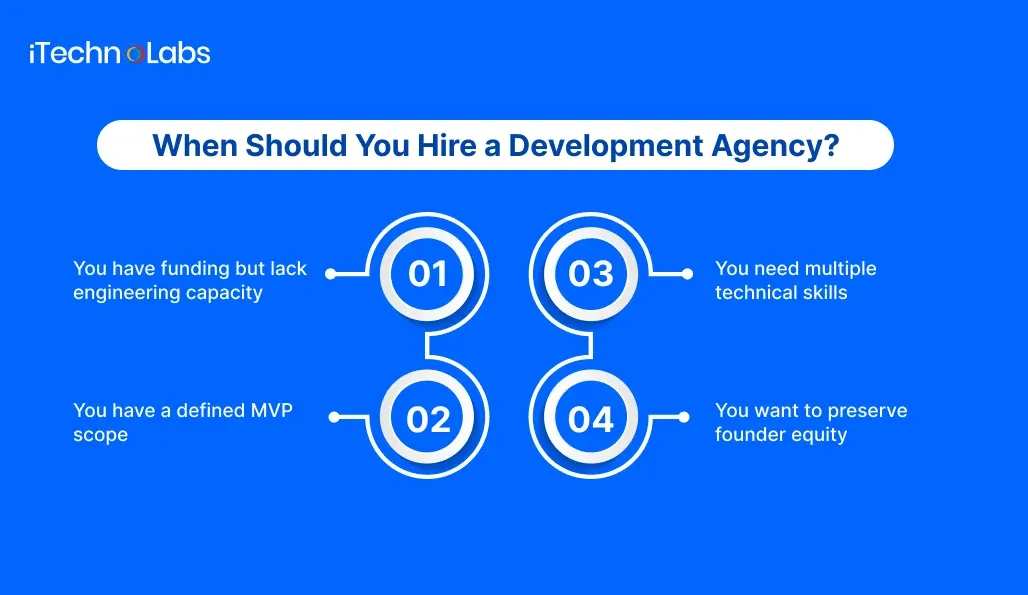
An agency can be a practical choice when you need to turn a defined business opportunity into working software and do not yet need a full-time founding engineering partner.
1. You have funding but lack engineering capacity
You may understand the problem, have spoken to prospective customers, and secured capital, yet still lack developers who can execute the product roadmap.
An agency gives you access to a development team without requiring every role to become a permanent employee from the outset.
2. You have a defined MVP scope
If you know which user problem to solve, what the initial product must do, and how you will evaluate its performance, you can prepare a clearer development brief.
That makes it easier to estimate work, compare proposals, agree on milestones, and manage delivery.
If the requirements are still uncertain, consider a discovery and product-scoping phase before committing to a full build.
3. You need multiple technical skills
Your product may require frontend and backend development, mobile engineering, UI/UX design, cloud infrastructure, testing, and integrations.
Building an internal team for every skill can be difficult when the immediate requirement is to launch an initial product. An agency can assemble the roles required for the agreed scope.
4. You want to preserve founder equity
A paid development engagement generally does not require giving the agency a founder’s ownership stake. That can matter when you want to preserve equity for future employees, investors, or a technical leader.
However, retaining equity does not make an agency automatically cheaper. You must compare the full cash commitment, continuing maintenance, future changes, and any additional work needed after launch.
Before signing, clarify who owns the source code, who controls the repositories and cloud accounts, what documentation is delivered, and how the team will support the product after the initial release.
Which Option Costs Less for a Funded Startup?
There is no reliable universal price comparison between a technical co-founder and a development agency. The answer depends on compensation, equity, project complexity, delivery scope, and how much technical leadership the business needs.
A useful comparison separates the initial cash requirement from the long-term cost of ownership.
| Cost consideration | Technical co-founder | Development agency |
| Cash outlay | May include salary and benefits, depending on the arrangement | Usually includes project fees, retainers, or developer costs |
| Equity | Often part of the compensation arrangement | Not normally required unless separately negotiated |
| Recruitment | Time and resources spent finding a suitable partner | Time spent evaluating vendors and agreeing on scope |
| Ongoing work | Compensation and costs of maintaining the internal team | Further development, maintenance, and support fees |
| Technical leadership | Can be part of the founding role | May need to be included in the agency’s scope or provided separately |
A co-founder may reduce the need to purchase some external technical services, but their contribution is not free. Likewise, an agency may help you avoid immediate hiring commitments, but a product that requires years of continuous engineering will need a sustainable long-term plan.
The right comparison is the total expected cost of building, operating, and improving your product, not just the first invoice or the equity percentage.

A Third Option: Start With an Agency and Add Technical Leadership
The decision does not have to be permanent.
If your startup has funding and a reasonably defined MVP, you could engage a development agency to establish the first version of the product while arranging independent technical oversight where needed.
That oversight might come from an experienced technical adviser, a fractional CTO, or a future full-time engineering leader. The appropriate arrangement depends on the complexity of your product and how much ongoing decision-making is required.
As the product matures, review whether your company needs a permanent technical leader, a larger internal engineering team, or continued support from an external partner.
This approach can help you avoid rushing into a founding partnership simply because development needs to begin. It also requires deliberate planning: make sure technical knowledge is documented, access remains under company control, and the transition to internal leadership is possible.
How to Make the Right Decision
Before committing to either option, answer these five questions.
- What do you need right now? If the immediate gap is development capacity, an agency may fit. If it is permanent technical leadership, a co-founder may be more appropriate.
- How clear is your product scope? Defined requirements make external delivery easier to plan. Significant uncertainty calls for stronger product discovery and close technical collaboration.
- How central is technology to your differentiation? If your competitive advantage depends on ongoing technical innovation, evaluate whether the company needs an internal leader who will own that work over time.
- What can your runway support? Compare available cash, expected development expenses, ongoing operating costs, and the long-term implications of granting equity.
- Who will own technical decisions? Even with an agency, someone on the startup side must prioritize requirements, approve trade-offs, understand delivery risks, and protect the company’s interests.
Why Choose iTechnolabs for Your Startup Development Needs?
When you have a product idea but lack the engineering capacity to build it, choosing the right development partner can help you move from planning to execution. iTechnolabs offers software development services and dedicated development teams for startups evaluating their product development options.
Development Support for Your Product Goals
Your immediate priorities might include validating an idea, building an MVP, launching a mobile app, or preparing an existing product for its next stage. Define the scope and required expertise before choosing a development engagement.
Access to Relevant Technical Skills
Depending on your requirements, you may need mobile app development, custom software development, AI development, or a dedicated engineering team. Select the capabilities that match your product roadmap rather than paying for resources you do not currently need.
Quality and Information Security
iTechnolabs identifies ISO 9001:2015 quality management and ISO 27001:2013 information security certifications among its credentials. When evaluating a development partner, also review its delivery processes, documentation practices, security responsibilities, and approach to protecting your intellectual property.
A Clearer Path From MVP to Growth
Before development begins, agree on project scope, milestones, communication, source code ownership, repository access, testing, and post-launch support. These details help you understand what the engagement covers and how your startup can maintain control of its product.
Conclusion
Choosing between a technical co-founder and a development agency comes down to the kind of technical support your startup needs. A co-founder can provide long-term technical leadership and share responsibility for the company’s direction. A development agency gives you access to a team that can build your product without requiring an equity partnership.
If your startup has funding, a defined product vision, and limited engineering capacity, assess your MVP requirements, budget, and long-term technical roadmap before making a decision. Consider who will own technical decisions, how your product will evolve after launch, and what support you will need as the business grows.
The right approach is the one that helps you move forward without compromising your product goals or future flexibility.

FAQs
1. Does every startup need a technical co-founder?
No. Some startups need a permanent technical leader from an early stage, while others can begin with external development support. The decision depends on product complexity, technical uncertainty, available skills, and long-term engineering needs. What matters is having sufficient technical judgment to make sound decisions and retain control of the product.
2. Is hiring a development agency better than giving away equity?
Not necessarily. An agency may preserve founder equity, but it requires cash and can involve ongoing development expenses. A co-founder may contribute substantial technical work in exchange for ownership. Compare the full financial commitment, expected responsibilities, time horizon, and future funding needs before deciding which arrangement makes more sense.
3. Can a development agency build an MVP for a funded startup?
Yes. A development agency can build an MVP when the startup has a clear problem to solve, agreed priorities, and a workable development scope. The founder must remain involved in validating assumptions, reviewing progress, and deciding what to release. Budget for testing, deployment, and post-launch improvements, as well as initial development.
4. How do I find the right technical co-founder?
Look for complementary skills, aligned business goals, a compatible working style, and a shared willingness to commit for the long term. Discuss responsibilities, decision-making authority, compensation, intellectual property, and equity expectations before formalizing the partnership. Consider working together on a defined project before making an irreversible ownership commitment.
5. Can I switch from an agency to an internal development team later?
Yes, provided the engagement is structured to support a transition. Ensure the company controls its source code, repositories, cloud accounts, credentials, and relevant documentation. Confirm contractual rights to the deliverables and agree on knowledge transfer and support arrangements before the relationship ends.
6. What if I need technical leadership but cannot hire a full-time CTO?
Consider a fractional CTO or experienced technical adviser if your immediate need is architecture review, vendor evaluation, hiring guidance, or technical strategy. If you also need engineers to execute the plan, combine leadership with an appropriate delivery model. Define responsibilities and deliverables so advisory work produces actionable decisions.