Key Takeaways
- A digital transformation roadmap connects technology investments to specific operational and commercial goals.
- Most programs should begin with an assessment, followed by prioritized initiatives, a controlled pilot, and phased implementation.
- Total cost depends on system complexity, integrations, data migration, security requirements, and internal resources.
- Estimate timelines by project phase, including dependencies and testing rather than focusing only on development.
- A consulting partner should provide clear deliverables, ownership, cost assumptions, and measurable success criteria.
Digital transformation consulting services help businesses plan, prioritize, and implement technology changes around measurable business goals. A practical roadmap covers the current state of operations, target outcomes, technology selection, implementation phases, budget, security, and employee adoption. The right approach starts with business problems, then identifies the systems and processes that need to change.
Table of Contents
- What is a Digital Transformation Roadmap?
- 7 Steps to Build a Digital Transformation Roadmap
- How Much Do Digital Transformation Consulting Services Cost?
- What Is a Realistic Digital Transformation Timeline?
- How to Choose a Digital Transformation Consulting Partner
- Why Choose iTechnolabs for Digital Transformation?
- Conclusion
- FAQs
What is a Digital Transformation Roadmap?
A digital transformation roadmap is a sequenced plan for improving how a business operates through software, automation, data, cloud infrastructure, and other digital capabilities. It identifies the problems to solve, the systems to change, the resources required, and the measures that will determine whether each initiative succeeds.
For an established small or midsize business, transformation might involve replacing spreadsheet-driven workflows, connecting accounting and customer relationship management systems, modernizing a legacy application, or introducing AI-assisted processes.
The goal is not to replace every existing tool. It is to identify which changes will deliver meaningful business value and implement them in a manageable order.
7 Steps to Build a Digital Transformation Roadmap
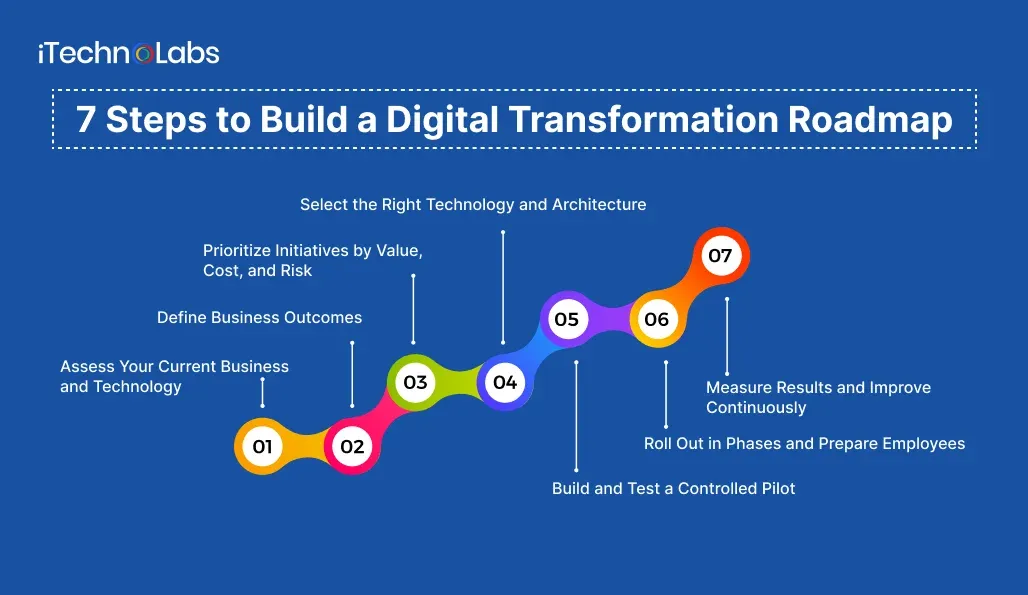
1. Assess Your Current Business and Technology
Start by documenting how work gets done today. Review the applications, databases, spreadsheets, manual approvals, reporting processes, and customer touchpoints your business depends on.
Identify where information is duplicated, employees repeat tasks, systems fail to exchange data, or management lacks timely visibility.
Your assessment should cover:
- Existing software and infrastructure.
- Manual processes and operational bottlenecks.
- Data quality, access, and ownership.
- Security, privacy, and compliance requirements.
- Internal technical skills and available capacity.
Deliverable: A current state assessment listing major problems, technical dependencies, and opportunities for improvement.
2. Define Business Outcomes
Translate the problems identified during the assessment into measurable objectives. Avoid goals such as adopting AI or moving everything to the cloud unless they connect to a business requirement.
Examples include reducing order processing time, improving inventory accuracy, shortening customer response times, or making financial reporting more reliable.
Record a baseline before implementation. Define the target, the measurement method, the accountable owner, and the review period for each objective.
Deliverable: A set of approved business outcomes with baseline measurements and accountable owners.
3. Prioritize Initiatives by Value, Cost, and Risk
Not every initiative deserves immediate investment. Rank potential projects according to business impact, implementation effort, dependencies, risk, and organizational readiness.
A workflow automation project may be a better first step than replacing an entire enterprise platform if it addresses a clear bottleneck and can be tested independently.
Classify initiatives into three groups:
- Quick wins: Focused improvements with limited dependencies.
- Foundational projects: Data cleanup, integration architecture, security controls, and infrastructure work.
- Strategic investments: Major application modernization, ERP replacement, or enterprise-wide transformation.
Deliverable: A prioritized backlog that explains why each initiative should start now, later, or not at all.
4. Select the Right Technology and Architecture
Choose technology based on the problem, existing systems, security needs, and future operating requirements.
Possible approaches include configuring existing software, connecting applications through APIs, building custom software, modernizing a legacy application, migrating selected workloads to the cloud, or introducing AI for specific tasks.
Before committing, assess integration requirements, licensing, vendor dependence, data migration, ongoing maintenance, and the skills needed to operate the solution.
Deliverable: A target architecture, technology rationale, integration plan, and documented implementation assumptions.
5. Build and Test a Controlled Pilot
Start with a bounded initiative that can validate important assumptions without exposing the entire business to unnecessary risk.
For example, a company could automate one invoice approval workflow before expanding automation across finance and procurement.
Define the pilot’s scope, users, data, acceptance criteria, testing approach, and rollback plan. Include the people who will use the system in testing. A technically functional product is not enough if it disrupts daily work or fails to solve the original problem.
Deliverable: A tested pilot with documented results and a decision to proceed, revise, or stop.
6. Roll Out in Phases and Prepare Employees
Expand the solution according to dependencies and business readiness. Coordinate integrations, data migration, training, operational support, and communication before each release.
Assign clear ownership for decisions, technical delivery, data quality, security, and change management. Train employees on the new process rather than limiting training to software features.
Use staged releases where possible. Monitor errors, adoption, user feedback, and operational performance before moving to the next group or business function.
Deliverable: A phased rollout plan, trained users, operational documentation, and named owners.
7. Measure Results and Improve Continuously
Transformation continues after launch. Compare actual performance with the baseline and targets established at the beginning.
Track indicators relevant to the initiative, such as processing time, error rates, system availability, cost per transaction, customer response time, or adoption of a new workflow.
If a project misses its targets, investigate the cause before expanding it. The problem may involve poor data, an incomplete integration, insufficient training, or an unrealistic business case.
Deliverable: A performance review, prioritized improvement backlog, and updated transformation roadmap.
How Much Do Digital Transformation Consulting Services Cost?
Digital transformation consulting services can cost around $5,000 to $25,000 for a focused assessment and roadmap, while projects that include software development, system integration, data migration, and implementation can range from $25,000 to $250,000 or more. These are indicative budgeting ranges in USD, not verified industry averages or fixed quotes. The actual cost depends on project scope, location, existing technology, and implementation requirements.
A strategy assessment is fundamentally different from a multi-system modernization program involving data migration, custom development, cloud infrastructure, security controls, and employee training. A credible estimate should separate consulting fees from implementation expenses and ongoing operating costs.
Main Cost Drivers
| Cost factor | What affects the budget | Indicative cost range (USD) |
| Discovery and planning | Departmental assessments, stakeholder workshops, process reviews, and architecture decisions | $5,000–$30,000 |
| Software development | Custom functionality, application complexity, testing, and team size | $10,000–$100,000+ |
| Integration | Number of connected systems, API complexity, and external vendors | $5,000–$50,000+ |
| Data migration | Data volume, quality, cleansing, mapping, validation, and retention requirements | $5,000–$50,000+ |
| Cloud and infrastructure | Hosting, environments, storage, monitoring, and recurring usage | $2,000–$25,000+ |
| Security and compliance | Access controls, security testing, privacy reviews, and applicable regulatory requirements | $3,000–$30,000+ |
| Change management | Training, documentation, process redesign, and employee support | $2,000–$20,000+ |
| Ongoing operations | Maintenance, licensing, support, monitoring, and future enhancements | $1,000–$10,000+ per month |
How to Estimate Your Investment
Use a bottom-up estimate rather than relying on a universal industry price.
- Define the deliverables and acceptance criteria for each phase.
- Estimate the people, skills, and effort needed for discovery, development, integration, testing, and deployment.
- Obtain quotes for software licenses, cloud services, and external dependencies.
- Include internal employee time, training, support, and maintenance.
- Identify uncertainties and document a contingency based on project-specific risks.
- Separate one-time implementation costs from recurring expenses.
Important cost caveat: No independently verified, universal pricing benchmark is established here. A specific budget range should not be published as an industry average without a reliable source. Request a scoped estimate based on your existing systems, requirements, integrations, and delivery model.
A good proposal should explain what is included, what is excluded, the assumptions behind the estimate, how changes are priced, and when payment milestones apply.
What Is a Realistic Digital Transformation Timeline?
A transformation timeline depends on scope, dependencies, technical complexity, stakeholder availability, and the amount of change employees must absorb. A focused process improvement should not be scheduled like a full enterprise modernization.
The following is an illustrative planning model, not a verified industry benchmark.
| Phase | Illustrative planning window | Main output |
| Discovery and assessment | 2 to 6 weeks | Current state assessment and business case |
| Roadmap and architecture | 2 to 4 weeks | Prioritized plan and target architecture |
| Pilot development and validation | 6 to 12 weeks | Tested solution and evaluation |
| Phased implementation | 2 to 6 months or longer | Production rollout across agreed scope |
| Optimization | Ongoing | Performance improvements and new priorities |
Planning assumption: These phases may overlap, and some can take substantially longer. The overall timeline depends on project scope and whether legacy systems, complex integrations, data remediation, or regulatory reviews are involved. The table should be validated against an actual project plan before being used for commercial commitments.
For a more reliable schedule, map dependencies, assign owners, include user acceptance testing, plan data migration and rollback, and reserve time for employee training. Review progress at defined milestones and revise estimates when new information changes the scope.
How to Choose a Digital Transformation Consulting Partner
The right partner should help your business make sound decisions before implementation begins, not simply recommend a technology stack.
Evaluate prospective partners against these criteria:
- Business understanding: Can they translate operational problems into measurable objectives?
- Technical depth: Can they explain how your existing applications, databases, and integrations will work together?
- Cost transparency: Do their proposals distinguish scope, assumptions, exclusions, recurring costs, and change requests?
- Security and governance: Can they explain access controls, data handling, testing, and applicable compliance requirements?
- Delivery discipline: Are milestones, acceptance criteria, responsibilities, and escalation procedures documented?
- Knowledge transfer: Will your employees receive documentation and the skills needed to operate the new systems?
- Evidence: Can they provide relevant, approved case studies or references that demonstrate experience with comparable challenges?
Ask the partner to explain what happens if the pilot fails, requirements change, or an integration proves more complex than expected. Their answers can reveal how they manage delivery risk.
The appropriate engagement should be determined by your business requirements and confirmed scope, rather than assuming that every transformation requires a custom-built platform.
Why Choose iTechnolabs for Digital Transformation?
iTechnolabs is an AI-first software and mobile app development company that helps businesses build, modernize, and integrate digital products. Its services include custom software development, AI development, cloud and DevOps, and web and mobile application development.
Digital transformation often requires several technologies to work together. Choosing a development partner with capabilities across software engineering, AI, and integrations can help businesses plan connected improvements around their existing systems and operational needs.
Why consider iTechnolabs?
- Business-focused planning: Define project requirements, priorities, and implementation milestones around your operational goals.
- Custom software development: Build or modernize applications to address specific workflow and system requirements.
- AI and automation capabilities: Evaluate opportunities to introduce AI, automate repetitive tasks, and improve how business systems support employees.
- Integration and modernization: Connect existing applications and plan technical improvements based on your current architecture.
- Security and quality credentials: iTechnolabs lists ISO 27001:2013 information security certification and ISO 9001:2015 quality management certification.
- Experienced development capacity: Company materials report more than 500 apps delivered, 50,000+ end users, and 300+ developers.
Before starting, discuss your current systems, the problems you want to solve, your budget expectations, and your preferred timeline with the team. These details provide a practical foundation for defining the project scope and identifying the next steps.
Conclusion
Digital transformation is most effective when technology investments are guided by clear business objectives, realistic budgets, and a phased implementation plan. By assessing existing systems, prioritizing high-impact improvements, testing solutions before wider deployment, and measuring results, businesses can reduce implementation risks and make better technology decisions.
The right roadmap does not require changing everything at once. It identifies what needs attention first, which investments can deliver measurable value, and how each phase supports long-term business goals.
If your business is planning software modernization, workflow automation, AI adoption, or system integration, start with a clearly defined scope and a practical delivery plan. The right digital transformation consulting partner can help you evaluate your options, establish priorities, and turn your goals into an actionable roadmap.

FAQs
1. What do digital transformation consulting services include?
Digital transformation consulting services can include business process assessment, technology strategy, roadmap development, architecture planning, software selection, integration planning, implementation support, change management, and performance measurement. The precise scope depends on the engagement. Before signing, confirm the deliverables, responsible parties, exclusions, implementation requirements, and post-launch support arrangements.
2. How long does a digital transformation project take?
A focused initiative may be planned over a period of weeks or months, while a broader transformation spanning multiple systems and departments may require a year or longer. These are planning considerations, not guaranteed industry averages. The actual schedule depends on requirements, integration complexity, data readiness, approvals, testing, and employee adoption.
3. How much does digital transformation cost?
There is no single price that applies to every transformation program. Digital transformation consulting services can cost around $5,000 to $30,000 for a focused assessment and roadmap, while broader implementation projects may range from $25,000 to $250,000 or more. Costs depend on consulting scope, custom development, integrations, data migration, infrastructure, security, training, and ongoing support. Ask for an itemized estimate tied to defined deliverables and assumptions. Treat broad online price ranges cautiously unless their scope, geography, date, and evidence are clearly documented.
4. What should a digital transformation roadmap include?
A useful roadmap includes current state findings, business objectives, prioritized initiatives, target architecture, dependencies, budget assumptions, milestones, security requirements, ownership, change management, and success metrics. It should also identify risks and explain how progress will be reviewed. The roadmap must be specific enough to guide investment decisions and implementation.
5. Should a business modernize all its systems at once?
Usually, a phased approach makes it easier to validate assumptions and manage dependencies. However, some foundational changes must happen together when systems share critical data or tightly coupled processes. Assess business continuity, integration constraints, migration risks, and operational readiness before choosing between phased delivery and a coordinated release.
6. How do you measure digital transformation success?
Measure success against a baseline and agreed business objectives. Relevant indicators may include processing time, error rates, operating costs, system availability, customer response time, or employee adoption. Select metrics that directly reflect the original problem, assign an owner to each metric, and review results after launch rather than treating deployment alone as success.
7. When should a business hire a digital transformation consultant?
Consider consulting support when existing systems create persistent bottlenecks, internal teams lack the capacity to evaluate alternatives, multiple applications need to work together, or a major investment requires a clear implementation plan. A useful engagement should reduce uncertainty, define priorities, and produce actionable deliverables rather than simply recommend additional technology.
8. How can a business reduce digital transformation risks?
Start with clear objectives, a realistic scope, and an assessment of technical and operational dependencies. Validate major assumptions through a pilot, protect sensitive data, test integrations, document rollback procedures, and involve employees early. Establish decision owners and review progress at milestones so problems can be addressed before they affect a wider rollout.