If you read this, you probably debate whether it’s better to construct a remote software development team rather than an in-house staff. We have experienced the best of both worlds as a Canadian mobile app development company that provides remote IT talent to enhance our clients’ internal teams. It will be explained why hiring a small software development team is the best option in this post so you can make an informed decision. We will also go over the 8 most important steps to hiring a remote software development team for your business.
If you have a software concept, the next logical step is to figure out how to make it a reality. In many cases, the question isn’t how you will develop; it is who will work on it. Whether remote developers or home-based teams are required is no more a constraint. Instead, in today’s linked world, you can put together a remote software engineering unit made up of talented people from all over the world and collaborate with them virtually as if they were next door.
We are all familiar with the concept of working remotely in today’s society, but working remotely and having a dedicated remote team are two very different things. Working remotely is becoming more popular, according to research, and it can be pretty liberating.
Our goal as a Canadian software development company is to create a remote team that functions as an extension of your in-house team, meaning they are totally dedicated to your project, follow your company’s process, and communicate directly with you. You will maintain control over the remote development process at the same time.
Table of Contents
- 8 Steps to Hire a Remote Software Development Team
- Advantages to Hire Remote Software Development Team:
- What are the responsibilities of a remote dedicated software team?
- How and Where to Find a Remote Software Development Team?
- Ways to Manage a Dedicated Remote Software Development Team
- How much does it cost to hire a remote software development team?
- Frequently Asked Questions About Hiring a Remote Software Development Team
8 Steps to Hire a Remote Software Development Team
1. Identify your requirements:
Begin by clearly defining the specific skills, experience, and technological proficiency that are crucial for the success of your project. Consider the specific programming languages, frameworks, and tools that are necessary to accomplish your goals. This detailed requirement list will help you focus your search and accurately assess potential candidates who possess the exact qualifications you need.
2. Search for talent:
Utilize a wide range of resources to find potential candidates. Leverage your professional networks, explore popular job search platforms, and consider specialized remote work websites that cater to the tech industry. By casting a wide net, you increase your chances of finding talented individuals who align with your project’s requirements.
3. Screen candidates:
Review resumes and portfolios with a discerning eye. Look for candidates who have relevant experience and skills that align with your project’s complexity and the technology stack you are utilizing. Pay attention to projects they have worked on that are similar in nature, as this will provide insights into their problem-solving abilities and their ability to handle challenges similar to yours.
4. Conduct interviews:
Set up video interviews with the most promising candidates. This will allow you to assess not only their technical skills but also their communication abilities, reliability, and cultural fit with your team. Prepare a list of questions that cover various aspects of their experience, problem-solving approach, and their ability to work effectively in a remote setting.
5. Technical assessment:
To gain a deeper understanding of the practical skills of your candidates, consider implementing a technical test or trial task. This will help you evaluate their problem-solving abilities, their attention to detail, and their approach to coding. Crafting a well-designed assessment will provide valuable insights into their capabilities and help you make an informed decision.
6. Check references:
Go the extra mile by reaching out to previous employers or clients to gather feedback on the candidate’s reliability, technical skills, and ability to work remotely. This step will provide you with a comprehensive perspective on their past performance and their ability to deliver results in a remote work environment.
7. Negotiate terms:
Once you have chosen a candidate, it’s time to negotiate the terms of the contract. Discuss important aspects such as payment, work hours, project deadlines, and any other relevant details. This step ensures that both parties have a clear understanding of the expectations and sets the stage for a successful working relationship.
8. Onboard your remote developer:
A smooth onboarding process is crucial for the success of your remote developer. Provide them with all the necessary resources, including access to relevant tools, documentation, and any additional training they may require. Introduce them to your team and make sure they understand the workflows and communication channels used within your organization. By setting up your remote developer for success, you lay the foundation for a productive and collaborative working relationship.
Advantages to Hire Remote Software Development Team:
There are plenty of advantages to hire remore software development team; some of them are given below:-
- Access to Global Talent: Hiring remote software development teams allows your company to tap into a global talent pool, not restricted by geographical boundaries.
- Cost-Effectiveness: Remote teams often reduce overhead costs related to office space, utilities, and equipment.
- Increased Productivity: Studies suggest that remote developers often have higher productivity levels as they can work in their own comfortable environments.
- Flexible Work Hours: Remote teams can work in different time zones, providing the possibility of round-the-clock productivity.
- Improved Employee Retention: Remote work often leads to better work-life balance, contributing to increased employee satisfaction and retention.
- Scalability: With remote teams, you can easily scale your operations up or down, according to the project needs.
- Diversity: A remote team brings diverse perspectives and experiences, which can foster creativity and innovation.
- Reduced Time-to-Hire: The hiring process for remote developers can be faster as it eliminates the need for relocation.
- Enhanced Technological Proficiency: Remote teams are often familiar with the latest digital tools and platforms, facilitating efficient collaboration and communication.
- Environmentally Friendly: Remote work reduces commuting, contributing to less traffic and lower carbon emissions, thus being an eco-friendly option.
What are the responsibilities of a remote dedicated software team?
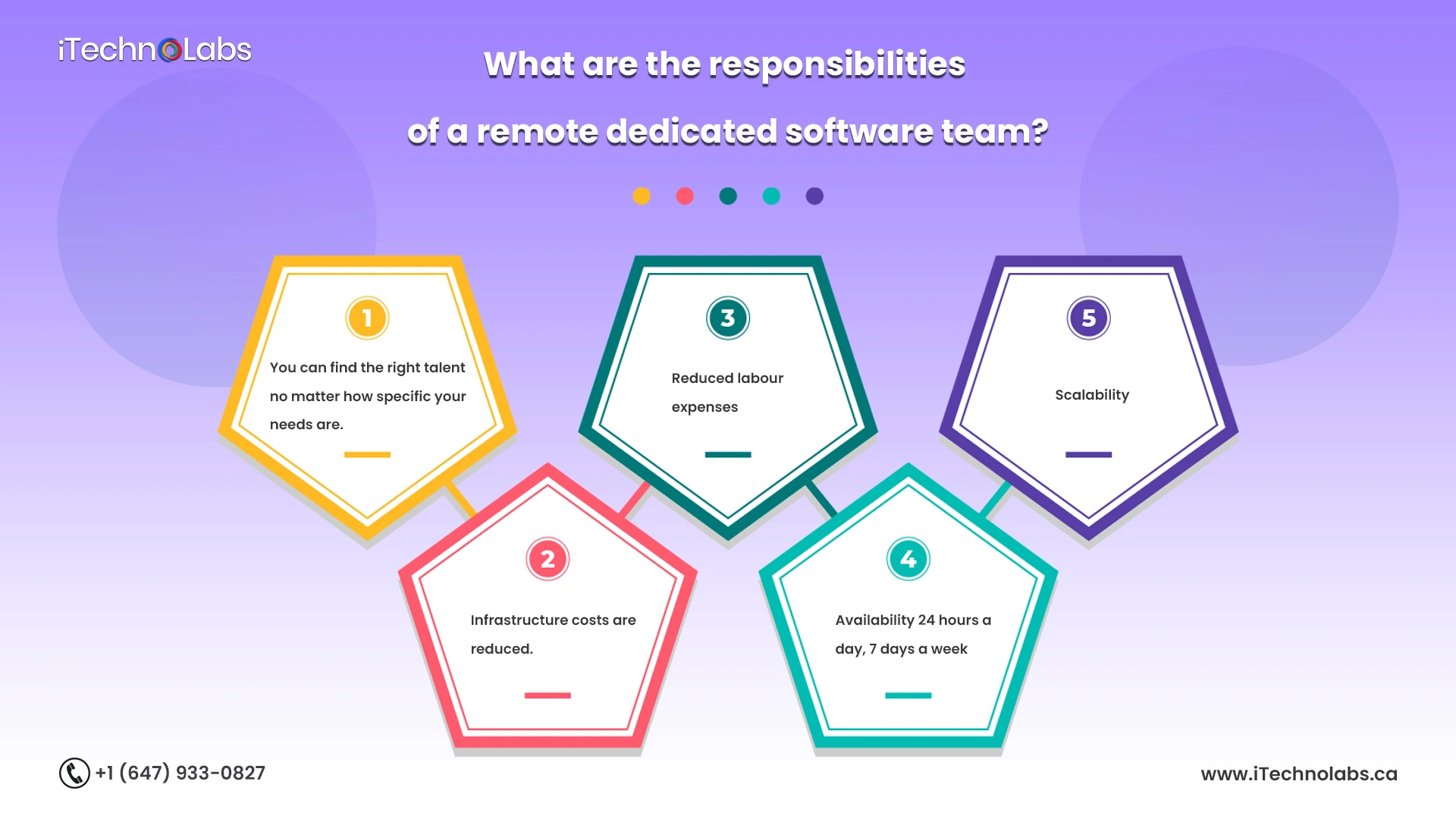
Business Analysts, Designers, and UX professionals may collaborate with front-end and back-end development engineers in a remote dedicated software team. As a client, you’ll usually deal with the Project Manager, who monitors everything and keeps your vision on track by delivering regular updates, incorporating your feedback, and keeping you informed.
Of course, the specific remote software development team structure you use will be determined by the project’s requirements, as current software development team structures differ from one organization to the next and according to your project’s needs.
Let’s take a look at the benefits of employing a remote software development team now.
1. You can find the right talent no matter how specific your needs are.
According to the 2025 Developer Skills Report, 74% of developers say it is still difficult to land tech jobs despite ongoing hiring demand, while companies continue to face challenges identifying and attracting qualified talent with specialized skills. This makes it even more challenging to locate someone specializing in a specific tech stack or niche technology, such as a developer specializing in cutting-edge technology (e.g., progressive web apps) or someone who can work on your legacy Fortran systems.
By allowing remote developer applicants to apply, you significantly increase your talent pool. This will enable you to hire developers from all around the world, including those who don’t want to relocate for a job or enjoy the freedom of working from home.
2. Infrastructure costs are reduced:
Workplaces that are appealing and aesthetically planned, in a beautiful location, and equipped with the latest technology infrastructure and systems are expensive to construct. If you hire remotely, you won’t have to spend corporate dollars on a physical office to attract talent.
3. Reduced labour expenses
It would help if you considered their compensation and legally needed benefits when recruiting a full-time employee rather than a freelancer. These costs are the responsibility of the person you hired when you recruit a remote team member. You have the option of adding advantages to your project to make it more appealing, but there is no obligation to do so.
4. Availability 24 hours a day, 7 days a week
End customers are accustomed to instant pleasure and immediate notifications in today’s world. This isn’t easy to achieve with the regular workday unless teams work the night shift.
5. Scalability
Working with a partner like us allows you to add, remove, and replace people as needed, making you more pragmatic and never compromising on your project requirements. A remote software engineering approach makes it easier to transfer resources and build a team faster than an in-house team.
How and Where to Find a Remote Software Development Team?
1. Identify Your Project Needs: Before you start the hiring process, it’s crucial to clearly identify the specific needs of your project. Understand what type of developer you need, the technologies they should be proficient in, and the level of experience required. This step will significantly streamline the subsequent hiring process as you’ll know exactly what to look for in a candidate.
2. Utilize Online Hiring Platforms: There are numerous online platforms designed to make the process of hiring remote developers easier. Sites such as Upwork, GitHub Jobs, and Toptal host a plethora of talented developers from around the world. These platforms allow you to review portfolios, conduct interviews, and even run trial tasks to assess a developer’s skills before hiring them.
3. Implement a Rigorous Screening Process: Once you have a pool of potential candidates, implementing a rigorous screening process will ensure you hire the best-fit remote developer for your project. This process could include technical tests, behavioral interviews, and reference checks. Don’t rush this step, as the quality of your project heavily relies on the developer’s skills and work ethic.
4. Ensure Clear Communication: When working with remote developers, clear and effective communication is paramount. Make sure you have a robust communication system in place that enables seamless collaboration between your local team and remote developers. Use tools like Slack, Zoom, or Google Hangouts for real-time communication and project management tools like Jira or Trello to track project progress.
5. Establish a Reliable Payment System: Lastly, setting up a reliable payment system is vital when hiring remote developers. Different countries have different payment systems, so make sure you decide on a method that is convenient for both parties. Additionally, make sure to establish clear terms regarding work hours, payment rates, and project deadlines to avoid any future misunderstandings.
If you’re still unsure about hiring and managing remote developers on your own, consider partnering with a trusted company like iTechnolabs. They can provide you with a dedicated remote software development team tailored to your project needs.
iTechnolabs handles the hiring process, ensuring that you get skilled developers without spending valuable time on recruitment and screening. Their team of professionals is well-versed in various technology stacks and committed to delivering quality work within stipulated timelines.
Get in touch with iTechnolabs today to discuss your project requirements and see how they can help accelerate your business with their remote software development services.
Hire Your Remote Software Development Team in These Countries:
Because of the significant change to the new business model of remote labour, organizations have been forced to abandon their old employment practices and rely on outsourced development teams. Working with a small group has become easier as more data security solutions and remote work tools have become available.
Of course, when it comes to outsourcing, you have a lot of options. When it comes to balancing price, talent, and quality, the following countries are some of your best bets.
Hotspots for Remote Software Development Team:
- Canada
- India
- Argentina
- Poland
- Taiwan
- China
- Ukraine
- Romania
- Brazil
- Egypt
Regardless of whatever nation you choose, it would help if you examined whether your development staff is willing to adjust their work hours to match your demands better. When our clients require it, we at iTechnolabs provide it.
Ways to Manage a Dedicated Remote Software Development Team
According to recent remote work studies, approximately 20% of full-time employees work entirely remotely, while many more follow hybrid work arrangements. Additionally, 98% of remote workers say they would like to continue working remotely in some capacity throughout their careers.
Building a successful company with remote staff is not only possible, but it may be the best option in some circumstances. After all, studies indicate that remote employees can be 13-25% more productive than their office-based counterparts in certain roles. However, to manage a successful small software developer team, you must follow these five best practices.
-
Work with different time zones:
To establish communication, find the most common working hours.
-
Establish clear work procedures:
When it comes to managing remote teams, this is critical. You must establish clear and specific procedures to be followed.
-
Improve your communication skills:
You must communicate clearly with them and ensure that your internal and remote teams are on the same page.
- Meetings should be scheduled.
- Make personal ties with all members of the team.
- Make the most of face-to-face meetings.
-
Make use of tracking
It can be tough to grasp what is going on with the project, how long each individual has worked, and what they are currently working on at times. As a result, all basic productivity measures should be recorded to:
- Monitor the team’s growth and performance over time.
- Objectively assess each employee’s skills and capabilities.
- Evaluate their contribution, value, and importance to the team.
-
Be open and honest:
To build a smooth communication flow, you should keep your remote workers updated with all the latest information. Everyone should be informed of the company’s goals, critical choices, strategy revisions, and other essential information. Ensure you keep track of everything and email it to everyone on your team, whether on-site or not.
With our assistance, you may begin the process of forming your own remote software development team for your project. Recognize your requirements and contact us; we will meet them. You can also create your group by following the methods outlined above.
How much does it cost to hire a remote software development team?
The cost to hire a remote software development team can vary significantly based on several factors. These include the complexity and scope of your project, the specific skills and experience required, the geographic location of the developers, and their level of expertise. In general, you can expect to pay anywhere from $20 to $150 per hour per developer. It’s important to remember that while hiring remote developers can often be more cost-effective than hiring in-house staff, the lowest cost option may not always provide the best quality. Always consider the value that the team will bring to your project and choose a team that can deliver high-quality results within your budget.
- Project Complexity and Scope: The cost to hire a remote software development team often depends on the complexity and scope of your project. More complex projects require more skilled developers and potentially more time to complete, leading to higher costs.
- Required Skills and Experience: If your project requires specific skills or a high level of experience, you may need to pay more to attract qualified developers.
- Geographic Location: Developers based in different regions have different cost expectations. For instance, developers in North America or Western Europe typically charge more than their counterparts in Eastern Europe or Asia.
- Level of Expertise: The level of expertise of the developers also influences the cost. Senior developers with extensive experience and a proven record of successful projects usually charge higher rates.
Remember, while cost is an important factor, it should not be the only consideration when hiring a remote software development team. The value that the team brings to your project and their ability to deliver high-quality results should also be key considerations in your decision.
Frequently Asked Questions About Hiring a Remote Software Development Team
1. What is a remote software development team?
A remote software development team is a group of developers, designers, QA engineers, and project managers who collaborate from different locations to build software products. Using modern communication and project management tools, remote teams work efficiently while providing businesses access to skilled talent worldwide.
2. Why should I hire a remote development team?
Hiring a remote development team allows businesses to access a global pool of skilled developers, designers, and engineers without being limited by geographic boundaries. It can significantly reduce operational costs associated with office space, equipment, and employee benefits while enabling faster hiring from a broader talent market. Remote teams also provide greater flexibility, allowing companies to scale resources up or down based on project requirements. As a result, businesses can build high-performing development teams more efficiently and cost-effectively while accelerating project delivery.
3. What are the key steps to hiring a remote team?
The process of hiring a remote software development team typically includes:
- Define project requirements
- Choose hiring model (freelancers, agency, in-house remote)
- Set budget and timeline
- Shortlist candidates
- Conduct technical interviews
- Test skills
- Onboard and integrate
- Monitor performance
Following these steps helps ensure a successful hiring process and project outcome.
4. Where can I find remote developers?
You can find qualified remote developers through several channels:
- Freelance Platforms – Such as Upwork and Toptal.
- Job Boards – Including LinkedIn and Indeed.
- Development Agencies – Offering dedicated remote development teams.
- Tech Communities – Such as GitHub and Stack Overflow.
The best option depends on your project complexity, budget, and long-term hiring goals.
5. How do I evaluate remote developers?
When evaluating remote developers, consider the following factors:
- Technical Expertise – Assess proficiency in relevant technologies and frameworks.
- Portfolio and Experience – Review previous projects and industry experience.
- Communication Skills – Ensure they can collaborate effectively in a remote environment.
- Problem-Solving Ability – Evaluate how they approach technical challenges.
- Cultural Fit – Determine whether they align with your team’s work style and values.
A thorough evaluation helps you hire developers who can contribute effectively to your project.
6. What is the cost of hiring a remote development team?
The cost of hiring a remote development team varies based on experience level, location, and project requirements:
- Junior Developers: $15–$40/hour
- Mid-Level Developers: $40–$80/hour
- Senior Developers: $80–$150+/hour
Factors such as project complexity, technology stack, and team size can significantly impact the overall development cost.
7. How do I manage communication with a remote team?
Effective communication is essential for successful remote collaboration. Common tools include:
- Slack or Microsoft Teams – For daily communication and team discussions.
- Zoom or Google Meet – For meetings, planning sessions, and video calls.
- Jira or Trello – For project tracking and task management.
Establishing clear communication protocols and regular check-ins helps keep projects on track.
8. What are the challenges of hiring remote developers?
Some common challenges of hiring remote developers include:
- Time zone differences
- Communication gaps
- Quality control
- Team collaboration
These challenges can be effectively managed through proper processes, tools, and leadership.
9. How much time does it take to hire a remote developer?
The time required to hire a remote developer typically ranges from 2 to 5 business days for straightforward hiring needs. However, depending on project requirements, technical screening, and candidate availability, the process can extend to 4–5 weeks.
At iTechnolabs, businesses can often hire qualified remote developers within 48 hours, helping accelerate project timelines.
10. How much does it cost to hire a remote developer?
The cost of hiring a remote developer depends on several factors:
- Application Size – Larger projects require more development effort.
- Application Category – Industry-specific requirements can affect costs.
- Features and Complexity – Advanced functionality increases development time.
- Developer Location and Expertise – Rates vary across regions and skill levels.
On average, hiring a remote developer may cost between $9,000 and $140,000 for a project, while hourly rates generally range from $15 to $90+ depending on the required expertise.
11. What are the benefits of hiring remote developers?
Hiring remote developers provides numerous business advantages:
- Reduced Overhead Costs – Eliminate expenses associated with office space and infrastructure.
- Access to Global Talent – Work with highly skilled professionals worldwide.
- Improved Scalability – Quickly scale teams up or down as project needs change.
- Higher Productivity – Remote developers often benefit from flexible work environments.
- Faster Project Execution – Access specialized expertise without lengthy local hiring processes.
These benefits make remote hiring a practical and cost-effective strategy for businesses seeking quality software development talent.