

Key Takeaways
- Agile software development builds a product in small increments, using feedback to guide what the team does next.
- Founders can participate without coding by setting priorities, reviewing working software, and making timely business decisions.
- Define an MVP around the core customer problem instead of trying to launch every planned feature at once.
- Review working software, budget updates, acceptance criteria, and risks with your development partner throughout the project.
- Agree on scope, communication, testing, intellectual property ownership, security, and how changes affect cost before development begins.
Agile software development explained in simple terms means building software in small, testable increments, gathering feedback regularly, and adjusting priorities as the product develops. Instead of committing to every detail upfront, founders and developers work together to decide what to build next, validate decisions, and improve the product as they learn.
For a nontechnical founder, this approach can make product development easier to understand and manage. However, Agile does not guarantee lower costs, faster delivery, or a successful launch. Those outcomes depend on clear priorities, capable developers, realistic budgets, and active founder involvement.
Table of Contents
What Is Agile Software Development?
Agile is an approach to developing software through collaboration, incremental delivery, feedback, and adaptation. Its foundational values favour individuals and interactions, working software, customer collaboration, and responding to change. These values guide how teams work rather than prescribing one universal project management process.
Imagine you want to build an app that connects customers with local service providers. A traditional plan might attempt to define every screen and feature before development begins. An Agile team would identify the essential customer journey first, build that functionality, test it, and use what it learns to guide subsequent work.
Agile is not a single tool or fixed methodology. Scrum and Kanban are two approaches teams can use to organise and manage work. Scrum, for example, defines accountabilities, events, and artefacts for working on complex products.
You do not need to become a software engineer to participate effectively in Agile. Your job is to communicate the business goal, explain which problems matter most, review progress, and make informed decisions when priorities change.
How Does Agile Development Work in Practice?
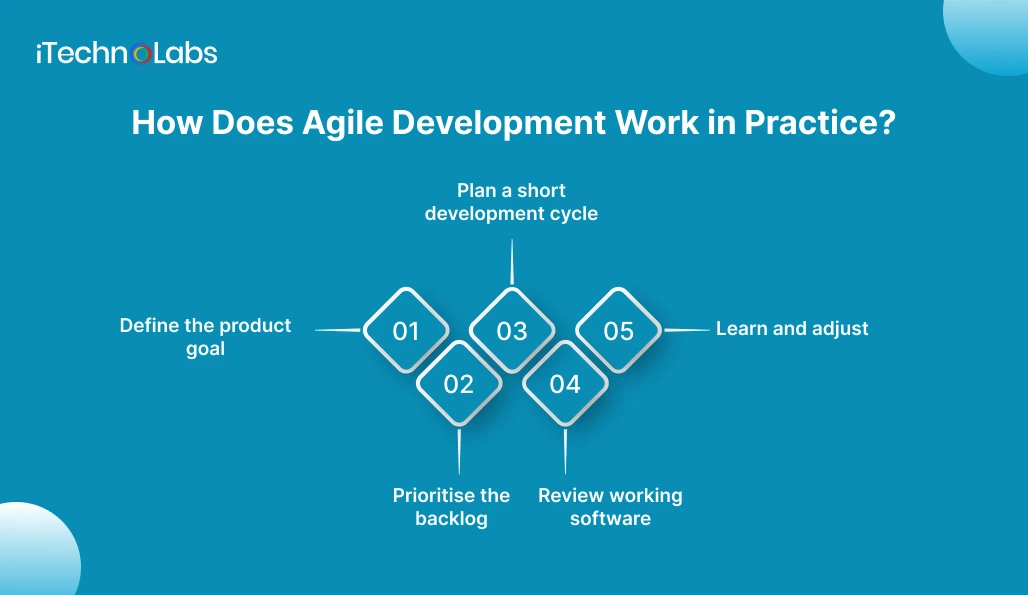
Agile teams break larger goals into smaller pieces of work, develop and test those pieces, review the results, and use feedback to determine what happens next. The exact process depends on the team and its chosen framework.
1. Define the product goal
Start by explaining the problem your product needs to solve. Describe the intended users, their needs, and the business outcome you want to achieve.
For example, rather than asking developers to build a complete appointment booking platform, define the first goal as allowing customers to find a provider, select an available time, and receive a booking confirmation.
A clear goal helps the team distinguish essential functionality from ideas that can wait. It also gives you a practical basis for evaluating whether development is moving in the right direction.
2. Prioritise the backlog
A product backlog is an ordered list of work that may include features, improvements, technical tasks, and bug fixes. In Scrum, the product backlog is an evolving source of work for the product.
Ask your team to rank proposed features according to user value, business importance, dependencies, risk, and effort. A simple priority list is often more useful than a lengthy specification filled with features that have not been validated.
3. Plan a short development cycle
In Scrum, a development cycle is called a Sprint. The official Scrum Guide describes Sprints as fixed-length events lasting one month or less.
During planning, the team agrees on a realistic amount of work and a goal for the cycle. You should understand what the team intends to deliver, what assumptions it is testing, and what might prevent completion.
Ask for a clear Sprint goal rather than a promise that every requested feature will be finished regardless of what the team discovers.
4. Review working software
Agile principles emphasise delivering working software frequently and using it to assess progress. The Agile Manifesto principles describe frequent delivery and regular reflection as important parts of the approach.
Request a demonstration at the end of each agreed cycle. Review the actual product, try important user journeys, and ask the team to explain what is complete, what remains unfinished, and what needs your decision.
5. Learn and adjust
A demonstration may reveal that a feature is confusing, an assumption was incorrect, or a dependency requires additional work. Agile gives the team a structured opportunity to respond rather than blindly continuing with an outdated plan.
Document decisions and update priorities after each review. Treat changes as choices with consequences, not as free additions to the original scope.
Agile vs Waterfall for Startup Founders
Waterfall generally organises work into sequential phases with greater emphasis on defining requirements and plans upfront. Agile uses iterative development and feedback to adapt the work as the product evolves. Real projects may combine elements of both approaches.
The important question is not which approach is universally better. It is which approach fits your project’s uncertainty, regulatory requirements, dependencies, and ability to make decisions.
| Consideration | Agile | Waterfall |
| Requirements | Can evolve as the team learns | Typically defined more fully upfront |
| Delivery | Working increments are reviewed throughout development | Delivery is often organised around planned phases |
| Feedback | Collected throughout the process | Often concentrated around planned review or acceptance stages |
| Changes | Can be reprioritised with scope and cost implications | May require formal change requests and re-planning |
| Planning | Initial direction with ongoing refinement | Greater emphasis on upfront planning |
| Best fit | Products with evolving needs and testable increments | Projects with stable requirements and predictable phase boundaries |
Consider Agile when you are building an MVP, testing an unproven business idea, or expecting user feedback to influence the roadmap. Consider a more sequential approach when requirements are stable, and the work requires tightly controlled phase approvals. Complex projects may benefit from a hybrid model.
Neither method removes the need for good management. A poorly run Agile project can waste money just as a poorly planned sequential project can. Choose based on the project’s needs, not the label used in a sales proposal.
Why Agile Can Help Nontechnical Founders
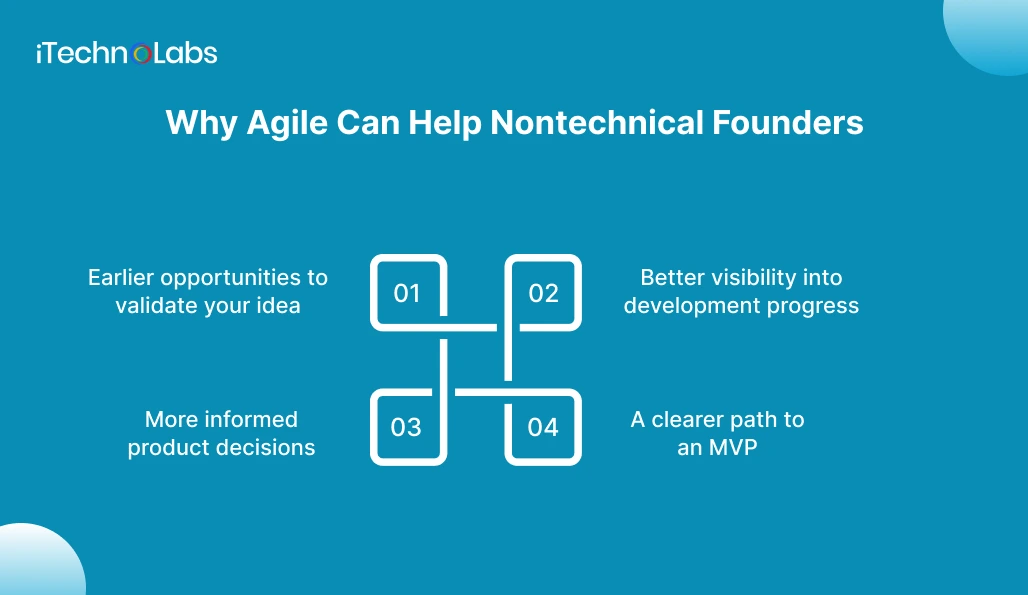
1. Earlier opportunities to validate your idea
Building smaller increments allows you to examine assumptions before investing in a larger feature set. If users struggle with the core workflow, you can investigate the problem while the product is still being developed.
Identify the riskiest business assumption first. Ask your team to build the smallest useful test that can help you evaluate it.
2. Better visibility into development progress
Regular demonstrations, task updates, and agreed Sprint goals give you more useful evidence of progress than a percentage complete reported without explanation.
Evaluate progress through working functionality, completed acceptance criteria, test results, and unresolved risks. A feature shown on a project board is not necessarily a finished feature.
3. More informed product decisions
Feedback from users and stakeholders can reveal which features matter and which are unnecessary. This gives you a basis for adjusting priorities instead of relying entirely on your initial assumptions.
Connect feature decisions to a measurable business question. Depending on your product, that might involve successful bookings, completed onboarding, qualified leads, or another meaningful user action. Establish the measurement method before development begins.
4. A clearer path to an MVP
A minimum viable product is an early version of a product designed to test important assumptions with the least amount of work needed to provide meaningful learning.
Agile can support MVP development by helping teams focus on the core user journey and expand the product based on evidence. It does not mean launching an unreliable or insecure product. Essential testing, privacy, security, and operational requirements still need to be addressed.
What Agile Does Not Guarantee
Founders should understand the limits of the approach before committing a development budget.
Agile does not guarantee a fixed final cost:
When priorities and requirements evolve, the amount of work can change. A fixed budget can still be agreed for a defined scope, but additional work must be handled through explicit trade-offs or change control.
Agile does not automatically make development faster:
Short cycles can reveal problems earlier, but slow decisions, missing requirements, technical dependencies, and repeated rework can delay delivery.
Agile does not eliminate project management:
Agree on who prioritises the work, who approves deliverables, how risks are escalated, and how the team reports budget and progress.
Agile does not mean requirements can change without consequences:
The Agile Manifesto values responding to change, but that does not remove the need to consider scope, cost, quality, and delivery commitments.
Agile does not transfer all responsibility to the developers:
Your partner can manage engineering work, but you still need to supply business context, approve important decisions, and make time for reviews.
Is Agile the Right Approach for Your Startup?
Agile is worth considering if your product idea needs validation, the roadmap may evolve, and you can participate in regular decisions. It can be particularly useful when you want to launch an MVP, learn from early users, and decide what to build next based on evidence.
Before choosing Agile, ask yourself these questions.
- Can I explain the customer problem and the first outcome the product must deliver?
- Can I make timely decisions about priorities and trade-offs?
- Can I attend demonstrations and provide actionable feedback?
- Does the development partner explain technical decisions in language I understand?
- Do we have clear agreements on scope, budget, testing, ownership, and security?
- Can we change priorities without losing sight of the product goal?
If you cannot yet answer every question, you do not necessarily need to abandon Agile. You may need a discovery phase to clarify requirements, map user journeys, assess technical risks, and define the first release.
Choose a partner who can explain the reasoning behind its process, not simply promise that Agile will make your project faster or cheaper. A good working relationship makes uncertainty visible and gives you a practical way to manage it.
Build Your Startup Product With iTechnolabs
iTechnolabs develops mobile applications, custom software, and AI-powered digital products for businesses building or improving digital products. For startup founders, the right development partner should help translate a product idea into a clear development plan, prioritise essential features, and explain technical decisions in terms of business goals.
For a nontechnical founder, choosing a development partner should mean finding a team that can translate business requirements into a practical development plan, explain technical decisions clearly, and keep product priorities connected to your goals.
At iTechnolabs, you can discuss your product concept, identify the essential features for your MVP, and explore a development approach suited to your requirements, budget, and roadmap.
Conclusion
Agile software development gives startup founders a practical way to build, test, and refine a product without committing to every feature upfront. By working in smaller increments, reviewing progress regularly, and prioritising features based on business needs, you can make more informed decisions as your product evolves.
Before choosing an Agile development partner, make sure you have a clear MVP scope, realistic budget expectations, agreed delivery milestones, and a communication process that keeps you involved without requiring you to manage every technical detail. Agile works best when your development team understands your business goals, and you have visibility into progress, risks, and upcoming decisions.
The goal is not simply to develop software faster. It is to build the right product, validate important assumptions, and use your resources thoughtfully as your startup grows.
FAQs
1. What is Agile software development in simple terms?
Agile software development is an approach to building software in small increments, reviewing working results, gathering feedback, and adjusting priorities. Rather than treating the initial plan as unchangeable, the team uses what it learns during development to guide subsequent work. The aim is to deliver useful software while adapting to changing needs.
2. Is Agile suitable for nontechnical founders?
Yes, Agile can suit nontechnical founders who can explain their business goals, prioritise features, review demonstrations, and make decisions. You do not need to write code, but you do need to participate. A development partner should explain technical trade-offs clearly and help you understand the cost, risks, and implications of product decisions.
3. Does Agile software development cost less?
Agile does not inherently guarantee lower development costs. Spending depends on the team’s rates, scope, technical complexity, dependencies, and how requirements change. Smaller increments can help identify unnecessary work earlier, but effective budgeting still requires estimates, prioritisation, expenditure tracking, and explicit decisions about what to include in each release.
4. How long does an Agile development project take?
There is no universal Agile project timeline. Duration depends on product complexity, team capacity, integrations, testing requirements, and the amount of functionality included. Scrum Sprints last one month or less, but that does not mean an entire product can be completed in one Sprint. Ask your partner for an estimate tied to defined scope and assumptions.
5. What is the difference between Agile and Scrum?
Agile is an approach guided by values and principles for software development. Scrum is a framework that teams can use to organise complex product work through defined accountabilities, events, and artefacts. A team can work in an Agile way without using Scrum, and using Scrum terminology alone does not prove that a team follows Agile principles.
6. How can I tell whether my Agile development partner is making progress?
Ask for regular demonstrations of working software, updates against agreed acceptance criteria, budget reports, and a clear list of blockers and risks. Review whether completed work advances the product goal, not just whether tasks have been marked complete. You should also have visibility into testing, defects, upcoming decisions, and changes to the forecast.











