Key Takeaways
- AI-generated code needs the same security, functionality, and architecture checks as manually written code before production.
- Automated scanners can identify known patterns, but they cannot independently establish that an application meets every business, security, and compliance requirement.
- A pre-launch audit should examine access controls, authentication, secrets, dependencies, data handling, business logic, and deployment configuration.
- CTOs should prioritize findings by business impact and exploitability, not by the number of warnings a tool produces.
- An independent AI code audit can help technical leaders make a documented launch decision and create a remediation plan.
An AI code review and audit service helps identify security vulnerabilities, logic errors, dependency risks, and architectural weaknesses in AI-generated code before it reaches production. For enterprise CTOs, passing initial tests is not enough. A pre-launch audit helps verify access controls, protect sensitive data, validate business logic, and assess whether the application meets production requirements before release.
AI coding tools can speed up development, but generated code still requires engineering validation. A feature may work as expected during a demonstration while exposing customer data, mishandling transactions, or failing under unexpected conditions. These risks make independent code review an important consideration for teams preparing AI-assisted production applications.
Table of Contents
- Why AI-Generated Code Needs an Independent Review
- What Can Go Wrong Without a Code Audit?
- What Should an Enterprise AI Code Audit Cover?
- Automated Code Review vs. an Independent Audit
- A Practical Pre-Launch Audit Workflow
- How Should CTOs Decide Whether the Application Is Ready to Launch?
- What Should You Expect From an AI Code Review and Audit Service?
- How iTechnolabs Can Help
- FAQs
Why AI-Generated Code Needs an Independent Review
An AI code review and audit service evaluates AI-generated and existing software for security vulnerabilities, logic errors, dependency risks, architectural weaknesses, and production readiness. It combines automated analysis with human engineering judgment to identify material risks, validate findings, and prioritize fixes before deployment.
AI coding tools can accelerate implementation, but generated code still needs to be tested against the application’s actual requirements. For enterprise teams, the key question is not whether AI helped write the code. It is whether the application enforces the right permissions, protects sensitive information, behaves correctly under failure, and can be maintained after launch.
A successful demonstration does not establish production readiness. A workflow may work for an administrator while exposing another customer’s records to an ordinary user. An integration may work during testing while failing when a service returns unexpected data. A dependency may introduce risk that is invisible in a typical user journey.
What Can Go Wrong Without a Code Audit?
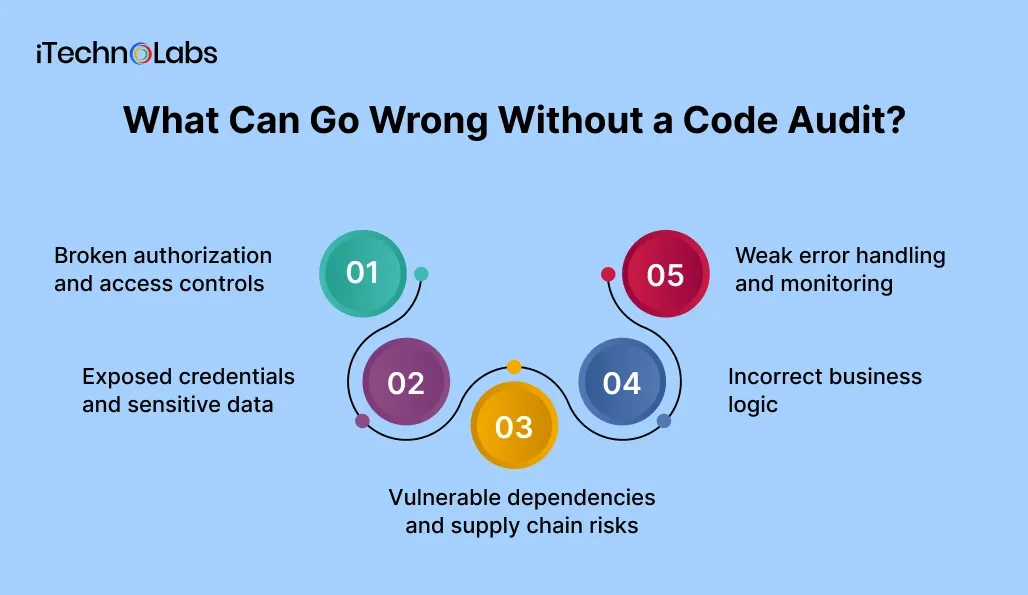
1. Broken authorization and access controls
A user interface can hide restricted features without enforcing permissions on the server. If the backend does not verify the user’s identity, role, and access to the requested resource, an attacker may be able to bypass the interface and access protected data.
For enterprise applications, reviewers should test permissions across roles, departments, customers, and tenants. They should also check whether authorization rules are consistently applied to APIs, background jobs, administrative functions, and database queries.
2. Exposed credentials and sensitive data
API keys, access tokens, database credentials, and private configuration values can end up in source code, logs, build artifacts, or client-side bundles.
A code audit should search repositories and deployment artifacts for exposed secrets, examine how credentials are stored, and verify that production access follows least privilege. If a credential has already been exposed, deleting it from the latest commit is not enough. The credential may need to be revoked or rotated, and its previous use investigated.
3. Vulnerable dependencies and supply chain risks
Generated applications may rely on third-party packages, frameworks, plugins, or APIs. These components can contain known vulnerabilities, become unsupported, or introduce unexpected changes.
Reviewers should inspect dependency manifests and lockfiles, identify vulnerable or unmaintained components, and check whether build and deployment pipelines protect dependencies and artifacts. Automated dependency scanners are useful, but findings must be evaluated in the context of the application’s actual use of each component.
4. Incorrect business logic
Not every serious defect is a conventional security vulnerability. An application can authenticate users correctly and still calculate invoices incorrectly, process duplicate payments, mishandle refunds, or apply inconsistent approval rules.
These defects require tests based on business requirements and realistic failure scenarios. An audit should establish what the software is supposed to do, then check whether its implementation and tests support that behaviour.
5. Weak error handling and monitoring
Unexpected inputs, unavailable services, repeated requests, and failed background jobs can reveal information or leave application state inconsistent.
Reviewers should check exception handling, logging, alerting, retry behaviour, and recovery procedures. Sensitive information should not appear unnecessarily in logs, and failures involving transactions should not leave partial or duplicated operations.
What Should an Enterprise AI Code Audit Cover?
A useful audit examines the application as a system, not simply a collection of code files.
- Security and identity: Review authentication, session management, role-based access, server-side authorization, input validation, encryption, and secret management.
- Architecture and maintainability: Examine service boundaries, data flows, coupling, duplicated logic, configuration management, and whether important decisions are documented. Determine whether the design supports the required operational and maintenance needs.
- Dependencies and build integrity: Inspect third-party packages, version pinning, dependency updates, repository permissions, CI/CD controls, and the integrity of release artifacts.
- Functional correctness: Validate important workflows, business rules, edge cases, and negative scenarios. Review existing unit, integration, and end-to-end tests for meaningful coverage of critical behaviour.
- Performance and reliability: Investigate likely bottlenecks, resource handling, database queries, concurrency, retry policies, and behaviour under expected operating conditions. Use load testing where the risk and scope justify it.
- Privacy and compliance requirements: Identify the categories of data processed, who can access them, where they are stored, and how they are retained or deleted. Map applicable legal, contractual, and internal requirements to specific controls. An engineering audit can provide evidence for a compliance review, but it does not itself certify compliance.
The scope should reflect the system’s architecture, data sensitivity, business impact, and intended operating environment.
Automated Code Review vs. an Independent Audit
Automated tools and human reviewers serve different purposes. A good assessment uses both where appropriate.
| Review method | Best suited to | Important limitation |
| Static analysis | Detecting suspicious code patterns without executing the application | May miss runtime behaviour and business logic errors |
| Dependency scanning | Identifying known issues in third-party packages | Does not establish whether every finding is exploitable in context |
| Dynamic security testing | Testing application behaviour while it runs | Only covers the paths, inputs, and conditions actually exercised |
| AI-assisted code review | Summarizing changes and identifying possible defects for investigation | Suggestions can be incorrect or incomplete and require validation |
| Human engineering audit | Evaluating architecture, business logic, permissions, and contextual risk | Depends on reviewer expertise, scope, access, and available evidence |
For software delivery, this means an AI review tool should support the engineering process rather than replace accountability for the release decision.
A Practical Pre-Launch Audit Workflow
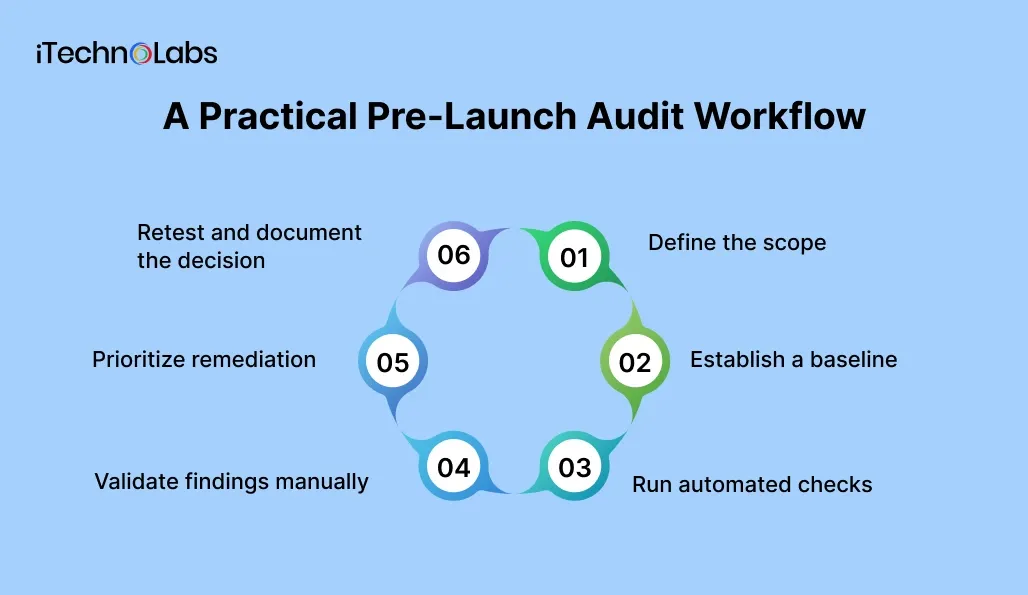
A structured review helps teams move from uncertainty to a clear decision.
Step 1: Define the scope
Document the repositories, applications, environments, integrations, data types, user roles, and critical workflows in scope. Agree on the review objectives, access requirements, and exclusions before testing begins.
Step 2: Establish a baseline
Identify the current architecture, technology stack, dependency versions, deployment process, and existing security controls. Review relevant documentation, automated test results, previous findings, and known technical debt.
Step 3: Run automated checks
Use suitable static analysis, dependency scanning, secret detection, and dynamic testing tools. Select tests based on the technology stack and risk profile. Record the tool, version, configuration, and scope so results can be reproduced.
Step 4: Validate findings manually
An engineer should confirm whether flagged issues are genuine, determine their impact, and investigate important areas automated checks may not cover. This includes access control, tenant isolation, transaction handling, and business rules that depend on application context.
Step 5: Prioritize remediation
Classify findings by severity, exploitability, affected data, business impact, and available mitigations. Separate launch-blocking issues from lower-priority improvements. Assign an owner and define the evidence needed to verify each fix.
Step 6: Retest and document the decision
Retest corrected issues, record unresolved risks, and confirm whether the agreed release criteria have been met. Any accepted residual risk should have a documented rationale and an accountable decision maker.
How Should CTOs Decide Whether the Application Is Ready to Launch?
A launch decision should be based on evidence, not a single scan score or the absence of visible errors.
Before release, confirm that critical user journeys have been tested, access controls have been verified, exposed credentials have been addressed, and important dependencies have been assessed. Confirm that deployment settings are appropriate, monitoring is operational, backups and recovery procedures have been considered, and a rollback plan exists.
The team should also distinguish between a defect that prevents launch and an improvement that can be scheduled later. A low-impact maintainability issue may not block release. An unresolved flaw that exposes customer data or allows unauthorized transactions usually demands a different response.
No audit can guarantee that software is free from vulnerabilities. Its value is in identifying material risks within an agreed scope, explaining their implications, and providing evidence for a defensible decision.
What Should You Expect From an AI Code Review and Audit Service?
A useful engagement should produce more than a list of scanner alerts. Ask for a defined scope, an explanation of the review methods, validated findings, severity ratings, evidence, remediation recommendations, and a retesting approach.
For an enterprise CTO, the final deliverable should answer four questions:
- Which findings create unacceptable risk before launch?
- What evidence supports each finding and its severity?
- What needs to change, and how will the team verify the fix?
- Which residual risks remain, and who is responsible for accepting them?
The engagement should also establish confidentiality requirements, access permissions, handling of source code and production data, reporting expectations, and the boundaries of any testing. These details matter when an external reviewer works with proprietary software or sensitive business information.
How iTechnolabs Can Help
iTechnolabs offers AI code audit services covering security analysis, code quality, architecture, performance, and actionable remediation recommendations. Its published audit process combines automated analysis with engineering evaluation to assess codebases and help teams identify issues that require attention.
For technical leaders reviewing an AI-assisted application, the first step is to establish the scope of the assessment. The relevant questions include which systems are approaching release, what data they handle, which integrations are business-critical, and what evidence is needed for internal security or governance approval.
A focused technical discussion can help establish those requirements before the review begins. Learn more about iTechnolabs AI Code Audit Services and determine whether an independent assessment fits your release plan.
FAQs
1. What is an AI code review and audit service?
An AI code review and audit service assesses software that contains AI-generated code or uses AI-assisted development workflows. It can combine automated scanning, dependency analysis, functional testing, and human engineering review to identify security, architecture, quality, and reliability risks. The exact scope depends on the application and the objectives agreed before the audit.
2. Is AI-generated code safe to deploy to production?
AI-generated code should not be considered production-ready solely because it compiles or passes a demonstration. It needs testing for security, correctness, maintainability, and operational behaviour. The appropriate level of review depends on the application’s risk, data sensitivity, user access, integrations, and business impact.
3. What does an AI code audit include?
An audit may include source code analysis, authentication and authorization checks, secret detection, dependency review, architecture assessment, business logic testing, and deployment configuration checks. The scope should be agreed in advance, with findings documented by severity and supported by evidence. Not every engagement includes penetration testing or formal compliance assessment.
4. Can automated AI code review tools replace human engineers?
No. Automated tools can help identify patterns, summarize changes, and surface possible defects, but their output can be incomplete or incorrect. Human engineers are needed to validate findings, understand business requirements, assess architecture, and decide whether a proposed fix is appropriate. Tool results should inform, not determine, the release decision.
5. When should an enterprise commission a code audit?
An enterprise should consider an independent audit before a major production launch, after substantial AI-assisted development, before integrating a newly acquired application, or when security and architecture concerns need independent evaluation. A review can also help when preparing evidence for customer security assessments or internal governance approvals.
6. How long does an AI code audit take?
The timeline depends on codebase size, architecture, integration count, data sensitivity, and the depth of testing required. A focused review of a small application may take substantially less time than an enterprise assessment involving multiple services and environments. Request a scoped estimate after the reviewer understands the system and expected deliverables.
7. What happens if the audit finds critical vulnerabilities?
The team should validate each finding, assess its potential impact, assign an owner, and agree on remediation priorities. Critical issues may require delaying release or restricting affected functionality until the risk is addressed. Corrected findings should be retested, and any unresolved risk should be explicitly documented for an accountable decision-maker.
8. Does an AI code audit guarantee compliance or eliminate security risk?
No. An audit provides evidence about the areas examined within an agreed scope. It cannot guarantee that every vulnerability has been found or that an organization meets every legal or regulatory obligation. Compliance depends on applicable requirements, operational practices, evidence, and governance beyond source code alone.