Key Takeaways
- AI voice agents combine speech processing, AI reasoning, and application integrations to handle spoken interactions and business tasks.
- Enterprise implementations require decisions about real-time versus chained voice architectures, system access, data handling, and human escalation.
- Start with one measurable workflow, define permitted actions, and evaluate task completion alongside response quality.
- Treat security, observability, testing, and ongoing maintenance as core engineering requirements, not post-launch additions.
- Select a development partner based on architecture fit, integration experience, security practices, and a clear evaluation plan.
Building AI voice agents for business involves connecting speech processing, language models, business systems, and application logic so users can complete tasks through natural spoken conversations. The right architecture depends on response time, workflow complexity, integration requirements, data controls, and how much oversight the business needs.
For enterprise technology leaders, the challenge is not simply making an AI system sound natural. It is ensuring the system can understand a request, retrieve reliable information, take only authorized actions, and recover gracefully when something goes wrong.
Table of Contents
- What Are AI Voice Agents, and How Do They Work?
- Which Voice AI Architecture Should Your Business Choose?
- Which Business Workflows Are Suitable For AI Voice Agents?
- What Does Enterprise AI Voice Agent Development Involve?
- How Should Enterprise Teams Approach Security and Governance?
- How Do You Evaluate Cost, Latency, and Business Value?
- How Do You Choose an AI Voice Agent Development Partner?
- Why Choose iTechnolabs for AI Voice Agent Development?
- Conclusion
- FAQs
What Are AI Voice Agents, and How Do They Work?
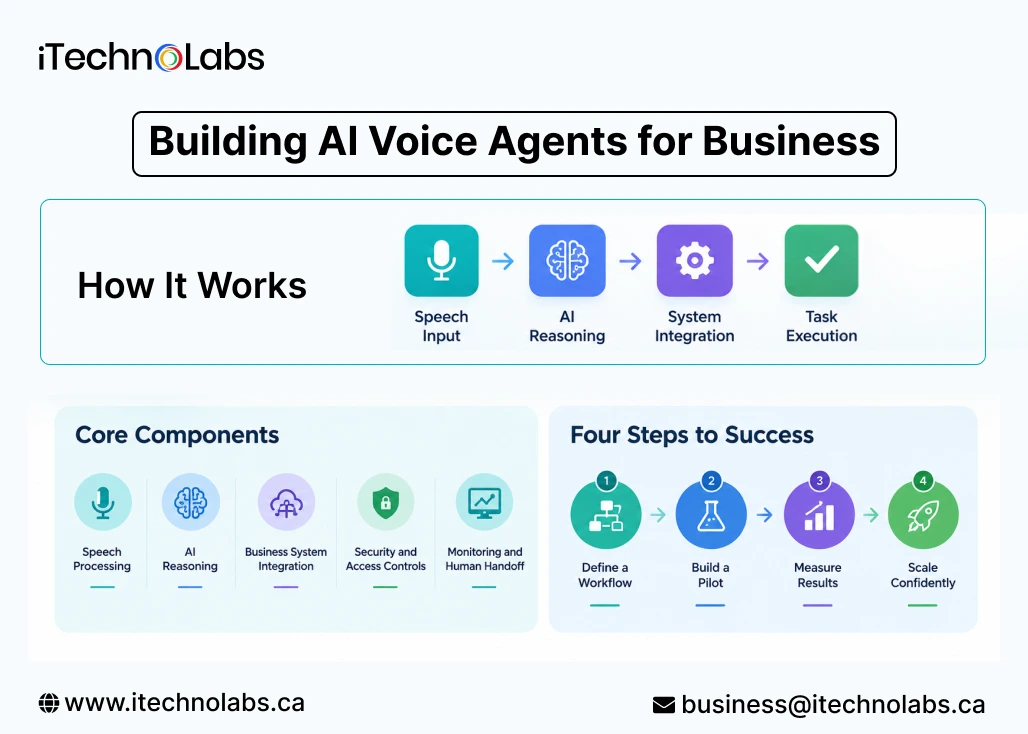
An AI voice agent is a software system that interprets spoken input, generates contextually relevant responses, and can interact with connected tools to perform defined tasks. Depending on its design, it may answer questions, qualify leads, retrieve account information, schedule appointments, or transfer a conversation to a human.
A conventional automated phone system typically routes callers through predefined menus. An AI voice agent can interpret natural language and respond to a broader range of requests within its permitted scope.
The distinction that matters to enterprise buyers is the difference between answering a question and completing a workflow. An agent that explains an appointment policy is less operationally complex than one that checks availability, updates a scheduling system, confirms the booking, and records the outcome.
Evaluate agents by the business tasks they complete accurately, rather than by conversational fluency alone.
Which Voice AI Architecture Should Your Business Choose?
OpenAI documents two broad implementation approaches: real-time speech-to-speech and chained voice pipelines. The appropriate choice depends on conversational requirements, control needs, and the existing application architecture.
Real-time speech-to-speech
A real-time architecture processes audio and generates spoken responses through a voice-capable model. It can support natural turn-taking, interruptions, and tool use within a live session.
This approach is worth evaluating when users need fluid conversations, such as troubleshooting, spoken product discovery, or complex customer support.
Its engineering requirements still include session management, authorization, interruption handling, failure recovery, and reliable connections to business systems.
Chained voice pipelines
A chained pipeline separates speech recognition, application or language model reasoning, and speech generation into distinct stages. This makes intermediate text available for inspection and gives developers more control over individual components.
A chained approach may be preferable when the business needs transcript review, explicit policy checks, structured outputs, or the ability to replace one component without redesigning the entire system.
The trade-off is that processing multiple stages can introduce additional latency and operational complexity.
How should you decide?
Compare both approaches using representative business conversations, not vendor demonstrations alone.
Assess:
- Response latency and interruption handling.
- Accuracy when capturing names, dates, account references, and other important details.
- Tool calling and integration reliability.
- Transcript availability and audit requirements.
- Failure recovery and human handoff.
- Cost per completed task.
The right architecture is the one that meets your operational requirements under realistic conditions.
Which Business Workflows Are Suitable For AI Voice Agents?
Enterprise adoption is easiest to evaluate when the initial use case has a clear beginning, a defined outcome, and limited consequences if the system needs to escalate.
| Business workflow | Potential agent responsibility | Important control |
| Customer support | Answer approved questions and route unresolved cases | Verify knowledge sources and escalate |
| Appointment management | Check availability and schedule appointments | Confirm details before writing changes |
| Sales qualification | Capture requirements and update lead records | Validate CRM fields and consent rules |
| Internal IT support | Guide users through approved troubleshooting | Restrict access to authorized systems |
| Order enquiries | Retrieve delivery or order status | Authenticate the caller before disclosing data |
| Service operations | Collect incident details and create tickets | Validate records and retain an audit trail |
These are candidate use cases, not verified iTechnolabs client outcomes. Suitability depends on the organization’s systems, data, risk tolerance, and workflow design.
Begin with one high-volume, well-defined workflow. Expand only after the agent demonstrates acceptable accuracy, task completion, and escalation behavior.
What Does Enterprise AI Voice Agent Development Involve?
A production-ready voice agent is an application system, not just a language model connected to a microphone. Its components must work together under real operating conditions.
1. Define the workflow and boundaries
Document the user’s goal, the information the agent needs, the systems it can access, and the conditions that require human involvement.
Define what the agent may read, what it may change, and which actions require explicit confirmation or approval.
2. Design the conversation and reasoning layer
Voice agent frameworks support tool use, handoffs, session management, and guardrails alongside spoken interaction.
Design prompts around explicit responsibilities, decision rules, exceptions, and tool calling conditions. Test ambiguous requests, interruptions, incomplete information, and attempts to bypass restrictions.
3. Connect business systems
The agent becomes useful when it can retrieve current information and perform authorized actions through controlled interfaces.
Typical integrations include CRM platforms, ticketing systems, scheduling applications, internal APIs, and knowledge repositories.
Put authorization and business rules in the application backend. Do not rely on the model’s instructions alone to prevent unauthorized database changes or sensitive data access.
4. Test and deploy incrementally
Use a staged rollout that begins with controlled scenarios, moves to a limited pilot, and expands only when agreed acceptance criteria are met.
Measure task completion, incorrect actions, escalation quality, latency, and cost. Maintain a repeatable test set so changes to prompts, models, or integrations can be evaluated before release.
How Should Enterprise Teams Approach Security and Governance?
The NIST Generative AI Profile provides a risk management framework for incorporating trustworthiness considerations throughout AI design, development, use, and evaluation. OWASP’s GenAI security guidance identifies risks including prompt injection, sensitive information disclosure, and excessive agency.
Voice adds practical considerations to familiar AI security problems. Spoken interactions may contain personal information, authentication details, account identifiers, or instructions intended to trigger actions in connected systems.
Before production deployment, establish the following controls:
- Identity and authorization: Authenticate callers where necessary and enforce permissions in backend services.
- Data minimization: Collect only information needed for the task. Define retention and deletion rules for audio, transcripts, and logs.
- Action boundaries: Require validation and, where appropriate, human approval for sensitive or irreversible actions.
- Prompt injection defenses: Treat spoken input, retrieved documents, and external content as untrusted data.
- Auditability: Record relevant tool calls, authorization decisions, errors, and workflow outcomes without unnecessarily exposing sensitive content.
- Escalation: Provide a clear route to a human when confidence is insufficient, the request exceeds the agent’s authority, or a technical failure occurs.
Compliance obligations depend on the data, sector, jurisdiction, and use case. A vendor’s general security statement does not establish that a specific implementation complies with every applicable regulation.
Have security, privacy, legal, and operations stakeholders review the proposed data flows and controls before launch.
How Do You Evaluate Cost, Latency, and Business Value?
No single development price or delivery timeline can be responsibly assigned to every enterprise voice agent. Requirements vary with telephony, model usage, integration complexity, security controls, expected traffic, and operational support.
A useful cost model separates initial engineering from recurring operations.
| Cost category | What to assess |
| Initial development | Discovery, architecture, conversation design, and implementation |
| Platform usage | Model, speech processing, telephony, and hosting charges |
| Integrations | APIs, identity management, CRM, and internal systems |
| Security and testing | Threat assessment, evaluation, access controls, and validation |
| Operations | Monitoring, incident handling, maintenance, and improvements |
Estimate total cost using expected conversation volume, average duration, integration requirements, and the proportion of tasks completed without human intervention.
For business value, compare the existing workflow with the proposed system. Track successful task completion, cost per resolved interaction, escalation rate, customer experience, and error remediation. Use measured pilot results rather than projected savings presented as guaranteed outcomes.
How Do You Choose an AI Voice Agent Development Partner?
Enterprise buyers need evidence that a development partner can handle application architecture, integrations, security, and operational ownership, rather than simply produce a convincing demo.
Ask prospective partners to explain:
- How they select between real-time and chained architectures.
- How they secure access to business data and connected tools.
- How they evaluate accuracy, latency, and task completion.
- How they manage failures, human escalation, and incident response.
- What monitoring, documentation, and ongoing support are included.
- How ownership of source code, configuration, and project deliverables is handled.
Request a technical discovery session before committing to a full implementation. Use it to agree on the initial workflow, architecture options, integration boundaries, acceptance criteria, and delivery plan.
Why Choose iTechnolabs for AI Voice Agent Development?
iTechnolabs provides AI development services covering AI agents, large language model integration, retrieval-augmented generation, and generative AI. The company also develops custom software and enterprise applications. These capabilities are relevant when a voice agent needs to work with existing business systems rather than operate as an isolated conversational interface.
For enterprise technology leaders, a development partner should understand the complete application environment, including APIs, access controls, data flows, testing, and ongoing maintenance. Evaluating these areas early helps identify implementation risks before they become production problems.
What iTechnolabs brings to your project
- AI and application integration: Connect AI agents, LLMs, and RAG with business applications.
- Custom enterprise software expertise: Build voice agents that integrate with CRM, ERP, and SaaS platforms.
- Security and quality credentials: Bring ISO 27001- and ISO 9001-certified management practices.
- Experience delivering software products: Leverage reported experience across 500+ apps and 50,000+ users.
- A project-specific development approach: Define workflows, integrations, security requirements, and success criteria before development.
Conclusion
Successful AI voice agent development depends on the quality of the entire system, not just the conversational model. Architecture, business integrations, access controls, testing, monitoring, and human escalation all influence whether an agent can operate reliably in an enterprise environment.
Start with one clearly defined workflow, establish measurable performance criteria, and validate the system through a controlled pilot before expanding its responsibilities. Evaluate potential development partners on their technical approach, integration capabilities, security practices, and ability to support the application after deployment.
For enterprise teams planning their next AI initiative, a structured discovery process can help clarify feasibility, identify integration challenges, and establish a practical implementation roadmap. The goal is to build a voice agent that solves a specific business problem while maintaining the control, visibility, and reliability your organization requires.
FAQs
1. What is AI voice agent development?
AI voice agent development is the process of designing, building, integrating, testing, and maintaining software that communicates through spoken language and performs defined tasks. It can involve speech processing, language models, business APIs, authentication, monitoring, and human escalation. The exact architecture depends on the workflow and its operational constraints.
2. How long does it take to build an enterprise AI voice agent?
Delivery time depends on the number of workflows, existing integrations, security requirements, testing scope, and deployment environment. A limited prototype and a production system with authentication, monitoring, and enterprise integrations are different projects. Establish a timeline after technical discovery and dependency assessment rather than relying on a universal estimate.
3. Should a business choose real-time speech-to-speech or a chained pipeline?
Real-time speech-to-speech is suited to applications requiring fluid conversation and low latency. Chained pipelines provide more visibility into intermediate text and greater control over processing stages. The choice should reflect interaction requirements, transcript needs, policy checks, integration complexity, and measured performance in representative tests.
4. Can AI voice agents integrate with existing CRM and ERP systems?
AI voice agents can connect to business systems through APIs and other supported integration methods. The implementation must define authentication, data permissions, input validation, error handling, and transaction boundaries. Read access and write access should be evaluated separately, especially when actions can affect customer records or business operations.
5. How can enterprises secure AI voice agents?
Security requires layered controls covering authentication, authorization, data minimization, secure integration, logging, and restricted tool access. Teams should also test prompt injection, unauthorized disclosure, incorrect actions, and failure scenarios. Applicable privacy and regulatory requirements must be assessed for the actual deployment, rather than assumed from a platform’s general capabilities.
6. How should a business measure AI voice agent performance?
Establish a baseline for the existing workflow, then measure successful task completion, factual accuracy, escalation rate, latency, operating cost, and user experience during a controlled pilot. Track harmful or unauthorized actions separately from ordinary errors. Expand deployment only when the results meet predefined acceptance criteria and operational owners approve the risks.