Key Takeaways
- Third party API integration connects external services to your existing applications, allowing systems to exchange data and trigger business processes.
- Successful integration starts with clear requirements, documented data flows, and an architecture that fits your security and availability needs.
- Authentication, data validation, error handling, rate limits, and version management should be designed before production deployment.
- Automated testing, monitoring, and ownership of integration failures are essential for long-term reliability.
- The right integration approach depends on business requirements, existing architecture, data sensitivity, and the third-party provider’s capabilities.
Third party API integration enables enterprises to connect applications, exchange data, and automate business processes without rebuilding every system from scratch. According to Postman’s 2025 State of the API Report, 82% of surveyed organizations had adopted some level of an API first approach. For enterprise technology leaders, the challenge is turning these connections into secure, reliable, and maintainable business infrastructure.
As organizations rely on more cloud platforms, legacy applications, external services, and AI-powered tools, disconnected systems can create data inconsistencies, manual work, and operational bottlenecks. A poorly planned integration can introduce additional risks, including exposed credentials, failed transactions, unexpected downtime, and costly maintenance.
The right approach starts with understanding your business requirements, evaluating the third-party API, selecting an appropriate architecture, and planning for security, testing, error handling, and long-term support.
This practical API integration development guide walks through each stage, helping technology leaders assess implementation options, manage technical risks, and make informed decisions about their integration projects.
Table of Contents
- What Is Third-Party Api Integration?
- Why Do Enterprises Need Third-Party Api Integration?
- API Integration Development Guide: 8 Implementation Steps
- A Practical Example: Connecting a CRM to an ERP
- How To Evaluate An Api Integration Development Partner
- How iTechnolabs Helps with Third-Party API Integration
- Conclusion
- FAQs
What Is Third-Party Api Integration?
Third party API integration connects an application to an external service through a documented API, allowing systems to exchange data or trigger actions without rebuilding the external capability. For enterprises, successful integration depends on clear requirements, secure authentication, reliable data handling, appropriate error recovery, thorough testing, and ongoing monitoring.
For enterprise technology leaders, the objective is not simply to make two applications communicate. It is to create a dependable connection that supports business operations without introducing unnecessary security risks, maintenance costs, or points of failure.
Consider an organisation that uses a CRM, an ERP platform, a payment provider, and a customer support system. Without integration, employees may need to transfer information manually or work across disconnected records. An appropriately designed API integration can move relevant information between these systems under defined rules.
Why Do Enterprises Need Third-Party Api Integration?
API integrations can extend existing systems without requiring an organisation to replace every application involved in a business process.
Common use cases include:
- CRM and ERP synchronisation: Share customer, order, inventory, or account information across business systems.
- Payment processing: Connect applications to payment gateways and reconcile transaction statuses.
- Identity and access management: Use established identity providers for authentication and access workflows.
- Reporting and analytics: Transfer operational data into reporting platforms or data warehouses.
- AI-enabled workflows: Connect approved AI services with internal applications and business data.
- Customer support automation: Synchronise tickets, customer profiles, and service updates across tools.
The value of an integration depends on the business process it improves, not on the number of APIs connected. Before selecting a provider, identify the manual work, duplicated data, delayed decisions, or operational risk the integration is expected to address.
API Integration Development Guide: 8 Implementation Steps
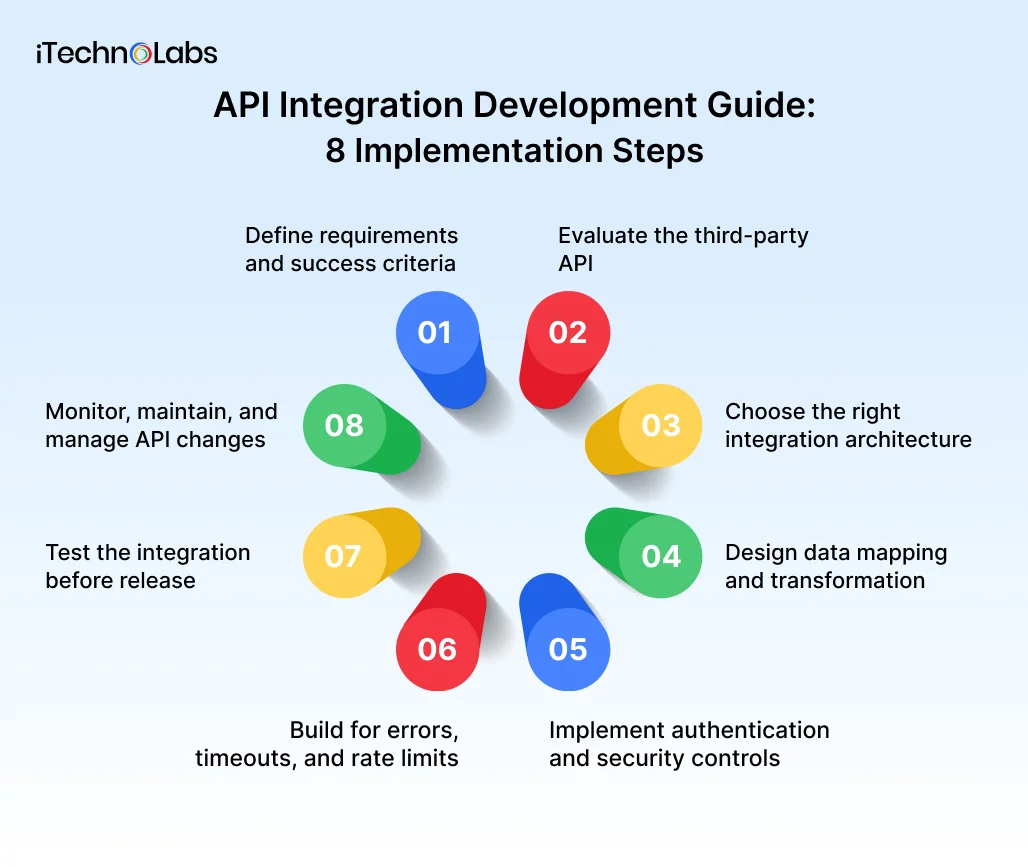
1. Define requirements and success criteria
Start by documenting the business process and the systems involved. Identify which application owns each data field, which events trigger an exchange, who can access the information, and what should happen when a request fails.
Define measurable acceptance criteria before development begins. Depending on the use case, these may include data accuracy, processing time, transaction completion, recovery behaviour, or the ability to trace a failed operation.
Also clarify the integration’s operational requirements. A process that updates a dashboard every few minutes may tolerate some delay. A workflow that confirms a financial transaction needs stricter consistency and reconciliation rules.
2. Evaluate the third-party API
Review the provider’s official documentation before committing to an integration design.
Check the available endpoints, supported request methods, response formats, authentication options, rate limits, pagination behaviour, webhook support, and versioning policy. Confirm whether the API supports the operations your business process requires.
Assess commercial and operational dependencies as well. Review usage charges, support arrangements, service commitments, data retention, regional availability, and any restrictions on storing or processing information.
Create a dependency assessment that records the provider, API version, business owner, technical owner, data exchanged, and consequences of an outage. This provides a starting point for architecture reviews and future maintenance.
3. Choose the right integration architecture
The integration pattern should reflect the workload, not a preference for a particular technology.
Direct API integration
Your application communicates directly with the external provider. This can suit straightforward workflows with limited dependencies. However, provider-specific logic can spread throughout the codebase unless it is isolated behind a dedicated integration layer.
Middleware or integration service
A separate service manages communication, data transformation, authentication, and error handling. This can help when several internal applications need the same external capability or when integration logic requires independent maintenance.
Event-driven integration
Events or webhooks trigger processing when something changes. This approach can reduce the need for continuous polling, but it requires careful handling of duplicate events, delivery delays, ordering, and retries.
Asynchronous integration using a queue
A queue separates the system producing work from the system processing it. It can help absorb temporary load and support retries, provided that consumers are idempotent and failed messages can be investigated and recovered.
There is no universally correct architecture. Select the least complex approach that satisfies the system’s reliability, security, throughput, and maintenance requirements.
4. Design data mapping and transformation
Different applications often represent the same business concept differently. One system may identify a customer by an internal account ID, while another uses an external customer reference. Dates, currency values, status codes, and optional fields can also differ.
Create an explicit mapping between source and destination fields. Define validation rules, required fields, default behaviour, and how invalid or incomplete records should be handled.
Decide how the systems will resolve conflicting updates. For example, if an employee changes a customer’s address in the CRM while an external platform submits an older address, the integration needs a documented rule for deciding which value is authoritative.
Avoid transferring fields that the receiving system does not need. Smaller, purpose-specific payloads simplify processing and limit unnecessary exposure of sensitive information.
5. Implement authentication and security controls
Security needs to be part of the integration design from the beginning.
Use the authentication method supported by the provider and appropriate to the application. OAuth 2.0 is commonly used for delegated authorisation, while other integrations may use signed requests, client credentials, or provider-issued API keys.
Follow the provider’s current security guidance and the IETF’s OAuth 2.0 Security Best Current Practice.
Key controls include:
- Store secrets in an approved secrets manager rather than source code or public configuration.
- Grant only the permissions and scopes required for the integration.
- Use encrypted transport and validate certificates.
- Rotate credentials according to a defined policy and revoke compromised credentials promptly.
- Validate incoming data and verify authorisation for the specific resource or action.
- Remove sensitive values, access tokens, and personal data from routine logs.
- Review data residency, retention, privacy, and contractual obligations before sending information to an external provider.
Treat responses from a third party as untrusted input. A provider’s reputation does not remove the need to validate response structure, content, and expected behaviour.
6. Build for errors, timeouts, and rate limits
An API request can fail even when the integration code is correct. The provider may be unavailable, a request may time out, credentials may expire, or usage limits may be reached.
Define how the integration handles expected failure conditions.
- Set connection and response timeouts appropriate to the operation.
- Retry transient failures with bounded exponential backoff and jitter.
- Respect rate limit instructions, including a provider’s Retry-After header where applicable.
- Do not repeatedly retry invalid requests or authentication failures without addressing their cause.
- Use idempotency controls for operations that create records, submit payments, or trigger other consequential actions.
- Record failed operations for investigation and, where appropriate, controlled replay.
- Provide a fallback or escalation path when an external dependency remains unavailable.
HTTP response codes help distinguish successful requests, client errors, rate limiting, and temporary server failures. The MDN HTTP status code reference explains these response categories.
A timeout deserves particular attention. It does not always mean that the external operation failed. The provider might have processed a request but failed to return its response in time. Retrying a non-idempotent operation without checking its status can create duplicate transactions or records.
7. Test the integration before release
Testing should verify business behaviour as well as technical connectivity.
A practical test plan includes:
- Unit tests: Check mapping rules, validation, and error handling in isolation.
- Contract tests: Confirm that requests and responses match the documented API contract.
- Integration tests: Verify communication between your application and the provider in an appropriate test environment.
- Negative tests: Check invalid payloads, expired credentials, missing permissions, timeouts, and unexpected responses.
- Load and rate limit tests: Evaluate behaviour under expected traffic and provider constraints.
- Security tests: Check access controls, secret handling, input validation, and exposure of sensitive information.
- Recovery tests: Verify that failed operations can be reconciled or replayed safely.
Use sandbox environments where available. Before launch, define rollback procedures, operational ownership, and the conditions under which a release should be paused.
8. Monitor, maintain, and manage API changes
An integration is an ongoing dependency, not a one-time development task.
Monitor request success rates, latency, timeout frequency, rate limit responses, queue depth, and failed processing. Track business outcomes as well, such as whether an order was synchronised or a customer record was updated correctly.
Centralise logs and use correlation IDs to trace a transaction across systems. Set alerts around meaningful operational thresholds, with clear ownership and escalation procedures.
Maintain an inventory of API endpoints, credentials, owners, versions, and provider dependencies. Review release notes and deprecation notices so that changes do not arrive as unexpected production failures.
A technically successful API response does not necessarily mean the business process completed correctly. Reconciliation checks should verify important outcomes, especially when financial records, customer data, or order processing are involved.

A Practical Example: Connecting a CRM to an ERP
Imagine an enterprise that needs customer orders created in its CRM to appear in its ERP system.
First, the team defines which application owns customer details, order identifiers, prices, and order status. It then documents the event that triggers synchronisation and maps the required fields between the two systems.
The integration authenticates with the ERP API, validates the order payload, and submits the request. If the ERP accepts the order, the integration records the external order ID and updates the CRM with the confirmed status.
If the request times out, the integration checks whether the ERP created the order before attempting another submission. If the provider is temporarily unavailable, the request can be queued for controlled processing, subject to the architecture and business requirements.
Monitoring tracks failed synchronisations and unresolved orders. A reconciliation process identifies records that remain inconsistent between the two systems.
This is an illustrative workflow, not a documented iTechnolabs client case study or a claim of measured project results. The exact design depends on the CRM, ERP, provider API, and business rules.
How To Evaluate An Api Integration Development Partner
Enterprise teams should assess more than the ability to make an API request succeed.
Ask prospective development partners how they approach:
- Architecture reviews and integration with legacy applications.
- Authentication, authorisation, secrets management, and data protection.
- Retry policies, idempotency, reconciliation, and recovery.
- Automated testing and release management.
- Monitoring, incident response, documentation, and long-term maintenance.
- Ownership of source code, credentials, integration logic, and operational procedures.
Request a proposed architecture, a clear scope, identified dependencies, acceptance criteria, and a plan for handling provider changes. Ask for relevant, verifiable examples of previous integration work rather than relying only on general capability claims.
An experienced integration team should be able to explain its trade-offs, identify risks early, and show how the finished system will be operated and maintained.
How iTechnolabs Helps with Third-Party API Integration
Connecting third-party APIs to your existing software requires careful planning, secure data exchange, and reliable communication between systems. iTechnolabs helps businesses build and modernize software integrations that connect applications, automate workflows, and support changing business requirements.
Our team can help you assess your existing architecture, identify integration requirements, select appropriate implementation approaches, and address technical considerations such as authentication, data mapping, error handling, and API security. We also consider testing, monitoring, and ongoing maintenance to help keep integrations dependable as your software evolves.
Whether you need to connect enterprise platforms, extend an existing application with an external service, or incorporate AI capabilities into your workflows, the right integration approach starts with understanding your systems and business objectives.
Conclusion
Third party API integration can help enterprises connect disconnected systems, reduce manual processes, and extend existing software without replacing every application. Achieving these outcomes requires a clear implementation strategy, secure authentication, well-defined data mapping, appropriate error handling, thorough testing, and ongoing monitoring.
For CTOs and IT directors, the key decision is not simply which API to connect. It is how to build an integration that fits the existing architecture, protects business data, handles failures predictably, and remains maintainable as systems evolve.
Before committing to development, document your requirements, assess provider dependencies, define acceptance criteria, and establish who will own the integration after launch. These steps help your team make informed technical decisions and reduce avoidable implementation risks.
FAQs
- What is third-party API integration?
Third-party API integration connects your application to an external service through a documented interface. It allows authorised systems to exchange information or request actions without requiring you to build the external capability yourself. The implementation must account for authentication, data mapping, errors, security, and ongoing maintenance.
- How does API integration development work?
API integration development typically begins with requirements and provider evaluation, followed by architecture design, authentication, data mapping, implementation, and testing. After deployment, teams monitor performance, investigate failures, reconcile important records, and adapt the integration as business requirements or provider APIs change.
- How long does API integration take?
The timeline depends on the provider’s documentation, authentication requirements, data complexity, number of systems, security reviews, testing needs, and legacy constraints. A straightforward connection may require substantially less work than an integration involving several applications, complex business rules, and strict recovery requirements. Estimate the timeline after technical discovery.
- What are the main risks of third-party API integration?
Common risks include credential exposure, insufficient access controls, data mapping errors, provider outages, rate limits, API deprecations, and duplicate processing. Teams can reduce these risks through least privilege, input validation, monitoring, bounded retries, idempotency, reconciliation, and a documented maintenance plan.
- How do you secure an API integration?
Use the provider’s recommended authentication mechanism, least privilege permissions, encrypted transport, protected secrets, and validated input and output. Monitor access, remove sensitive information from logs, rotate credentials appropriately, and test authorisation boundaries. Review the provider’s security requirements and applicable privacy obligations before moving production data.
- What happens when a third-party API goes down?
The integration should respond according to the business impact of the failure. Depending on the operation, it may queue work, retry transient errors within limits, activate a fallback, or alert an operator. Important transactions should have a reconciliation process so teams can determine whether an operation completed before retrying it.
- Should enterprises use middleware or direct API integration?
Direct integration can suit a limited, straightforward connection. Middleware or a dedicated integration service can be more appropriate when several systems share integration logic or when transformation, monitoring, and access controls need to be centralised. The right choice depends on existing architecture, operational ownership, and long-term maintenance needs.
- How should API integrations be maintained?
Maintain an inventory of providers, endpoints, versions, credentials, and owners. Monitor latency, failures, and business outcomes. Review provider release notes, test changes in a non-production environment, rotate secrets according to policy, and document recovery procedures. These practices help teams detect changes before they disrupt important workflows.