Key Takeaways
- A freelancer can be the right choice for a clearly defined project, a specialist task, or an early prototype with limited technical requirements.
- An app development company can be a better fit when your product needs several disciplines, coordinated delivery, structured testing, and long-term technical support.
- The cheapest initial quote does not necessarily represent the lowest total cost. Scope changes, coordination, maintenance, and rework all affect your budget.
- Before signing an agreement, clarify ownership of the code, access to repositories, documentation, security responsibilities, and post-launch support.
- Choose your development partner based on your product roadmap, internal capabilities, budget, and tolerance for delivery risk, not company size alone.
The 2026 Stack Overflow Developer Survey reports that freelancers and sole proprietors account for 11% of its respondents, up from 4% in 2025. Meanwhile, the U.S. Bureau of Labor Statistics projects software developer employment to grow by 15.8% between 2024 and 2034. These figures highlight a changing development workforce, but choosing between a freelancer and an app development company still comes down to your product requirements.
For startup founders, the decision affects more than the initial development budget. It determines who handles product design, technical architecture, quality assurance, deployment, and maintenance. A freelancer may be the right fit for a focused MVP or a clearly defined feature. A development company may be better suited to a product that requires multiple specialists and coordinated delivery.
Before committing your startup’s runway to either option, compare the total cost, delivery responsibilities, technical expertise, ownership terms, and support available after launch. The right partner is the one that matches your current needs while giving your product a practical path forward.
Table of Contents
- App Development Company vs Freelancer: Which Should You Choose?
- What Is the Difference Between a Freelancer and an App Development Company?
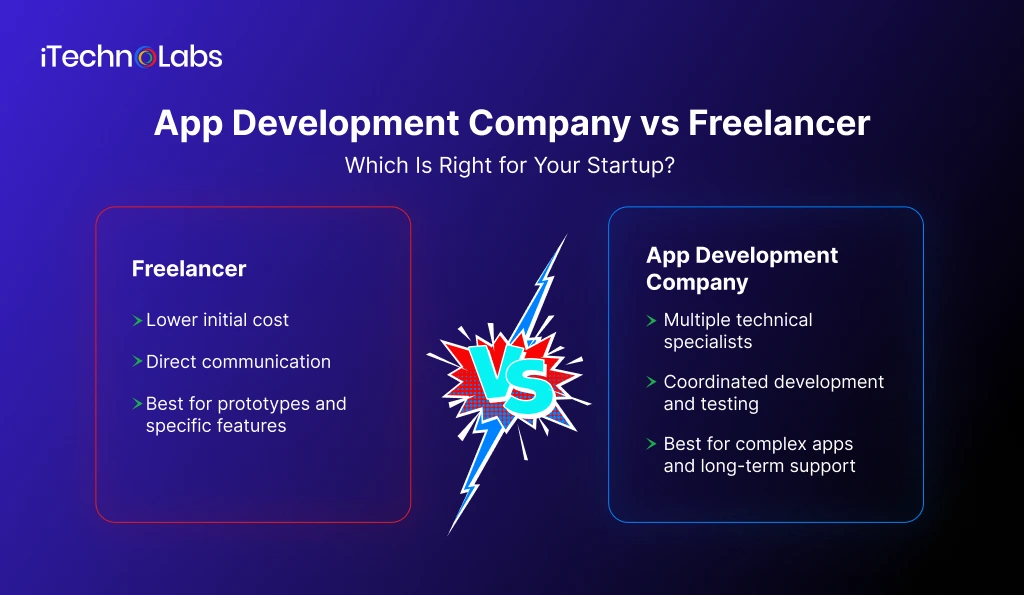
- App Development Company vs Freelancer: Side by Side
- Cost: Is a Freelancer Actually Cheaper?
- Speed to Market: Who Can Launch Your MVP Faster?
- Quality, Testing, and Technical Risk
- Communication and Accountability
- Ownership, Security, and What Happens After Launch
- When Should a Startup Choose a Freelancer?
- When Should a Startup Choose an App Development Company?
- A Practical Decision Framework for Founders
- The Final Verdict
- From Startup Idea to Launch-Ready App: Build With the Right Team
- FAQs
App Development Company vs Freelancer: Which Should You Choose?
An app development company vs freelancer comparison comes down to the skills, accountability, and support your product requires. A freelancer can be a strong choice for a focused build or specialist task. A development company may be better suited to a product requiring design, engineering, testing, integrations, and ongoing maintenance. Your budget matters, but so do delivery risk and future development needs.
For a startup founder, this decision affects more than who writes the code. It influences how quickly you can validate your idea, how much time you spend managing development, and how easily your product can evolve after launch.
A prototype with a narrow feature set has different requirements from a customer-facing app that handles payments, personal information, third-party integrations, or complex business workflows.
The goal is not to hire the biggest team or the cheapest developer. It is to find the right delivery model for the stage your product is in.
What Is the Difference Between a Freelancer and an App Development Company?
Hiring a freelance app developer
A freelancer is an independent professional who contracts directly with your business to perform agreed work. Depending on their experience, they may handle product development independently or specialise in a particular area, such as iOS development, Android development, Flutter, React Native, or backend engineering.
You generally communicate directly with the person doing the work. This can make decisions faster and simplify collaboration when the scope is well defined.
However, you may need to coordinate separate specialists for design, backend development, testing, deployment, and maintenance if one freelancer does not cover those responsibilities.
Hiring an app development company
An app development company provides software development services through an organisation that may include developers, designers, project managers, quality assurance specialists, and other technical professionals.
The exact team structure varies by provider and engagement model. Some companies assign a dedicated team, while others allocate specialists according to project needs.
For a founder, the potential advantage is coordinated delivery across multiple disciplines. The tradeoff is that you need to understand the company’s communication process, team allocation, pricing structure, and decision-making responsibilities.
Neither model guarantees quality. An experienced freelancer may outperform a poorly managed agency, while a capable development company may provide support that one individual cannot reasonably deliver alone.
App Development Company vs Freelancer: Side by Side
| Factor | Freelancer | App development company |
| Initial cost | May cost less for narrowly scoped work | May involve broader team and management costs |
| Communication | Often direct access to the developer | May involve a project manager and several specialists |
| Skill coverage | Depends on the individual’s expertise | May provide multiple complementary disciplines |
| Project management | Often handled by the founder or freelancer | May be included in the engagement |
| Delivery capacity | Depends on individual availability | May offer additional resources, subject to staffing |
| Quality assurance | Must be explicitly arranged | May have a dedicated testing process |
| Continuity | Can depend heavily on one person’s availability | May offer team continuity and knowledge transfer |
| Flexibility | Can work well for small, changing tasks | Depends on contract terms and team structure |
| Maintenance | Must be agreed separately | May be available through a support agreement |
| Best fit | Focused projects and specialist work | Multi-discipline products and longer roadmaps |
This comparison describes typical engagement differences, not guaranteed outcomes. Ask each prospective partner to explain exactly who will perform the work, how delivery will be managed, and what happens when requirements change.
Cost: Is a Freelancer Actually Cheaper?
A freelancer may be the more economical option when you need a limited amount of development work and can manage the remaining responsibilities internally. A company may justify a larger budget when it reduces coordination overhead or provides several skills that would otherwise need to be sourced separately.
The important distinction is between the quoted development fee and the total cost of getting your product built, launched, and maintained.
What affects the total cost?
Consider five areas before comparing proposals.
- Development scope: A single feature, clickable prototype, or limited proof of concept requires a different level of effort from a complete mobile application with authentication, payments, an administrative dashboard, and third-party integrations.
- Design and product discovery: If your idea still needs user research, feature prioritisation, wireframes, or technical planning, establish who will perform that work. Do not assume it is included in a developer’s quote.
- Testing and release preparation: Ask whether the estimate includes device testing, bug fixing, app store submission support, deployment, and documentation. A low quote can be difficult to compare fairly if important deliverables are excluded.
- Project coordination: Your time has a cost. If you must manage several independent contractors, write detailed specifications, resolve dependencies, and coordinate releases, include that responsibility in your decision.
- Maintenance and future changes: Your product may need operating system updates, security fixes, performance improvements, new features, and infrastructure changes after launch. Confirm how support is priced and how quickly issues will be addressed.
How to compare quotes fairly
Ask every candidate to price the same scope. Request a breakdown of deliverables, assumptions, exclusions, payment milestones, change requests, testing, deployment, and post-launch support.
Compare the expected cost of the complete engagement rather than selecting the lowest headline figure.
Avoid accepting an unrealistically precise estimate before the requirements are understood. If the scope is still evolving, a paid discovery phase or a clearly bounded initial milestone can help establish what should be built next.
Speed to Market: Who Can Launch Your MVP Faster?
For a startup, time matters because development competes with customer discovery, fundraising, sales, and other demands on limited runway.
A freelancer may move quickly when one experienced developer can complete the required work without waiting on other specialists. A company may move faster when the project requires parallel work across design, frontend development, backend engineering, and testing.
The result depends on the actual team, the quality of requirements, the complexity of integrations, and the speed of decision-making.
A company with several developers is not automatically faster. More people can introduce coordination overhead, and adding developers to an unclear project does not remove uncertainty.
Likewise, one freelancer can become a bottleneck if every feature depends on that person’s availability.
What founders should ask
- Who will work on the project, and how much time will they commit?
- What are the first two or three delivery milestones?
- Which decisions or materials must we provide before work can proceed?
- How will you handle unexpected technical problems?
- What must be completed before the app is ready for release?
Evaluate delivery plans rather than accepting promises about launch speed. A credible proposal explains the assumptions behind its timeline and identifies the dependencies that could delay it.
Quality, Testing, and Technical Risk
An app can look finished while still containing problems that affect users, data, or business operations. Testing, code review, monitoring, and deployment planning help identify those problems before and after release.
A freelancer’s ability to cover these responsibilities depends on their skills and the agreement. An app development company may provide dedicated quality assurance and engineering processes, but these should be verified rather than assumed.
Ask candidates to explain how they approach:
- Functional testing and regression testing.
- Device and operating system compatibility.
- API integrations and error handling.
- Authentication, permissions, and sensitive data.
- Code reviews and version control.
- Release management, monitoring, and bug resolution.
For a simple internal prototype, a lightweight testing process may be appropriate. For an app handling payments, personal information, or business-critical operations, security and release readiness deserve greater attention.
Ask to see a sample test plan, delivery checklist, or technical documentation with confidential information removed. Find out who approves releases, how defects are tracked, and what happens if a critical issue appears after launch.
Communication and Accountability
Direct communication is one of the strongest reasons founders choose freelancers. You can discuss technical decisions with the person writing the code, often without additional management layers.
The challenge is that you may also become the project manager, product owner, and point of coordination between several contractors.
A development company may provide a project manager or delivery lead who coordinates work and reports progress. That structure can reduce the founder’s day-to-day workload, although it also introduces an additional communication channel.
Neither approach is inherently better. The question is how much management responsibility your startup can absorb.
Before choosing a partner, agree on:
- A named point of contact.
- The frequency of progress updates and demonstrations.
- Where tasks, decisions, and technical issues will be recorded.
- How quickly questions should receive a response.
- Who can approve scope changes and additional spending.
- How disagreements and missed milestones will be handled.
Clear accountability matters more than the number of people on the team. You should always know what has been completed, what remains, what is blocked, and what decisions are needed from you.
Ownership, Security, and What Happens After Launch
Your app is a business asset. Make sure your agreement protects your ability to operate, maintain, and improve it.
Intellectual property ownership and usage rights depend on the applicable law and contractual terms. The World Intellectual Property Organization’s startup guide recommends addressing intellectual property rights in agreements with third-party contractors.
Before development starts, document:
- Ownership or licensing rights for source code, designs, and other deliverables.
- Treatment of pre-existing libraries, reusable tools, and third-party software.
- Access to source code repositories and project documentation.
- Ownership and control of cloud, app store, and other production accounts.
- Confidentiality, data access, and security responsibilities.
- Warranty periods, maintenance terms, and knowledge transfer.
- Handover procedures if the relationship ends.
Do not assume that paying an invoice automatically resolves every question about ownership or access. Review the contract carefully and seek qualified legal advice where appropriate, especially if your product will operate across multiple countries.
Keep critical accounts under your company’s control and ensure that the agreement clearly establishes the rights and access your business needs. This makes it easier to continue development if you change providers or build an internal team later.
When Should a Startup Choose a Freelancer?
A freelancer can be a strong fit when the work is clearly bounded, and the required expertise is well understood.
Consider hiring a freelancer if:
- You need a prototype to test a specific product assumption.
- You already have a technical cofounder who can review code and architecture.
- You need a specialist to add a feature to an existing application.
- Your internal team can manage product design, testing, and release coordination.
- The project has a limited scope and straightforward dependencies.
- You have a documented handover plan and a backup for ongoing support.
For example, a startup with an existing application may need a React Native specialist to resolve a defined performance issue. If the requirements are documented and another engineer can review the work, a freelancer may be the practical choice.
The strongest reason to choose a freelancer is not simply a lower quote. It is that the project is manageable by one person and your business can cover the responsibilities outside that person’s scope.
When Should a Startup Choose an App Development Company?
A development company may be the better option when your product requires several disciplines, or you need a partner to coordinate a larger share of delivery.
Consider this model if:
- Your MVP needs product design, mobile development, backend engineering, and testing.
- You do not have an internal engineering team to manage technical decisions.
- Your app requires multiple integrations or complex business workflows.
- You need a defined process for releases, documentation, and quality assurance.
- You expect ongoing development after the initial launch.
- You want access to different specialists without recruiting each one independently.
For example, a startup building a customer-facing app with user accounts, payment processing, an administrative portal, and external API integrations may need coordinated work across several technical areas.
A capable company can organise those responsibilities under one engagement. However, verify the proposed team’s experience, named roles, deliverables, and support commitments before signing.
A company is most valuable when its team structure and delivery process solve a real problem for your startup. If the work only needs one specialist for a short period, a larger engagement may add unnecessary cost.
A Practical Decision Framework for Founders
Use these questions to narrow your options before requesting proposals.
| Your situation | Starting point |
| You need a small, clearly specified feature | Consider a freelancer |
| You have an internal engineer who can lead development | Consider a freelancer or specialist contractor |
| You need several skills coordinated under one plan | Consider an app development company |
| You have no technical person to oversee the build | Consider a company with a defined delivery process |
| You need an ongoing roadmap after launch | Compare team continuity and maintenance commitments |
| You are uncertain what should be built first | Start with product and technical discovery |
Treat this table as a starting point, not a final verdict. Interview candidates using the same requirements, request a written proposal, and compare how each candidate explains tradeoffs and manages risk.
A good partner should be able to tell you when your proposed scope is too ambitious, which features can wait, and what information is needed before the team can estimate the work responsibly.
The Final Verdict
The right choice in the app development company vs freelancer decision depends on the work you need done and the responsibilities your startup can manage internally.
A freelancer can be the right partner for a prototype, a focused feature, or specialist engineering work. A development company can be a better fit for a multi-discipline MVP, coordinated delivery, and a product that needs continued engineering support.
Do not choose based on price alone. Compare scope, technical capability, communication, ownership terms, testing, and maintenance. A smaller engagement that fits your immediate needs can be smarter than an unnecessarily large team. A coordinated team can also be worth the investment when managing separate contractors would distract you from building the business.
The best decision is the one that gives you a clear path from your current product stage to the next, with costs, responsibilities, and risks understood before development begins.
From Startup Idea to Launch-Ready App: Build With the Right Team
iTechnolabs is a software and mobile app development company offering development services for iOS, Android, Flutter, React Native, and custom software projects. The company’s published credentials include ISO 27001:2013 and ISO 9001:2015 certifications, along with a reported track record of 500+ apps delivered.
If you are building an MVP, you need more than someone who can write code. You need a clear development scope, sensible technical decisions, a plan for testing, and a roadmap for what happens after launch. The right engagement should fit your budget and product stage without creating avoidable complexity.
iTechnolabs can help you evaluate your app requirements, identify the technical skills your project needs, and discuss an appropriate development approach before you commit to a build.
Whether you are validating a new idea or preparing a more feature-rich product, start with a conversation about your goals, priorities, and constraints.
FAQs
1. Is an app development company better than a freelancer?
Neither option is universally better. A freelancer may suit a focused project that one person can deliver, while a development company may suit products requiring several skills and coordinated project management. Compare the actual team, deliverables, testing process, communication, and support commitments before deciding which model fits your startup.
2. Is hiring a freelance app developer cheaper?
A freelancer may have a lower initial quote for a limited scope, but the total cost depends on what is included. Design, testing, project management, deployment, and maintenance may need separate arrangements. Compare equivalent deliverables and account for the time your team will spend managing the engagement before deciding which option costs less.
3. Should a startup hire a freelancer to build an MVP?
A freelancer can be a good option when the MVP has a defined scope, the required skills are available from one person, and the startup can handle product decisions and technical oversight. If the MVP needs several specialists and ongoing coordination, compare a development company or a small dedicated team before committing.
4. How do I evaluate an app development company?
Ask for relevant project examples, proposed team roles, a delivery plan, a testing approach, communication arrangements, and clear pricing assumptions. Verify the claims you receive and speak with references where possible. Review source code access, ownership terms, security responsibilities, and post-launch support before signing an agreement.
5. Who owns the source code when hiring a freelancer or company?
Ownership depends on the applicable law, the contract, and the rights associated with pre-existing and third-party components. Your agreement should specify ownership or licensing of the deliverables, when rights transfer, and what access your business retains. Have the terms reviewed by qualified legal counsel if ownership is important to your product.
6. Can I switch from a freelancer to an app development company later?
Yes, a transition is possible when you have the necessary contractual rights, source code access, documentation, credentials, and technical handover. Before development begins, define how another team can take over the work. A code review and technical assessment can help identify missing documentation, dependencies, and issues that need attention.