Key Takeaways
- Choose a monetization model based on the value your app delivers, how often users return, and what they are willing to pay for.
- Common revenue models include subscriptions, in-app purchases, advertising, paid downloads, freemium upgrades, affiliate revenue, and transaction fees.
- Subscriptions suit products that deliver ongoing value, while one-time purchases work better for clearly defined features or digital products.
- Test pricing, trial periods, paywalls, and free feature limits before committing to a single revenue model.
- Track retention, paying user conversion, customer acquisition cost, and lifetime value alongside revenue.
The most effective app monetization strategies in 2026 connect a clear revenue model to a product’s ongoing value, user behaviour, and operating costs. Founders can generate revenue through subscriptions, advertising, in-app purchases, paid downloads, freemium upgrades, or transaction fees. The right choice depends on how users benefit from the app and why they would pay.
For funded startups, monetization is more than adding a payment screen. It shapes product development, customer acquisition, retention, and the business’s ability to grow without exhausting its budget. A model that generates early revenue but discourages repeat use can create problems later.
The goal is to build a revenue system that supports both customer value and sustainable economics.
Table of Contents
- App Monetization Strategies 2026: Comparing Revenue Models
- Which Monetization Model Should Your Startup Choose?
- What the 2026 Subscription Data Tells Founders
- How to Choose the Right Pricing Strategy
- Measure the Metrics That Matter
- A Practical Monetization Roadmap for Startup Founders
- Build Monetization Into the App From the Start
- Turn Your App Idea Into a Revenue-Generating Product With iTechnolabs
- Final Thoughts
- FAQs
App Monetization Strategies 2026: Comparing Revenue Models
The following table compares the six app monetization strategies based on how they generate revenue, where they work best, and their main advantages and challenges.
Comparison of App Monetization Strategies 2026
| Strategy | Revenue Model | Best For | Main Challenge |
| Subscription | Recurring payments | Fitness, SaaS, learning apps | User retention |
| Freemium | Paid feature upgrades | Productivity apps | Converting free users |
| In-app purchases | Digital item sales | Gaming, creative apps | Unpredictable purchases |
| In-app advertising | Ad revenue | High-traffic apps | User experience |
| Paid downloads | Upfront payment | Specialist tools | Lower initial adoption |
| Affiliate & transaction fees | Commissions or fees | Marketplaces, travel apps | Conversion and transaction costs |
Choose a model based on your app’s value, audience, and usage patterns.
1. Subscription model
Subscriptions charge users at recurring intervals, typically monthly or annually, in exchange for continued access to a product, service, or premium features.
This model suits productivity tools, fitness apps, learning platforms, business software, and products that deliver fresh content or ongoing utility.
Advantages
- Predictable recurring revenue when subscribers remain active.
- Opportunities to improve retention through continued product development.
- Clearer revenue forecasting when renewal patterns are understood.
Challenges
- Users need a compelling reason to keep paying.
- Poor onboarding can lead to cancellations before users experience the product’s value.
- Pricing and renewal terms must be transparent.
Use subscriptions when your app solves a recurring problem. Test monthly and annual plans, and communicate the value of each before asking users to subscribe.
2. Freemium model
Freemium gives users access to a free version while charging for additional features, capacity, content, or functionality.
For a startup, this can reduce the barrier to trying a new product. Users can experience its core benefit before deciding whether a paid plan makes sense.
The challenge is finding the right boundary between free and paid access. If the free version is too restrictive, users may leave before discovering its value. If it includes everything users need, few may have a reason to upgrade.
Keep the free experience useful enough to demonstrate the product’s value. Reserve paid features for capabilities that meaningfully improve the user’s results, convenience, or productivity.
3. In-app purchases
In-app purchases let users buy digital items, extra features, virtual currency, content, or additional functionality within an app.
This approach is common in gaming, creative tools, entertainment products, and apps where users have different needs or levels of engagement.
Advantages
- Users pay for specific benefits instead of committing to a recurring plan.
- Revenue can grow with engagement and demand for premium features.
- Multiple purchase options can serve different customer segments.
Challenges
- Purchase options can complicate the user experience.
- Revenue may fluctuate with purchasing behaviour.
- Digital purchases must comply with the applicable app store rules.
Offer purchases that directly improve the experience. Avoid interrupting essential tasks with repeated payment prompts.
4. In-app advertising
Advertising generates revenue by displaying paid promotions within the app. Common formats include banner ads, rewarded video, native ads, and interstitial placements.
Advertising can work well for apps with frequent usage and a large audience, particularly when users are unlikely to pay directly.
However, revenue depends on factors such as active users, ad impressions, geography, advertiser demand, and engagement. Poorly placed ads can damage retention.
Start with placements that do not interrupt essential tasks. Rewarded ads can be appropriate when users voluntarily exchange attention for an optional benefit. Measure whether advertising affects session quality and repeat usage.
5. Paid downloads
A paid download requires users to pay before installing or accessing the app.
This model can suit specialist utilities, professional tools, or products with a clear benefit that customers understand before purchase.
The main trade-off is that the upfront price creates a barrier to trial. Users may hesitate to pay for an unfamiliar product without evidence that it meets their needs.
Consider a paid download when the product has a specific audience, a clearly communicated benefit, and a reason to justify the upfront price.
6. Affiliate revenue and transaction fees
Affiliate monetization earns commissions when users complete qualifying actions through tracked referrals. Transaction fee models charge a fee for payments or transactions facilitated by the app.
Affiliate revenue may suit recommendation platforms, travel products, and shopping apps. Transaction fees can fit marketplaces, booking platforms, and services connecting buyers with providers.
These models are most appropriate when the app already creates meaningful purchasing intent or facilitates a transaction. They are less suitable when the product has no natural connection to an external purchase or payment.
Evaluate the value of each completed transaction, payment processing costs, refunds, fraud exposure, and the effect of fees on conversion before choosing this model.
Which Monetization Model Should Your Startup Choose?
Use your product’s core behaviour to narrow the options before testing specific prices.
| App type | Models worth testing | Primary consideration |
| Productivity or business app | Subscription, freemium | Ongoing utility and time saved |
| Fitness or learning app | Subscription, paid content | Continued engagement and fresh value |
| Mobile game | Advertising, in-app purchases | Engagement and optional purchases |
| Shopping or booking platform | Transaction fees, affiliate revenue | Completed transactions and margins |
| Specialist utility | Paid download, freemium | Immediate value and purchase intent |
| Creative app | Freemium, subscription, in-app purchases | Premium tools and usage patterns |
These are starting hypotheses, not guaranteed matches. Validate them with user interviews, product analytics, and controlled experiments.
For example, a startup building a business productivity app might test a free tier with limited functionality and a paid subscription for team collaboration. A game might test rewarded ads alongside optional purchases. A booking marketplace might charge a transparent fee for completed bookings.
Each model should be evaluated against the same question: does the revenue generated justify the cost of acquiring, serving, and retaining the user?
What the 2026 Subscription Data Tells Founders
RevenueCat’s State of Subscription Apps 2026 analyses data from more than 115,000 apps representing over $16 billion in revenue. The dataset covers apps using RevenueCat’s subscription management platform and should not be treated as a complete representation of every mobile app.
The report highlights a substantial gap in subscription app performance. The top 25% of apps grew year over year, with subscription revenue growth of 80%, while the bottom 25% experienced a contraction of 33%.
These findings show why selecting a subscription model alone does not guarantee growth. Pricing, product value, onboarding, retention, and acquisition economics all influence whether recurring revenue becomes sustainable.
Founders should use industry benchmarks as reference points rather than targets detached from their own product data.
How to Choose the Right Pricing Strategy
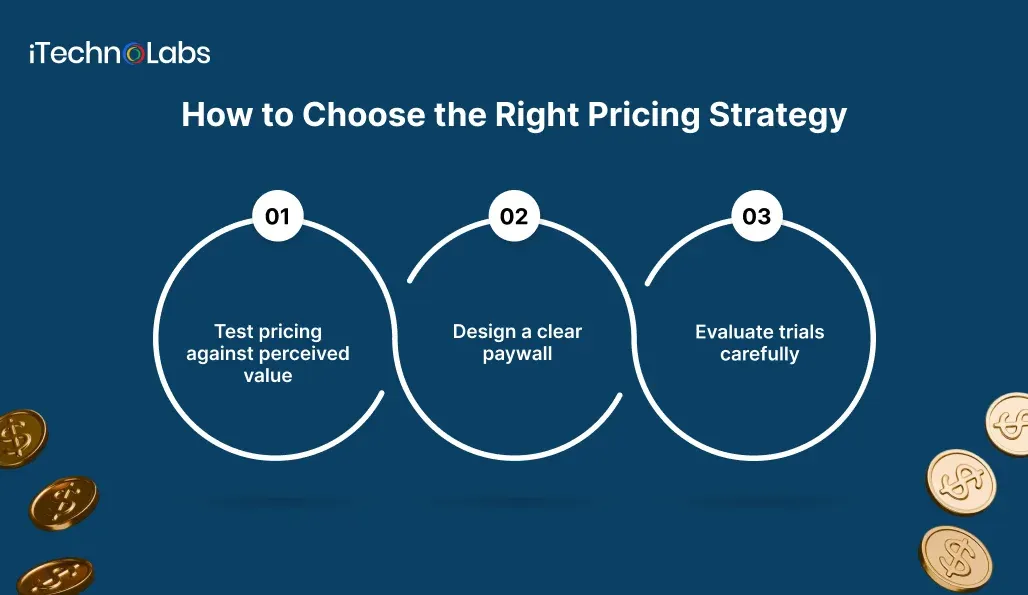
Selecting a revenue model is only the first decision. Founders must also decide how much to charge, what to include, and when to introduce a payment request.
Test pricing against perceived value
Start by identifying the problem your app solves and the measurable benefit users receive. Compare pricing options against that benefit rather than copying another app’s price.
For business software, value might come from reduced manual work or better collaboration. For consumer apps, it might involve convenience, access to premium content, or a personalised experience.
Design a clear paywall
Explain what users receive, what it costs, how billing works, and how cancellation operates. Avoid vague feature descriptions or unexpected charges.
Apple’s App Review Guidelines set requirements for in-app purchases and subscriptions. Google Play also requires transparent subscription offers and billing terms under its developer policies.
Review the current requirements for your distribution regions and payment flow before implementation.
Evaluate trials carefully
A free trial can reduce purchase hesitation, but it is only useful when users have enough time and guidance to experience the product’s value.
Test trial length, onboarding messages, and the timing of upgrade prompts. Track trial activation, conversion, cancellation, refunds, and retention after the first billing cycle.
Do not optimise solely for trial starts. A trial that attracts users who never engage with the product may create little long-term value.
Measure the Metrics That Matter
Build a monetization dashboard before increasing acquisition spending. Track these metrics together rather than judging performance by revenue alone.
| Metric | What it tells you |
| Paying user conversion | How effectively the app turns users into customers |
| Average revenue per user | Revenue generated per user over a defined period |
| Monthly recurring revenue | Recurring subscription revenue, where applicable |
| Retention and churn | Whether users continue using and paying for the app |
| Customer acquisition cost | The cost of acquiring a customer |
| Customer lifetime value | The revenue or contribution expected over a customer’s relationship with the product |
| Refund and failed payment rates | Potential friction in the purchase and billing process |
Strong monetization requires more than increasing conversion. If acquisition costs exceed the contribution generated by customers, growth can increase losses rather than improve the business.
Calculate customer lifetime value using a consistent definition, and distinguish revenue from profit or contribution margin. Include hosting, support, payment processing, app store fees, and variable infrastructure costs where relevant.
For apps using AI features, also account for inference and other usage-based costs. Heavy users may generate more revenue, but they can also require more expensive resources.
A Practical Monetization Roadmap for Startup Founders
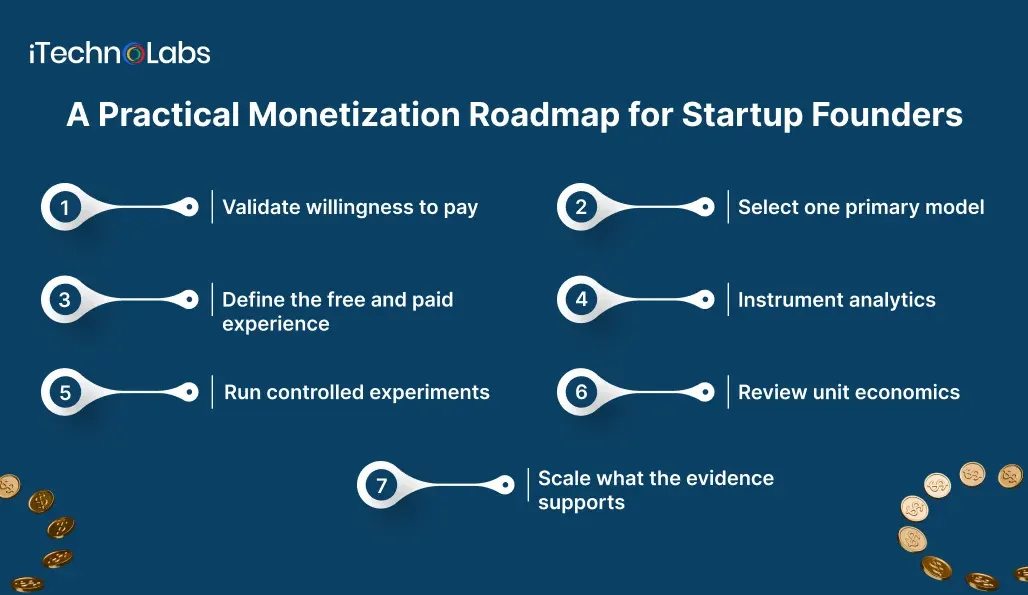
Use a staged process to validate the business model before investing heavily in monetization features.
Step 1: Validate willingness to pay: Interview target users and test whether the problem is important enough to justify a purchase.
Step 2: Select one primary model: Choose the model that best fits the product’s value and expected usage. Add a second model only when it serves a clear purpose.
Step 3: Define the free and paid experience: Document which features remain free, which require payment, and what each paid tier delivers.
Step 4: Instrument analytics: Track activation, engagement, conversion, retention, refunds, and revenue from the beginning.
Step 5: Run controlled experiments: Test one meaningful variable at a time, such as pricing, paywall placement, or trial duration. Evaluate the results against predefined success criteria.
Step 6: Review unit economics: Compare acquisition costs with customer contribution and retention. Include the operational cost of serving paying users.
Step 7: Scale what the evidence supports: Expand acquisition or introduce additional pricing tiers only after the model shows encouraging results.
Build Monetization Into the App From the Start
Monetization affects product architecture, user experience, analytics, security, and ongoing maintenance. Treating it as a last-minute addition can create avoidable rework.
A subscription app may need entitlement management, renewal handling, payment failure recovery, and subscription status synchronisation. A marketplace may require commission calculations, refunds, payment reconciliation, and dispute handling. An advertising-supported app needs appropriate ad integrations, consent management, and performance monitoring.
Discuss monetization requirements during product discovery and technical planning. Decide how purchases will be validated, how access will be granted, how billing events will be recorded, and what happens when a payment fails.
If you are planning a new product, review the relevant mobile app development services before finalising the feature scope. A development plan should connect the revenue model to the product’s architecture and business goals.
Turn Your App Idea Into a Revenue-Generating Product With iTechnolabs
Choosing the right monetization model is only the first step. Your app also needs the right features, payment infrastructure, user experience, and technical architecture to turn that strategy into a working business.
iTechnolabs helps startups plan, build, and modernize mobile applications with a focus on product goals, business requirements, and long-term growth. From MVP development to subscription integration, in-app purchases, payment workflows, and AI-powered features, our team can help you translate your monetization strategy into a practical development plan.
With experience delivering 500+ apps and serving 50,000+ end users, iTechnolabs brings mobile app development expertise across iOS, Android, Flutter, and React Native.
Whether you are launching your first app or improving an existing product, we can help you evaluate the technical requirements, prioritise revenue-generating features, and plan the next stage of development.
Final Thoughts
Successful app monetization comes from matching a revenue model to a real user need and improving it through evidence. A subscription, advertising, or transaction-based approach can work, but none removes the need to understand retention, acquisition costs, and customer value.
Before investing in a new app or changing its revenue model, establish the assumptions you need to test, the metrics that will define success, and the technical requirements for collecting revenue reliably.
FAQs
1. What are the best app monetization strategies in 2026?
Subscriptions, freemium upgrades, in-app purchases, advertising, paid downloads, affiliate revenue, and transaction fees are options worth evaluating. The best fit depends on the app’s audience, usage patterns, perceived value, and costs. Validate the model with user research and product analytics before scaling acquisition.
2. Can a free mobile app make money?
Yes. A free app can generate revenue through advertising, subscriptions, premium features, digital purchases, affiliate commissions, or transaction fees. Users don’t need to pay to download an app for it to earn revenue. The model must still provide value to users and cover operating and acquisition costs.
3. Is subscription monetization better than advertising?
Neither model is universally better. Subscriptions depend on users receiving ongoing value and remaining willing to pay. Advertising depends on audience size, engagement, ad demand, and placement quality. Compare expected revenue, retention, user experience, and operating costs before selecting a model.
4. How should a startup price its mobile app?
Begin with the value the app delivers, the audience’s willingness to pay, competitor alternatives, and the cost of serving customers. Test a small number of pricing options and track conversion, retention, refunds, and customer lifetime value. Avoid choosing a price based solely on what similar apps charge.
5. What is hybrid app monetization?
Hybrid monetization combines two or more revenue models, such as subscriptions and in-app purchases or advertising and premium upgrades. It can serve different user needs, but it also adds product and operational complexity. Introduce a second model when evidence shows that it adds value without undermining the primary experience.
6. When should a startup implement monetization?
Define the intended revenue model during product planning, then validate pricing and purchase behaviour as the product develops. A minimum viable product can test willingness to pay before you build every feature. The timing and scope should depend on user evidence, technical requirements, and the cost of running experiments.