It is a fact that the radical possibilities of Artificial Intelligence technology for Saudi Arabia are not just an area of study, but the real world, the implementation of the ambitious Vision 2030 by the state. This initiative is designed to reconstruct the Saudi economy, enhance public services, and raise the quality of life of the citizens through strategic investment and the wide use of AI. AI is not an accident in the wonders of Saudi Arabia, as it is causing a change along with penetration in terms of technology and societal affairs.
From artificial intelligence (AI) improvement in diagnostic healthcare through machine learning software capable of making future medical decisions to building smart city facilities that eliminate costly resource management errors by AI algorithms, artificial intelligence in Saudi Arabia will dominate the country’s technological and societal landscape. This blog is an in-depth analysis of the various initiatives, specific sectoral applications, and the most difficult challenges associated with the booming AI ecosystem in Saudi Arabia.
Table of Contents
- Vision 2030 and the Strategic Rise of Artificial Intelligence in Saudi Arabia
- Key Applications of Artificial Intelligence in Saudi Arabia
- Fostering Research, Development, and Talent in the Artificial Intelligence in Saudi Arabia Ecosystem
- Navigating the Gaps and Renovation for the Development of AI in Saudi Arabia
- AI in the Public Sector and Governance
- AI in Tourism and Entertainment
- AI and the Future of Work in Saudi Arabia
- Cybersecurity and AI
- Conclusion
- FAQ’s
Vision 2030 and the Strategic Rise of Artificial Intelligence in Saudi Arabia
The Saudi Arabian Vision 2030, which is a comprehensive plan for the future, views Artificial Intelligence in Saudi Arabia as an important mechanism for economic diversity and social development. The Saudi Data & AI Authority (SDAIA) is leading the National Strategy for Data and AI (NSDAI) and is setting its primary goal of building the trust of all stakeholders through real policy frameworks and investing strategies. NEOM, which is a futuristic smart city, is a great example of AI´s extensive application in Saudi Arabia´s urban living, and it is implemented as part of a sustainable and efficient system.
NSDAI’s Tangible Impact
- During the COVID-19 pandemic, the “Tawakkalna” app was quickly put in place by AI, which allowed it to become the tool for contact tracing, health status verification, and movement permits.
- Powered by AI, the “Basher” platform is overseeing a revamp of the efficiency of governmental services, cutting out the bureaucratic derailments and developing the citizens’ interaction thanks to automated document processing and smart chatbots. It is a perfect presentation of the operational efficiencies brought about by the Artificial Intelligence system in Saudi Arabia.
- The Kingdom also embraces some AI technologies and thus is taking steps to create AI sandboxes to let people experiment with new AI technologies.
Key Applications of Artificial Intelligence in Saudi Arabia
Artificial intelligence is a technology that has had an immense impact on several domains in Saudi Arabia, with particular examples of its applications that breathe life into innovation and efficiency.
Healthcare Transformation with AI Precision
- AI-enabled computer-aided diagnostic tools, which use deep learning algorithms for interpreting medical images such as MRI and CT scans, are having a much greater effect on the accuracy and speed of disease detection, thus resulting in earlier and better treatment of patients.
- AI-supported telemedicine platforms, which also have remote patient monitoring functions and AI-driven symptom analysis, have been the main drivers of further healthcare distribution in remote places, thus providing remote realities and personalized therapy plans.
Financial Innovation and Security through AI
- AI-driven detection of fraud systems, which apply very advanced machine learning models, analyze transaction patterns in real-time and thus are a major reason for the notable decline of financial losses and the danger of online banking and e-commerce protection.
- Robo-advisors, which are AI-based devices that are being used to investigate marketing trends and to work on the risky part of the personal, are democratizing the provision of personalized investment guidelines, and they are also making it easier for many people to get financial data.
Energy Optimization and Sustainability with AI
- AI-driven systems that provide predictive maintenance, on the other hand, which are using sensor data and machine learning to make equipment failure predictions, have very much fewer downtimes and maintenance costs in the energy sector.
- AI is turned to be optimizing the positioning and output of renewable energies, like solar and wind power.
Smart Transportation and Urban Mobility through AI
- AI-based traffic control systems in real-time, which make use of real-time data to optimize the traffic flow and decrease the traffic jam rate.
- The creation of autonomous vehicles, together with the high-speed rail networks that are controlled by AI technology.
Retail and E-commerce Expansion
- AI-based recommendation systems are being used to create personal shopping experiences.
- AI-powered supply chain management that uses the best routing practices.
Fostering Research, Development, and Talent in the Artificial Intelligence in Saudi Arabia Ecosystem
To sustain its ambitious AI trajectory, Saudi Arabia is making substantial investments in research, development, and talent cultivation.
KAUST’s Pivotal Role in AI Research
King Abdullah University of Science and Technology (KAUST) is a leading research institution in machine learning, computer vision, and natural language processing, and develops partnerships with global tech companies.
Strategic Talent Development Initiatives
- The “AI Academy” launched by SDAIA provides specialized training programs in AI and data science, so the Saudi workforce becomes ready to afford the required skills in this AI-driven economy.
- The kingdom is. working on attracting and keeping global AI talent.
Nurturing a Vibrant AI Startup Ecosystem
- Cash funding, like merchant control funds and funds from large financial institutions, provides a great environment for AI startups’ growth and brings around innovation and entrepreneurship.
- The kingdom is hiring AI companies from foreign countries to open in their zones.
Establishing Ethical AI Frameworks
SDAIA continues its effort of ethical development and deployment of intelligent AI. They are putting the necessary guidelines for this job in place. AI in general remains accountable and fair.
Navigating the Gaps and Renovation for the Development of AI in Saudi Arabia
Although AI is, beyond doubt, the future of the State in Saudi Arabia, the country will face some obstacles to becoming a leader in AI.
-
Addressing Data Privacy and Security Concerns
To guarantee national concerns’ safety and retain citizens’ affection for artificial intelligence (AI) systems, having sturdy cybersecurity systems and data governance structures is indispensable.
-
Expanding Infrastructure and Connectivity
It is vital for the development of AI that there is a fund in place for internet speed infrastructure and cloud computing resources.
-
Developing Adaptive Regulatory Frameworks
What matters most is innovation and risk management, which a newly conceived legislation should focus on flexibly so as to be adaptable to the fast AI evolution.
-
Capitalizing on Regional Leadership Opportunities
Saudi Arabia is well-positioned to become a regional AI leader, leveraging its financial resources and strategic vision to drive AI innovation and collaboration. The kingdom can help to bridge the digital divide and promote AI development in the region.
AI in the Public Sector and Governance
Saudi Arabia, in an attempt to promote efficiency, transparency, and citizen participation in public services, is creatively incorporating AI. This section includes the specific application and the policy initiatives.
E-Government and Citizen Services
- The “Absher” platform, which is the portal for government e-services, employs AI to cater to the needs of the citizens, which not only personalizes the interactions but also makes the processes easier. To top it off, AI chatbots provide users with immediate support, while AI algorithms conduct the analysis of the data to give tailor-made service recommendations.
- Data-based AI analysis is being utilized to locate and remove public service bottlenecks. This will result in the improvement of the efficiency level and the reduction of this sequence.
- AI is being promoted to detect and prevent any kind of fraud inside the government systems.
Legal and Judicial Applications
- AI technology is being tested to automate the activities related to legal document processing and research in different legal matters, and it will also predict the outcomes of cases. This could be one way to address backlogs in the judicial system and consequently have more legal cases resolved efficiently.
- The AI-powered tools that are under development are used to analyze legal cases, predict verdicts, and provide legal aid to judges and attorneys.
- AI technology is used in large amounts to analyze legal documents, thereby finding out the peculiarities of the documents and finally helping the verification process.
Policy Development and Analysis
- AI modeling and simulation projects are being used to predict the potential impact of government policies on the community and allow for evidence-based policy-making. This ensures scientific assessments and – thus – the right decisions.
- AI voice analysis is becoming the tool par excellence for the analysis of public sentiment & feedback, the tool that may help lawmakers come up with better policy decisions, and, lastly, the one that could assist in strengthening citizen involvement.
- The application of artificial intelligence to identify corruption and supervise public spending is gaining immense popularity.
Suggested Article: Benefits of AI in Software Development
AI in Tourism and Entertainment
Saudi Arabia’s Vision 2030 emphasizes the development of travel and leisure zones to a great extent. Thanks to the usage of AI, this process is in progress.
Personalized Tourism Experiences
- The AI-powered recommendation systems have been developed to help travelers in the personalization of travel itineraries, by selecting the right places, eateries, and activities according to individual preferences.
- VR and AR technologies are now AI-driven and are used extensively to offer tourists new ways of experiencing destinations through brilliant tours and interactive displays.
- The AI device for language translation is stepping up to better communication between tourists and locals.
Entertainment and Cultural Preservation
- AI has become a key factor in facilitating the interaction of people with museums and cultural experiences, which turns heritage into an interactive way of meeting with history.
- AI tools are being developed to study, analyze, and preserve cultural artifacts to ensure the long-term preservation of their evidence.
- A mobile phone or digital device with an AI outline will be used to create and spread the entertainment materials to the public through a person in charge, based on the model.
Smart Tourism Infrastructure
- The utilization of AI-enabled smart city technologies has brought improvement in the transportation, accommodation, and security of tourist destinations.
- The AI-powered chatbots could be installed in various tourist spots immediately, helping tourists to search for information or ask for directions with ease.
AI and the Future of Work in Saudi Arabia
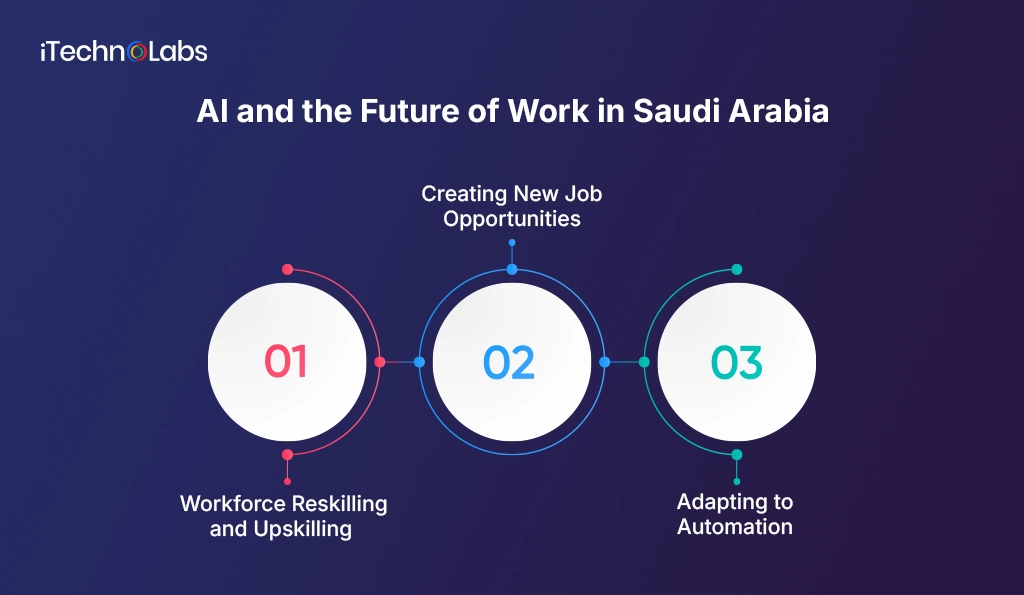
Ramping up AI adoption is among the developments that are a source of concern for the future of work. However, Saudi Arabia is currently working in this direction.
Workforce Reskilling and Upskilling
- The government is putting a fund into effect that will retrain and develop the workforce, thereby enabling them for the AI-driven jobs in the economy.
- Artificial intelligence has been integrated into training platforms to support personalized learning, thus enabling students to learn according to their learning style and learning needs.
- Technological innovations such as the use of virtual augmented and mixed/augmented reality help develop the nations by partnering with the most digitally advanced nations.
Creating New Job Opportunities
- The AI industry is in dire need of workers and AI scientists, which has led to the emergence of the industries of data science, AI engineering, and AI ethics.
- AI-driven economy is taking over the job market with growth as AI industries, such as e-commerce and fintech, do the same, with more related jobs being created.
- The King of Saudi Arabia (KSA) has further agreed to the unconditional new start of AI startups.
Adapting to Automation
- A systematic overhaul of various sectors is brought about by artificial intelligence-powered automation, which concomitantly increases productivity and lessens cost and waste.
- The government is working to guarantee that the profits of automation are spread equitably and that workers are not abandoned during the transition.
- The kingdom is researching and implementing universal basic income programs.
Cybersecurity and AI
As AI adoption increases, cybersecurity becomes even more critical. Saudi Arabia is investing in AI-powered cybersecurity solutions.
AI-Powered Threat Detection
- The utilization of AI algorithms to analyze network traffic and to detect suspicious activities, in addition to the real-time detection of cyber threats, is a hot topic today.
- The Use of AI-based tools is one of the prevailing methods of forecasting and trapping cyberattacks today, and it is based on historical data and intelligence on threats.
Automated Security Response
- Automation is being done through AI for the security of the system that contains the threats and minimizes the damage.
- AI machine-learning tools are utilized in the Management of security incidents and the spotting of vulnerabilities.
Data Privacy and Protection
- Scanning through the data that is considered sensitive and then securing them is another great way for AI in data protection and ensuring compliance with the regulations.
- Another way people can protect data during transmission is the AI empowerment issue, which is the introduction of AI-enabled encryption and anonymization technology.
National Cybersecurity Strategies
- These are national cybersecurity strategies being done by the Kingdom that include AI as one of the elements in the strategies.
- The government of the Kingdom shall inform the general public of cybersecurity threats to alleviate the fear of cybersecurity.
Also, read: AI App Development in 2026: A Complete Guide for Businesses
Conclusion
The deployment of Artificial Intelligence in Saudi Arabia is just as it is laid out in Vision 2030, a key area that is completely remodeling the economic and social life of the nation. AI is not just the result of progress in health care, like diagnostics, or smart cities development projects, but it is also the trend that the technology of artificial intelligence has become a driving force for innovation in many different fields.
While navigating challenges related to data privacy, infrastructure development, and regulatory frameworks remains crucial, the Kingdom’s unwavering focus on research, talent cultivation, and ethical AI development positions it as a prominent regional AI leader. With the help of international interactions and the timeless approach of using technology, Saudi Arabia is on the verge of clouding Artificial Intelligence in Saudi Arabia to get to a stage where it will register growth that is sustainable without doubt and moreover, the prosperity that will come along with it will be a realization of the ambitious goals which the country has set for itself on the path to the future.
FAQ’s
Q1: What are the primary goals of Saudi Arabia’s AI initiatives, as outlined in Vision 2030?
Saudi Arabia aims to diversify its economy beyond oil by investing heavily in artificial intelligence, digital transformation, and innovation under Vision 2030. The Kingdom focuses on smart cities like NEOM, advanced healthcare, improved government services, and building a technology-driven economy that enhances quality of life and supports entrepreneurship.
Q2: How is the Saudi Data & AI Authority (SDAIA) driving AI development in the Kingdom?
SDAIA has the responsibility to put the National Strategy for Data and AI (NSDAI) into action. It works to create ethical guidelines, give money to research, build pools of AI talent, and encourage the use of AI in both government and private sectors.
Q3: In which sectors is Saudi Arabia seeing the most significant AI applications?
Saudi Arabia is seeing major AI applications in healthcare, finance, energy, transportation, and smart city development. AI supports medical diagnostics, fraud detection, predictive maintenance, autonomous transport, and infrastructure management, especially in futuristic projects like NEOM and digital government initiatives.
Q4: What steps is Saudi Arabia taking to address the challenges related to AI, such as data privacy and workforce adaptation?
Saudi Arabia is introducing data protection laws, ethical AI frameworks, and cybersecurity regulations to address AI-related challenges. The Kingdom is also investing in workforce reskilling programs, AI education, and international collaborations to ensure responsible AI adoption and prepare citizens for future digital jobs.
Q5: What role does King Abdullah University of Science and Technology (KAUST) play in Saudi Arabia’s AI research and development?
King Abdullah University of Science and Technology (KAUST) plays a major role in Saudi Arabia’s AI advancement through research in machine learning, robotics, computer vision, and natural language processing. The university collaborates with international technology companies and supports innovation, talent development, and AI-focused startup ecosystems in the Kingdom.