Almost a decade ago, the idea of humans and machines evolving together was not only fictional but also sounded absurd to some. But the advancement in technology has made it possible. Today, not only the coexistence of humans and machines but also the dependence on each other is surreal.
But, this is just the start. Technology is in no way stopping. The boundary between the virtual and real world is slowly depleting. And, that’s where Augmented Reality came into the picture!
Table of Contents
- What is Augmented Reality Development?
- Which are the Apps Built with Augmented Reality Development
- Augmented Reality Development: Technology & Tools
- Step-by-Step Guide to Augmented Reality Development
- Are You Looking for Augmented Reality Development Services from iTechnolabs?
- Frequently Asked Questions For Augmented Reality Development
What is Augmented Reality Development?
Augmented Reality (AR) is a technology that enhances real-world experiences by overlaying digital elements onto the physical environment. Augmented Reality Development is an interactive combination of real and virtual worlds coming together. It blends digital content with real-world surroundings, creating a more immersive and interactive experience.
The purpose of leveraging AR can be to enhance user experience or to impart extra knowledge to them. One of the most notable examples of mainstream AR adoption was Pokémon Go, which launched in 2016 and introduced millions of users to augmented reality experiences.
Ever since then, the AR field has been getting a lot of attention. And scientists, as well as IT professionals, are exploring this field.
“According to recent industry forecasts, the number of mobile AR users worldwide is expected to exceed 1.1 billion in 2026, highlighting the growing adoption of augmented reality across smartphones and connected devices. “
But, as simple as it may sound to leverage AR, the associated tools, platforms, and technologies need to be comprehended. We will discuss all this in detail here! But, first, let’s start by knowing what types of Augmented Reality apps there can be!
Which are the Apps Built with Augmented Reality Development
- Location-based AR Apps
- Superimposing AR
- Marker-Based AR
- Markerless AR
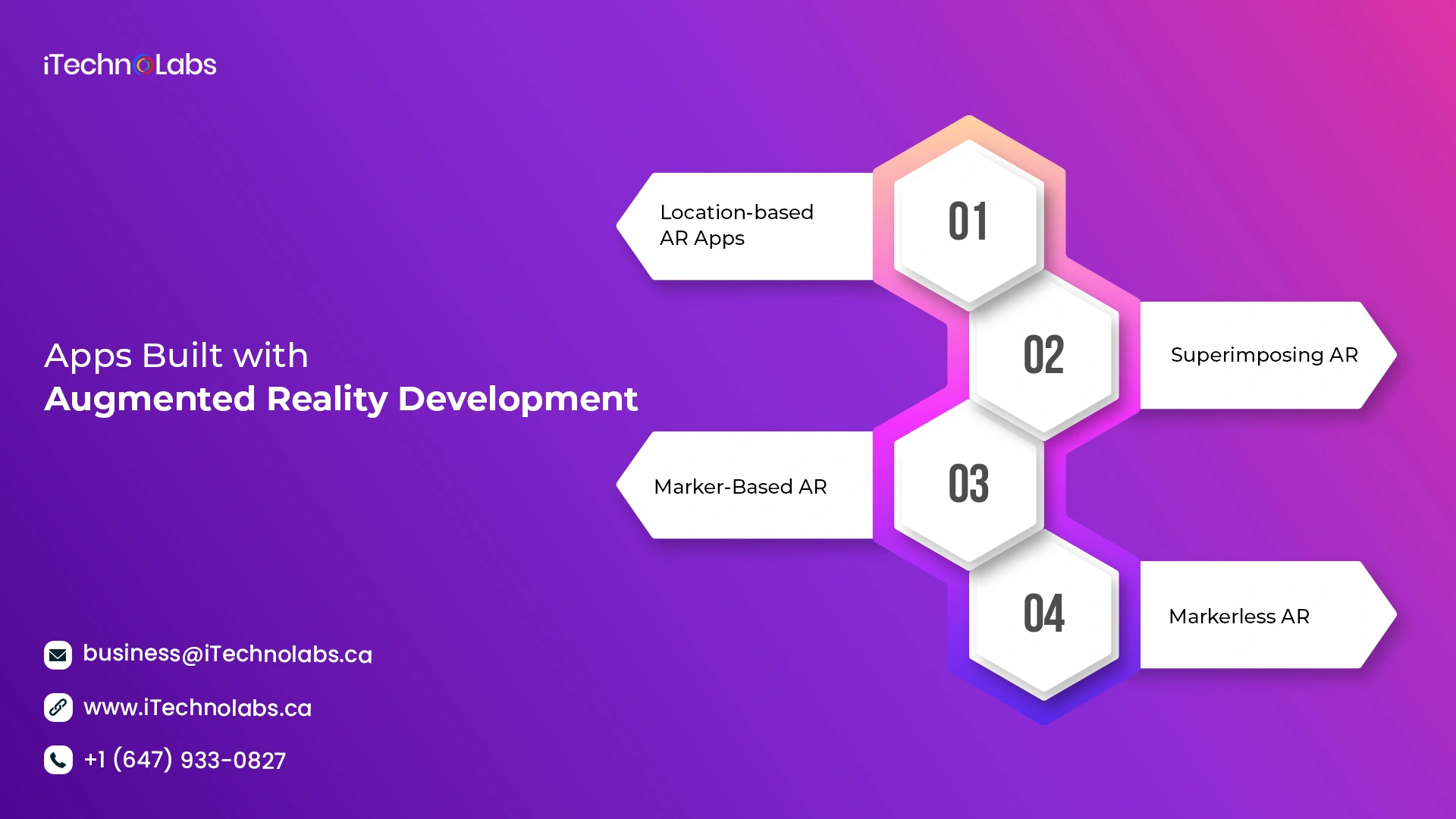
As the technology is vast and hypothetically limitless, there can be several types of apps on the principle of AR. Some of these are-
1. Location-based AR Apps
Location-based AR apps leverage the location of the user to show precise virtual content. These apps track location with the help of GPS, a compass, or sometimes via an accelerometer. Apart from these, other technologies such as low-range Wi-Fi Direct, VPS or virtual positioning system, BLE (Bluetooth Low Energy) beacons, etc. can also be used to track the position or location of the user.
But, what all features and activities users can execute on the app depends on how the developer has programmed the app.
2. Superimposing AR
There is a type of Augmented Reality app that can change your real surroundings by imposing a virtual image on it. This can be done via apps. The underlying principle involves replacing an object or superimposing an image on it, but all virtually.
For instance, to buy a new couch, you use an app to change the color of that couch to know which suits best for your home. This is an example of a cause-and-effect demonstration. Another example of superimposing AR can be a mobile app that helps you go back in time and see what your city used to look like years ago. This can be done by pointing a camera at a particular area of the city. And, that app then fetches a view from Google Maps’ archives. These types of applications can be useful for other industries as well.
3. Marker-Based AR
The Augmented Reality applications that are based on some markers are known as Marker-based AR apps. These markers, however, can be QR codes or any other image. The 3D image generated in an app is then placed above these markers. One example of such an app is the PlayStation 3 Wonderbook.
This is also the principle behind some of the Snapchat and Instagram features.
4. Markerless AR
While marker-based AR relies on certain markers, markerless AR, as the name suggests, does not rely on any markers. It leverages the camera feature of devices. It detects environmental patterns and motion sensors to identify and place 3d objects in its surroundings.
Along with this, it also revolves around technologies like GPS or other location data, a digital compass, depth sensors, camera features, an accelerometer, a gyroscope, and others. In some cases, ML or machine learning algorithms are also known to be used in apps based on markerless AR technology.
These were the types of AR apps. But what if we tell you the main applications of AR depend on which technology is used? Let’s discuss Augmented Reality technologies!
Augmented Reality Development: Technology & Tools
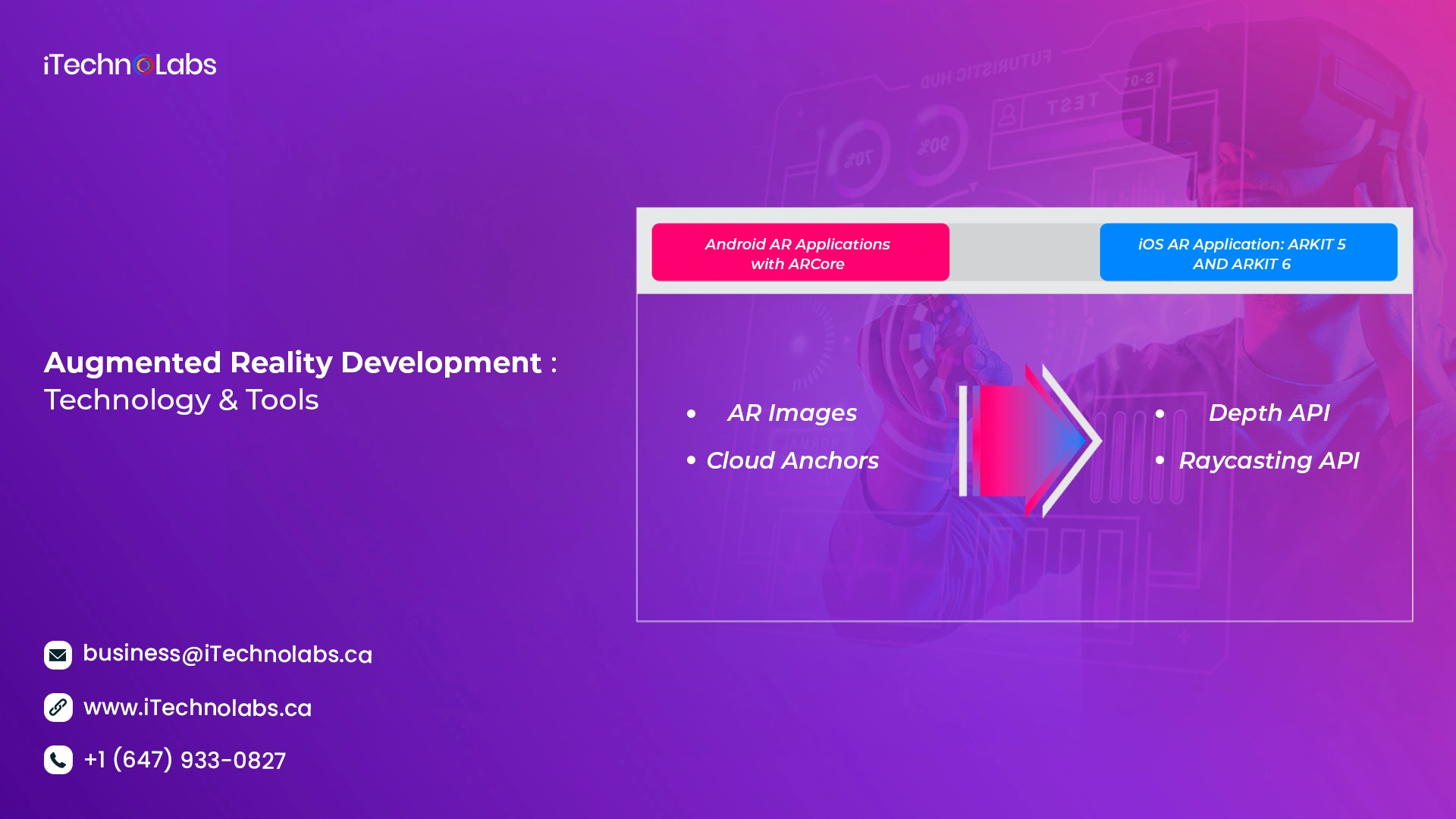
Selecting which technology and tool would be used to develop AR applications might look simple, but it isn’t. It can depend on a range of factors. Like hardware used, features of the device leveraged, power options available, and aim of the application. Apart from this, the operating system for which the application is being built also decides the technology and tools. Here are some of the options!
Android AR Applications with ARCore
ARCore is an SDK (software development kit) that allows easy development of AR applications. Delivered by Google Play services, ARCore can make the development process of AR applications for the Android platform easier. Considered one of the most versatile platforms for AR app development, it is also stable and reliable. Here are some of the renowned features leveraged by developers-
-
AR Images
This feature of ARCore is widely used in forming virtual business cards or advertising posters. With 2D markers, it becomes easy to implement utilities like AR indoor navigation with AR image features. Along with this, ARCore’s AR images feature also allows programmers to incorporate facial renderings with the help of generating 468-point 3D models. And, all this without hindering the quality.
-
Cloud Anchors
If you want to develop an augmented reality application that allows placing virtual objects in physical space (like the one we discussed earlier in this blog), you can leverage the Cloud Anchor feature of the ARCore SDK. This feature can work on iOS devices as well.
This upgrades the geographic anchoring placed in virtual objects.
iOS AR Application: ARKIT 5 AND ARKIT 6
Let’s comprehend the features ARKIT 5 AND ARKIT 6 have to offer while developing an iOS AR application.
-
Depth API
This feature was also part of ARKIT 4 and has been kept in ARKIT 5 and 6 as well. Depth API takes advantage of the LiDAR scanner feature of iPad Pro and other models of the 12 and 13 series of iPhone. With the help of this feature, an application can help get an advanced and better analysis of scenes. It also takes care of accuracy while superimposing virtual objects on real objects.
-
Raycasting API
To produce an enhanced object placement, the correct conjunction of depth API is required. And that’s what the Raycasting API can ensure. This not only enhances the virtual object placement but also elevates the precision. It also takes into account the curvature and edges of the object, which can increase precision by several folds.
These were the technologies that can help you develop a functional Augmented Reality Application. But, where to start? How to process?
Step-by-Step Guide to Augmented Reality Development
- Idea and Requirements
- Technology
- Hire Experts
- Design your Application
- Development Phase
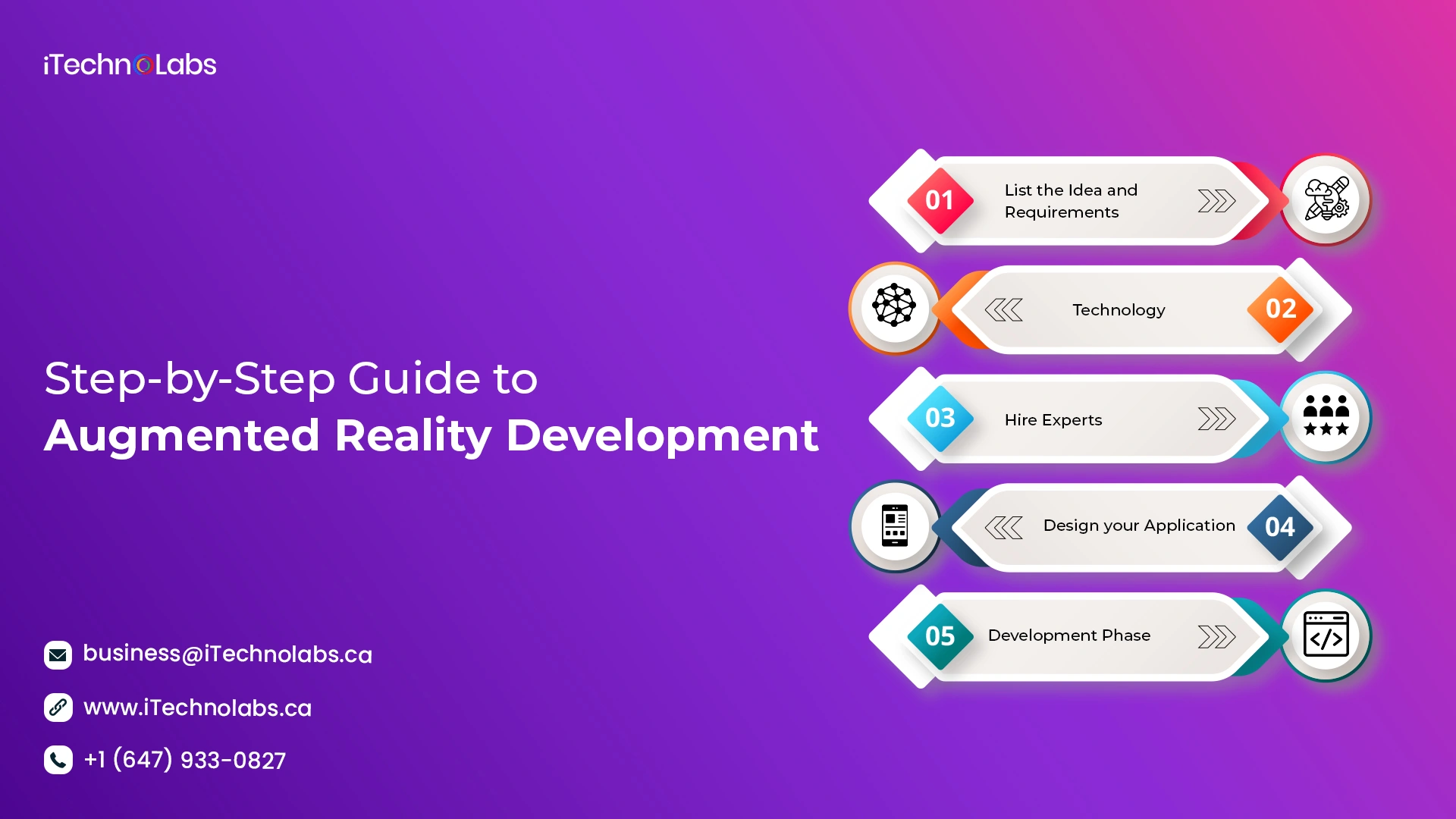
Here is a step-by-step approach to developing AR applications-
1. List the Idea and Requirements
How you will process your AR development application depends on what features you need to deliver in your application. Do you need it to leverage location, or superimpose AR? All this will help you shortlist the technology and tools you would need.
Therefore, the foremost step is to make a list of features and utilities you want in your application.
2. Technology
Once you have all the features and utilities you want to add to your augmented reality application, it’s time to select the technology or tool you would leverage. While this might sound perplexing at first sight, you can make this easy by hiring professional experts.
3. Hire Experts
If you are not an expert in AR and don’t have in-house AR application developers, it’s time you contact the experts at iTechnolabs. We have a team of developers to assist you in the process of getting your application developed from zero. Just tell us what you need in your application, and we will deliver it to you. Explore our range of services, and hire the best experts for your AR application.
4. Design your Application
Another important part of delivering a perfect AR application. As AR applications take part in real surroundings, it is important you design this smartly. Take into account devices, operating systems, user-friendliness, and comfort levels of your target audience while designing. As much as possible, try to keep the application simple to use.
5. Development Phase
Don’t worry our experts will handle this. We take the complete onus of developing an AR application for you. All you need is to contact us today!
Are You Looking for Augmented Reality Development Services from iTechnolabs?
We know the value of technology, and therefore, we never compromise on what our clients need. If you are looking to get best-in-class augmented reality development services, we have your back. Contact us today!
Frequently Asked Questions For Augmented Reality Development
1. What are the various augmented reality (AR) development services?
Augmented reality development services cover a wide range of solutions designed to help businesses create immersive and interactive digital experiences. Some of the most common AR development services include:
- AR Consulting Services – Expert guidance on AR strategy, technology selection, and project planning.
- Data Visualization Solutions – Transform complex data into engaging AR visualizations for better decision-making and ROI.
- Sensor-Based AR App Development – AR applications that use device sensors to enhance real-world interactions.
- Location-Based AR Development – GPS-powered AR experiences for navigation, tourism, retail, and marketing.
- AR App Maintenance & Upgrades – Ongoing support, performance optimization, and feature enhancements.
- Face & Gesture Recognition Solutions – Interactive AR experiences powered by facial tracking and gesture detection.
Partnering with an experienced AR development company ensures that your solution is scalable, user-friendly, and aligned with your business goals.
2. Which industries benefit from augmented reality app development services?
Augmented reality is transforming how businesses engage customers, train employees, and improve operations across various industries. Popular sectors using AR include:
- Retail & E-commerce
- Education
- Corporate Training
- Gaming
- Healthcare
- Social Media
- Entertainment
- Logistics & Warehousing
- Real Estate
By combining digital content with the physical world, AR helps businesses improve user engagement, streamline processes, and create memorable experiences.
3. What devices support augmented reality applications?
Modern AR applications are compatible with a variety of devices, making the technology more accessible than ever. AR apps can run on:
- Smartphones and Tablets (iOS and Android devices)
- AR Glasses and Headsets
- Smart Wearables
- Advanced Sensor-Enabled Tablets
- Mixed Reality Devices
The supported device depends on the app’s features, hardware requirements, and the AR platform used during development.
4. What are the best platforms for AR development?
Several powerful platforms are available for building high-performance AR applications. The most widely used AR development platforms include:
- Unity – Popular for creating cross-platform AR experiences.
- Unreal Engine – Known for high-quality graphics and immersive experiences.
- ARKit – Apple’s framework for AR app development on iOS devices.
- ARCore – Google’s AR platform for Android devices.
The ideal platform depends on your project goals, target audience, budget, and desired functionality.
5. How much does it cost to develop an AR app?
The cost of AR app development varies based on factors such as app complexity, features, platform compatibility, design requirements, and integration needs. In general, AR development costs can range from $30,000 to $300,000 or more.
Basic AR applications typically require a smaller investment, while advanced solutions featuring 3D modeling, real-time interaction, AI integration, or custom animations may significantly increase development costs.
6. What are the key benefits of augmented reality for businesses?
Augmented reality offers numerous advantages for businesses looking to improve customer engagement and operational efficiency. Key benefits include:
- Enhanced Customer Experiences
- Improved Product Visualization
- Higher User Engagement
- Better Employee Training
- Reduced Operational Costs
- Increased Brand Awareness
By delivering interactive and immersive experiences, AR helps businesses stand out in competitive markets and drive better results.