Key Takeaways
- An enterprise AI tutor needs more than a language model. These are the core decisions to make before development begins.
- Start with one clearly defined learning problem, such as explaining course concepts or answering questions about approved learning materials.
- Use retrieval-augmented generation (RAG) to help the tutor answer from authorized course content rather than relying only on the model’s general knowledge.
- Integrate through supported LMS APIs or Learning Tools Interoperability (LTI), where appropriate.
- Establish access controls, data retention rules, evaluation criteria, and human oversight before launching to learners.
- Measure answer accuracy, source relevance, learner task completion, and operational cost before expanding the tutor’s responsibilities.
To build AI for a Learning Management System (LMS), connect a language model to your learning platform, ground its responses in approved course materials, and create a secure interface that supports personalized tutoring. The implementation also needs learner permissions, content retrieval, evaluation, monitoring, and integration with existing LMS workflows.
For enterprise technology leaders, the central challenge is not simply adding a chatbot. It is building an AI tutor that works within existing identity, content, security, and learning management systems without compromising learner privacy or instructional quality.
Table of Contents
Why Build an AI Tutor for Your LMS?
A conventional LMS organizes courses, lessons, assessments, and learner records. An AI tutor adds a conversational layer that lets learners ask questions, request explanations, and explore concepts in context.
An enterprise training team may want employees to ask questions about internal training modules without searching multiple documents or waiting for an instructor to respond. An AI tutor could address this use case by retrieving relevant material and explaining it in language appropriate to the learner.
Define the tutor’s intended role before selecting technology. Decide whether it will explain course content, generate practice questions, provide hints, summarize lessons, or guide learners toward relevant resources. Keep assessment decisions and other high-impact actions under appropriate human control.
How to Build AI for Learning Management System Platforms
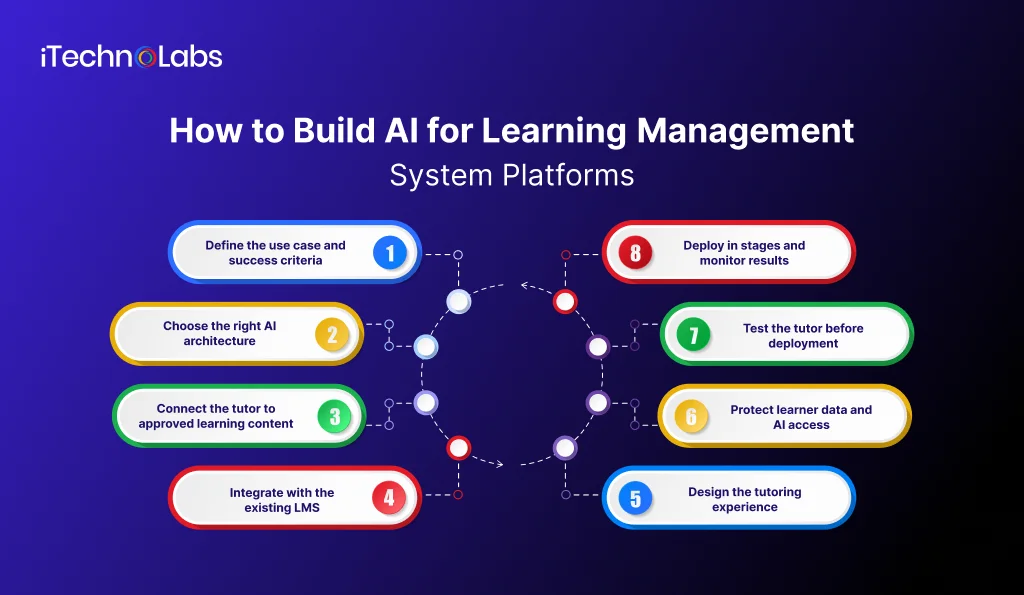
- Define the use case and success criteria
Begin with a narrow use case that can be tested against actual learning tasks. Avoid launching a general-purpose assistant that attempts to answer every question across every course from day one.
Different use cases require different levels of complexity.
- Course question answering: retrieve relevant passages and explain them in conversational language.
- Guided practice: provide hints, worked examples, and follow-up questions.
- Lesson summaries: condense approved material while preserving important concepts.
- Learning recommendations: suggest relevant modules based on course structure and permitted learner progress data.
Define measurable acceptance criteria before development. These could include factual correctness, relevance to course material, citation accuracy, response latency, successful task completion, and escalation rates for unanswered questions.
The first release should focus on one course or a limited set of training modules. The appropriate pilot scope depends on content quality, user volume, integration complexity, and available evaluation resources.
- Choose the right AI architecture
Most enterprise LMS tutors can be designed around a model layer, a knowledge retrieval layer, an integration layer, and a user interface. The specific components depend on the LMS, security requirements, and intended features.
Evaluate three common implementation approaches before committing to an architecture.
Option A: Hosted language model API
A hosted language model can generate explanations and conversational responses through an application programming interface.
This approach can reduce the need to operate model infrastructure directly, but the organization must evaluate provider terms, data handling, latency, availability, and usage costs.
Option B: Retrieval-augmented generation
RAG combines information retrieval with language generation. The system retrieves relevant content and supplies it to the model as context for answering a question.
Consider RAG when the tutor must answer from changing course materials, internal documentation, policies, or approved instructional resources. It allows content updates to be handled through the retrieval pipeline instead of requiring model retraining for every document change.
Option C: Fine tuning
Fine-tuning adjusts a model using training examples to influence its behavior on particular tasks.
Fine-tuning may help with consistent response formats or specialized task behavior, but it does not automatically keep the tutor informed about newly updated course content.
For a first enterprise implementation, evaluate a hosted model with RAG before considering fine-tuning. Introduce additional complexity only when evaluation results show a specific need.
- Connect the tutor to approved learning content
The quality of an AI tutor depends heavily on the quality, organization, and permissions of its source material.
Build a content ingestion pipeline that can:
- Extract text from supported course documents, lesson pages, and approved learning resources.
- Remove duplicated or outdated material.
- Split content into meaningful passages that preserve headings and context.
- Attach metadata such as course ID, module ID, content version, and access permissions.
- Generate embeddings and store them in a suitable vector search system.
- Retrieve relevant passages when a learner asks a question.
Embeddings represent content as numerical vectors that can support semantic similarity search. A retrieval system can use these representations to find passages related to a question even when the wording differs.
Apply authorization checks before retrieved material reaches the language model. A learner enrolled in one course should not receive content restricted to another course or a different user group.
Include source references in tutor responses whenever possible. If the approved material does not answer the question, the tutor should explain that limitation instead of inventing a course policy or unsupported explanation.
- Integrate with the existing LMS
LMS integration is often one of the most consequential architectural decisions because it determines how learners access the tutor and which platform capabilities it can use.
Compare the following integration options against the capabilities of the existing platform:
- Embedded tutor interface within a course or lesson.
- LMS APIs for accessing permitted course data and relevant learner context.
- LTI for launching an external tutor within supported LMS workflows.
- Webhooks or scheduled synchronization for keeping approved content current.
Confirm support for the required integration methods with the LMS vendor before development. Do not assume that every platform exposes the same APIs, gradebook functions, or user data.
Keep authentication and authorization responsibilities explicit. The LMS should establish the learner’s identity, while the tutor backend independently enforces access to the relevant content and permitted operations.
- Design the tutoring experience
A useful AI tutor should guide learning, not simply return long answers to every question.
Design the interface around a short conversational cycle: understand the question, retrieve relevant course material, explain the concept, and offer a suitable next step.
Include practical features such as:
- Follow-up questions that retain relevant conversational context.
- Source links that open the corresponding course materials.
- Explanations at different levels of detail.
- Hints and practice questions that encourage active learning.
- Clear indications when an answer is uncertain or unavailable.
- A way for learners or instructors to flag incorrect responses.
Personalization should be purposeful. Course enrollment, learner-selected preferences, and explicitly authorized progress information may help tailor explanations. Collecting additional personal data does not automatically improve instruction.
Give instructors control over approved content, tutoring boundaries, and any learner-facing settings that affect their courses.
- Protect learner data and AI access
An AI tutor introduces security and privacy considerations that extend beyond the LMS itself. Prompts, retrieved documents, conversation histories, and model responses can all contain sensitive information.
Include the following controls in the design:
- Enforce role-based access and least privilege across the LMS and retrieval system.
- Encrypt data in transit and at rest, and manage secrets outside application code.
- Establish retention and deletion rules for prompts, logs, and conversation history.
- Review the model provider’s data processing, retention, and training terms.
- Validate model outputs before displaying or passing them to other systems.
- Test prompt injection attempts involving both learner inputs and retrieved documents.
- Restrict tool access so the model cannot independently change grades, enrollments, or learner records.
- Maintain audit logs that support investigation without unnecessarily exposing sensitive content.
Map these controls to the organization’s applicable privacy laws, contractual obligations, data residency requirements, and internal security policies before processing production learner data.
- Test the tutor before deployment
A successful technical integration does not prove that an AI tutor is educationally useful or safe.
Build an evaluation dataset from representative questions, approved answers, course references, and known failure cases. Include straightforward questions, ambiguous prompts, questions outside the course scope, and attempts to access restricted material.
Evaluate at least five areas:
| Evaluation area | What to test |
| Answer accuracy | Does the response match the approved material? |
| Retrieval quality | Did the system retrieve the right passages? |
| Citation accuracy | Do the cited sources support the response? |
| Access control | Can users retrieve material outside their permissions? |
| Learning usefulness | Can learners understand the explanation and complete the intended task? |
Add performance, availability, and cost checks under expected and peak workloads. Test how the system behaves when the model provider is unavailable, retrieval returns no useful results, or the LMS integration fails.
Establish release thresholds before the pilot and review failures with instructors, security stakeholders, and the engineering team. Use the results to decide whether to proceed, revise, or restrict the feature.
- Deploy in stages and monitor results
Use a controlled rollout rather than making the tutor available across every course immediately.
- Prototype: Validate the core tutoring flow against a small, approved content collection.
- Pilot: Test with a defined learner group and instructor oversight.
- Production release: Expand only after security, integration, quality, and performance criteria are met.
- Continuous improvement: Review flagged responses, update content indexes, test model changes, and monitor operational costs.
Track answer acceptance, unresolved questions, source relevance, user feedback, response latency, cost per interaction, and task completion. Where appropriate, compare results with a baseline or a controlled pilot group.
Conversation volume alone is not evidence of improved learning. Learning outcomes require appropriate assessment, a meaningful baseline, and careful interpretation of the results.
What Does an Enterprise AI Tutor Project Require?
The iTechnolabs company context identifies AI development capabilities that include large language model integration, AI agents, retrieval-augmented generation, and generative AI, alongside custom software development.
For an enterprise LMS project, the important evaluation criteria are architectural fit, integration experience, security design, testing practices, and clarity about ownership and ongoing maintenance.
Before selecting a development partner, request a proposed architecture, an integration plan for your actual LMS, a data flow and security review, a pilot evaluation plan, and a breakdown of ongoing infrastructure and model costs.
Build an AI Tutor for Your Learning Management System With iTechnolabs
iTechnolabs provides AI development and custom software development services, with capabilities that include large language model integration, retrieval-augmented generation (RAG), AI agents, and generative AI. The company context also documents 500+ apps delivered and a team of 300+ developers.
If your organization is planning to add AI tutoring to an existing LMS, the key decisions involve choosing the right architecture, connecting approved learning materials, managing learner permissions, and ensuring that the tutor meets your security and performance requirements.
iTechnolabs can help you assess your technical requirements, evaluate integration options, and define a development roadmap aligned with your learning platform and business objectives. Begin with a focused discussion about your existing LMS, intended tutoring features, data requirements, and deployment goals.
Conclusion
Building an AI tutor for your learning management system requires more than connecting a language model to a chat interface. The real value comes from combining accurate course content retrieval, personalized explanations, secure LMS integration, and continuous evaluation within an architecture that meets your organization’s technical and operational requirements.
Start with a clearly defined learning use case, select an appropriate AI architecture, and validate the tutor through a controlled pilot. Evaluate answer accuracy, source relevance, learner feedback, data security, and operating costs before expanding to additional courses or user groups.
For enterprise technology leaders, a successful implementation balances learning experience improvements with governance, integration reliability, and long-term maintainability. A well-planned approach helps your organization make informed technology decisions while reducing the risks associated with deploying AI in an existing learning environment.
FAQs
- How do you build an AI tutor for an existing LMS?
Start by defining the tutoring use case and identifying approved course content. Select a language model, implement retrieval and access controls, connect the tutor to the LMS through supported APIs or LTI, and build an interface for learners. Validate accuracy, security, and learning usefulness before expanding beyond a controlled pilot.
- Should an AI tutor use RAG or fine-tuning?
RAG is useful when answers need to reflect approved documents that change over time. Fine-tuning can help shape model behavior for specific tasks, but it does not automatically update the model’s knowledge with new course material. The right choice depends on content freshness, response requirements, available training examples, and evaluation results.
- Can an AI tutor integrate with Moodle, Canvas, or another LMS?
Integration depends on the capabilities and configuration of the specific LMS. Platforms may offer APIs, extension mechanisms, or support for standards such as LTI. Verify the required authentication, course content, enrollment, and gradebook capabilities against the platform’s current documentation before finalizing the architecture.
- How can an AI tutor reduce hallucinations?
Ground responses in approved course materials, retrieve relevant passages, show source references, and instruct the system to acknowledge when evidence is insufficient. Test responses against a curated evaluation dataset and monitor incorrect answers after deployment. These controls reduce risk, but they cannot guarantee that every generated response will be correct.
- How do you protect learner data when integrating AI?
Enforce access permissions, minimize the data sent to the model, review provider data handling terms, define retention policies, and secure logs and credentials. Test for unauthorized retrieval and prompt injection. The appropriate controls depend on the institution’s jurisdiction, learner population, contractual obligations, and information security requirements.
- How should an enterprise measure AI tutor performance?
Measure answer correctness, retrieval relevance, citation accuracy, response time, system availability, operating cost, and learner feedback. Add task completion and learning assessments when they match the use case. Establish baseline measurements before launch and review results with instructional and technical stakeholders before increasing deployment scope.