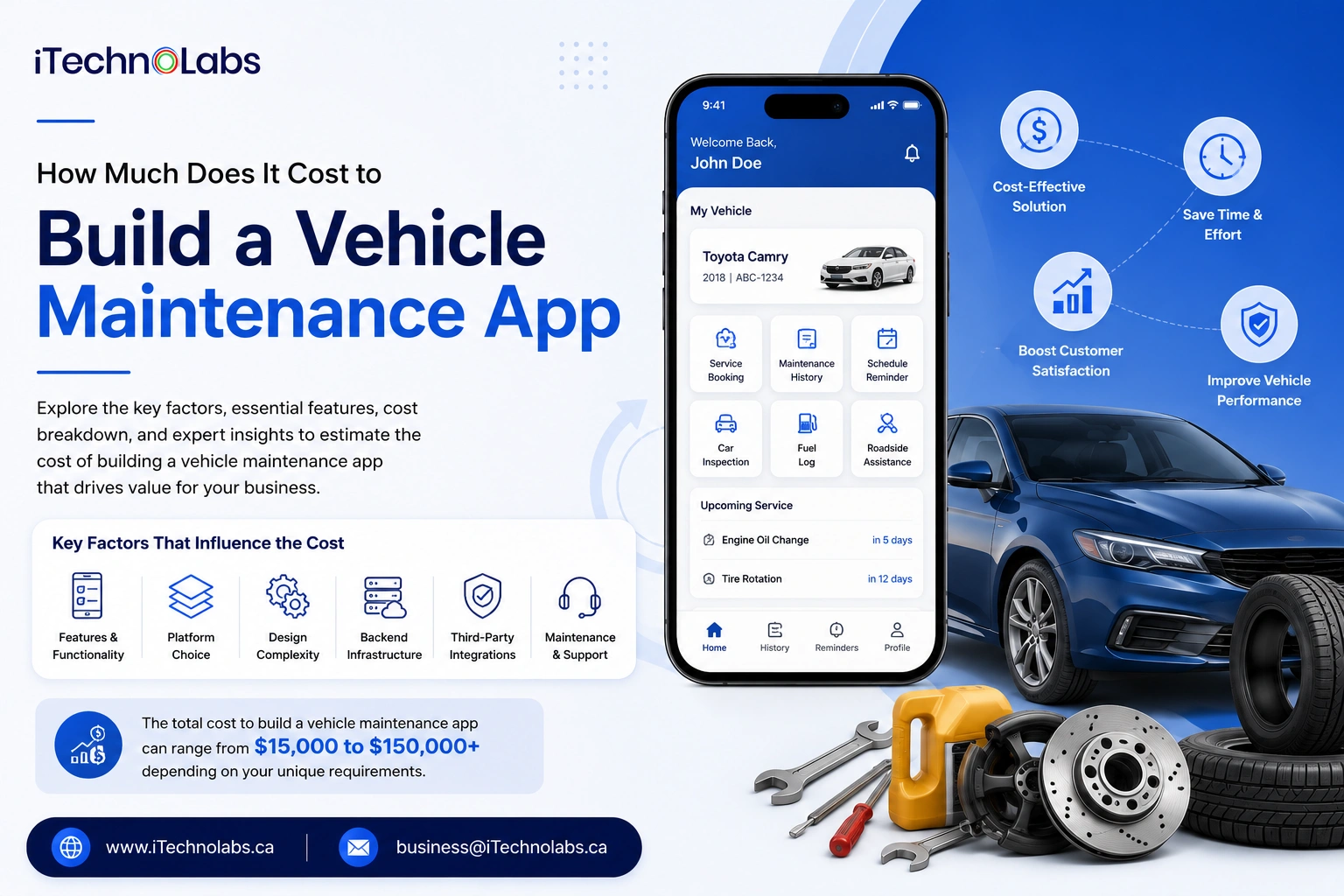
Vehicle maintenance mobile applications have greatly altered how vehicle operators deal with their cars by providing them with advanced tracking service history, automated maintenance scheduling, and vehicle health checking software. These apps have evolved from mere service records to interfaces that pair not only with local maintenance services but also with satellite networks and car computer systems. In today’s tech-savvy society, a maintenance app on one’s phone can help car owners increase the life of their machine, minimize untimely breakdowns, comply with safety standards, and optimize spending by setting the arrival of the due service and accurately tracking the expenses. Moreover, for the sake of companies and their managers who work with a fleet, the utility of these apps is in vast data analysis that takes place for their operational efficiency.
Table of Contents
- Key Features to Build a Vehicle Maintenance App
- Factors Affecting the Cost to Build a Vehicle Maintenance App
- Cost Breakdown to Build a Vehicle Maintenance App
- Estimated Cost to Build a Vehicle Maintenance App Based on Features
- How to Reduce the Cost to Build a Vehicle Maintenance App
- Monetization Strategies for a Vehicle Maintenance App
- Conclusion
- Faq’s
Key Features to Build a Vehicle Maintenance App
1. User Profile & Vehicle Management
Users can open accounts, save personal data, and input several different cars with details such as their brand, model, year, VIN, and current mileage. This is the base for receiving personalized maintenance suggestions that fully comply with the specifics of the vehicle according to the OEM’s guidelines.
2. Service Reminders & Alerts
The app takes the initiative to generate maintenance schedules by itself based on distance that has been covered or achieved time intervals, thus sending alerts to that effect when oil changes, tire rotations, and brake inspections are due, and other routine services. These preemptive alerts help to avoid unnecessary repairs by means of regularly attending to the maintenance of the vehicle.
3. Repair & Maintenance History Tracking
The app has a wide range of log functionalities that enable the users to keep track of all the service activities, including the date, the service performed, the parts that have been changed, the costs borne, and the service provider information. This may be taken as a substitute for a physical service record, and it does have the advantage of improving the resale value of the vehicle as well as facilitating trend analysis.
4. GPS & Nearby Service Centers Integration
Geopositional services provide the opportunity for users to find in situ mechanics, dealers, and auto parts stores and also to be guided there with the help of a navigation system in real-time mode. Service center ratings, appointment scheduling, and special deal notifications are examples of the ways that advanced technology can be used in this context, with the possible collaboration of companies being the incorporation of such services.
5. Cost Estimation & Budgeting
Predictive cost analytics provide estimates for upcoming maintenance services based on local market rates and vehicle-specific requirements. Budgeting tools help users plan for routine maintenance expenses and track actual spending against projected costs.
6. Push Notifications & Reminders
Beyond maintenance alerts, the app delivers customizable notifications for registration renewals, insurance deadlines, emissions testing, and recall notices. Users can set preferred notification methods, including in-app alerts, email, or SMS for critical reminders.
7. Cloud Backup & Data Security
Service records, vehicle information, and user data are securely stored in the cloud with encryption and authentication protocols. This ensures data persistence across device changes while maintaining privacy through industry-standard security practices.
8. Multi-Vehicle Support
The app accommodates multiple vehicles under single or family accounts with customized maintenance schedules for each. This feature is particularly valuable for households with several vehicles or small business fleets requiring consolidated management.
Factors Affecting the Cost to Build a Vehicle Maintenance App
1. App Complexity & Features
The feature set dramatically impacts development costs, with basic logging apps starting around $15,000, while AI-powered predictive maintenance systems with IoT integration can exceed $100,000. Each additional feature increases both development time and technical complexity.
2. Platform (iOS, Android, or Cross-Platform)
Developing a single native platform (iOS or Android) will most often cost around $15,000-$35,000, i.e., the total. Distinct from this, the cross-platforms kinds of development, which could be React Native or Flutter, could be almost equal to 70% of the native app building cost, but this could be balanced off by the use of the latter performance to the requirements of the complex system only.
3. UI/UX Design Requirements
Non-standard interfaces with animations, unique branding, and flows of high user complexity trigger a significant increase in the costs of the design. A Representative case in the template of a simple design would be something like a range of $5,000-$10,000, whereas potential customized examples with advanced visualization tools might be in the range of $20,000-$30,000.
4. Development Team & Location
Rates in North America remain higher than in Eastern Europe and South Asia by charging $100-$150, $35-$70, and $20-$50 per hour, respectively. A hypothetical scenario becomes when one has (the same) the development specifications, and 50-70% global cost reduction between the two execution regions is achieved by choosing the right company to work on the product.
5. Third-Party API Integration
Each integration (mapping services, vehicle databases, and payment processors) adds $1,000-$5,000 to development costs, plus ongoing subscription fees. OBD-II diagnostic systems or direct manufacturer API connections are particularly complex, potentially adding $10,000+ to development costs.
6. Backend Infrastructure & Cloud Services
Cloud infrastructure costs scale with user numbers and data complexity, starting at $200-$500 monthly for basic apps but potentially reaching several thousand dollars monthly for apps with heavy data processing needs and large user bases.
7. Testing & Maintenance
Quality assurance typically accounts for 20-30% of initial development costs, with ongoing maintenance requiring approximately 15-20% of the original development cost annually. Testing complexity increases with more platforms and device configurations supported.
| Development Aspect | Estimated Cost Range (USD) | Notes |
| App Complexity & Features | $15,000 – $100,000+ | Basic logging apps start at $15K, while AI-powered predictive maintenance apps with IoT integration can exceed $100K. |
| Platform (iOS, Android, or Cross-Platform) | $15,000 – $35,000 per platform | Native development costs per platform. Cross-platform (Flutter/React Native) can reduce costs by 30-40%, but might limit performance for complex apps. |
| UI/UX Design | $5,000 – $30,000 | Basic templates: $5K-$10K, Premium designs with animations and visualization tools: $20K-$30K. |
| Development Team & Location | Varies (Hourly Rate) | – North America: $100-$150/hr
– Eastern Europe: $35-$70/hr – South Asia: $20-$50/hr Choosing offshore teams can reduce costs by 50-70%. |
| Third-Party API Integration | $1,000 – $10,000+ per API | Standard APIs (Maps, Payment) $1K-$5K, complex integrations (OBD-II, Manufacturer APIs) can add $10K+. |
| Backend Infrastructure & Cloud Services | $200 – $500 per month (basic) | Costs scale with data storage and user base. High data processing apps may reach several thousand per month. |
| Testing & QA | 20-30% of development cost | More supported devices & platforms increase testing time. |
| Ongoing Maintenance | 15-20% of original cost annually | Includes updates, bug fixes, and performance improvements. |
Cost Breakdown to Build a Vehicle Maintenance App
1. UI/UX Design Costs
Professional design services include user research, wireframing, prototyping, and final UI asset creation, typically ranging from $5,000-$30,000 depending on complexity. User experience optimization through iterative testing and refinement accounts for roughly 30% of design costs.
2. Development Costs (Front-end & Back-end)
Front-end development ($15,000-$40,000) includes building user interfaces and client-side functionality, while back-end development ($20,000-$50,000) covers databases, server architecture, and business logic. Development typically represents 50-60% of the total project budget.
3. API & Third-Party Service Costs
Initial integration development costs range from $3,000-$15,000, depending on complexity, plus ongoing subscription fees. Vehicle diagnostic database access can cost $500-$3,000 monthly, while mapping APIs typically charge based on request volume, potentially adding $100-$1,000 monthly.
4. Testing & Quality Assurance Costs
Comprehensive testing across multiple devices and scenarios requires $8,000-$25,000 for initial deployment. Automated testing frameworks add upfront costs but reduce long-term quality assurance expenses through more efficient regression testing processes.
5. Deployment & Maintenance Costs
Initial app store submission and server deployment costs approximately $1,000-$3,000, followed by ongoing maintenance ranging from $1,000-$5,000 monthly. This includes bug fixes, security updates, platform compatibility adjustments, and performance optimization.
Estimated Cost to Build a Vehicle Maintenance App Based on Features
1. Basic Vehicle Maintenance App ($15,000 – $30,000)
Entry-level applications offer manual service logging, basic reminder functionality, and simple vehicle profiles without complex integrations. These MVPs typically feature template-based designs and limited cloud functionality and are usually developed for a single platform first.
2. Mid-Level App with Advanced Features ($30,000 – $70,000)
The apps in this segment are marked by their complete system upkeep feature, service center linkage for easy and fast service, cost analytics, and ability to work across different platforms.
3. High-End App with AI & IoT Integration ($70,000 – $150,000+)
The top applications come with the ability to predict the condition of the machines with machine learning, OBD-II device for diagnostics in real time, and advanced analytical dashboards, and that’s not all; they even have a full-fledged fleet management system. These highly advanced systems also come with special customer-specific interfaces and have the security of enterprise level.
4. App Development Cost by Complexity Level
| Complexity Level | Description | Cost Range | Development Timeline |
| Basic App | Core features only: vehicle profiles, maintenance logging, basic reminders | $15,000 – $30,000 | 2-4 months |
| Mid-Level App | Advanced features: service center integration, cost analytics, cross-platform functionality, cloud sync | $30,000 – $70,000 | 4-7 months |
| Premium App | Full feature set: AI-powered predictions, IoT/OBD-II integration, advanced analytics, enterprise capabilities | $70,000 – $150,000+ | 7-12+ months |
How to Reduce the Cost to Build a Vehicle Maintenance App
1. Choosing a Minimal Viable Product (MVP) Approach
Launch with core functionality only—vehicle profiles, basic maintenance logging, and simple reminders—then add features based on user feedback. This approach reduces initial development costs by 40-60% while validating market fit before significant investment.
2. Using Pre-Built Solutions & APIs
Leveraging existing solutions like Firebase for authentication, Google Maps for location services, and template UI kits can reduce development time by 30-40%. Ready-made components decrease custom development requirements while maintaining professional quality and reliability.
3. Hiring an Offshore Development Team
Attracting software developers from low-cost areas can help you save up to 40-70% on development costs as opposed to North American or Western European companies. Nonetheless, for an outsource project to be successful, you should have unambiguous requirements, ongoing conversation, and vendor selection that is both reputable and has previous experience with the same kind of task.
4. Open-Source vs. Custom Development
Utilizing open-source frameworks and libraries reduces development costs while maintaining quality. Solutions like React Native (for cross-platform development), Node.js (for backends), and open-source UI frameworks can lower development costs by 20-40% compared to fully custom implementations.
Monetization Strategies for a Vehicle Maintenance App
1. Subscription-Based Model
Tiered subscription plans ($2.99-$9.99 monthly) grant access to premium features like unlimited vehicle tracking, advanced analytics, and document storage. Enterprise subscriptions for fleet management can command $20-$50 per vehicle monthly, providing substantial recurring revenue.
2. In-App Purchases & Premium Features
Core functionality remains free while advanced features—detailed analytics, diagnostics interpretation, and service manual access—are available as one-time purchases or feature-specific subscriptions. This model attracts a large user base while monetizing power users.
3. Affiliate Marketing & Partnerships
Parallel ventures with service centers (7-15% of bookings), parts vendors (5-10% of sales), and insurance companies form a source of passive income for a company. Cooperating with automotive brands on a contractual basis can be a big money spinner. A brand or an influencer would earn from $5,000 up to $20,000 per month by referring to the products or promoting them through social media.
4. Advertising Revenue
Targeted advertisements from automotive service providers, parts manufacturers, and car dealerships generate $2-$10 per thousand impressions. Native advertising and sponsored content offer higher returns ($15-$30 CPM) and better user experience compared to display advertisements.
Conclusion
The cost of an MVP for a vehicle maintenance app is highly determined by the complexity, feature set, and development method used, with prices varying from $15,000 for simple applications to more than $150,000 for platforms with AI and IoT support. The best way to go is to focus on a good MVP at first, which is centered around unique user problems, and then improve it based on the real patterns of usage and user feedback. If you are intending a vehicle maintenance application, you should consider not only the initial costs for development but also the continuous expenses for regular operation just so that you can create a sustainable business model. In the end, the apt degree of feature richness and development investment rests upon your audience, revenue-making tactics, and competitive positioning in the auto industry’s aftermarket.
Faq’s
1. How much does it cost to develop a vehicle maintenance app?
Costs range from $15,000 for basic apps to over $150,000 for AI-powered, IoT-integrated solutions, depending on features, platforms, and development complexity.
2. How long does it take to build a vehicle maintenance app?
Development timelines range from 2-4 months for basic apps to 12+ months for high-end applications with predictive analytics, real-time diagnostics, and cloud synchronization.
3. Which platform should I develop for: iOS, Android, or both?
Developing for both increases reach, but cross-platform frameworks like Flutter or React Native can reduce costs by 30-40% compared to separate native apps.
4. Can the app integrate with OBD-II devices for real-time diagnostics?
Yes, but OBD-II integration requires advanced APIs and adds $10,000+ to development costs due to complex data handling and compatibility with different vehicle manufacturers.
5. What are the best ways to monetize a vehicle maintenance app?
Monetization options include subscriptions, in-app purchases, affiliate partnerships with service centers, and advertising revenue from auto service providers and parts retailers.
6. How can I minimize development costs without sacrificing quality?
Basically, by just using the MVP, having APIs that can be reused even if you have a lesser budget, hiring the services of available and experienced offshore developers, and open-source frameworks, you can cut costs by a considerable margin, say 70%.