Artificial Intelligence (AI) in the educational sector plays a crucial part in streamlining the whole education system. Of course, its impact on AI and other technologies of the present across diverse industries is positive. The potential of AI’s automated capabilities to develop smart and innovative learning Management systems (LMS) can be higher than what we had predicted.
Develop an AI-Based Learning Management System which allows virtual learning and teaching and brings education services to new levels. Additionally, the demand for LMS software by corporate firms is also very high. Companies are increasing their usage of LMS software to better track and management of their admin training of employees and onboarding.
Both of these trends are driving the growth in LMS applications. During the COVID season in particular, it is evident that the need for AI-powered learning management systems has seen significant growth in comparison to the time before the outbreak.
The market value of AI learning management has estimated to be $14 billion by 2021. According to market research, the market dimension of this global system for learning management will also extend throughout the education industry and could increase to around $41 billion in 2029. Mobile apps for education and e-learning platforms and various other online interactive learning applications are the primary factors behind this massive growth.
Table of Contents
How AI Is Used In LMS?
AI can be utilized to enhance the functions and efficiency of LMS solutions. Virtual Assistants, voice recognition bots, and attendance trackers that use facial recognition technology Intelligent analytics and reporting tools, automated knowledge testing tools, and, in a variety of ways, AI technology can be employed to improve the capabilities of LMS.
Benefits Of Artificial Intelligence In LMS Development
AI-powered LMS software development will bring many benefits to educational service providers. In this blog, we’ve collected some of the best advantages of AI-powered learning management applications.
- AI-powered learning management platforms simplify the learning and teaching process in its entirety.
- AI-based learning management software available for Android, iOS, or web OS will help educators or training institutions in providing better learning experiences via virtual technology.
- Through the integration of video and audio-enabled open-online lessons, AI digital learning solutions improve the personalization of users.
- Knowledge sharing and access to content will be easy to access and share information on secured cloud-enabled LMS platforms.
- The application of AI in the development of apps for learning management automates admin processes and enhances document management functions.
- AI-powered corporate LMS software will allow companies to better track and manage their employee onboarding and training functions.
- The application of Artificial intelligence in LMS solutions will track the pattern of learning for the user and automatically alter the curriculum to improve their skills.
- By utilizing AI in LMS Software development, learners can access the material in the language they prefer and improve their learning experiences.
- A chatbot that is AI-enabled or a virtual tutoring module within LMS applications will be able to recognize voice commands from users or written texts and can automate the process of training by providing exact responses in a matter of minutes. Because self-learning chatbots are able to learn from their previous experiences, they will be able to give the same support as an instructor to learners.
There are many advantages of AI in LMS applications. AI-driven LMS applications help automate and improve the entire process of learning and training. In general, AI-driven LMS platforms can help to make learning more engaging and exciting.
How To Build An AI-Based Learning Management System?
If you’re planning to create a sophisticated Artificial Intelligence-powered LMS system for your organization or training institutes, you must take a few steps in the creation of a reliable software application. As a leading AI development firm, iTechnolabs has collected our experience and expertise in the design of LMS software.
Key Steps To Develop an AI-Based Learning Management System
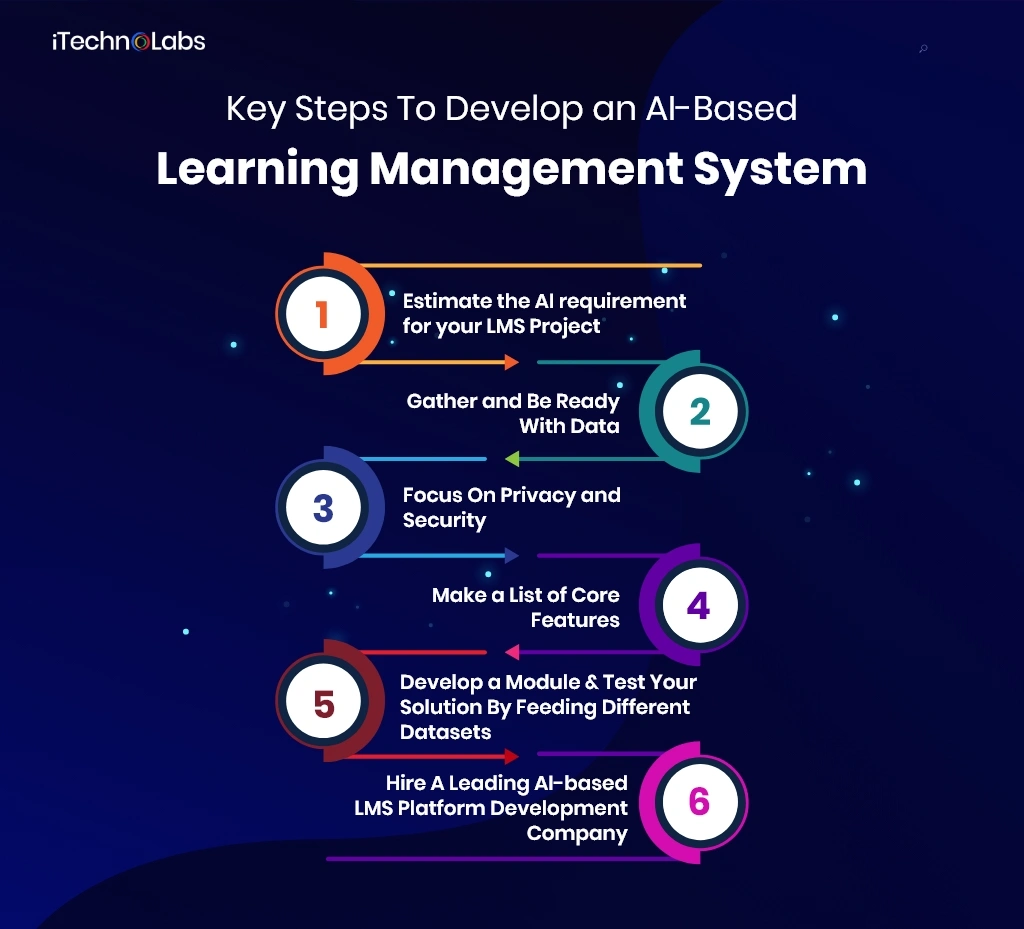
Step-1: Estimate the AI requirement for your LMS Project
AI is an essential technology for mobile applications for e-learning development. Before you begin the development of your software, it is important to assess the necessity for AI in your application.
Although the technology is most effective at automating repetitive functions, it is also necessary to examine AI creation and costs for implementation. Therefore, based on the requirements of the application and the business goals of the final user, take the next step to incorporate AI functions into LMS applications.
Step-2: Gather and Be Ready With Data
Data is crucial for training AI algorithms and helping to meet the application’s goals and vision. As long as you do not supply AI algorithms with the right data, you can’t expect to see a significant improvement. AI algorithms with proper data don’t think of achieving a robust performance from AI solutions.
If it’s education-related LMS software or corporate LMS software, the need for data is paramount. So, you must collect the required data from the communities you belong to and modify the data to meet the needs of your project. Instead of spending a lot of in collecting and categorizing information, this will cut time and speed up the development speedier.
Step-3: Focus On Privacy and Security
AI-powered LMS solution requires the storage of huge amounts of user data and managing content for applications. Furthermore, LMS apps offer content access and sharing across digital platforms. Therefore, improving the security of the user data and ensuring its security of user data is an essential feature that is provided by LMS apps.
But AI algorithms can identify irregular patterns in data and block security threats to data seamlessly. Before beginning the development process, it is essential to organize the process to ensure the highest level of encryption for the personal data of the users.
Step-4: Make a List Of Core Features
It is among the most important stages in the process of developing software. The process of identifying and listing the features of apps is a crucial job of app creators.
In accordance with the requirements of the project and client requirements, choose the most important elements (like user profile as well as learning materials, test of knowledge and performance reports, notification as well as an online audio/video learning facility, download content to offline tracking Integrations, etc.) for the development of a learning management system.
Step-5: Develop a Module & Test Your Solution By Feeding Different Datasets
When an AI-powered LMS software module has been developed, you can connect your AI solution with various datasets and track the results. This thorough testing process will help you to evaluate the effectiveness and performance that you can get from the LMS applications.
Furthermore, depending on the kind of LMS solution, mobile app developers must also design the UX/UI so that they can better connect with users while also increasing app performance.
Step-6: Hire A Leading AI-based LMS Platform Development Company
Finding a top mobile app development company for creating an outstanding and engaging LMS solution is crucial. Employ iTechnolabs, the top custom-designed e-learning app development firm located in both Canada and the USA. We are a team of app developers who are full-stack and imaginative designers who design the top-of-the-line LMS platform with the latest AI features.
How Much Does It Cost To Develop An LMS?
The price to create an online learning application or LMS program will range from roughly $35,000 to $70,000. The final price is determined based on elements like the complexity of the app’s design and features list, as well as the platform for app development, the type of app (native or hybrid or cross-platform), technology stack, and integrations with third-party partners.
Do you want to develop an AI-Based Learning Management System from iTechnolabs?
iTechnolabs is the top mobile app development firm and is one of the top E-learning app development firms across Canada and the USA. We develop collaborative digital learning platforms for the corporate and education sectors. So if you are looking for developing an AI-based LMS App, you have landed at the right place.
Frequently Asked Questions for Learning Management System
1. How much does it cost to build a learning management system?
The cost of developing an AI-based Learning Management System (LMS) typically ranges from $40,000 to $100,000 or more, depending on project requirements. Several factors influence the overall investment, including:
- Software Size and Complexity – More advanced platforms require additional development effort.
- Technology Stack – Modern frameworks, AI tools, and cloud infrastructure can impact costs.
- Features and Functionalities – Personalized learning, analytics, automation, and AI capabilities increase development scope.
- Development Team – Team size, expertise, and location affect pricing.
- UI/UX Design Requirements – Custom and interactive interfaces require additional design work.
The final cost varies based on your business goals, customization needs, and long-term scalability requirements.
2. How do you build an AI-based Learning Management System (LMS)?
Developing an AI-powered LMS requires careful planning and execution. The typical process includes:
- Define Business Objectives – Identify how AI will enhance learning experiences and platform efficiency.
- Consult LMS Development Experts – Work with experienced professionals to validate your idea and technical requirements.
- Collect and Prepare Data – AI models require quality data for accurate recommendations and insights.
- Identify Core Features – Determine essential functionalities such as course management, assessments, and personalization.
- Implement Security Measures – Protect user data through encryption and secure access controls.
- Design the User Experience – Create an intuitive and engaging interface for learners and administrators.
- Develop AI and LMS Components – Build the platform using suitable technologies and AI frameworks.
- Test and Optimize – Conduct extensive testing to ensure reliability, performance, and accuracy.
- Deploy and Maintain – Launch the LMS and continuously update it based on user feedback and evolving needs.
Following these steps helps create a scalable, secure, and intelligent learning platform.
3. What features are required to build an AI-based LMS?
An AI-powered Learning Management System should include features that improve learning outcomes and administrative efficiency. Key features include:
- User Management – Manage students, instructors, and administrators with role-based access.
- Course Creation and Management – Create, organize, and deliver learning content efficiently.
- AI-Powered Recommendations – Suggest personalized learning paths and course content based on user behavior.
- Automated Assessments and Grading – Reduce manual effort through intelligent evaluation systems.
- Progress Tracking and Analytics – Monitor learner performance and generate actionable insights.
Additional features such as chatbots, predictive analytics, and adaptive learning can further enhance the user experience.
4. How much does it cost to develop an AI-based LMS with advanced features?
The cost of developing an AI-based LMS with advanced capabilities generally ranges from $40,000 to $300,000+. The final budget depends on factors such as AI-powered personalization, adaptive learning modules, analytics dashboards, third-party integrations, cloud infrastructure, and custom feature requirements. Enterprise-grade solutions typically require a higher investment due to increased complexity and scalability needs.
5. How long does it take to develop an AI-based LMS?
The development timeline for an AI-powered LMS depends on the platform’s complexity, features, and customization requirements.
- Basic LMS Development: Approximately 4–6 months.
- Advanced AI-Based LMS: Typically 6–12 months or longer.
- Enterprise-Level Platforms: May require more than a year when incorporating advanced AI, integrations, and extensive testing.
Proper planning, experienced developers, and a clear project scope can help accelerate the development process.
6. What technologies are commonly used in AI-based LMS development?
AI-based LMS development relies on a combination of modern web, mobile, and AI technologies:
- Frontend Development: React and Angular for responsive user interfaces.
- Backend Development: Node.js and Django for scalable application logic.
- AI and Machine Learning: Python, TensorFlow, and PyTorch for intelligent features and automation.
- Database Management: PostgreSQL and MongoDB for secure data storage.
- Cloud Infrastructure: AWS, Google Cloud, or Microsoft Azure for scalability and performance.
The technology stack is selected based on project requirements, scalability goals, and AI functionality needs.