
Key Takeaways
- Track DORA’s five software delivery metrics to evaluate delivery speed, stability, recovery, and deployment rework.
- Pilot one team and one pipeline before expanding DevOps practices across the organization.
- Automate in stages, starting with builds and tests before deployment, infrastructure, security, and monitoring.
- Google’s 2025 DORA research describes AI as an amplifier of existing organizational strengths and weaknesses.
- Decide whether to build in-house, hire dedicated developers, or partner for missing platform engineering skills.
A DevOps implementation guide for a mid-size company comes down to seven steps: baseline your delivery metrics, pilot one team, automate the pipeline, codify infrastructure, build in security, add observability, then scale through a platform team. Order matters, because each step relies on data and habits from the one before.
Mid-size companies often need to improve software delivery while maintaining existing systems and supporting ongoing product development. Engineering teams may need to modernize deployment processes without dedicating a separate team to every platform or tooling requirement. A phased DevOps roadmap helps CTOs and IT directors prioritize improvements while keeping operational risk manageable.
Table of Contents
What a DevOps implementation involves
DevOps joins software development and IT operations under shared ownership of delivery. In practice, four things work together: version-controlled code, automated build-test-deploy pipelines (CI/CD), infrastructure defined as code, and monitoring that feeds back into the next release.
Tools such as GitHub Actions, GitLab CI, Jenkins, Terraform, and Kubernetes support these practices, but buying them does not create DevOps. The practices come from changed team habits: who approves changes, who is paged when a release fails, and how failures are reviewed.
Treat it as a delivery-performance programme with a measurable outcome, not an infrastructure project. That framing keeps the budget conversation tied to release speed and stability instead of tool licences.
Step-by-Step DevOps Implementation Process
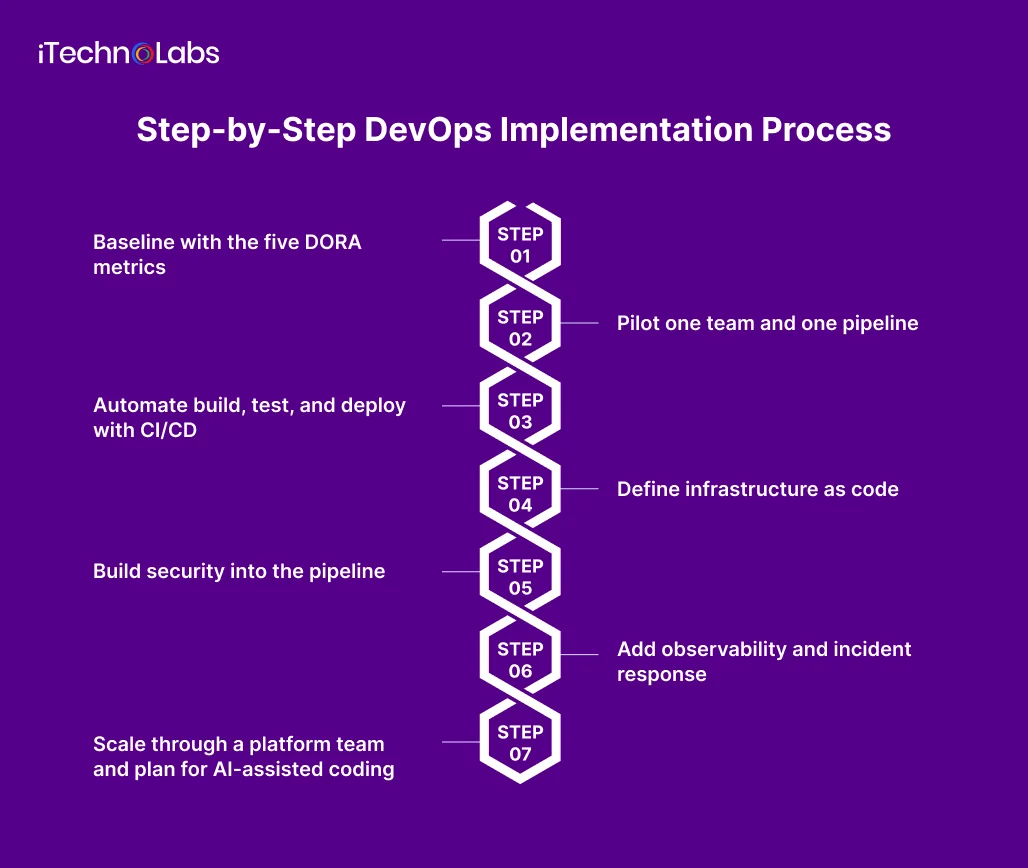
A successful DevOps implementation requires a structured approach that aligns development and operations with your business goals. From assessing existing infrastructure and selecting suitable tools to automating workflows, configuring CI/CD pipelines, and monitoring performance, each stage helps improve deployment efficiency, system reliability, security, and scalability while supporting continuous delivery and long-term growth.
Step 1: Baseline with the five DORA metrics
DORA, the DevOps Research and Assessment programme within Google Cloud, identifies five software delivery performance metrics: change lead time, deployment frequency, failed deployment recovery time, change failure rate, and deployment rework rate. These measures help teams evaluate delivery speed, reliability, recovery, and the corrective work deployments cause.
Pull these numbers for the last quarter from your repositories, deployment logs, and incident tracker. Do not wait for a polished dashboard. A spreadsheet is enough to start.
Two rules prevent misuse:
- Measure at team or service level: Use the metrics to identify bottlenecks and guide improvement, not to rank teams or impose isolated performance targets.
- Read all five together: Higher deployment frequency alone does not demonstrate success. Review throughput metrics alongside change fail rate and deployment rework rate to understand whether delivery is becoming faster and more stable.
Step 2: Pilot one team and one pipeline
Choose a product team and a service with real release pain: frequent hotfixes, a manual deployment runbook, or releases that need a weekend. Avoid your most critical system, and avoid a trivial one. A trivial pilot proves nothing, and a mission-critical one carries too much risk.
Set exit criteria before you start. For example: lead time for this service falls and change failure rate does not rise over two release cycles.
Name an executive sponsor who can resolve cross-team dependencies and clarify approval responsibilities. Review the release process to determine whether approval queues, testing delays, environment provisioning, or other bottlenecks are slowing delivery. Focus the pilot on the constraints identified in your own assessment.
Step 3: Automate build, test, and deploy with CI/CD
Start with continuous integration: every commit triggers an automated build and test run, and a failing build blocks the merge. Only then automate deployment. Teams that automate deployment before they trust their tests move defects into production faster.
Work in this order:
- Short-lived branches with mandatory code review.
- Automated unit and integration tests as a merge gate.
- Automated deployment to staging.
- Progressive release to production (canary or blue-green) with automated rollback.
Keep the pipeline definition in the repository, so changes to it are reviewed like any other code.
Step 4: Define infrastructure as code
Describe environments in Terraform, Pulumi, AWS CloudFormation, or Azure Bicep, and apply them through the same pipeline. The goal is to reduce configuration differences between staging and production so that releases behave more consistently across environments. Infrastructure as code helps teams manage environment changes through repeatable, reviewable processes.
Infrastructure as code also creates a reviewable record of environment changes, which can support change management and audit evidence when appropriate controls are in place.
Adopt Kubernetes when your service count and scaling needs justify its operating cost, not by default. Managed container or serverless services on AWS, Azure, or GCP cover many mid-size workloads with less to maintain.
Step 5: Build security into the pipeline
Move security checks into the pipeline instead of after it. Add dependency and container image scanning, static analysis, and secrets detection as pipeline stages. Store credentials in a vault, not in configuration files. Give pipeline service accounts least-privilege access, because the pipeline can deploy to production.
For companies working toward or maintaining ISO 27001 certification, version-controlled pipelines, access controls, approval records, and deployment logs can support audit evidence when configured appropriately. These controls do not establish compliance on their own. Organizations must also implement the applicable information security management processes and verify that their controls meet relevant requirements. iTechnolabs holds ISO 27001:2013 and ISO 9001:2015 certifications.
Step 6: Add observability and incident response
Instrument the pilot service with metrics, logs, and traces. Define service-level objectives (SLOs) and alert on customer impact, not server CPU. Set an on-call rota and a blameless post-incident review template.
These produce your failed deployment recovery time figure and feed the next sprint’s priorities. Prometheus, Grafana, Datadog, and OpenTelemetry all cover this ground. The discipline of incident reviews matters more than the vendor.
Step 7: Scale through a platform team and plan for AI-assisted coding
When the pilot meets its exit criteria, extend to the next two or three teams using the pilot’s pipeline templates. Around this point, a small platform team becomes worthwhile. It owns shared pipeline templates, environment provisioning, and guardrails, so product teams do not rebuild them. InfoQ’s coverage of the 2025 DORA report notes the growing weight platform teams carry in AI-assisted development.
This is why timing matters. Google Cloud’s 2025 DORA report reported that nearly 90% of surveyed respondents were using AI. The report describes AI as an amplifier of existing organizational strengths and weaknesses, emphasizing the importance of foundational engineering practices and organizational capabilities.
If automated tests are limited and releases rely on manual procedures, an increase in AI-generated code can put additional pressure on existing review and deployment processes. Automated testing, code review, security checks, observability, and rollback procedures help teams manage these risks as AI-assisted development expands.
Build, hire, or partner?
| Option | Fits when | Main risk |
| Build in-house | You already employ platform or site-reliability engineers and can wait for hiring | Hiring lead time; knowledge held by one or two people |
| Add dedicated developers | You need extra capacity inside your own team and tooling choices | Onboarding effort and management overhead |
| Partner for the programme | You lack platform skills and need baseline-to-pilot quickly | Weak handover; require documented pipelines and training |
Whichever route you take, insist that your own engineers own the pipelines by the end of the pilot. When working with an external partner, agree on code ownership, configuration access, documentation, and knowledge transfer before the engagement begins. These requirements help your internal engineers maintain and operate the pipelines after the pilot.
Accelerate DevOps Adoption with iTechnolabs.
Implementing DevOps requires more than setting up CI/CD pipelines. It involves improving deployment workflows, automating infrastructure, strengthening security, and giving engineering teams better visibility into application performance.
iTechnolabs helps businesses assess their current development processes, identify bottlenecks, and implement DevOps practices aligned with their infrastructure, security requirements, and business goals. Whether you’re starting with a pilot or modernizing existing workflows, our team can help you plan a practical path toward more consistent software delivery.
Conclusion: Build a DevOps Roadmap That Supports Business Growth
DevOps adoption works best when it addresses real engineering challenges, from slow releases and manual deployments to security gaps and limited production visibility. A phased implementation roadmap helps technology leaders improve delivery processes, establish clear ownership, and measure progress without disrupting existing operations.
Start with the workflows that create the greatest bottlenecks, validate improvements through a pilot, and expand proven practices across engineering teams. The right approach depends on your existing infrastructure, security requirements, team capabilities, and long-term technology goals.
FAQ
1. What is the first step in a DevOps implementation?
Baseline your current delivery performance using DORA’s five software delivery metrics: change lead time, deployment frequency, failed deployment recovery time, change failure rate, and deployment rework rate. Collect data from repositories, deployment logs, and incident records. This baseline helps identify bottlenecks, select a suitable pilot, and evaluate progress after implementation.
2. Do we need Kubernetes to adopt DevOps?
No. DevOps is a set of delivery practices, not a platform. CI/CD, infrastructure as code, and monitoring work on virtual machines, managed container services, or serverless platforms. Adopt Kubernetes when service count and scaling needs justify the operating cost, not as a prerequisite.
3. How do you measure whether DevOps is working?
Track DORA’s five software delivery metrics at team or service level: change lead time, deployment frequency, failed deployment recovery time, change failure rate, and deployment rework rate. Review them together over time. Improvements should reflect faster delivery and controlled instability, rather than higher deployment frequency alone.
4. Should a mid-size company build a DevOps team or hire a partner?
Build in-house if you already employ platform or site-reliability engineers and can wait for hiring. Add dedicated developers if you need capacity inside your own team. Use a partner when you lack platform skills and need a pilot quickly, but require documented handover so your team owns the pipelines.
5. Does DevOps matter more now that developers use AI coding tools?
DevOps practices help teams manage the risks associated with increased AI-assisted coding. Google’s 2025 DORA report describes AI as an amplifier of existing organizational strengths and weaknesses. Automated testing, code review, security checks, and reliable rollback procedures help teams manage code quality and deployment risks as AI adoption grows.
6. How long does DevOps implementation take for a mid-size company?
The timeline depends on the existing infrastructure, application complexity, security requirements, and team capabilities. A focused pilot can establish the initial pipeline and baseline improvements before wider rollout. Assess the scope and dependencies first, then set milestones for automation, infrastructure as code, security controls, monitoring, and team adoption.











