

Key Takeaways
- Fitness apps should help users build sustainable routines through achievable goals, relevant workouts, and visible progress.
- Personalization and adaptive recommendations make the experience more relevant as users’ fitness levels and preferences change.
- Retention metrics, onboarding completion, workout frequency, and user feedback help identify which features deserve further investment.
- Privacy, reliable performance, and an intuitive interface are essential for building user trust and long-term engagement.
Building a fitness app is only half the challenge. The real test is keeping users engaged long after they download it. Many users start with ambitious fitness goals but lose motivation when workouts feel repetitive, progress is unclear, or the app fails to fit their routines. This is where thoughtful fitness app development makes a difference.
Features such as personalized workout plans, progress tracking, smart reminders, and community challenges can encourage consistent usage and build lasting habits.
In this guide, we explore the fitness app features that drive retention, how to prioritize them, and which metrics help measure their impact.
Table of Contents
Why Retention Matters in Fitness App Development
Getting users to download a fitness app is only the first step. The bigger challenge is giving them enough value to return after the initial excitement fades.
Users may abandon an app when workouts feel repetitive, progress is difficult to measure, reminders become annoying, or the experience does not match their fitness goals. Adding more features will not necessarily solve these problems.
Successful fitness app development starts with understanding user motivation. Beginners may need guided routines and simple goals, while experienced athletes may want detailed performance analytics and training plans.
The objective is to make regular use feel useful, achievable, and rewarding.
8 Fitness App Features That Drive User Retention
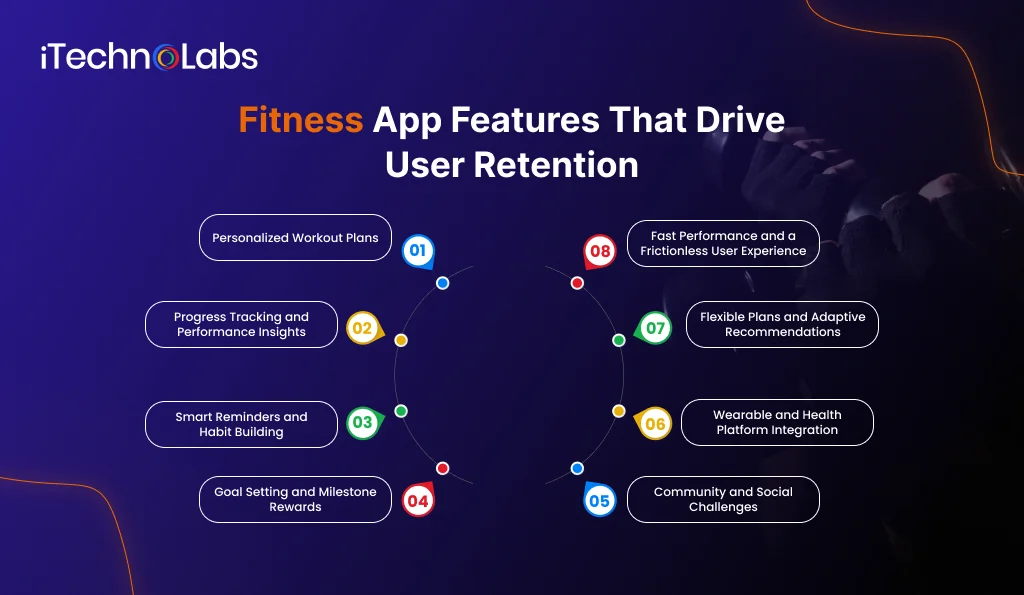
1. Personalized Workout Plans
A workout plan should reflect the user’s goals, experience, available equipment, schedule, and preferred training style.
For example, a beginner who wants to improve general fitness may benefit from short, low-intensity workouts. An experienced runner may prefer structured training sessions with distance and pace targets.
Personalization can also adjust recommendations according to completed workouts, skipped sessions, and changing goals.
Retention impact: Relevant workouts reduce friction and help users feel that the app fits their routine.
2. Progress Tracking and Performance Insights
Users need to see whether their efforts are making a difference. Progress tracking turns individual workouts into a broader picture of improvement.
Useful capabilities include:
- Workout history and completed sessions
- Personal records and performance milestones
- Weight, distance, duration, or repetition tracking where relevant
- Weekly and monthly activity summaries
- Goal completion and consistency trends
Present the data in a way that users can understand quickly. A simple weekly summary showing completed workouts against a target may be more motivating than a dashboard crowded with metrics.
Retention impact: Visible progress reinforces the value of returning and helps users recognize achievements that might otherwise go unnoticed.
3. Smart Reminders and Habit Building
Notifications can bring users back when they are likely to need a prompt. However, poorly timed or excessive messages can cause notification fatigue.
Allow users to choose their preferred workout days, reminder times, and notification types. Reminders should reflect their schedules and recent activity rather than follow an inflexible daily pattern.
For instance, an app could remind someone about a planned evening workout or suggest a shorter session when they have limited time.
Streaks and weekly goals can reinforce consistency, but avoid making users feel that missing a day erases their progress.
Retention impact: Thoughtful reminders support routine formation without making the app feel intrusive.
4. Goal Setting and Milestone Rewards
Large fitness goals can feel overwhelming when users cannot see the smaller steps needed to reach them.
Break objectives into manageable milestones. A user preparing for a 5K run might progress through walking intervals, short runs, longer distances, and timed sessions.
Achievement badges, progress celebrations, and milestone notifications can provide additional encouragement. Rewards should recognize meaningful effort rather than encourage excessive exercise.
Retention impact: Smaller milestones create regular opportunities for users to experience progress and maintain motivation.
5. Community and Social Challenges
Fitness can become more engaging when users have opportunities to share achievements, participate in challenges, or exercise with others.
Depending on the target audience, useful features may include:
- Group challenges and shared goals
- Friends lists and activity feeds
- Workout sharing and achievement badges
- Community groups organized around interests
- Optional accountability partners
Community design requires moderation, reporting tools, and privacy controls. Users should be able to participate without exposing sensitive health information or competing publicly.
Retention impact: Social accountability can give users another reason to return beyond their individual workout plans.
6. Wearable and Health Platform Integration
Many users already track activity through smartwatches, fitness bands, and health platforms. Integrations can reduce manual data entry and provide a more complete activity history.
Depending on the product, integrations may support steps, heart rate, workout sessions, distance, or energy expenditure. Apple’s HealthKit documentation explains how apps can access and share health and fitness data with user permission.
For Android products, evaluate Health Connect for supported health and fitness data integrations.
Choose integrations based on the devices your target users actually use. Request only the permissions needed for the app’s core functionality, and explain why each permission is required.
Retention impact: Connected data and reduced manual effort make it easier for users to keep their fitness records up to date.
7. Flexible Plans and Adaptive Recommendations
Users’ schedules, energy levels, and training needs change. An app that assumes every user can follow the same plan indefinitely may become less useful over time.
Offer alternatives such as shorter workouts, recovery sessions, different exercise variations, and rescheduling options. Recommendations can use workout history and stated preferences to suggest suitable next steps.
AI can help personalize recommendations or identify patterns in user behavior, provided the app has suitable data and evaluates whether those recommendations improve the experience.
Fitness guidance should remain within the product’s intended scope. Health-related recommendations need appropriate safeguards and should not present unvalidated predictions as medical advice.
Retention impact: Flexibility helps the app remain useful when users encounter schedule changes, plateaus, or evolving goals.
8. Fast Performance and a Frictionless User Experience
Even valuable fitness features can lose their appeal when the app is slow, confusing, or unreliable.
Prioritize a straightforward onboarding flow, clear navigation, readable workout instructions, and quick access to the next session. Users should be able to resume a workout without repeatedly navigating through menus.
Consider offline access to downloaded workout plans, reliable synchronization, accessible interface elements, and graceful handling of connectivity problems where relevant.
Protect personal information through appropriate access controls, secure data handling, transparent privacy practices, and user control over data sharing.
Retention impact: A dependable, easy-to-use experience removes obstacles that might otherwise prevent users from completing workouts.
Which Features Should You Build First?
Not every fitness product needs all eight features at launch. The right priorities depend on the target audience, business model, available budget, and primary user problem.
| Development stage | Features to prioritize | Main objective |
| MVP | Onboarding, workout plans, activity logging, basic progress tracking, reminders | Establish a repeatable workout routine |
| Next release | Personalized plans, milestones, analytics, wearable integration | Improve relevance and reduce friction |
| Later releases | Community challenges, advanced recommendations, premium programs | Expand engagement and monetization opportunities |
Start by identifying the core action users should repeat. For a home workout app, that might be selecting a routine, completing a session, and tracking progress. For a running app, it could involve planning a run, recording activity, and reviewing performance.
Build the features that support this cycle first. Use real usage data to decide what comes next.
How to Measure Fitness App Retention
Feature adoption alone does not prove that a feature improves retention. Track whether it changes meaningful user behavior.
Important metrics include:
- Day 1, Day 7, and Day 30 retention: Measure how many users return after their first use.
- Workout completion rate: Track the percentage of started workouts that users finish.
- Weekly active users: Measure how many users engage with the app each week.
- Workout frequency: Monitor how often users complete sessions over a defined period.
- Notification engagement: Evaluate whether reminders lead to meaningful app activity.
- Feature adoption: Identify which features users discover and use repeatedly.
- Subscription conversion and churn: For paid products, assess whether users see enough ongoing value to subscribe and remain subscribers.
Compare these metrics across user groups and onboarding cohorts. Test changes to reminders, workout recommendations, and onboarding flows rather than assuming that a new feature will automatically improve retention.
How iTechnolabs Can Help With Fitness App Development
Building a fitness app requires more than creating workout screens. The product needs a clear user journey, suitable integrations, reliable data handling, useful analytics, and an architecture that can support future growth.
iTechnolabs provides mobile app development services for businesses planning custom digital products. Its fitness app development work can be scoped around your target audience, core features, preferred platforms, integrations, and business goals.
A discovery phase helps establish the MVP, prioritize retention-focused functionality, and define the technical approach before development begins.
Final Thoughts
Fitness app retention comes from helping users make progress consistently. Personalized workouts, clear performance insights, thoughtful reminders, achievable milestones, and a frictionless experience give users practical reasons to return.
The strongest approach to fitness app development is to launch with a focused set of features, measure how people use them, and improve the product based on evidence. Build around the habits your audience wants to develop, not the number of features you can add.
FAQs
- What features make a fitness app successful?
Personalized workouts, progress tracking, goal setting, reminders, and an intuitive interface form a useful foundation. Wearable integrations, community challenges, and adaptive recommendations can add value when they support the target audience’s needs.
- How can a fitness app increase user retention?
Help users build consistent routines through achievable goals, visible progress, relevant workout recommendations, and well-timed reminders. Analyze retention data and user feedback to identify where people disengage.
- Which features should a fitness app MVP include?
A typical MVP includes onboarding, user profiles, workout plans, activity logging, basic progress tracking, and configurable reminders. The exact scope depends on the app’s primary use case and target audience.
- Does AI improve fitness app retention?
AI may improve retention through personalized workout suggestions, adaptive plans, and behavior-based recommendations. Its value should be measured against clear outcomes, and recommendations should include appropriate safety boundaries.
- How important are wearable integrations in fitness app development?
Wearable integrations can make activity tracking more convenient and provide richer workout data. They are worth prioritizing when the target audience already uses compatible devices or when connected data is central to the app’s value.
- How do you measure whether fitness app features improve retention?
Track retention by cohort, workout completion, session frequency, feature adoption, and relevant subscription metrics. Compare results before and after changes, and use controlled experiments where practical.











