Artificial Intelligence (AI) is a game-changer for businesses, revolutionizing how they innovate, automate their operations, and base their decisions on data. As well as upgrading customer experiences and making processes more efficient, AI also plays a big part in speeding up product development. In fact, the usage of AI has now spread to be a big part of digital transformation in many different sectors. A recent survey by McKinsey shows that globally, 78% of companies are employing AI in at least one function of their business, whereas 71% are using Generative AI on a regular basis. This indicates how quickly the business world is embracing AI-powered operations.
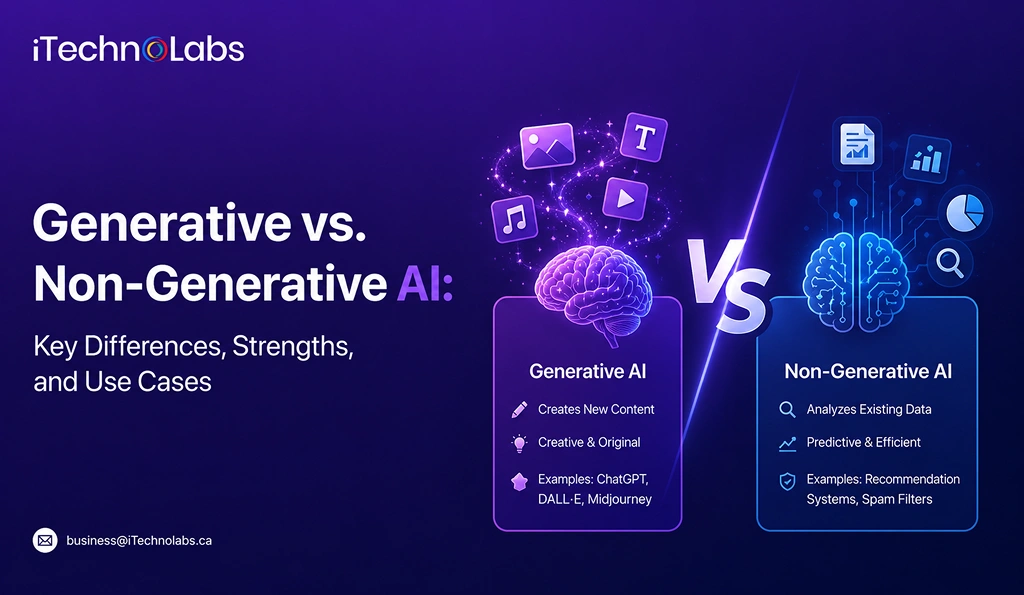
With more and more companies jumping on the AI bandwagon, the focus of innovation has been on two main approaches—Generative AI and Non-Generative AI. Powered by sophisticated machine learning models, these two modes are intended to address quite different issues faced by businesses. The primary differentiating factor is that whilst Generative AI produces entirely new outputs ranging from textual or visual content, videos, and code to even audio, Non-Generative AI focuses more on analyzing existing data and pattern recognition to make forecasts and automate decisions. Companies aiming to invest their resources in the right AI approach must therefore be clear about Generative AI vs. Non-Generative AI. In this post, we’ll explore how these 2 broad types of AI differ, explore potential applications & benefits, and demonstrate how you could implement either or both to enhance your innovation and competitiveness.
TL;DR
- Understand the key differences between Generative AI and Non-Generative AI.
- Learn strengths, limitations, and real-world applications of both technologies.
- Discover when businesses should choose each AI approach effectively.
- Explore hybrid AI systems that combine creativity with predictive intelligence.
- Find future AI trends shaping enterprise innovation and digital transformation.
Key Takeaways
- Generative AI creates original content like text, images, code, and videos, making it ideal for creativity, automation, and personalized experiences.
- Non-Generative AI analyzes existing data to deliver accurate predictions, recommendations, fraud detection, and data-driven business insights.
- Many organizations combine both AI approaches to improve operational efficiency, automate workflows, and enhance customer engagement with intelligent solutions.
- Choosing the right AI strategy depends on your business goals, available data, industry requirements, and desired outcomes for innovation or analytics.
- As AI continues evolving, hybrid AI platforms integrating Generative and Non-Generative AI will become the foundation of enterprise digital transformation.
Table of Contents
- What is Generative AI?
- What is Non-Generative AI?
- How Generative AI and Non-Generative AI Work
- Generative AI vs. Non-Generative AI: Key Differences
- Strengths of Generative AI
- Strengths of Non-Generative AI
- When Should Businesses Use Generative AI?
- When Should Businesses Use Non-Generative AI?
- Challenges of Generative AI and Non-Generative AI
- Future Trends in Generative and Non-Generative AI
- Why Choose iTechnolabs for Generative AI?
- Conclusion
- FAQs
What is Generative AI?
Generative AI develops entirely new, original content through understanding the patterns, structures, and relationships in the data. Instead of merely analyzing or processing the existing information, the generative AI output is new content that looks very much like the human-created one. And that is the reason businesses and individuals can use it to automate their creative tasks while at the same time increasing their productivity and innovation.
Generative AI models are capable of creating text, images, videos, audio, software codes, and even 3D designs. They use sophisticated deep learning methods, in particular transformer-based models and neural networks, to comprehend the context and produce appropriate, high-quality output. The capabilities of these models are increasing. They can be more accurate and creative and handle more complex tasks.
Currently, Generative AI has a lot of applications like content creation, customer support, software development, marketing, healthcare, education, and product design. This type of AI has been incorporated in many widely used tools that can compose articles, generate marketing copy, create realistic images, assist developers with coding, and produce personalized customer experiences. Organizations using Generative AI can automate creative and knowledge-intensive tasks, which in turn help them cut costs, speed up innovation, and even improve the quality of their products.
1. Key Characteristics of Generative AI
- Creates original content
- Learns from large datasets
- Supports creativity and innovation
- Generates text, images, code, audio, and video
- Improves productivity through automation
2. Common Generative AI Applications
- Content creation and marketing
- Chatbots and virtual assistants
- Software code generation
- Product design and prototyping
- Personalized customer experiences
- Creative industries such as art, music, and entertainment
What is Non-Generative AI?
Non-Generative AI is also known as predictive or discriminative AI and is meant to study the existing data rather than bring about new content. Identifying patterns, categorizing information, detecting anomalies, and making predictions with high accuracy are some of the main functions that this type of AI fulfills based on historical and real-time data. Instead of creating new outputs, it assists organizations with their decisions by unveiling insights that are hidden in huge datasets.
Such AI systems are programmed to carry out certain job functions like fraud detection, customer segmentation, demand forecasting, recommendation engines, medical diagnosis, and predictive maintenance, among others. Through the use of machine learning methods and statistical models, Non-Generative AI is not only able to maintain but also to enhance its precision progressively with the availability of more data, thereby becoming a dependable tool for business processes that require repetition and are intensely data-based.
Non-Generative AI solutions are nowadays being used across diverse sectors such as finance, healthcare, retail, manufacturing, and logistics. Enterprises rely on it for the optimization of their operations, risk mitigation, automation of decision-making, and enhancement of customer experiences with the help of personalized recommendations and predictive analytics. Its capability to provide quick, data-driven insights positions it as a critical technology for those organizations that prioritize operational efficiency and intelligent business decisions.
1. Key Characteristics of Non-Generative AI
- Analyzes existing data
- Identifies patterns and trends
- Makes predictions and recommendations
- Supports business decision-making
- Delivers measurable operational improvements
2. Common Non-Generative AI Applications
- Fraud detection
- Demand forecasting
- Recommendation engines
- Medical diagnostics
- Credit scoring
- Predictive maintenance
- Customer behavior analysis
How Generative AI and Non-Generative AI Work
However, before looking into a comparative view in terms of functionalities, advantages, and potential use cases, we need to look into a functional explanation for both Generative AI and Non-Generative AI. Though machine learning and the need to analyze the vast amount of data are the basis of both of these, their core functionality differs in achieving particular goals. To better implement either of these modes into any business process, like automation, decision making, innovation, or other digital transformation goals, we first should learn how this works out.
How Generative AI Works
Generative AI generates new content by training on huge amounts of data—recognizing patterns, understanding context, and identifying relationships. It doesn’t copy information; it learns the underlying relationships to construct original responses to user requests. Here is an overview of the process of Generative AI generation in four steps.
1. Data Collection and Training
This AI is trained on lots of data; anything you think it could be trained on—be it texts, videos, audio, code, or images. It enables it to learn the Language, Visual patterns, structure, and also the relationship between them.
2. Pattern Recognition
Using methods like neural networks and the deep learning approach of transformers, the system looks for relationships between various information pieces such as syntax, grammar, learning patterns, and even writing style from various sources it’s training with. It knows the patterns and connections, but doesn’t memorize anything.
3. Prompt Interpretation
Upon receiving the input from the user, the model will evaluate the query. The context and intention of your query, along with the final desired outcome, determine what kind of model output is required by the model, given its learned information from the training data.
4. Content Generation
Predicts the best combination of words, pixel code, or other data structures to output new content. The data it outputs is expected to be unique, sensible, and similar to the production of humans.
5. Output Refinement
This process of training and retraining Modern Generative AI models over and over again with fresh new information based on users’ previous requests helps the AI in generating responses more efficiently, accurately, creatively, and relevantly over time.
How Non-Generative AI Works
Non-Generative AI centers on examining existing data to spot patterns, categorize information, and forecast outcomes. Instead of producing new stuff, it employs machine learning algorithms to help with intelligent decision-making and automate analytical tasks. Here’s the workflow:
1. Data Collection
Structured or unstructured data can be collected by the system from a wide variety of sources, like customer records, transaction sensors, medical reports, or business databases. Good quality data is fundamental for the development of an accurate predictive model.
2. Data Processing and Training
The obtained data is then cleaned, stored, processed, and used to train machine learning models. AI systems get smarter by understanding relationships between various entities during the training phase.
3. Pattern Analysis
Once this model is built, the model inspects any new data and attempts to find similarities, trends, anomalies, or categorization depending on what it has learned from the dataset. It makes the system faster at processing large amounts of data.
4. Prediction and Decision Making
Using its learned knowledge, the AI produces predictions, recommendations, risks, fraud alerts or classifications that allow organizations to make quicker, more informed decisions.
5. Continuous Learning and Improvement
The model is retrained whenever more data comes in, so its accuracy can be maintained and also so the model can take changing business conditions into consideration. Retrained models make sure predictions stay valid in the long run.
Generative AI vs. Non-Generative AI: Key Differences
While both Generative AI and Non-Generative AI depend on machine learning and huge datasets, they are made for different kinds of problems. Generative AI is all about producing new content, whereas Non-Generative AI works on analyzing the data at hand, recognizing patterns, and helping with smart decision-making. Knowing these differences is beneficial for businesses in deciding the best technology for their goals.
| Feature | Generative AI | Non-Generative AI |
| Primary Goal | Create original content | Analyze existing data and make predictions |
| Output | Text, images, videos, audio, code | Predictions, classifications, recommendations, insights |
| Data Usage | Learns patterns to generate new content | Learns patterns to classify, detect, and predict outcomes |
| Creativity | High | Limited |
| Decision Support | Moderate | High |
| Business Focus | Innovation, creativity, and automation | Optimization, forecasting, and operational efficiency |
| Examples | ChatGPT, DALL·E, AI image generators | Fraud detection systems, recommendation engines, predictive analytics |
Strengths of Generative AI
Generative AI has been an incredible basis of power in the hands of organizations seeking to enhance their creative processes, free their workforce from the shackles of monotonous tasks, and innovate at a faster pace. The capability it exhibits to create fresh content and shift per different business requirements makes it a worthy asset in many sectors, including marketing, healthcare, education, software development, and customer service. Here are some of its main advantages:
1. Content Creation at Scale
Generative AI helps companies produce large amounts of quality content quickly, which is a huge time-saver compared to traditional ways of doing things. It is capable of creating blog posts, marketing copy, product descriptions, social media content, images, videos, and even software code. It also helps in staying consistent and cutting down manual work, so organizations can work more effectively and fulfill their increasing content requirements.
2. Enhanced Creativity and Innovation
Generative AI is not a substitute for human creativity. Instead, it works as a creative partner in helping humans generate ideas, suggest designs, draft concepts, and develop prototypes. Companies employ this tool when brainstorming new products, designing advertising campaigns, and exploring multiple design options, thereby enabling their teams to innovate more quickly and get to market faster.
3. Personalized Customer Experiences
Through customizable emails, personalized product recommendations, tailored chatbot answers, engaging marketing initiatives, and personalized training sessions designed to fulfill their particular interests and actions, Generative AI allows for more deeply personalized experiences. Businesses can foster more powerful consumer interactions, improve consumer engagement, and better retain customers as a result.
4. Faster Product Development
Organizations employ Generative AI mainly to help speed up their research, software development, and product design processes. This is done through the generation of code, technical documentation, design ideas, and a range of possible solutions. Automation of lengthy tasks and shortening of development cycles result in faster time-to-market of products, cost reduction, and overall enhancement of the efficiency of the business.
Strengths of Non-Generative AI
Non-Generative AI is essentially a very effective assistant to the organizations that use data as their backbone for decision-making. It digs into the past and current data to find patterns, forecast what will happen in the future, and automate regular work with considerable precision. The power of this technology in providing trustworthy guidance has made it an indispensable tool in sectors like finance, healthcare, retail, manufacturing, and logistics.
1. Accurate Predictions
It can effectively predict and forecast future outcomes from vast amounts of data using patterns identified through its operation. Some applications of such an algorithm can be used to determine trends, business performance, future financial outcomes, customer turnover, and future sales based on customer behavior.
2. Improved Operational Efficiency
Businesses adopt Non-Generative AI for the automation of routine tasks and for the maximization of the efficiency of their operations. It boosts inventory management, supply chain planning, logistics, workforce scheduling, and resource allocation, in turn, enabling companies to cut down on operational expenses, raise their productivity, and simplify their workflows.
3. Enhanced Risk Management
Non-Generative AI is a key point in the safety net to catch possible risks and spot irregular data behavior. Banks doing money operations use this technology to find fraud, and doctors use it as their guide in forecasting diseases and making an early diagnosis. It also helps in following the rules since it keeps checking the data and signals the risky points that can cause big problems.
4. Data-Driven Decision Making
One of the main advantages of Non-Generative AI is its ability to analyze large volumes of structured and unstructured data and turn it into concrete insights. It offers better classifications, more effective recommendations, and more useful predictions, all of which lead to faster, smarter, and more decisive decision-making and ultimately to the growth and success of your organization.
Read Also: How Enterprises Are Using Generative AI Services To Scale in 2026
When Should Businesses Use Generative AI?
Choosing generative AI will deliver greater value to businesses looking to scale content creation, enhance customer personalization, boost creativity, and more. Generative AI is extremely advantageous in cases where the company must produce novel material, hasten its innovative processes, or develop smoother customer interactions, all without the involvement of a human. The use of automated content will reduce the effort required to manage repetitive, routine, or thought-intensive tasks, thereby allowing organizations to increase productivity.
Businesses should consider using Generative AI when they need to:
- Produce content at scale, including blogs, marketing copy, product descriptions, emails, and social media posts.
- Improve customer engagement through personalized communications, AI-powered recommendations, and dynamic marketing campaigns.
- Build conversational AI solutions such as intelligent chatbots and virtual assistants that provide natural, human-like interactions.
- Accelerate software development by generating code, documentation, test cases, and debugging suggestions.
- Create product designs and prototypes to explore ideas quickly and shorten product development cycles.
- Generate synthetic training data for machine learning models while protecting sensitive or limited real-world data.
The marketing media, software development, education, healthcare, and eCommerce sectors are some of the most prominent users of Generative AI. They employ this technology to streamline their work that needs creativity but is very repetitive, offer individualized customer services, enhance their efficiency in operations, and foster the development of new ideas. This allows them to remain competitive in the business environment, which is getting more and more influenced by AI.
When Should Businesses Use Non-Generative AI?
Non-Generative AI is the go-to technology for the organization who require extracting data, identifying predictive factors, and optimizing their operation. It isn’t used to create fresh information, but rather as a method to discover patterns, recognise anomalies, and deliver insight derived from real-time data along with prior information. Organizations that depend significantly on reliable estimations as well as the results from data tend to find it quite helpful.
Businesses should consider using Non-Generative AI when they need to:
- Forecast future outcomes, including sales performance, customer demand, revenue growth, and market trends.
- Detect fraud and anomalies by identifying suspicious transactions, unusual system behavior, or security threats in real time.
- Improve operational efficiency by automating repetitive processes, optimizing workflows, and reducing manual intervention.
- Optimize supply chains through demand forecasting, inventory management, route optimization, and resource planning.
- Analyze customer behavior to understand purchasing patterns, segment audiences, and deliver personalized recommendations.
- Support financial planning with predictive analytics, risk assessment, budgeting, and investment forecasting.
Businesses that leverage Non-Generative AI in finance, healthcare, insurance, manufacturing, retail, and logistics, among others, can make significant strides in mission-critical applications, from providing correct predictions of outcomes to lowering operational risks and translating vast data into tangible information to boost organizational performance and drive long-term profitability.
The Rise of Hybrid AI Systems
As AI technologies constantly evolve, companies no longer just choose between Generative AI and Non-Generative AI but are adopting hybrid AI systems that combine the best of both. Non-Generative AI is good at data analysis, pattern recognition, and prediction, while Generative AI turns these insights into personalized content, intelligent conversations, and other creative outputs. Their combination results in a stronger, more efficient AI system capable of supporting business processes from start to finish.
Hybrid AI allows companies to carry out complex task automation, enhance decision-making, and improve customer experience. For instance, a bank can employ Non-Generative AI to spot potential investments, evaluate market risks, and predict changes in investment portfolios. Following this, Generative AI can put those findings into personalized investment reports, customer letters, and financial summaries, Because of this aiding the advisors to provide more customized service.
This concept is also changing other sectors. An online retail business can utilize Non-Generative AI to analyze customer behavior and product recommendations, while Generative AI develops unique product descriptions, promotional emails, and marketing campaigns. Also in the healthcare sector, predictive AI can support doctors by recognizing diseases and estimating patient risks. However, Generative AI aids in clinical documentation, producing discharge summaries, and educating patients. Through the fusion of analytical prowess and creative abilities, hybrid AI systems help businesses to enhance efficiency, speed up innovation, and offer highly personalized experiences.
Given the rising trend of AI implementation, industry professionals agree that combining both technologies results in the highest business value rather than giving just one. Generative AI has caught the attention of many due to its content creation feature; Yet, Non-Generative AI continues to work as the basis for predictive analysis, operational efficiency, and smart decision-making. These two complementary technologies together equip businesses to increase work output, cut down expenses, and create more intelligent and scalable AI-powered solutions.
Suggested Article: How to Create a Generative AI Solution: An Ultimate Guide In 2026
Challenges of Generative AI and Non-Generative AI
However, despite the opportunities offered by generative AI to boost innovation and automation, some obstacles must be managed. The problems, such as wrong results, privacy risk, bias in the models, and the high costs of infrastructure, can affect performance and create problems for any company. In this way, knowledge of the limitations and taking action can make Generative AI’s integration effective and improve the business performance of the company.
Challenges of Generative AI
Organizations can make the most out of artificial intelligence by addressing some limitations of generative AI. Before fully implementing, let’s look at the potential risks. Generated content is prone to creating errors or misinterpretations due to the fact that Gen AI algorithms only operate on the massive data with which they were trained.
1. Hallucinations
Challenge:
One danger with the use of generative AI is that sometimes it can generate inaccurate, misleading, and in fact, false statements as if they were fact. Known as AI hallucination, it means that we are often put in a situation where this output might have a detrimental effect on the user’s business decision-making and their overall trust in AI tools.
Solution:
Use a human-in-the-loop process for sensitive content, RAGs for sources to retrieve trusted content, and frequent AI model fine-tuning for data sets relevant to your industry for more accurate responses.
2. Data Privacy and Security
Challenge:
AI models will be processing tons of business data and customer data. For this reason, if not securely implemented or if due to some accident, it will result in security data leakage, privacy breach, compliance issues, etc.
Solution:
Maintain robust encryption and access protocols and implement anonymous data usage wherever possible while meeting guidelines under GDPR and HIPAA. Businesses must also have in place AI governance policies as well as those covering the handling of their data.
3. Bias and Fairness
Challenge:
The inputs Generative AI consumes can be riddled with prejudice and unbalanced data sets to generate biased, inaccurate, and discriminatory results. This could hurt customers and your organization’s decisions.
Solution:
Use diverse and representative training datasets, regularly audit AI outputs for bias, and implement fairness testing to ensure ethical and inclusive AI performance.
4. High Computing Costs
Challenge:
Developing, training, and deploying advanced Generative AI models requires significant computing resources, specialized hardware, and ongoing infrastructure investment, making implementation costly for many organizations.
Solution:
Leverage cloud-based AI platforms, pre-trained foundation models, and model optimization techniques to reduce infrastructure costs while maintaining high performance and scalability.
Challenges of Non-Generative AI
While Non-Generative AI provides excellent predictions and data-driven recommendations, there are a number of issues that the organization should bear in mind in order for models not to drift as business requirements continue to change over time.
1. Dependence on High-Quality Data
Challenge:
Non-Generative AI relies heavily on large volumes of clean, accurate, and relevant historical data. Poor-quality or incomplete datasets can significantly reduce prediction accuracy.
Solution:
Invest in strong data governance, data cleaning, and validation processes to ensure models are trained using reliable, up-to-date, and high-quality datasets.
2. Limited Adaptability to Changing Conditions
Challenge:
Predictive models trained on historical data may struggle when market trends, customer behavior, or business environments change significantly, resulting in less reliable predictions.
Solution:
Continuously monitor model performance, retrain models with recent data, and update algorithms regularly to adapt to evolving business conditions and maintain prediction accuracy.
3. Lack of Creative Capabilities
Challenge:
Unlike Generative AI, Non-Generative AI cannot create original content such as text, images, videos, or software code. Its capabilities are limited to analysis, prediction, and classification tasks.
Solution:
Combine Non-Generative AI with Generative AI in a hybrid AI strategy, allowing businesses to benefit from both predictive insights and automated content generation.
4. Continuous Model Maintenance
Challenge:
Machine learning models require ongoing monitoring, retraining, and optimization as new data becomes available. Without regular updates, prediction accuracy may decline over time due to model drift.
Solution:
Implement automated model monitoring, scheduled retraining, and performance evaluation to ensure AI systems remain accurate, reliable, and aligned with changing business requirements.
5. Limited Explainability
Challenge:
Some advanced predictive models operate as “black boxes,” making it difficult for users to understand how decisions or predictions are made. This can reduce trust and complicate regulatory compliance.
Solution:
Use Explainable AI (XAI) techniques to improve transparency by providing clear explanations for AI-generated predictions, helping businesses build trust, meet compliance requirements, and support informed decision-making.
Future Trends in Generative and Non-Generative AI
As AI advances, the difference between Generative AI and Non-Generative AI is fading. Rather than utilizing these technologies separately, companies are gradually incorporating both of them to develop intelligent and adaptable AI systems. The next AI tools will be a mix of content creation, forecasting analysis, robots, and brainy decision-making to assist companies in raising productivity, innovating, and providing extremely personalized experiences. Here is a list of the main trends in AI:
1. Growth of Multimodal AI
Future AI applications will simultaneously consume and generate data of many different forms—text, images, audio, video, code, etc.-on one model. This means the average business would be able to construct more intuitive applications, create better customer service, and simplify a host of complicated processes across countless sectors.
2. Expansion of AI Copilots and Virtual Assistants
Today, copilots are rapidly weaving into the fabric of everyday business processes. For developers writing code, customer care teams handling support inquiries, or even for employees automating a wide variety of tasks, intelligent assistants will play an expanding role in bolstering performance.
3. Smarter Predictive Analytics
Non-Generative AI use will scale further, utilizing newer deep learning models and foundation models to generate accurate predictions so companies can make better decisions about customer behavior, supply chains, and more. This includes detecting fraudulent activities, assessing risk factors, and making faster purchasing or supply chain decisions.
4. Greater Focus on Responsible and Explainable AI
As AI adoption grows, organizations and regulators will place greater emphasis on transparency, fairness, privacy, and accountability. Explainable AI (XAI) will help businesses understand how AI models make decisions, ensuring compliance with regulations while building trust among customers and stakeholders.
5. Unified Enterprise AI Platforms
Looking ahead, integrating Generative AI with Non-Generative AI into the same enterprise platform will define the AI future. It all will come down to the effective synergy between predictive, operationalized, and then GenAI; that is, having your data produce insights (and predict future results), then taking that predictive power and turning it into actionable plans for your organization: reports, custom content, automation, and personalized conversational experiences. The synergy between the non-GenAI platforms will result in higher levels of productivity, greater customer satisfaction, faster product development, and in general, higher business value.
As the capabilities of AI are further developed, companies that effectively combine Generative AI and Non-Generative AI into their processes will be in the strongest position to innovate, automate tasks, and maintain their competitive edge.
Why Choose iTechnolabs for Generative AI?
Our company, iTechnolabs, can assist you in tapping the power of Artificial Intelligence to the fullest extent with creative, scalable, and secure AI solutions. If your intent is to use Generative AI, Non-Generative AI, or a combination of both AI strategies, our team of skilled professionals will come up with personalized solutions that fit your business goals and produce quantifiable results.
1. End-to-End AI Expertise
From AI strategy and consulting to model development, deployment, and ongoing support, we provide comprehensive AI services tailored to your unique business needs.
2. Custom AI Solutions
We don’t believe in one-size-fits-all solutions. Our AI experts build customized Generative AI, predictive analytics, machine learning, and intelligent automation solutions designed specifically for your industry and business goals.
3. Experienced AI Development Team
Our skilled AI engineers, data scientists, and machine learning specialists leverage the latest technologies and frameworks to build high-performance, future-ready AI applications.
4. Scalable, Secure, and Responsible AI
We develop AI systems that prioritize scalability, data security, regulatory compliance, and ethical AI practices, ensuring your solutions remain reliable as your business grows.
5. Proven Industry Experience
From healthcare and finance to retail, manufacturing, logistics, and eCommerce, we have experience delivering AI-powered solutions that improve operational efficiency, automate workflows, and enhance customer experiences.
6. Focus on Business Outcomes
At iTechnolabs, we go beyond developing AI models—we create solutions that solve real business challenges. Our goal is to help organizations reduce costs, improve productivity, accelerate innovation, and gain a competitive advantage through AI.
Partner with iTechnolabs to Build Intelligent AI Solutions
From leveraging the power of Generative AI to build next-gen solutions, implementing predictive AI to identify future trends and gain actionable insights, or building a scalable Hybrid AI platform to achieve maximum agility, iTechnolabs offers complete AI consulting, strategy, and development solutions that bring your idea into reality.
Also, read: 15 Best Generative AI Development Companies Dominating 2026
Conclusion
It’s not about whether Generative AI or Non-Generative AI is superior; rather, it’s about how you leverage these different tools for the tasks at hand. Generative AI’s capabilities for content creation, boosting creativity, and enhancing customer engagement make it an excellent choice for those applications, whereas Non-Generative AI is ideal for predictions, classification, and making data-driven business decisions.
Companies can develop better and more sophisticated AI applications and strategies by understanding what works well with both styles. The ability to combine Generative AI and Non-Generative AI can help organizations to drive growth through innovation, optimize their operations, and create long-term competitive advantages as their digital transformations continue to develop.
FAQs
1. What is the main difference between Generative AI and Non-Generative AI?
Generative AI creates original content such as text, images, code, and videos by learning patterns from data. Non-Generative AI analyzes existing data to make predictions, classify information, detect anomalies, and support informed business decisions.
2. Which industries benefit most from Generative AI?
Generative AI is widely used in marketing, media, software development, education, healthcare, eCommerce, and customer service. It helps organizations automate content creation, personalize customer experiences, accelerate innovation, and improve overall business productivity.
3. Is Non-Generative AI still relevant in the age of Generative AI?
Yes. Non-Generative AI remains essential for predictive analytics, fraud detection, demand forecasting, risk management, and operational optimization. It provides accurate insights that help organizations make smarter decisions and improve business efficiency across industries.
4. Can Generative AI and Non-Generative AI work together?
Yes. Many businesses combine both technologies to maximize results. Non-Generative AI analyzes data and generates insights, while Generative AI transforms those insights into reports, personalized content, customer communications, and automated workflows for greater efficiency.
5. Which AI approach is better for business growth?
The right choice depends on your business objectives. Generative AI is ideal for creativity and automation, while Non-Generative AI excels at analytics and forecasting. Combining both technologies often delivers the best long-term business value and competitive advantage.