

- Dating app development involves more than profiles and swiping. The product needs matching, messaging, moderation, privacy, safety, payments, and administration.
- The core user journey is profile creation, discovery, matching, conversation, and connection. Build this loop before adding advanced functionality.
- Safety features such as reporting, blocking, moderation, profile verification, and privacy controls should be part of the initial product scope.
- A focused dating app MVP can typically cost around USD 30,000 to USD 55,000, while an advanced platform can require USD 110,000 or more.
- Development time depends on user roles, platforms, matching logic, real-time communication, integrations, moderation, and testing.
- AI can improve recommendations, profile assistance, moderation, and matchmaking, but it should support a well-designed product rather than replace the core matching experience.
Dating apps bring together profile creation, personalised discovery, matching, messaging, location-based services, safety controls, and paid features in one product. This makes dating app development more complex than building a basic social or networking app.
The online dating market continues to represent a substantial digital consumer category. Statista projects the global online dating market to generate about $3.17 billion in revenue in 2026, with the number of users expected to reach $452.1 million by 2031. These figures indicate continued demand for digital dating services and room for differentiated products focused on specific audiences and use cases.
For product teams, the opportunity is increasingly tied to better discovery, personalisation, user safety, and retention. Dating apps that combine relevant recommendations with effective moderation and clear value in premium features can build stronger experiences without relying on feature volume alone.
This guide explains how to build a dating app, which features to prioritise, what affects development cost and timeline, how AI can improve the experience, and what should be included in the first release.
Table of Contents
What Does a Dating App Need to Do
A dating app connects users based on preferences, location, interests, behaviour, compatibility criteria, or other matching rules.
A typical user journey looks like this
- Create an account
- Build a profile
- Set preferences
- Discover potential matches
- Like or pass on profiles
- Receive a match when interest is mutual
- Start a conversation
- Continue communicating or arrange a connection
The exact model can vary. Some apps focus on swipe-based discovery, while others prioritise compatibility questions, curated recommendations, niche communities, or relationship goals.
The important part is defining the product around one clear audience and one core interaction model.
Essential Dating App Features
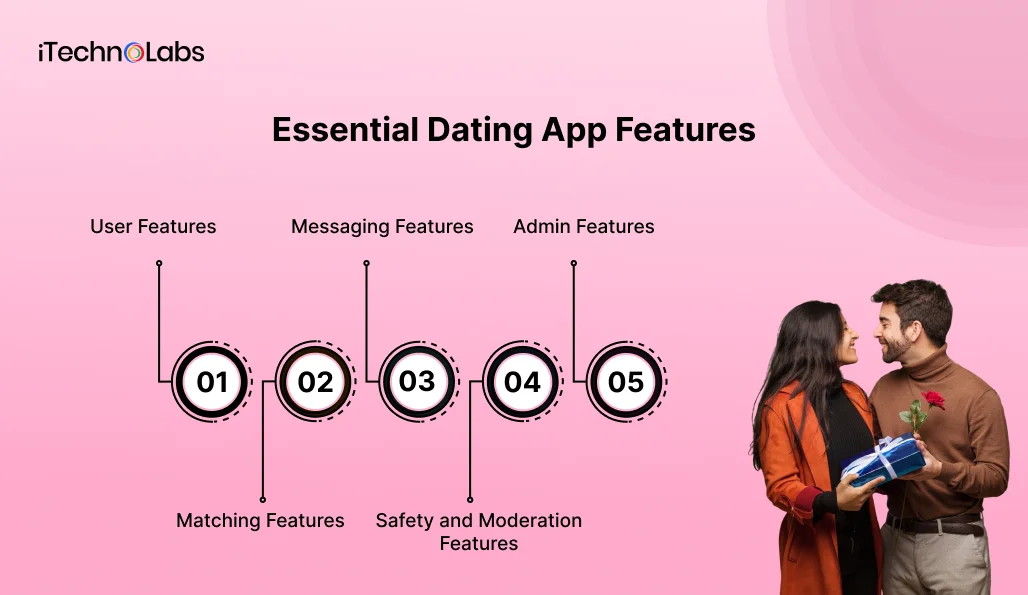
The right feature set depends on the target audience and business model. Most dating platforms need functionality across user, matching, communication, safety, and administration layers.
User Features
Core user functionality should include
- Account registration and secure login: Lets users create accounts and securely access their dating profiles.
- User profile creation: Allows users to build profiles with relevant personal and dating information.
- Profile photos and prompts: Lets users add photos and prompts that showcase their personality and interests.
- Dating preferences: Allows users to define preferred age ranges, locations, interests, and relationship goals.
- Location-based discovery: Shows potential matches based on selected location and preferred distance settings.
- Search and filters: Helps users narrow potential matches using preferences, interests, age, location, and other criteria.
- Like and pass actions: Let users quickly express interest or skip profiles during the discovery process.
- Match notifications: Alerts users when another person likes them and creates a mutual match.
- Profile editing: Allows users to update personal details, photos, prompts, preferences, and other information.
- Privacy settings: Gives users control over profile visibility, discovery settings, notifications, and personal information.
- Account blocking: Allows users to prevent unwanted interactions by blocking specific accounts from contacting them.
- Account deletion: Lets users permanently remove their account and associated personal data from the platform.
Profile creation should collect only information that is relevant to the matching experience. Asking for excessive personal information can increase friction and create unnecessary privacy obligations.
Matching Features
Matching is the product engine.
- Matching preferences: Uses user preferences and profile information to identify potentially relevant dating connections.
- Compatibility scoring: Calculates compatibility using shared interests, preferences, behaviours, and relationship goals.
- Personalised recommendations: Suggests potential matches based on profile data, activity, preferences, and interaction patterns.
- Mutual matching: Creates connections when two users independently express interest in each other.
- Match ranking: Prioritises potential matches using relevance signals and user interaction patterns.
Start with transparent matching rules that can be tested and adjusted. A sophisticated algorithm is not useful if the app does not have enough quality data to support it.
Messaging Features
Once two users match, messaging becomes the next important workflow.
A dating app can include
- One-to-one messaging: Enables private conversations between users after they establish a mutual match.
- Message notifications: Alerts users when they receive new messages, helping conversations continue without delays.
- Image sharing: Allows matched users to exchange photos directly within their private conversations.
- Read status: Shows whether messages have been opened to provide clearer conversation context.
- Conversation controls: Gives users options to manage, mute, delete, or control individual conversations.
- Report and block options: Lets users quickly report inappropriate behaviour or block unwanted contacts.
- Optional voice or video calling: Enables matched users to communicate through voice or video without sharing personal contact details.
Real-time messaging adds backend and infrastructure requirements, so it should be scoped according to the product strategy.
Safety and Moderation Features
Safety should not be treated as a later enhancement.
A dating platform should consider
- Profile and identity verification: Helps confirm user authenticity and reduces fake or misleading dating profiles.
- User reporting: Allows users to report inappropriate content, behaviour, harassment, or suspicious accounts.
- User blocking: Prevents unwanted users from contacting, matching, or interacting with the account.
- Content moderation: Reviews user-generated content to identify inappropriate, harmful, or policy-violating material.
- Spam and abuse detection: Identifies repeated spam, harassment, abusive messages, and other problematic user behaviour.
- Suspicious account detection: Flags accounts showing unusual activity patterns that may indicate fraud or misuse.
- Privacy controls: Give users control over profile visibility, personal information, discovery, and communication preferences.
- Moderation queues: Organises reported profiles and content for review by authorised moderation teams.
- Admin review tools: Help moderators investigate reports, review evidence, and take appropriate account actions.
Apple requires user-generated content apps to provide filtering, reporting, and blocking mechanisms, while Google requires robust UGC moderation with reporting and blocking functionality. Google also requires dating apps to use its tools to block minors. Current platform policies should be reviewed before launch.
Admin Features
The administration system manages the platform behind the scenes.
Important capabilities include
- User management: Gives administrators tools to view, manage, restrict, and maintain user accounts.
- Profile review: Allows administrators to inspect profiles for authenticity, quality, and policy compliance.
- Verification management: Helps administrators review verification requests and manage user identity verification processes.
- Reports and complaints: Centralizes user reports and complaints for investigation and resolution.
- Content moderation: Enables administrators to review, remove, or restrict content violating platform policies.
- Account suspension: Allows administrators to temporarily or permanently restrict accounts violating platform rules.
- Subscription management: Helps administrators manage plans, subscription status, upgrades, cancellations, and user entitlements.
- Payment monitoring: Tracks transactions, subscription payments, refunds, and payment-related issues across the platform.
- Analytics: Provides insights into users, matches, engagement, subscriptions, retention, and overall platform performance.
- Push notification management: Allows administrators to manage notification campaigns, alerts, reminders, and user communications.
- Privacy and access controls: Restricts administrative access based on roles, permissions, and sensitive data requirements.
The backend should also record moderation and administrative events needed for account management and platform oversight.
How to Build a Dating App
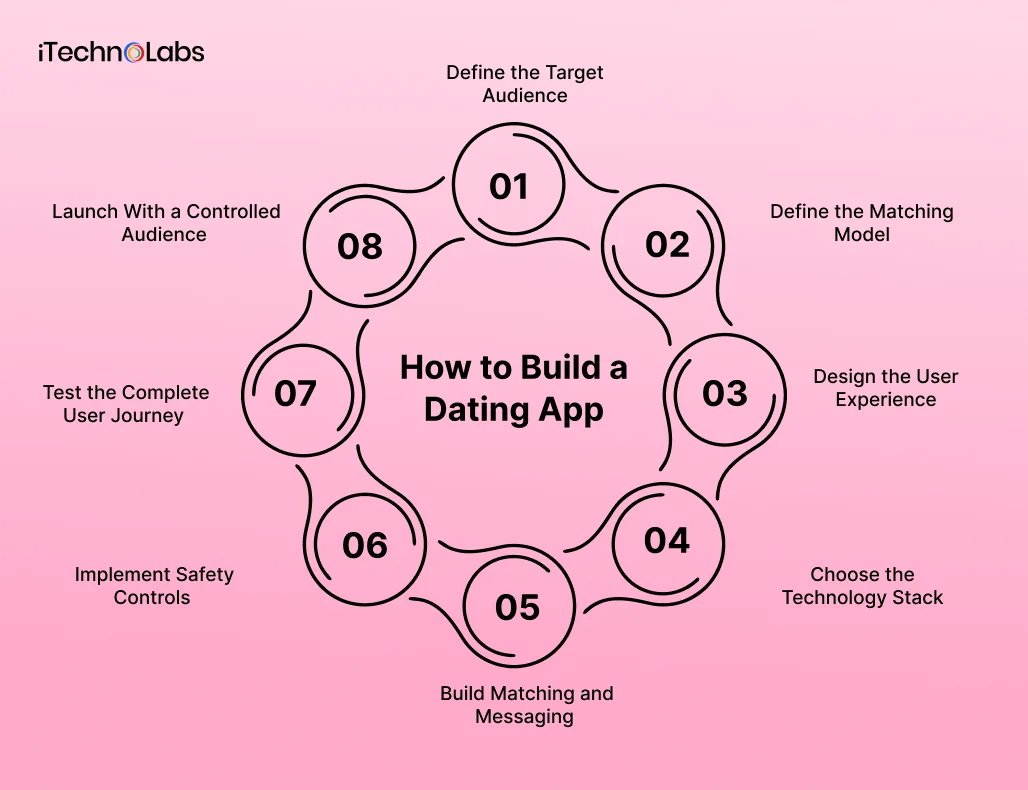
- Define the Target Audience
Decide who the app serves and what makes the experience different.
A general dating platform has different requirements from an app built around a specific community, relationship goal, location, interest, or demographic.
- Define the Matching Model
Document which signals determine discovery and matching.
Start with rules that are easy to understand, measure, and modify. More advanced recommendation models can be introduced once the platform has enough reliable behavioural data.
- Design the User Experience
Map the main journey from registration to conversation.
The onboarding process should collect enough information to produce useful matches without overwhelming new users. Discovery should also make it easy to understand why a profile is being shown.
- Choose the Technology Stack
A cross-platform framework such as Flutter or React Native can support iOS and Android through a shared codebase.
Native development using Swift or Kotlin can make sense when the product requires extensive platform-specific capabilities.
The backend may use technologies such as Node.js or Python with a transactional database such as PostgreSQL. Real-time messaging, notifications, media storage, analytics, payments, and moderation services can be added according to product requirements.
- Build Matching and Messaging
The backend should manage profiles, preferences, matching states, conversations, notifications, permissions, subscriptions, and moderation events.
The matching and messaging layer should handle real-time updates, notifications, permissions, and conversation states reliably.
- Implement Safety Controls
Build reporting, blocking, moderation, verification, privacy controls, and account management into the product architecture.
Moderation can combine automated detection with human review. The right approach depends on the type and volume of user-generated content.
- Test the Complete User Journey
Testing should cover registration, profile creation, matching, messaging, blocking, reporting, account deletion, subscriptions, payment failures, notifications, poor connectivity, and moderation workflows.
Real device testing is especially important because dating apps rely heavily on notifications, cameras, location services, media uploads, and background activity.
- Launch With a Controlled Audience
Launching within a specific geography or audience can make it easier to evaluate match quality, retention, moderation volume, acquisition costs, and engagement.
A dating app also needs enough users in the same market to make discovery useful. This network effect should be considered alongside the technical launch plan.
How Much Does It Cost to Build a Dating App
Dating app development can range from approximately USD 30,000 to USD 220,000 or more, depending on functionality, platforms, matching complexity, communication features, safety requirements, integrations, and scale.
| Dating app scope | Estimated cost in USD | Typical timeline |
| Focused MVP | USD 30,000 to USD 55,000 | 12 to 18 weeks |
| Standard dating app | USD 55,000 to USD 110,000 | 18 to 28 weeks |
| Advanced platform | USD 110,000 to USD 220,000+ | 28 to 40+ weeks |
These are planning ranges rather than fixed quotations. The final cost depends on features, platforms, backend complexity, integrations, security, testing, and the level of customisation required. A dating app with real-time communication, moderation, subscriptions, and sophisticated matching will generally cost more than a basic MVP.
The largest cost drivers include
- Number of platforms: Supporting iOS, Android, and web increases development, testing, and maintenance requirements.
- Matching and recommendation logic: Advanced algorithms require more development effort, data processing, testing, and optimisation.
- Real-time messaging: Instant messaging requires reliable infrastructure, notifications, message delivery, and real-time synchronization.
- Media and video functionality: Photos, videos, calls, and media storage require additional infrastructure and processing capabilities.
- Verification and moderation: Identity checks, content reviews, and reporting systems require specialised tools and workflows.
- Payment and subscription systems: Subscriptions, in-app purchases, billing, and payment security add development complexity.
- Backend architecture: Scalable backend systems require careful planning for performance, reliability, security, and growth.
- Third-party integrations: External services for maps, payments, analytics, verification, and notifications add integration costs.
- Security and privacy requirements: Strong data protection requires encryption, access controls, compliance measures, and security testing.
- Testing and post-launch support: Comprehensive testing, bug fixes, monitoring, updates, and ongoing support increase overall costs.
AI Features for Dating Apps
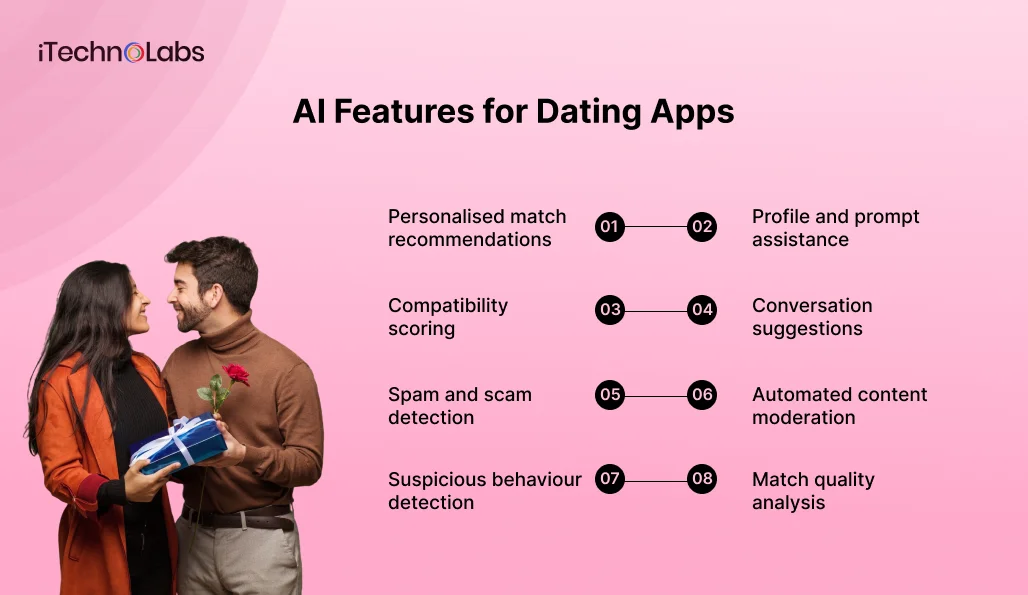
AI can improve dating apps when it solves a specific user or operational problem.
Useful applications include
- Personalised match recommendations: Suggests potential matches based on user preferences, interests, behaviour, and compatibility patterns.
- Profile and prompt assistance: Helps users create engaging profiles and prompts that better reflect their personality.
- Compatibility scoring: Evaluates shared preferences, interests, values, and behaviours to estimate potential relationship compatibility.
- Conversation suggestions: Recommends relevant opening lines and replies based on profile details and conversations.
- Spam and scam detection: Identifies suspicious messages, spam patterns, fraudulent profiles, and potential scam attempts automatically.
- Automated content moderation: Reviews profiles, images, messages, and reported content to identify policy violations.
- Suspicious behaviour detection: Detects unusual activity patterns that may indicate bots, fake accounts, or abusive behaviour.
- Match quality analysis: Analyses match interactions and outcomes to identify patterns that improve future recommendations.
AI should not be added simply because competitors use it. Start with a measurable problem and determine whether AI actually improves the outcome.
For example, AI can help identify potentially abusive or spam content for moderation review, while human moderators can handle difficult cases.
How iTechnolabs Can Help Build a Dating App
A dating app requires coordinated product design, mobile development, backend engineering, matching logic, real-time communication, moderation, payments, analytics, and ongoing support.
iTechnolabs provides dating app development services covering user profiles, matching, chat, location-based discovery, subscriptions, verification, safety features, admin dashboards, third-party integrations, testing, deployment, and post-launch development.
The development approach should be based on the target audience, core matching model, launch market, required platforms, and first release scope.
Final Thoughts
A successful dating app is not defined by the number of features it contains.
The foundation is a clear audience, useful discovery, relevant matching, reliable communication, and a safe environment.
Build those elements first. Then use real user behaviour to decide whether AI recommendations, video calling, advanced verification, premium features, social functionality, or other capabilities deserve the next development cycle.
For businesses planning dating app development, defining the MVP before development begins can make the budget, timeline, technology choices, and launch strategy much easier to manage.
FAQs
What are the must-have features of a dating app?
The core features include secure registration, profiles, photos, preferences, discovery, matching, messaging, notifications, reporting, blocking, privacy controls, and an admin dashboard. Verification, subscriptions, video calling, and AI matching can be added based on the product strategy.
How much does it cost to develop a dating app?
A focused dating app MVP can cost around USD 30,000 to USD 55,000. A standard product may cost USD 55,000 to USD 110,000, while an advanced platform can exceed USD 110,000. The final budget depends on platforms, features, backend complexity, matching, moderation, integrations, and testing.
How long does it take to build a dating app?
A focused MVP can take around 12 to 18 weeks. A standard dating app may require 18 to 28 weeks, while an advanced platform can take 28 to 40 weeks or more. Integrations, moderation, video, complex matching, and multiple platforms can extend the timeline.
How does a dating app matching algorithm work?
A basic matching system can compare preferences, location, interests, profile information, and mutual likes. More advanced systems can use behavioural signals and compatibility models to improve recommendations. The algorithm should be tested against real engagement and match quality rather than judged by complexity alone.
Should I use AI in a dating app?
AI can support recommendations, profile assistance, moderation, spam detection, compatibility analysis, and conversation suggestions. It should be introduced where it solves a measurable problem and where the output can be evaluated.
How do dating apps keep users safe?
Dating apps can combine profile verification, reporting, blocking, content moderation, privacy controls, suspicious activity detection, and administrative review. Safety requirements should be considered during product design rather than added after development.
Should I build a native or cross-platform dating app?
Flutter or React Native can be suitable when the goal is to launch on iOS and Android from a shared codebase. Native development can be preferable when the product requires extensive platform-specific functionality. The decision should follow the feature and performance requirements.
How do dating apps make money?
Common models include subscriptions, paid boosts, premium discovery features, additional interactions, one-time purchases, and advertising. A freemium model is often suitable because users can experience the core matching journey before deciding whether to pay for additional functionality.











