Key Takeaways
- Every candidate hears the same questions. The software transcribes each reply and rates it using a scoring guide your team wrote, and a hiring manager picks who goes through.
- Expect the first version to take 12 to 20 weeks. A ready-made tool gets you going sooner, though you’ll have less say over the process and over who holds the candidate data.
- Recording an answer is the easy part. Scoring it fairly takes most of the effort, so give that step extra time.
- Plenty of candidates don’t like these interviews. In a Greenhouse survey, 38% of job seekers said they had walked away from a hiring process because of one run by software.
- Software that scores job candidates is already regulated in New York City, Illinois, and the EU. Set aside time from the first week for telling candidates, collecting consent, and a fairness review every year.
Table of Contents
- What Are AI Interview Platforms, and When Should a Team Build One?
- What Can an AI Interview Platform Take Off a Hiring Team’s Plate?
- Should You Build or Buy an AI Interview Platform?
- What Belongs in a First Version?
- How Do You Build an AI Interview Platform, Step by Step?
- How Much Money and Time Does an Interview Platform Take?
- How Do You Keep AI Interview Platforms Fair and Legal?
- What Goes Wrong With Interview Platform Projects?
- What Makes iTechnolabs a Fit for Building Your Interview Platform?
- Conclusion
- FAQs
What Are AI Interview Platforms, and When Should a Team Build One?
AI interview platforms give each candidate an identical set of questions, keep the answers, and grade them with a guide that you write. For a growing team, a working first version takes about 12 to 20 weeks. Building your own pays off when your hiring is unusual or you want to hold the candidate data yourself. Otherwise, buy one.
Growth makes hiring chaotic. Picture ten jobs opening within the same four weeks. Every recruiter words the questions in their own way, and a promising candidate sits around for a week before anyone calls. Software that runs the first round is meant to shorten that wait. LinkedIn’s 2026 research found that 66% of recruiters plan to lean on AI more for pre-screening interviews this year. Candidates aren’t all on board. A Greenhouse survey of 2,950 job seekers found something less welcome. 38% have already walked away from a hiring process because it included an interview run by software. Lose good candidates at the door and the time you saved isn’t worth much. The build details matter.
What Can an AI Interview Platform Take Off a Hiring Team’s Plate?
Each candidate gets a link and picks their own time to answer. Your team receives a scored shortlist. Most of what they replace is the first phone screen.
Say a recruiter has twenty screening calls this week, and nearly every question is the same. By Friday her notes had run together. Was Monday’s candidate stronger than Thursday’s? Nobody can say for sure. An interview platform takes over that first round. The candidate opens a link, reads or hears a question, and either talks or types. Once they finish, the software stores a written copy, grades each answer against your guide, and leaves a short note on why it gave that grade.
You’ll find these tools in two forms. A recorded interview lets people answer at any hour, with nobody waiting on the other end. A live one comes closer to a real call, because the software can ask for a follow-up as soon as the candidate stops speaking. Recording is far easier to build and far easier to explain to candidates. Most teams start there and add the live style later, if they add it at all.
These tools don’t decide who gets hired. They sort and score. Your own people still read the shortlist and have the conversations that count.
Should You Build or Buy an AI Interview Platform?
A typical hiring process is well served by an off-the-shelf product. Building makes sense once your process is unusual, or once you need candidate data to remain under your control.
| What to weigh | Ready-made tool | Custom build |
| How fast can you start? | Days to a few weeks | Several months |
| What does it cost? | A monthly or per-interview fee that grows as you hire | A larger cost upfront, then smaller running costs |
| Does it fit your process? | You adapt to the tool | The tool adapts to you |
| Who controls candidate data? | The vendor holds it, under their rules | You do |
| Works best when | You hire often for common roles | Your roles, questions, or rules are unusual |
A middle path exists. Plenty of teams split the difference. The usual approach is to rent software for the everyday roles and pay for custom work only where nothing off the shelf fits, such as a scoring guide for a specialist job or a connection to the hiring system you already own. It’s a low-cost way to learn whether the idea works before the big spend. If it does, custom software development services can shape the platform around your hiring routine.
Teams in regulated fields often end up building anyway. When a client or regulator wants to know where candidate recordings are stored and who has access, “Our vendor looks after that” is an answer that rarely satisfies them.
What Belongs in a First Version?
Three pieces are enough to launch. People answer the questions, the software turns those answers into text and grades them, and a staff member looks over the results.
Begin with the questions. Each role gets its own question list, and every question comes with a line describing a good answer. For the candidate, the experience is one clean page that works well on a phone. In the background, the software keeps the recording, produces a transcript, assigns a grade, and writes a short reason so managers can see how it arrived at the number. Give managers one more screen too, where they can change any score they don’t agree with. Before any of this starts, candidates should see a notice saying software will score their answers.
Park the extras. Scheduling tools, extra languages, polished reports, and the hookup to your hiring system can all come later. Make the core work first, then let candidates show you what frustrates them. Building everything first means a late launch and no real feedback until then. Many teams treat the first version as a small pilot, and iTechnolabs’ MVP development services are built around that approach.
How Do You Build an AI Interview Platform, Step by Step?
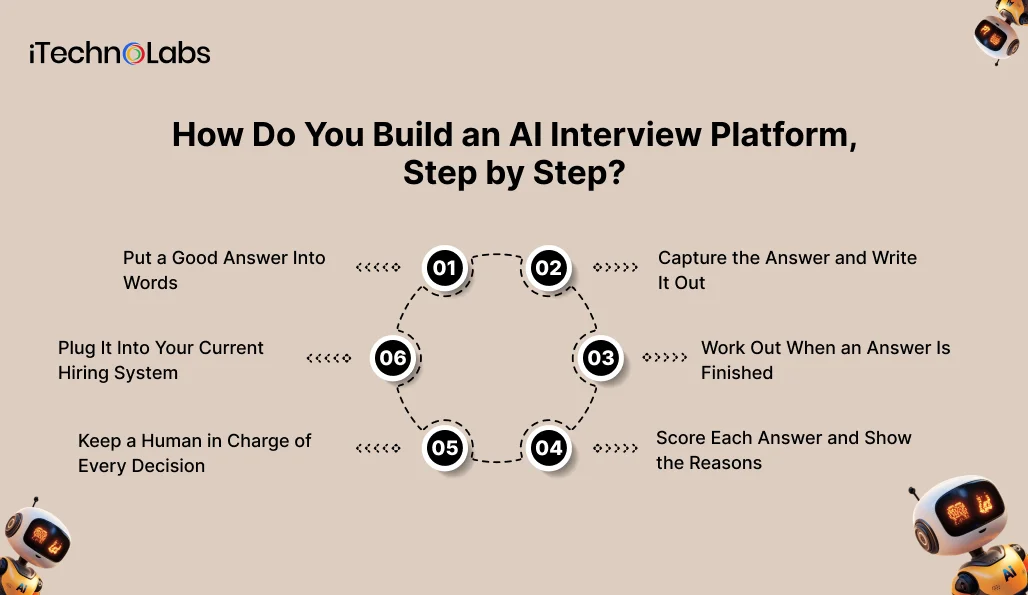
There are six steps, and the order matters. The scoring guide goes first because every later step leans on it.
1. Put a Good Answer Into Words
Sit down with the hiring manager and write the scoring guide while there’s still no code. Under each question, describe in ordinary language what a strong reply sounds like and what a poor one sounds like. If the manager can’t describe that difference, the software has no standard to judge by.
Test the guide on five answers from past interviews. Grade each one yourself, ask a coworker to grade the same set, and put your numbers next to theirs. Where your grades disagree, the question is likely unclear and should be reworded.
2. Capture the Answer and Write It Out
The candidate’s phone or laptop records the audio. A speech service, which you rent instead of building, turns it into text while they talk. Test it with the voices your candidates have. Strong accents, street noise behind the speaker, and specialist vocabulary all cause transcription mistakes. One wrong word in the transcript can pull a candidate’s score down later.
Store the recordings and the typed text on servers your company controls. Decide how long you’ll keep them well before the first interview runs.
3. Work Out When an Answer Is Finished
People pause to think. Someone says “um, give me a second,” then delivers the best point of the whole interview. If the software cuts in at the first quiet moment, it ends up scoring a thought that wasn’t done yet. A wait of two to three seconds is a fair starting point [ASSUMPTION], and a Done button keeps candidates in control. Run a test with people who speak slowly, and add more waiting time if the software talks over them.
4. Score Each Answer and Show the Reasons
The scoring service takes the typed answer, holds it up against your guide, and sends back a number with a brief explanation. Make it quote the candidate’s own words in that note. A score with no evidence is a guess.
Tell it never to invent details. If a candidate didn’t mention a project, the note shouldn’t either. After that, send one answer through the scorer three separate times. Getting a 4 once and an 8 the next time means the guide leaves too much open and needs tighter wording.
5. Keep a Human in Charge of Every Decision
Present the scores to managers as a first draft they’re free to edit. Nobody should be rejected until a real person has approved it. Log who changed which score, and when. If a candidate comes back later asking why they weren’t chosen, the log gives you a clear answer.
6. Plug It Into Your Current Hiring System
Recruiters should find the scores, notes, and candidate names inside the system they already open at the start of each day. Make them copy results across by hand and the new platform will gather dust. Look into the connection early, because many older hiring systems limit what outside tools are allowed to send in.
How Much Money and Time Does an Interview Platform Take?
For a first version, plan on 12 to 20 weeks and a budget of $40,000 to $120,000. Where you end up depends on the number of roles, the languages, and the local rules you need to cover.
| Phase | What happens | Time |
| Planning | Scoring guides, rules to follow, screens sketched | 2 to 3 weeks |
| Core build | Question flow, recording, text, scoring | 6 to 9 weeks |
| Fairness and voice testing | Real voices, score comparisons, fixes | 2 to 4 weeks |
| Pilot run | A small group of real candidates, then fixes based on what they tell you | 2 to 4 weeks |
More languages push the price up. So do live follow-up questions, video analysis, and heavy paperwork in regulated fields. One group of roles, recorded interviews only, and a plain review screen keep it down.
Once the platform is live, each completed interview carries a small charge, because the speech and scoring services bill by usage. Next to the hours a recruiter spends on screening calls, that charge is modest. Get current prices from every vendor before you lock in a budget. They change often.
How Do You Keep AI Interview Platforms Fair and Legal?
Laws covering this kind of software are already on the books in several places. The common thread is that you warn candidates in advance and test your tool for unfair outcomes.
New York City is the strictest example. Employers using software to screen candidates for jobs there need an outside reviewer to check the tool for bias within the past year. They must publish a summary of the results. They must also notify candidates 10 business days before use. Fines reach up to $500 for a first violation and $500 to $1,500 for each one after it.
Illinois focuses on video. Say you record interviews for jobs based there and use software to analyze them. You must tell the candidate, explain how the software works, and get their consent first. When a candidate asks, you have 30 days to delete their video and every copy, according to the state’s AI Video Interview Act.
The EU treats software that sorts or scores job applicants as high risk. The rules were first due in August 2026, but lawmakers have agreed to move the start to December 2, 2027. A later start date doesn’t cancel the rules, and getting ready now will save you a scramble.
In Canada, PIPEDA sets out how a business may gather, use, and hold personal information. A recorded interview is personal information. Ask a lawyer which other rules apply where you hire. This section is general information and isn’t legal advice.
Fairness takes work beyond the law. Check scores by group before launch and again every year. If one group scores lower for no job-related reason, rewrite the guide. Then tell candidates what you’re doing. Greenhouse found that 70% of job seekers said nobody told them upfront that software would evaluate them. A short notice before the interview fixes that.
What Goes Wrong With Interview Platform Projects?
Projects usually stumble over conversations the team skipped. The software itself is rarely the problem.
Teams often write the scoring guide once the build is done. By then the software has been shaped by guesses, and fixing it means doing work twice. Another is letting the score settle the matter. Managers who never see the reasoning can’t spot a bad score, and a candidate turned down by a bare number has every reason to be upset. In the US, 33% of job seekers who walked away named recorded video interviews scored by software with no human present as the reason.
Long question lists wear candidates out. Candidates tire out on a long list, and the later questions add little to what you’ve already learned. Ten sharp questions will serve you better than thirty loose ones. Testing with clear voices only is another trap. The first candidate with a strong accent or a loud kitchen behind them gets marked down through no fault of their own. Test with the voices and rooms real candidates will use.
What Makes iTechnolabs a Fit for Building Your Interview Platform?
With 300+ developers and 500+ apps delivered, iTechnolabs builds software under ISO certified standards.
Its information security practices are certified to ISO 27001:2013, and its quality management to ISO 9001:2015. Candidate recordings and scores are sensitive data, so those certifications matter here. The team has delivered 500+ apps used by 50,000+ end users, working from offices in Markham, Calgary, Ottawa, and Sheridan, Wyoming. As an AI development company, iTechnolabs designs and tests the scoring side through its generative AI development services. Should your own team need more capacity, you can hire developers from iTechnolabs month by month.
Conclusion
Build when your hiring process is unusual or your data rules are strict, or when you interview often enough that renting gets pricey. If neither applies, a ready-made tool gets you up and running faster. The route matters less than a handful of decisions that determine how far candidates and managers trust the results.
Involve the people who do the hiring when you write the scoring guide, and keep a manager responsible for each final decision. Candidates should hear ahead of time that software will score what they say. Review the scores for unfair patterns before launch, then again every year.
If you build, start small. Recorded interviews for one group of roles is enough to learn what works. Every rule mentioned above asks for the same underlying thing, which is that someone can explain how a decision was made. A first version designed around that is easier to defend and easier to improve. Plan for 12 to 20 weeks [ASSUMPTION] and a pilot group, and you’ll have a real answer before you spend the full budget.

FAQs
What are AI interview platforms?
AI interview platforms are programs that interview every candidate with the same questions. They save each answer and grade it using criteria your team sets. Managers then go through a ranked list. The tool covers the first phone screen, and people still make the hiring decision.
How much does it cost to build an AI interview platform?
Budget $40,000 to $120,000 for a first version. Where you fall depends on the number of roles, the languages, and the local rules involved. A recorded-only setup for one kind of job sits at the bottom of that range. Live follow-ups and video review push it higher. Once you launch, running costs grow with the number of interviews.
How long does it take to build an AI interview platform?
A first version usually takes 12 to 20 weeks, including planning, the build, testing for fair scores across different voices, and a small pilot. A ready-made tool can be running within days or a few weeks. The tradeoff is less say over how interviews run and where candidate data lives.
Is it legal to use software to interview candidates?
In most places it is, if you follow the local rules. New York City wants a yearly outside review and advance notice to candidates. Illinois asks for notice, an explanation, and consent when video interviews are analyzed. The EU calls hiring tools high risk, with rules due December 2, 2027. A local lawyer can confirm what applies.
Can software score candidates fairly?
It can be fairer than an unstructured phone call, but only with work. Write clear scoring guides, test with many kinds of voices, and compare scores across groups before launch and yearly after. Keep a manager in charge of every final decision, so one odd score never ends a candidacy alone.
Should a small team build or buy an interview platform?
Most small teams should buy first. A ready-made tool is quicker and cheaper to start, and it shows you what you need. Build later if your roles or rules are unusual, or if owning candidate data matters. A small pilot lowers the risk of building.