Key Takeaways
- Prioritise the insurance workflows creating the greatest operational friction before expanding the feature set.
- Build a connected platform for policy administration, claims, customer service, and analytics rather than isolated applications.
- Introduce AI where it supports a defined decision or workflow, with human oversight for consequential insurance decisions.
- Design security, auditability, access control, and regulatory requirements into the architecture from the beginning.
- Start with a focused MVP, validate its value, and expand through a phased product roadmap.
InsurTech app development in 2026 requires enterprise technology leaders to make clear decisions about product scope, system integration, AI governance, and security before development begins. Rather than building another general-purpose insurance app, CTOs should prioritise the workflows that matter most, identify which capabilities to build or buy, and define how the platform will connect with existing insurance systems.
Table of Contents
- What Should Enterprises Build in InsurTech in 2026?
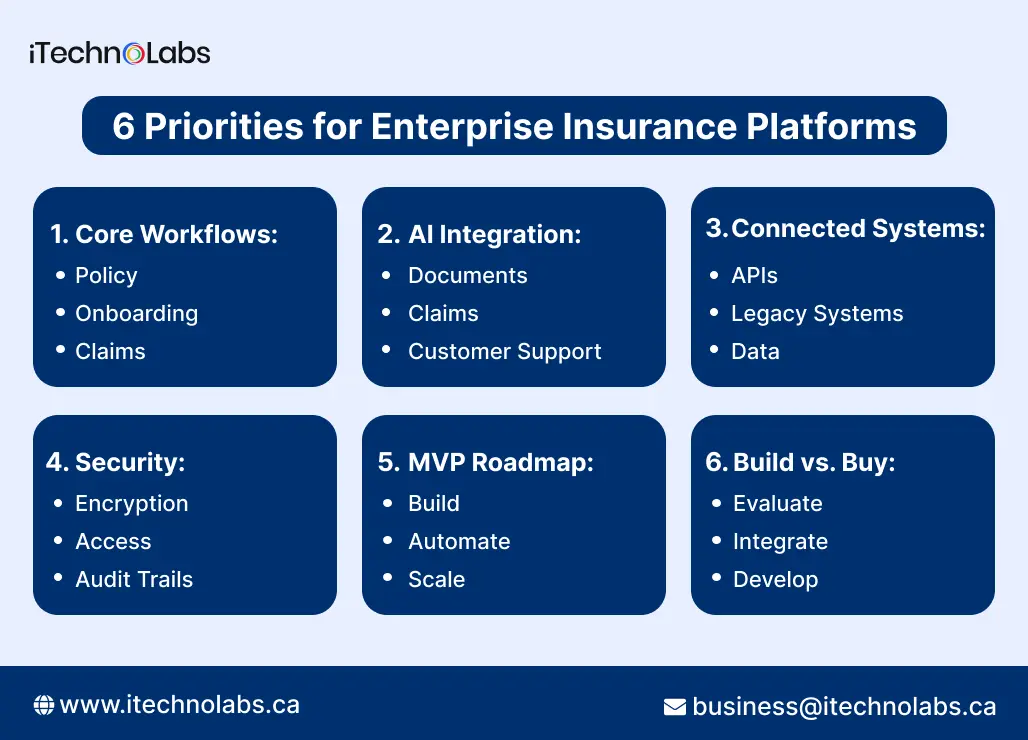
- 1. Build the Core Insurance Workflows First
- 2. Add AI Where It Has a Defined Job
- 3. Choose an Architecture That Connects Existing Systems
- 4. Make Security and AI Governance Part of the Product
- 5. Prioritise Features Through an MVP Roadmap
- 6. Build Versus Buy: What Should Your Team Decide?
- How to Select an InsurTech Development Partner
- Why Choose iTechnolabs for InsurTech App Development?
- Conclusion
- FAQs
What Should Enterprises Build in InsurTech in 2026?
The right InsurTech roadmap begins with the operating model, not a predetermined feature list. An established insurer modernising claims operations has different requirements from a digital insurance provider launching a new product or a brokerage connecting multiple carriers. Enterprise teams should map the target workflow, identify its system dependencies, and prioritise capabilities according to business value, implementation complexity, and risk.
Enterprise teams should evaluate proposed features against three questions: which business problem does the feature solve, which systems and data does it depend on, and how will its performance and risks be measured?
This approach keeps the product roadmap connected to business priorities instead of turning it into a list of technology trends.
1. Build the Core Insurance Workflows First
Policy administration and servicing
A policy management module should give authorised users a reliable way to view policy details, manage changes, access documents, track renewals, and review policy status.
The implementation should connect to the insurer’s existing policy administration system where appropriate. Rebuilding core insurance records without a clear reason can increase migration effort and introduce inconsistencies.
Prioritise accurate policy data, version history, role-based access, and clear records of changes.
Digital onboarding and policy issuance
Digital onboarding can bring identity verification, application forms, document collection, eligibility checks, and payment into a coordinated workflow.
The exact process depends on the insurance product and jurisdiction. Some applications may require manual review, additional evidence, or approval from an authorised professional.
Design the workflow to show applicants what information is missing, what happens next, and whether further review is required.
Claims intake and tracking
Claims management is a strong candidate for digital workflow improvement because it connects customers, claims handlers, documents, assessments, and settlement decisions.
A useful first release might include claim submission, document uploads, status tracking, requests for additional information, notifications, and an internal case management dashboard.
Add automation after the underlying process is clear. Digitising a confusing claims process without resolving its handoffs can simply move the same inefficiencies onto a screen.
2. Add AI Where It Has a Defined Job
AI can support underwriting, customer service, claims review, document processing, and fraud detection. The important architectural decision is determining which tasks can be assisted by AI and which require an authorised person to make or approve a decision.
The National Association of Insurance Commissioners (NAIC) describes AI applications across insurance operations and highlights concerns involving accuracy, unfair discrimination, data vulnerability, transparency, and explainability. Its guidance emphasises that AI-supported insurance decisions remain subject to applicable insurance laws and regulations.
Consider three practical applications.
- AI-assisted document processing: Extract relevant fields from submitted documents, identify missing information, and route exceptions to the appropriate team. Validate extracted data before it enters authoritative insurance records.
- Claims triage and decision support: Use defined rules and approved models to prioritise cases, identify inconsistencies, and summarise supporting evidence. Keep claim denial, settlement, and other consequential decisions under the appropriate governance and review process.
- Customer service assistance: Provide answers grounded in approved policy documents and customer records. Restrict access to sensitive information, identify the source of answers where possible, and transfer complex or disputed cases to a qualified representative.
Begin with an AI use case that has a clear baseline, measurable acceptance criteria, and a safe fallback when the model is uncertain. Do not introduce an autonomous decision system simply because the capability is available.
3. Choose an Architecture That Connects Existing Systems
Many enterprise InsurTech projects need to work with established policy administration, claims, billing, CRM, identity verification, and document management systems.
A practical architecture should separate customer-facing applications from core business services, expose controlled APIs, and provide a consistent approach to authentication, logging, monitoring, and error handling.
Key architectural components include:
- Experience layer: Web portals and mobile applications for policyholders, brokers, agents, and employees.
- Business services: Policy servicing, claims workflows, billing, customer records, and notifications.
- Integration layer: APIs, event processing, and connectors to internal platforms and approved external providers.
- Data layer: Governed operational records, document storage, analytics, and approved AI data pipelines.
- Control layer: Identity management, permissions, audit trails, monitoring, and security policies.
The right choice between extending an existing platform and building new services depends on system capabilities, ownership, integration constraints, and the cost of maintaining duplicated functionality.
For an enterprise, the architecture should also define data ownership, service availability requirements, recovery procedures, and how changes will be tested before release.
4. Make Security and AI Governance Part of the Product
Insurance platforms can process personal, financial, health, and other sensitive information. Security therefore needs to influence product design, data flows, vendor selection, and operational procedures.
Enterprise teams should plan for:
- Strong authentication and role-based access control.
- Encryption in transit and at rest, supported by appropriate key management.
- Audit logs for access to sensitive records and changes to important decisions.
- Data minimisation, retention rules, and controlled deletion.
- Model validation, performance monitoring, and testing for unfair or inaccurate outcomes.
- Vendor assessments covering data handling, security, availability, and contractual responsibilities.
- Incident response, backup, and recovery procedures.
For Canadian operations, assess applicable privacy obligations, including PIPEDA where relevant. For US and UK operations, review the specific federal, state, and sector requirements that apply to the business and product.
Maintain a traceable record of important automated decisions, including the data used, the model or rules applied, the output, and any human review. The appropriate record will vary by use case and legal requirements.
5. Prioritise Features Through an MVP Roadmap
A minimum viable product should prove that a defined workflow can work reliably before the team expands the platform.
| Phase | Build priorities | Validation focus |
| Phase 1 | Core user journey, identity and access, essential integrations, operational dashboard | Workflow completion, data accuracy, security controls |
| Phase 2 | Document automation, notifications, analytics, exception handling | Processing quality, exception rates, user adoption |
| Phase 3 | Selected AI assistance, advanced analytics, additional integrations | Model quality, fairness, review requirements, operational value |
This phased roadmap is a planning model, not a promised delivery schedule. Actual sequencing depends on legacy systems, regulatory approvals, available data, team capacity, and the scope of the first release.
Before development begins, agree on success measures. Depending on the workflow, these may include processing time, incomplete submissions, manual handoffs, error rates, customer effort, or the proportion of cases requiring human intervention.
Avoid claiming savings or performance improvements until the organisation has measured them against a documented baseline.
6. Build Versus Buy: What Should Your Team Decide?
Not every InsurTech capability needs to be developed from scratch. The decision should reflect strategic differentiation, integration complexity, operational risk, and long-term ownership.
| Capability | Option to evaluate | Key consideration |
| Identity verification | Buy or integrate | Coverage, assurance level, privacy, and vendor risk |
| Payments | Integrate an established provider | Security, reconciliation, and supported payment methods |
| Policy administration | Extend an existing system or build selectively | Migration risk, business rules, and data ownership |
| Claims workflows | Configure or develop | Workflow complexity and integration requirements |
| AI document processing | Pilot a vendor or build a controlled service | Accuracy, data exposure, explainability, and monitoring |
| Analytics | Extend existing tooling or build a governed data layer | Data quality, access controls, and reporting needs |
Buying can shorten the path to a standard capability, but it does not remove integration, governance, or vendor management responsibilities. Building can provide greater control over specialised workflows, but it creates ongoing engineering and maintenance obligations.
Document the decision for each major component, including exit options if a provider no longer meets business requirements.

How to Select an InsurTech Development Partner
An enterprise technology partner should be evaluated on its ability to understand insurance workflows, integrate with existing systems, and support the security and governance requirements of the intended product.
Use a structured evaluation that covers:
- Architecture: Ask for an explanation of API design, data ownership, system boundaries, and legacy integration.
- Security: Review access controls, secure development practices, vulnerability management, and incident response.
- AI governance: Ask how models are evaluated, monitored, documented, and escalated when results are uncertain.
- Delivery approach: Confirm milestones, testing responsibilities, release controls, documentation, and knowledge transfer.
- Ownership: Establish who owns source code, deployment configurations, data models, and technical documentation.
- Evidence: Request relevant, verifiable project examples and references rather than relying on general capability claims.
Why Choose iTechnolabs for InsurTech App Development?
Enterprise insurance platforms must connect business workflows, customer experiences, data, and existing technology systems. Choosing a development partner requires evaluating how well the team can translate those requirements into a defined technical scope and delivery plan.
iTechnolabs provides mobile app development, AI development, and custom software development services that may support different parts of an InsurTech initiative.
At iTechnolabs, the proposed engagement can focus on:
- Product and architecture planning: Define the initial use case, system boundaries, integration dependencies, and MVP priorities.
- Application development: Plan web and mobile experiences around the needs of policyholders, brokers, agents, and internal teams.
- AI implementation planning: Evaluate appropriate uses of document processing, customer support assistance, and workflow automation.
- System integration: Assess how the proposed platform should connect with existing policy administration, claims, billing, CRM, and data systems.
- Security and delivery planning: Define access controls, testing responsibilities, documentation, and ownership expectations.
The appropriate approach depends on your insurance product, existing infrastructure, regulatory obligations, and internal engineering capacity. Relevant insurance project experience and jurisdiction-specific requirements should be verified during partner evaluation.
Conclusion
InsurTech app development in 2026 is an enterprise product decision as much as an engineering initiative. The right roadmap connects business priorities with practical feature choices, existing system capabilities, security requirements, and responsible AI governance.
For CTOs and IT directors, the priority is to define the first workflow, determine which capabilities should be built or purchased, and establish measurable acceptance criteria before expanding the platform. A phased approach makes it easier to validate technical decisions, manage dependencies, and identify risks before they affect a wider rollout.
Before committing to development, review your current architecture, data flows, integration requirements, and operational constraints. These decisions will help establish a realistic scope and a clearer path from initial planning to implementation.

FAQs
1. How should a CTO define the scope of an InsurTech MVP?
Start with one high-priority insurance workflow and map its users, data requirements, system dependencies, and approval steps. Define the minimum capabilities needed to operate that workflow securely, then establish acceptance criteria for functionality, integration, and operational performance. Expand the scope after the initial implementation has been evaluated.
2. Should an insurer replace its legacy systems when building a new application?
Not necessarily. An insurer can often develop a new customer or employee experience around existing core systems through APIs and controlled integrations. Replacement may be justified when a legacy platform cannot meet critical requirements, but the decision should account for migration complexity, data integrity, business continuity, and long-term maintenance.
3. Which insurance workflows are suitable for AI assistance?
Document extraction, customer service assistance, claims triage, and case summarisation may be suitable starting points when the data and process requirements are well defined. Assess each use case for accuracy, privacy, explainability, and the consequences of errors. Establish human review and escalation procedures appropriate to the decision’s risk.
4. How should enterprises evaluate an InsurTech technology vendor?
Assess the vendor’s architecture, integration approach, security practices, delivery process, documentation, and source code ownership arrangements. Ask for relevant project evidence and references, and confirm how the proposed solution will meet your organisation’s regulatory, availability, and operational requirements before committing.
5. What should an InsurTech architecture include from the beginning?
Plan for identity and access management, secure APIs, data ownership, audit logging, monitoring, backup and recovery, and controlled integrations. If AI is included, also define model evaluation, output validation, monitoring, and human escalation. The architecture should reflect the product’s actual risks and operational requirements rather than assuming every platform needs the same design.
6. How can CTOs measure whether an InsurTech implementation is successful?
Establish a baseline before development and choose measures tied to the target workflow. Depending on the use case, these could include processing time, incomplete submissions, manual handoffs, data errors, or customer effort. Compare results against the baseline after implementation and review security, reliability, and exception handling alongside operational performance.