Key Takeaways
- Cars, smoke alarms and watches can all report back over the internet now, and that’s what IoT is. Insurers use those reports to set fairer prices and head off losses.
- Car, home and life cover are where it has paid off most so far, mainly through fairer prices and earlier warnings. Flood cover has shown how fast a payout can get.
- Most of the work sits in the app. It gathers the readings, works out which ones matter, feeds them to the insurer’s systems and gives people a reason not to unplug the thing.
- Nobody hands data to a company they don’t trust, so asking clearly and explaining plainly has to come first.
- Old software, slow sign-ups and smaller premiums as claims fall will all come up. None of them should catch you off guard.
IoT app development for insurance means building the app that sits between connected devices and the insurer. A car tracker, smoke alarm or fitness watch sends readings. The app turns them into a fairer price, a heads-up before something goes wrong, or a faster claim. Your premium then follows how you actually live, beyond just your age and postcode.
Right now, most policies get priced once a year. The insurer looks at your age, where you live and what you’ve claimed before. After that, nothing changes until renewal. Connected devices change that. A car can report how it’s driven, and a water sensor can warn a homeowner about a leak at 3 a.m. For anyone leading technology or product at an insurer, the data is already out there. The harder part is an app that customers will install and keep using.
According to IMARC Group, the global IoT insurance market was worth roughly USD 48.3 billion in 2024. The firm expects it to top USD 483 billion by 2033. Other firms come in lower, sometimes by a lot, so we’d read any one number as a ballpark.
Table of Contents
- What Is IoT in Insurance, and Where Does an App Fit In?
- What Are the Benefits of IoT in Insurance?
- Which IoT Use Cases Are Insurers Running Today?
- What Does an IoT Insurance App Need to Do?
- How Do You Build an IoT Insurance App?
- How Do You Keep Customer Data Private and Safe?
- What Problems Do Insurers Run Into, and How Do They Fix Them?
- How Do You Know If an IoT App Is Paying Off?
- Where Is IoT in Insurance Heading?
- Why Build Your IoT App With iTechnolabs?
- What Should You Do Next?
- FAQs
What Is IoT in Insurance, and Where Does an App Fit In?
IoT stands for Internet of Things, which sounds grander than it is. It’s ordinary stuff sending small bits of information online. Your car, a smoke alarm and the watch on your wrist all count.
For an insurer, the app is where those readings turn into something a person notices. That might be a text about a leak or a smaller bill at renewal.
A smoke alarm that pings your phone when it smells smoke counts. So does the little gadget some drivers plug in to log how hard they brake, or a watch tallying steps. Each records facts and sends them out, but none of it is useful until an app gives that data a purpose.
In most setups, the device records something and sends it to the insurer’s system. A set of rules checks it, asking whether that was a hard brake or a water leak. If it matters, the customer gets a message, the insurer gets a flag, or a claim starts on its own. The customer sees the app, and the insurer sees the results.
That is why IoT app development, more than the hardware, decides whether a project works. A box of sensors nobody sets up saves nobody any money.
What Are the Benefits of IoT in Insurance?
Connected devices help insurers in six ways, and customers get something out of each one too. None of them happen on their own, though, because all of them depend on how the app is built.
Pricing comes first. Progressive’s Snapshot program, for example, lets drivers control their rate through how, how much and when they drive, so a careful driver can show it and be priced for it.
Prevention comes next. State Farm has given free Ting plug-in sensors to nearly 700,000 homes to watch for the electrical faults that start fires. A warning on a phone costs far less than a burnt kitchen, for the family and for the insurer.
Claims get faster too. When a device records what happened and when, there’s less to argue about and less paperwork to chase. FloodFlash, a UK insurer that fits a flood-depth sensor at each customer’s building, settled one claim in 9 hours and 44 minutes.
Honest records also make false claims harder. Say a customer reports a pipe burst on Tuesday, and the device shows nothing until Friday. The insurer knows where to look.
Then there’s loyalty. Most people hear from their insurer at renewal or after a bad day, and almost never in between. A device gives the insurer a reason to be useful the rest of the year. John Hancock’s Vitality program lets life insurance customers earn rewards for healthy habits tracked on a watch or fitness band, with premium savings of up to 25% on its Vitality PLUS version.
The data also lets insurers sell things they couldn’t before, such as cover that pays out the moment a set limit is crossed, which comes up again further down.
Go in with realistic hopes, though. Matteo Carbone, who founded the IoT Insurance Observatory, made this point at an industry event in 2023. Car trackers, he said, hadn’t really moved the needle on insurers’ overall results yet. In U.S. personal lines, insurers were paying out well over a dollar in claims and costs for every dollar of premium. His suggestion? Sell useful extras, like automatic crash alerts, and lean less on discounts. Hold onto that when you sketch out the app.
Which IoT Use Cases Are Insurers Running Today?
Car, home and life cover have the most real examples. Business, flood and farm cover are still growing. The table gives a quick view before the details.
| Type of cover | What the device records | What the insurer gets |
| Car | Braking, speed, time of day, miles driven | Prices based on real driving |
| Home | Electrical faults, water leaks, smoke | Early warnings and fewer big claims |
| Life and health | Steps, activity, workouts | Healthier customers and closer contact |
| Business sites | Machine condition, air quality, temperature | Warnings before something breaks |
| Flood and weather | Water depth, rainfall | Payouts that don’t need a site visit |
| Farms | Weather, soil, animal health | A better read on crop and livestock risk |
Car Insurance: Pricing by How People Drive
You either download a phone app or plug a little device into the car. Progressive says it starts the discount when you sign up and works out your personal rate at renewal, once it has enough driving data. The catch for drivers is that a bad score can push the rate up. Drivers will want to know exactly what’s being counted against them, and the app should tell them in normal words.
Home Insurance: Warnings Before the Damage
The Ting sensor plugs into a wall socket and watches a home’s wiring for the electrical arcing that comes before many fires. State Farm covers the cost of the service. If Ting finds a hazard, Whisker Labs, the company behind it, adds a $1,000 credit toward the repair. Leak sensors and smart smoke alarms work on the same hunch. Catch a drip under the sink early and maybe nobody ever files a claim.
Life and Health Insurance: Rewards for Healthy Habits
Here it’s the watch or fitness band doing the reporting. Walks and workouts earn points, and points turn into rewards or a cheaper premium. The app keeps score. Make it boring or hard to follow and the watch ends up in a drawer.
Business Insurance: Watching Machines and Buildings
On a factory floor or in a warehouse, small devices can listen to machines, check the air and watch the temperature. Say a motor starts to rattle, or a cold store drifts up a few degrees overnight. Someone gets told and fixes it before it breaks. That means no shutdown for the business and no claim for the insurer.
Flood and Weather Cover That Pays on a Set Trigger
FloodFlash works differently. When you buy the cover, you choose the water depth and how much you want paid. Then a sensor goes on the building to measure the water. When it hits the chosen depth, the policy pays out without a loss adjuster visiting. Insurers call this a set-trigger policy. In plain terms, it pays when a number is reached, not when someone has totted up the damage.
Farm Insurance: Weather, Soil and Livestock
Farmers can put out devices that log rainfall and soil moisture, and some even track how the livestock are doing. That gives an insurer a much better sense of crop and livestock risk when it sets the terms. This area is newer than cars and homes, and fewer public examples exist.
What Does an IoT Insurance App Need to Do?
There are five things the app has to get right. When one falls over, it’s usually the first or the last.
Start with sign-up. If getting the device going means a call to a helpline, you’ve already lost some people. Say what’s being recorded, wait for a real yes, and make opting out easy to find later. Anyone who feels tricked is gone for good.
Then comes checking the data. Plugs get pulled and Wi-Fi drops out. A strange reading could be a real problem, or it could be the cat knocking a cable loose. The app needs to spot gaps and bad readings rather than trust every number.
Next is deciding what matters. A leak alert should hit the homeowner’s phone straight away. One slightly odd drive home, though, shouldn’t touch anyone’s price. Your team writes those rules, and they’ll want to tweak them as they learn.
The fourth job is talking to your other systems. The app has to pass information to policy records, claims and customer files. If it can’t, someone ends up copying data across by hand, and there go your savings.
Last, give people a reason to keep the app. A handy alert, a tip, a reward or a claim paid quickly will all do it. An app that only watches people gets deleted.
How Do You Build an IoT Insurance App?
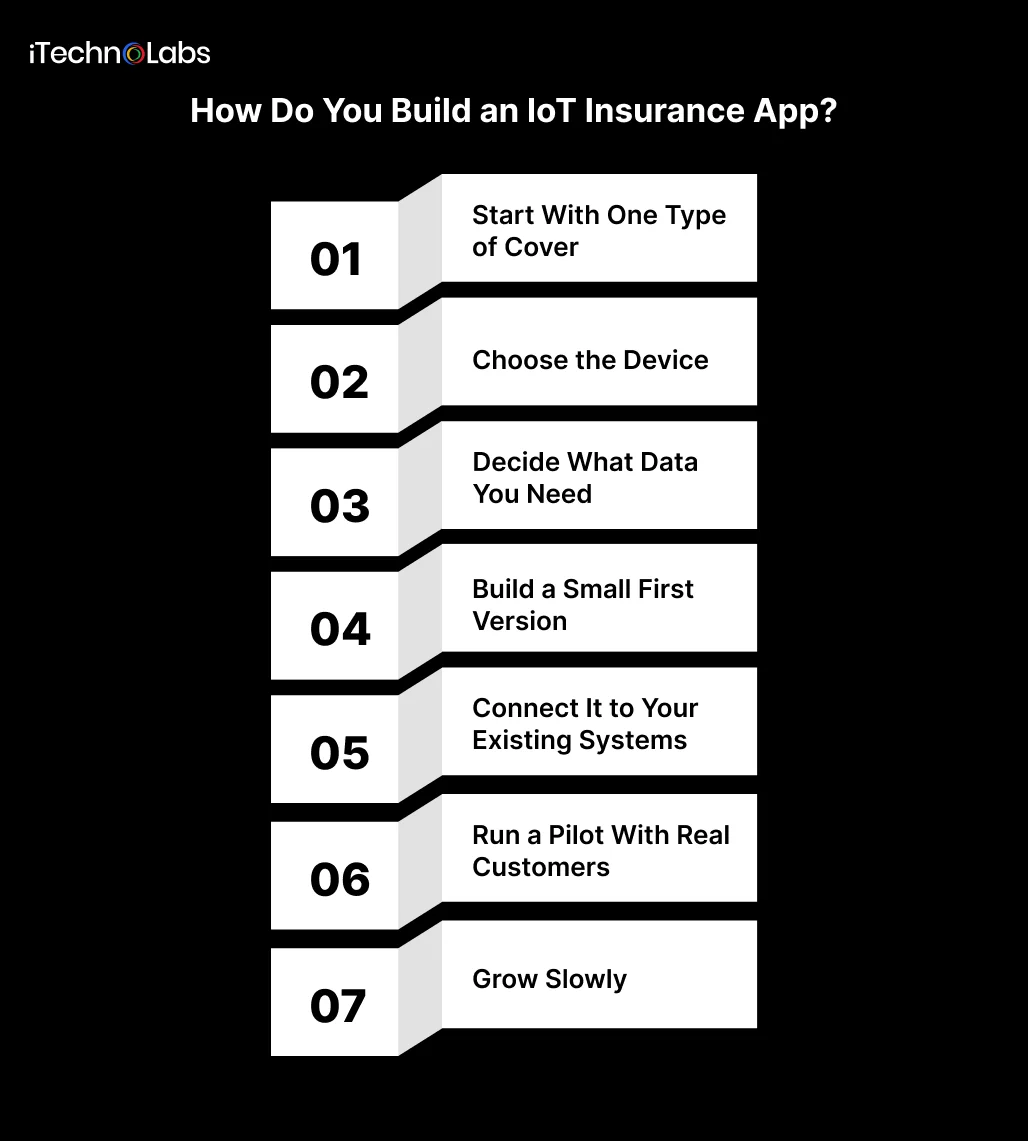
Start small, try it on real customers, and grow once the first version holds up. In practice that’s seven steps, roughly in this order.
Step 1: Start With One Type of Cover
Pick a car, home or business. Only one, though. They each need different devices, different rules and a different kind of customer, so a narrow start teaches you more for less money.
Step 2: Choose the Device
Very few insurers design their own hardware. They buy something proven that’s already on the market. When you’re comparing options, check the battery life and how fiddly the install is. Then hand one to someone non-technical and see if they can set it up alone.
Step 3: Decide What Data You Need
Make a list of every piece of data you want, with a reason next to each. Anything that doesn’t help with pricing, claims or prevention can go. This is also the moment to pull in your legal team, while changes are still cheap.
Step 4: Build a Small First Version
Your first version needs one device, one set of alerts and a few screens that are easy on the eye. That’s it. Get it in front of real customers soon and leave the full platform for later. Short on people? Custom software development services can pick up the slack.
Step 5: Connect It to Your Existing Systems
Next, the app has to talk to your policy, claims and billing records. Pad the timeline for this bit. Older systems rarely connect as smoothly as the project plan assumes.
Step 6: Run a Pilot With Real Customers
Give it to a small group before anyone else. How many sign up? How many keep the device switched on? How often are the alerts right? Sort out what’s broken before a wider launch.
Step 7: Grow Slowly
Add customers, then devices, then new types of cover. Budget for broken devices, software updates and support calls too. They tend to show up earlier than anyone planned.
We can’t quote one price here, because cost and timeline swing with a few things. Think about how many kinds of device you support, how many older systems the app has to talk to, and how much data flows through it. Our app cost calculator will give you a rough first number.
How Do You Keep Customer Data Private and Safe?
Ask before you collect anything and hold on to only what you actually use. Because the rules vary so much between countries, get a lawyer who knows your markets to look over the plan.
California has its own personal data law. So do Canada, the UK and the UAE, and they don’t all ask for the same things. Selling in more than one of those places? Then you’ll probably need a separate consent screen for each one.
People can’t really agree to something they don’t understand. So say what you collect and why, the way you’d explain it to a teenager. Let people withdraw. And collect only what you need. Whisker Labs, which makes the Ting sensor, says it does not share the sensor’s signal data with State Farm. All State Farm gets is enrollment details. Limits like that make it a lot easier for people to say yes.
Then there’s security. Data needs protecting both where it’s stored and while it’s on the move, and only staff who need it should be able to open it. An outside check helps too. iTechnolabs holds an international security certification, which means an outside body has reviewed how we protect information.
Who owns the data is still an open question. Customers think they should control what their devices record, and insurers believe they have rights to it as well. DICEUS, an insurance software firm, points out that nobody has settled this yet. In the meantime, put your own answer in the policy terms and keep the wording simple.
What Problems Do Insurers Run Into, and How Do They Fix Them?
The same five problems turn up in almost every project. Here they are, with what usually fixes them.
| Problem | What it looks like | Fix |
| Old systems | Software built around yearly paperwork can’t cope with readings arriving all day | A go-between piece of software to translate for now; swap out the old system later |
| Customers say no | “I don’t want to be watched.” Or setup just looks like a hassle | Be honest about it, keep setup quick, and offer a free device or a repair credit |
| Bad readings | Plugs get pulled, signal drops | Test in real homes and cars first; have the app flag gaps |
| Smaller premiums over time | Fewer claims, less premium | Charge for things people like, such as monitoring and alerts |
| Pilots that stall | Fine at 200 customers, creaking at 20,000 | Budget for replacement devices, support staff and extra developers from day one |
About that last row. A lot of insurers don’t have the developers in-house, so they hire developers for the pilot and hold off on building a full team. It’s faster. It also shows you which skills you’ll actually need before you hire anyone permanently.
How Do You Know If an IoT App Is Paying Off?
Before launch, pick four or five numbers you’ll check every quarter. Each should link back to money or to what customers do. And write down where those numbers sit today, or you’ll have nothing to measure against.
Good ones to start with are how much of each premium dollar goes out in claims, and how many days a claim takes to settle. Then look at renewals, sign-ups for the device program, and how many devices are still on after six months. Read the customer feedback as well. Complaints there often warn you about falling renewals before the numbers do.
Set honest expectations too. Carbone’s view was that results from car trackers came slower than many insurers hoped. A pilot that proves people will use the app is a real win, even before the claims numbers move.
Where Is IoT in Insurance Heading?
Faster mobile networks will let devices report more often and with less delay. Devices will also check their own readings before sending them, so false alarms should drop. Cover that pays when a set limit is crossed, like FloodFlash’s flood depth, is likely to reach more kinds of risk. Insurers will also lean harder on software that learns from the data to spot patterns people miss. None of this needs a rebuild if the first app has room to grow. If that’s on your roadmap, an AI development company can build it into the same app.
Why Build Your IoT App With iTechnolabs?
iTechnolabs is a Canadian software company. Our offices are in Markham, Calgary, Ottawa and Sheridan, Wyoming. So far we’ve delivered 500+ apps that reach 50,000+ end users, and we work with 300+ developers.
Two certifications matter here. ISO 27001:2013 is about information security, and ISO 9001:2015 is about quality management. If an app is going to handle people’s driving, home and health data, an outside body should have checked how the team behind it works.
We’d start the same way this guide suggests, with one type of cover, one device and a small pilot. That way you learn from real customers before spending more.
What Should You Do Next?
A few insurers are already well down this road. Progressive prices from driving data and State Farm hands out fire sensors. John Hancock rewards healthy habits, and FloodFlash has paid a flood claim in under ten hours. None of them got there by just buying devices. Each one built something customers were happy to keep using.
If you’re weighing it up, start with one narrow question. Where’s the loss you could prevent, or the claim you could speed up? Pick one device. Write down what you’ll record and why, and get your legal team involved before anyone writes code. Then run a small pilot and watch what customers do, which isn’t always what they say. And keep an eye on your older systems, because they’ll set the pace of the whole project.
There will be friction. Customers will ask why you want their data. Some readings will be wrong, and your own staff will take a while to trust the alerts. That’s all much easier to sort out with 200 customers than with 20,000.
Get it right, and IoT app development gives you a reason to talk to policyholders in all the months between renewals.
FAQs
How does IoT reduce insurance fraud?
Because the device keeps its own record of what happened and when. Say someone reports a leak on Monday, but the sensor saw nothing all week. The insurer has good reason to look closer. When the device does back up the story, the claim moves faster, which is good news for honest customers.
How much does it cost to build an IoT insurance app?
There’s no single price, honestly. It swings with how many kinds of device you support, how many older systems it connects to, and how much data it handles. We’d rather give you a real range after a short call than guess. Meanwhile, the app cost calculator gives a rough number for budget talks.
How long does it take to build an IoT insurance app?
The same things that drive cost drive the timeline. A first version covering one type of insurance and one device is far quicker to build than a full platform. In practice, your older systems usually set the pace. Once we know what the app has to connect to, we can give you a realistic date.
Can the app work with our old policy system?
Usually, yes. A piece of go-between software carries information back and forth, so the old system can stay where it is for now. That connecting work is slower than building the screens, so leave room for it. Plenty of insurers swap the old system out in stages once the app has proved itself.
What data can an insurer collect from connected devices?
Only what the customer has agreed to and what local privacy law allows. Even then, stick to data that helps with pricing, claims or prevention. Explain it plainly before anyone signs up, and make it easy to opt out later. Rules change from country to country, so check each market separately.
Will IoT lower an insurer’s revenue?
Over time, it might. Fewer losses mean fewer claims, and customers who are clearly lower risk will expect to pay less. Most insurers answer that by charging for things people actually value, like monitoring and alerts. Selling safety alongside the policy gives customers a reason to stay that isn’t only about price.