
Key Takeaways
- Generative AI ROI depends on measurable business outcomes, not adoption rates or model performance alone.
- A credible business case accounts for implementation, integration, operating, governance, and human review costs.
- Productivity, revenue growth, quality improvements, and risk reduction require different measurement methods.
- Controlled pilots and baseline comparisons help technology leaders validate returns before scaling AI.
- Governance, data quality, and workflow redesign influence whether initial gains translate into lasting business value.
Measuring generative AI ROI for business means comparing the financial and operational value created by an AI implementation against its total cost. For enterprise CTOs and IT directors, this requires tracking productivity, quality, revenue, and risk alongside infrastructure, integration, governance, and maintenance expenses. The objective is to identify which AI initiatives deliver measurable returns and deserve further investment.
A practical ROI framework connects each AI use case to a business objective, establishes a baseline before deployment, measures the resulting change, and accounts for the full cost of operating the solution.
Table of Contents
- Why Measuring Generative AI ROI Matters
- How to Calculate Generative AI ROI for Business
- Five Metrics to Track When Evaluating AI ROI
- A Practical Framework for Measuring Generative AI ROI
- Worked Example: Calculating AI Implementation ROI
- Common Challenges That Reduce AI ROI
- How CTOs Should Build an AI ROI Business Case
- Measure the ROI of Your Generative AI Investment with iTechnolabs
- Conclusion
- FAQs
Why Measuring Generative AI ROI Matters
Generative AI can support customer service, software engineering, internal knowledge management, document processing, and research. However, each use case creates value differently, so a single productivity metric cannot adequately evaluate every implementation.
McKinsey’s research on the economic potential of generative AI identified customer operations, marketing and sales, software engineering, and research and development as four areas accounting for approximately 75% of the potential value across the use cases it analysed. This provides a useful starting point for prioritising opportunities, not a guarantee of returns for an individual company.
The financial case also needs realistic expectations. Deloitte’s 2025 survey of 1,854 executives across Europe and the Middle East found that most respondents reported satisfactory ROI on a typical AI use case within two to four years. Only 6% reported a payback period under one year. These findings illustrate why enterprise AI investments need a longer evaluation horizon than a short pilot alone.
For technology leaders, ROI measurement serves three purposes:
- Investment prioritisation: Compare potential returns across AI initiatives before committing engineering resources.
- Operational accountability: Determine whether expected improvements translate into actual business outcomes.
- Scale decisions: Identify which pilots justify broader deployment and which require redesign or termination.

How to Calculate Generative AI ROI for Business
The standard ROI formula provides a starting point for evaluating an AI implementation.
ROI % = Net Benefits/Total Investment x100
Net benefits equal the financial value attributable to the implementation minus its total costs. For an AI initiative, the calculation must include both direct expenditure and the cost of integrating AI into existing operations.
- Calculate the total implementation cost
Include the costs required to build, deploy, secure, and maintain the solution.
| Cost category | What to include |
| Development | AI engineers, application development, testing, and prototyping |
| Infrastructure | Model usage, cloud compute, storage, and hosting |
| Integration | APIs, enterprise systems, data pipelines, and workflow changes |
| Data preparation | Data cleaning, access controls, retrieval systems, and evaluation datasets |
| Governance and security | Privacy reviews, compliance assessments, monitoring, and audit controls |
| Ongoing operations | Maintenance, model evaluations, support, retraining where needed, and incident handling |
| Workforce adoption | Training, change management, and human review |
A common mistake is to compare productivity savings against model subscription fees alone. Enterprise deployments often require substantial integration, security, and operational work that sits outside the model’s advertised price.
- Quantify the business benefits
Benefits should be tied to outcomes that finance and operational teams can verify.
- Cost savings: Reduced external spending, overtime, manual processing expenses, or other actual expenditures.
- Capacity gains: Employee hours released for higher-value work.
- Revenue gains: Incremental revenue attributable to improved conversion, customer retention, or sales productivity.
- Quality improvements: Fewer errors, less rework, and better consistency.
- Risk reduction: Lower expected losses from specific operational or compliance risks, where these can be reasonably estimated.
Avoid counting the same benefit twice. For example, if reduced processing time is already valued as an increase in productive capacity, do not also record the same hours as a direct payroll saving unless expenditure actually decreases.
- Separate financial savings from productivity gains
Time saved is not automatically money saved. If AI reduces a task from 60 minutes to 40 minutes, the organisation has released 20 minutes of capacity. That capacity creates financial value only when it supports additional productive work, avoids future hiring, reduces overtime, or produces another measurable outcome.
This distinction makes ROI reports more credible and helps CTOs communicate results accurately to finance leaders.
Five Metrics to Track When Evaluating AI ROI
A useful measurement framework combines financial outcomes with operational indicators. Select a small set of metrics that directly reflects the business objective of each implementation.
| Metric | What it measures | Example |
| Cost per task | Cost of completing a workflow | Cost per support ticket resolved |
| Time saved | Reduction in task completion time | Minutes per document processed |
| Error or rework rate | Quality of AI-assisted output | Percentage of outputs requiring correction |
| Adoption and utilisation | Actual use within the target workflow | Percentage of eligible tasks using AI |
| Business outcome | Impact on financial or operational goals | Cost per resolved case, conversion rate, or service-level performance |
These metrics should be measured together. High utilisation with poor output quality may increase costs. Strong time savings with low adoption may limit overall impact. A positive business outcome, supported by reliable baseline comparisons, provides stronger evidence of value.
Microsoft’s approach to measuring AI at work also illustrates why evaluation should extend beyond time saved. Its Copilot Assisted Hours metric combines different forms of AI-supported activity to help organisations assess how AI changes work patterns. Such activity measures are useful indicators, but they should be connected to business outcomes before being treated as financial returns.
A Practical Framework for Measuring Generative AI ROI
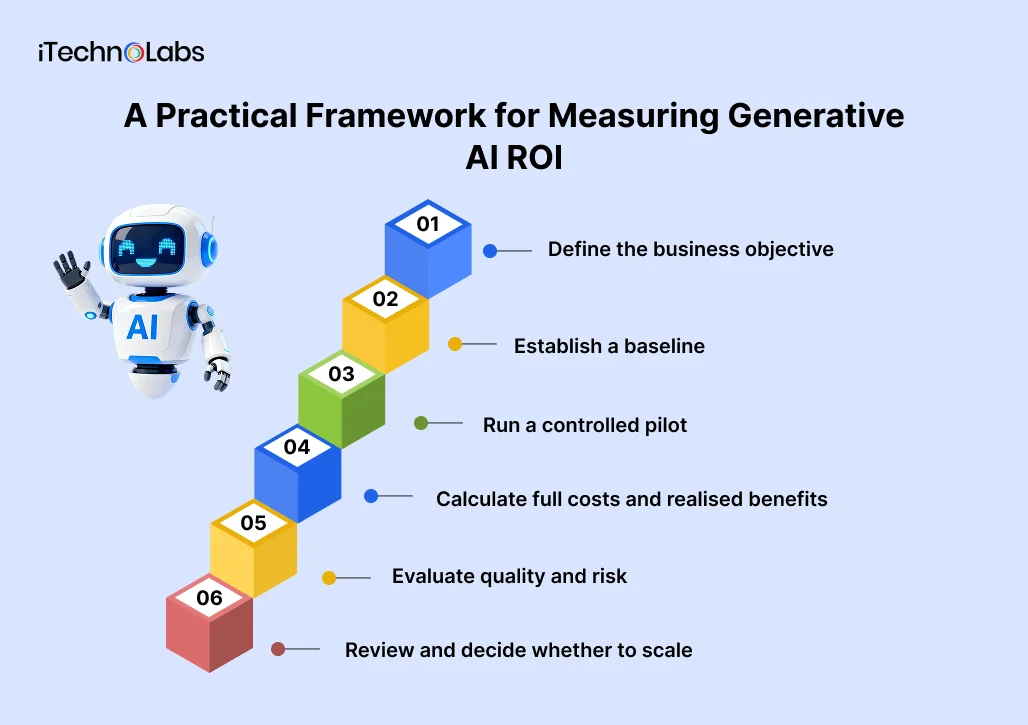
Enterprise teams can use the following six-step process to assess an AI initiative from pilot to production.
Step 1. Define the business objective
Identify the problem the implementation must solve. Examples include reducing document processing costs, shortening software delivery cycles, or improving support response times. Set a measurable target and assign an accountable business owner.
Step 2. Establish a baseline
Record current task volumes, processing times, costs, error rates, and service quality before deployment. Use representative historical data where available. Without a baseline, teams cannot reliably determine whether AI caused an improvement.
Step 3. Run a controlled pilot
Test AI against the existing workflow using representative tasks and appropriate human oversight. Where feasible, compare results with a similar control group or a consistent pre-deployment baseline to account for changes unrelated to AI.
Step 4. Calculate full costs and realised benefits
Include model usage, engineering, integration, security, monitoring, and review costs. Convert operational improvements into financial values only when the assumptions and attribution method are documented.
Step 5. Evaluate quality and risk
Check accuracy, exception rates, data exposure, human intervention, and compliance requirements. A solution that saves time but introduces unacceptable risk should not be considered a successful investment.
Step 6. Review and decide whether to scale
Review results with engineering, finance, security, and business stakeholders. Scale when the evidence supports the business case, redesign when performance falls short, and stop initiatives that cannot justify their cost or risk.
For risk evaluation, the NIST AI Risk Management Framework and its Generative AI Profile offer guidance for identifying and managing AI-specific risks throughout the system lifecycle.
Worked Example: Calculating AI Implementation ROI
Consider a hypothetical enterprise that introduces a generative AI system to assist with document processing. The following figures are illustrative assumptions, not actual iTechnolabs client results or industry benchmarks.
Assume the system reduces manual processing effort while employees continue reviewing the output.
| Input | Illustrative value |
| Employees using the workflow | 20 |
| Hours saved per employee per month | 10 |
| Internal value per productive hour | $50 |
| Annual gross capacity value | $120,000 |
| Annual AI, hosting, and support costs | $30,000 |
| Initial implementation cost | $45,000 |
| First-year total cost | $75,000 |
The annual gross capacity value is calculated as 20 employees multiplied by 10 hours per month, 12 months, and $50 per hour.
The first-year net benefit is $120,000 minus $75,000, or $45,000.
First-year ROI = 45,000/75,000 x 100 = 60%
However, the 60% result assumes that all released capacity is productively used and can be valued at $50 per hour. If the organisation cannot redeploy that time or convert it into measurable savings, the realised financial return will be lower.
This is why an ROI model should include conservative, expected, and optimistic scenarios rather than relying on a single forecast.
Common Challenges That Reduce AI ROI
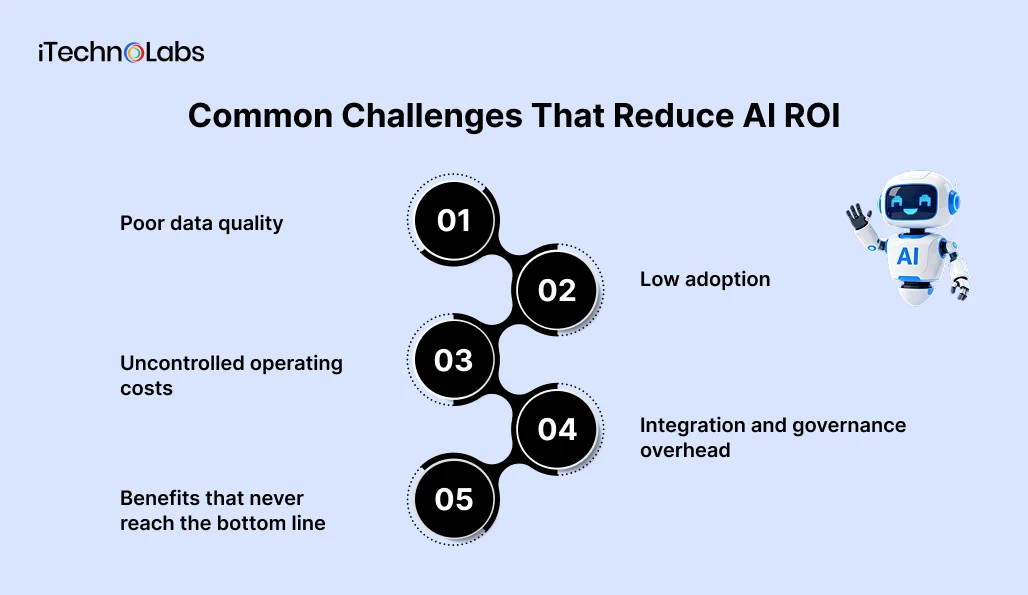
Even a technically successful implementation can fail to deliver its expected financial return. Enterprise leaders should account for the following issues before approving a wider rollout.
Poor data quality
Generative AI depends on the quality and relevance of the information available to it. Incomplete documentation, inconsistent records, and outdated knowledge sources can increase errors and human review costs. Data preparation and retrieval quality should therefore be part of the investment calculation.
Low adoption
Employees may avoid an AI tool if it disrupts established workflows, produces unreliable results, or requires extra manual steps. Measure adoption alongside task completion and output quality. Training and workflow redesign may be necessary before the system delivers consistent value.
Uncontrolled operating costs
Model usage, repeated prompts, long context windows, and unnecessary processing can increase operating expenses. Track cost per successful task rather than usage volume alone. Smaller models, retrieval improvements, caching, and task routing may reduce costs when they meet the required quality standard.
Integration and governance overhead
Connecting AI to enterprise applications introduces access controls, monitoring, security reviews, and maintenance requirements. These are essential operating costs, not optional additions. The NIST framework provides a useful reference for incorporating risk management into implementation planning.
Benefits that never reach the bottom line
A team may process more work without reducing spending or improving service. Define how released capacity will be used before the pilot begins. Otherwise, productivity gains can remain operational improvements without a demonstrable financial return.
How CTOs Should Build an AI ROI Business Case
A credible business case should make assumptions visible and give decision-makers a clear basis for investment.
Start by ranking proposed initiatives against four factors: expected financial value, implementation complexity, data readiness, and risk. Use the assessment to prioritise manageable use cases with clear business owners and measurable outcomes.
Next, create a financial model that includes:
- Initial development and integration expenditure.
- Recurring infrastructure, licensing, and maintenance costs.
- Expected productivity, revenue, quality, or risk benefits.
- Adoption assumptions and the time needed to realise value.
- Sensitivity analysis showing how returns change when adoption, costs, or performance differ from expectations.
Finally, define decision gates before deployment. A pilot should have a measurable success threshold, a review date, and clear conditions for scaling, redesigning, or stopping the initiative.
Measure the ROI of Your Generative AI Investment with iTechnolabs
Investing in generative AI is only worthwhile when it delivers measurable business value. iTechnolabs helps enterprises identify the right AI use cases, define clear success metrics, and build solutions that address specific operational challenges.
From automating repetitive tasks and improving internal workflows to integrating AI with existing enterprise systems, we focus on connecting AI capabilities to business outcomes.
Our team also helps account for integration requirements, data security, ongoing maintenance, and performance monitoring so you can evaluate costs, measure results, and make informed decisions about scaling your AI initiatives.

Conclusion
Generative AI ROI requires more than a promising demonstration or a productivity improvement. It requires a clear baseline, full cost accounting, measurable business outcomes, and ongoing evaluation of quality and risk.
For enterprise CTOs and IT directors, the priority is to identify where AI can improve existing workflows, validate the business case through controlled pilots, and scale only when the evidence supports further investment.
FAQs
- How do you measure generative AI ROI for business?
Measure generative AI ROI by comparing the financial value attributable to an implementation with its total investment. Track cost savings, productive capacity, revenue impact, quality improvements, and measurable risk reduction. Include development, integration, infrastructure, governance, and maintenance costs to avoid overstating returns.
- What is a good ROI for a generative AI implementation?
There is no universal ROI benchmark for generative AI. A worthwhile return depends on implementation costs, business priorities, risk tolerance, and the expected payback period. Compare the projected return with alternative investments and establish a minimum acceptable threshold before committing to deployment.
- How long does it take to see returns from generative AI?
The time to returns depends on the use case, implementation complexity, data readiness, and employee adoption. Deloitte’s 2025 survey of executives across Europe and the Middle East found that most respondents reported satisfactory ROI on a typical AI use case within two to four years. Individual projects may follow different timelines.
- Which KPIs should enterprises track for AI ROI?
Enterprises should track cost per task, processing time, output quality, adoption, and business outcomes. The specific KPIs depend on the use case. Customer support initiatives might measure cost per resolved ticket, while software engineering initiatives might assess review effort, defect rates, and delivery cycle time.
- How can businesses calculate AI ROI when benefits are difficult to quantify?
Establish measurable operational proxies, such as time saved, fewer errors, reduced rework, or faster response times. Compare these against a reliable baseline and document the assumptions used to assign financial value. Report unmonetised benefits separately until their business impact can be verified.
- When should a business scale or stop a generative AI project?
Scale an AI project when measured results meet predefined business targets, quality requirements, and security standards. Redesign it when performance gaps appear fixable. Stop or reconsider the investment when sustained costs exceed credible benefits, adoption remains low despite intervention, or risks cannot be reduced to an acceptable level.











