Key Takeaways
- Microservices are best suited to systems that need independent deployments, distinct scaling requirements, and clearly separated service ownership.
- A monolithic architecture can be the better choice when an application has a cohesive domain, manageable complexity, and a team that benefits from centralized development and deployment.
- A modular monolith offers a middle ground by separating business capabilities inside one deployable application.
- Microservices introduce additional responsibilities for service communication, distributed transactions, observability, security, and incident response.
- Enterprise architecture decisions should be based on measurable business requirements and operational readiness, not technology trends.
In the microservices vs monolith 2027 comparison, neither architecture is universally superior. A monolith keeps application components within one deployable unit, while microservices divide an application into independently deployable services. Enterprises should choose based on release requirements, scaling patterns, team ownership, data consistency, security, and operational maturity rather than anticipated growth alone.
For a CTO, this decision affects more than application structure. It shapes delivery processes, infrastructure expenditure, incident management, hiring requirements, and the cost of future change. Choosing the wrong architecture can create unnecessary complexity or make essential business changes harder to deliver.
Table of Contents
- What is a Monolithic Architecture?
- What is a Microservices Architecture?
- Monolithic Architecture vs Microservices: Key Differences
- When Should Enterprises Choose a Monolith?
- When Should Enterprises Choose Microservices?
- The Middle Ground: Modular Monolith and Hybrid Architecture
- How to Decide: A Practical Enterprise Framework
- How iTechnolabs Can Help You Choose the Right Architecture
- Conclusion
- FAQs
What is a Monolithic Architecture?
A monolithic architecture packages an application’s main business logic into a single deployable application. Its interface, domain logic, and data access components can remain organized into separate modules while being released together.
This structure can be effective for enterprise applications with closely related workflows, a shared release process, and a team that benefits from managing one application lifecycle.
Advantages of a monolith
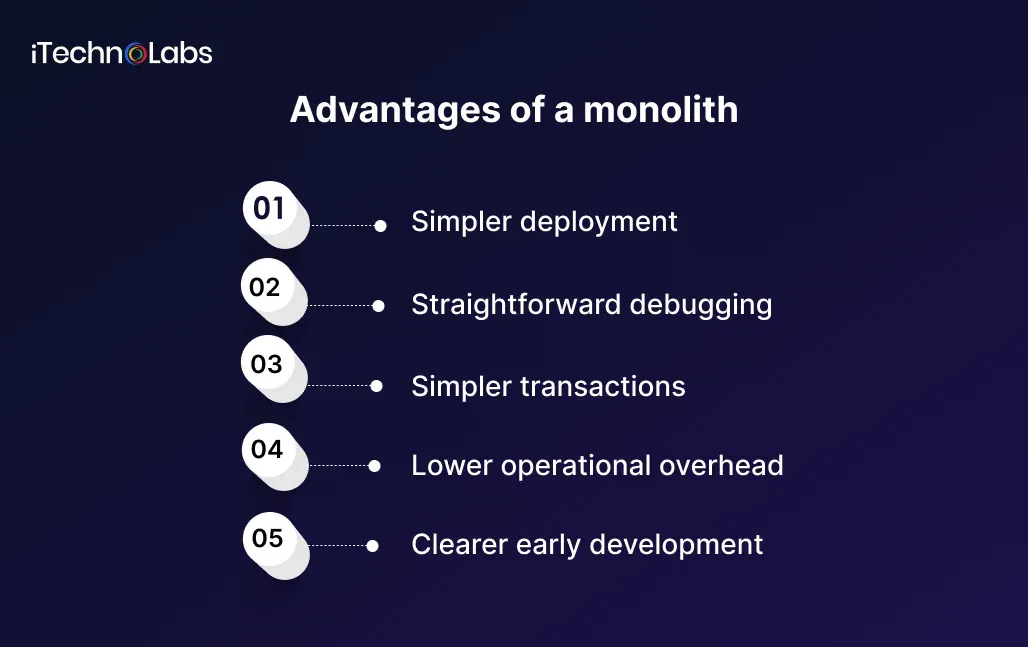
- Simpler deployment: Teams release one primary application artifact rather than coordinating multiple independently deployed services.
- Straightforward debugging: Developers can often investigate a request within one application process and use familiar debugging tools.
- Simpler transactions: Related operations can use database transactions without introducing network calls between separate services.
- Lower operational overhead: A single application can require fewer service discovery, routing, deployment, and distributed tracing components.
- Clearer early development: Teams can build and change a cohesive product without establishing a large service platform at the outset.
Limitations of a monolith
A monolithic application can become difficult to maintain when business logic becomes tightly coupled or module boundaries are poorly enforced.
- Changes in one area may require regression testing and redeployment of the wider application.
- Scaling one resource-intensive function may require scaling the entire application.
- Large teams can experience release coordination problems when many developers work in the same codebase.
- A defect in a critical shared component can affect multiple business functions.
Do not treat every monolith as legacy software. First assess its internal structure, deployment constraints, performance bottlenecks, and maintenance burden. A well-organized monolith may remain the most practical architecture for years.
What is a Microservices Architecture?
Microservices architecture divides an application into independently deployable services organized around business capabilities. Services communicate through defined interfaces, commonly APIs or messaging systems, and each service owns a specific responsibility.
Advantages of microservices
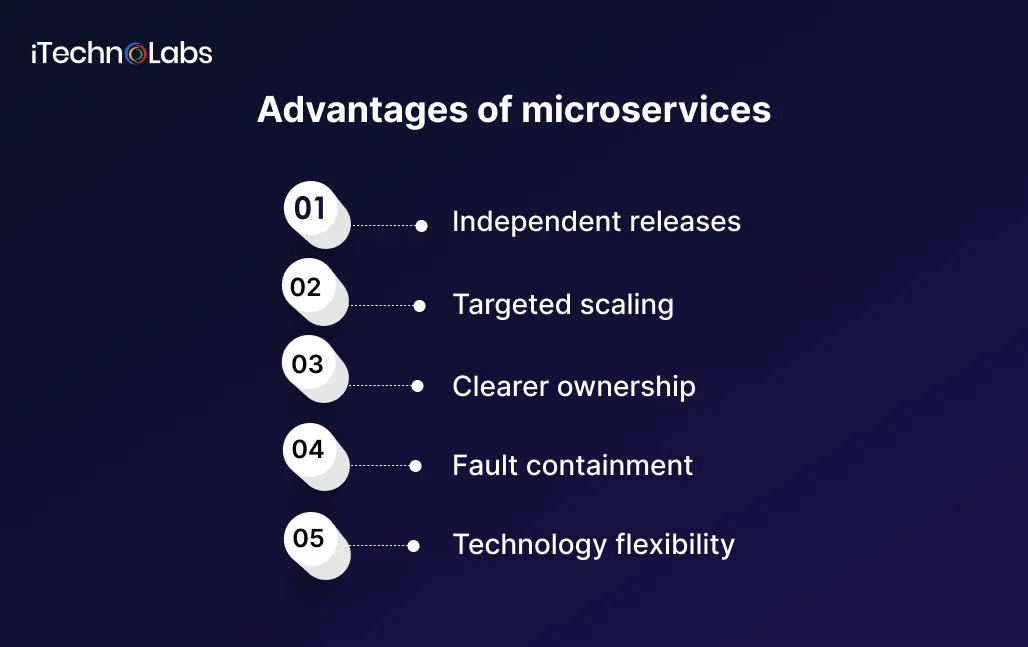
- Independent releases: A service can be updated without necessarily redeploying the entire application.
- Targeted scaling: Teams can allocate additional resources to services experiencing higher demand.
- Clearer ownership: Teams can take responsibility for defined business capabilities and their operational performance.
- Fault containment: Carefully designed service boundaries can limit the effects of individual failures.
- Technology flexibility: Different services can use different technologies when a genuine business or technical requirement justifies the choice.
Limitations of microservices
Distributed applications introduce failure modes that do not arise in the same way inside a single application process.
- Network calls can fail, time out, or increase response latency.
- Cross-service business transactions require deliberate consistency and recovery strategies.
- Teams need centralized observability, including logs, metrics, traces, and meaningful service health signals.
- API changes require compatibility and versioning policies.
- More independently operated components create additional security, deployment, and incident management responsibilities.
Microservices should be introduced when their independence solves a defined problem. Splitting an application into services without clear ownership boundaries can distribute complexity rather than remove it.

Monolithic Architecture vs Microservices: Key Differences
The following comparison summarizes typical architectural characteristics. Actual outcomes depend on implementation quality, application requirements, and operational practices.
| Decision factor | Monolithic architecture | Microservices architecture |
| Deployment | Application released as one unit | Services can be released independently |
| Scaling | Usually scales the application as a whole | Individual services can scale separately |
| Data management | Shared database is common | Service-owned data is a common design principle |
| Communication | Often in process | Commonly through APIs or messaging |
| Transactions | Local database transactions can be simpler | Distributed workflows require explicit design |
| Testing | Many tests run against one application | Service and cross-service testing are both important |
| Observability | Application-level monitoring may suffice initially | Distributed tracing and service-level monitoring are often necessary |
| Team structure | Centralized ownership can work well | Independent service ownership can support multiple teams |
| Operational overhead | Often lower | Generally higher because more components must be operated |
| Best fit | Cohesive applications with manageable release and scaling needs | Systems with justified service independence and operational readiness |
The practical distinction is not simply that one architecture is old and the other is modern. The decision concerns where the enterprise wants boundaries for deployment, data, ownership, and failure.
When Should Enterprises Choose a Monolith?
Choose a monolithic architecture when the application has cohesive business workflows, the development team can manage the codebase effectively, and independent scaling or deployment offers limited immediate value.
A monolith is worth considering when:
- The application has a relatively consistent release schedule.
- Most business operations depend on shared transactional data.
- One team owns most of the product.
- Infrastructure and operations capacity is limited.
- The business needs predictable delivery without introducing unnecessary distributed systems complexity.
A modular monolith is particularly useful when an enterprise wants clear internal boundaries without operating separate services. Modules can represent business capabilities, expose defined interfaces, and restrict direct access to one another’s implementation details.
Establish module ownership, automated tests, dependency rules, and clear data access boundaries from the beginning. These practices help prevent a manageable monolith from becoming a tightly coupled application that is difficult to change.
When Should Enterprises Choose Microservices?
Consider microservices when measurable business requirements justify independent deployment, scaling, ownership, or fault containment, and the organization can operate distributed systems reliably.
Microservices may be appropriate when:
- Different business capabilities require different release schedules.
- One component experiences materially different demand from the rest of the application.
- Multiple teams need clear ownership and independent delivery responsibilities.
- Specific workloads have distinct security, availability, or technology requirements.
- The organization already has suitable deployment automation, monitoring, incident response, and service governance.
Microservices are not an automatic performance improvement. An application with frequent synchronous service calls may experience additional latency, while a poorly bounded service can introduce more dependencies than it removes.
Before adopting this architecture, evaluate service boundaries, API contracts, authentication, authorization, data ownership, retry policies, timeouts, and failure recovery. Confirm that the organization can support these responsibilities after launch, not just during development.

The Middle Ground: Modular Monolith and Hybrid Architecture
A modular monolith retains one primary deployment unit while organizing the codebase into modules with explicit responsibilities. A hybrid architecture combines components that remain together with selected services that operate independently.
These options help enterprises avoid treating architecture as an irreversible, all-or-nothing decision.
Start by separating business domains within the existing application. Identify a capability that has a clear boundary, an independently justified scaling or release requirement, and manageable data dependencies. Extract that capability only when the expected benefits outweigh the migration and operational costs.
For example, an enterprise platform may keep customer records, core business rules, and transactional workflows within a modular monolith while operating a separately justified notification or document processing service. This is an illustrative architecture, not a claim about an iTechnolabs client implementation.
How to Decide: A Practical Enterprise Framework
Evaluate the architecture against the following questions before approving a new build or modernization program.
- Business change: Which capabilities change frequently, and do release dependencies delay important improvements?
- Scaling: Is there evidence that specific workloads need different capacity or scaling policies?
- Team ownership: Can teams own individual capabilities from development through production support?
- Data consistency: Do business operations require atomic transactions across multiple capabilities?
- Operational maturity: Are deployment automation, observability, incident response, and security controls ready for distributed services?
- Migration risk: Can the organization introduce changes incrementally while maintaining business continuity?
- Total cost: Have infrastructure, engineering, testing, monitoring, support, and migration costs been evaluated together?
The strongest choice is the architecture that meets current business requirements while preserving a practical path for future change.
How iTechnolabs Can Help You Choose the Right Architecture
Selecting an application architecture requires more than choosing between a single codebase and multiple services. It requires a clear understanding of your business processes, existing technology, integration requirements, security needs, and future development plans.
iTechnolabs provides custom software development, software modernization, and cloud and DevOps services for businesses building or evolving digital products.
Whether you are planning a new enterprise application, addressing technical debt in an existing monolith, or evaluating a gradual move toward microservices, start with a technical assessment of your requirements and constraints. This helps establish suitable architecture options, identify dependencies, and define a practical implementation approach before significant engineering resources are committed.
Conclusion
Choosing between microservices and a monolithic architecture in 2027 comes down to your business requirements, engineering capabilities, and long-term technology strategy. A monolith can provide a simpler path for applications with closely connected workflows, while microservices can offer greater deployment independence and targeted scaling when service boundaries are clearly defined.
For enterprise CTOs and IT directors, the goal is not to adopt the most fashionable architecture. It is to select an approach that supports business growth, maintains security, controls operational complexity, and allows teams to deliver changes without unnecessary risk. A modular monolith can also provide a practical starting point when greater separation may be needed in the future.
Before making a decision, assess your current application, identify the constraints affecting delivery, and compare the long-term costs of each approach. The right architecture is the one that solves your current challenges while leaving room for future change.

FAQs
1. Is microservices architecture better than a monolith in 2027?
Neither architecture is universally better. Microservices suit applications that need independent service ownership, deployment, or scaling and have the operational maturity to support them. A monolith is often appropriate for cohesive systems with manageable complexity. Evaluate business requirements, data consistency, team structure, and total operating cost before deciding.
2. Is a monolithic architecture suitable for enterprise applications?
Yes. A monolithic architecture can support enterprise workloads when its modules are well organized, security controls are appropriate, and performance and availability requirements are met. The key consideration is whether the application remains maintainable and whether its deployment model supports the business roadmap without creating unacceptable release or scaling constraints.
3. Are microservices more expensive than monoliths?
Microservices can increase operating costs through additional infrastructure, monitoring, networking, deployment automation, and specialist engineering responsibilities. They may also provide value through independent scaling and releases. The actual cost difference depends on workload, architecture, team maturity, and service boundaries, so compare total ownership costs rather than infrastructure bills alone.
4. Can an enterprise migrate from a monolith to microservices gradually?
Yes. Enterprises can use incremental decomposition approaches, extracting selected business capabilities while keeping the remaining application operational. Begin with a well-understood capability, map its dependencies, define clear interfaces, and plan rollback and data consistency before production migration.
5. What is a modular monolith, and when should an enterprise use one?
A modular monolith is a single deployable application whose internal components have defined responsibilities and controlled dependencies. It can be a useful choice when an organization needs clearer architecture boundaries but does not yet need independent service deployment. Enforced module boundaries also make future extraction easier to evaluate.
6. What should a CTO assess before choosing microservices?
Assess independent release requirements, scaling evidence, service boundaries, data ownership, security, observability, deployment automation, team ownership, and incident response. Estimate ongoing operational and migration costs as well. The decision should be documented against measurable business requirements and reviewed as those requirements change.