Key Takeaways
- React is a JavaScript library for building user interfaces, while Angular is a web framework with integrated tools for application development.
- React suits teams that want flexibility in choosing libraries and application architecture.
- Angular suits teams that prefer a more integrated development environment with established conventions.
- Both support server-side rendering and can be used to build complex web applications. Performance depends on implementation, rendering strategy, and application architecture.
- Choose based on the product you need to build, the developers available, and the maintenance requirements you expect over time.
Choosing between React and Angular in 2026 comes down to your product requirements, development team’s expertise, and long-term maintenance plans. React offers flexibility when building custom user interfaces, while Angular provides an integrated framework with built-in tools for application development. For startups planning an MVP or a new web application, understanding these differences can help avoid unnecessary complexity and make better use of development resources.
Both technologies can support complex applications, but they approach architecture, tooling, and development differently. The right choice depends on what you are building, how quickly you need to launch, and how you expect your product to evolve.
Table of Contents
React vs Angular: Which Should You Choose in 2026?
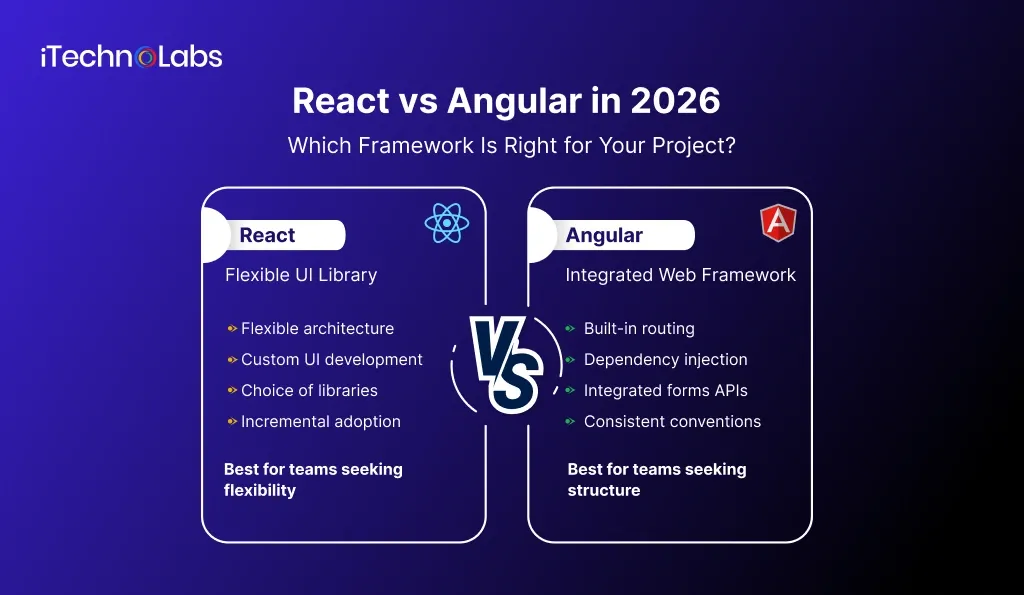
React vs Angular is a choice between two established approaches to building web applications. React provides a flexible library for creating user interfaces, while Angular offers a more integrated framework with routing, dependency injection, and other application development tools. The right option depends on your product scope, team experience, and architectural requirements.
For a startup building a new product, the decision affects more than the first release. It influences how developers organize code, add features, test functionality, and maintain the application as customer needs change.
Evaluate both technologies against your actual requirements rather than choosing based on popularity or assumptions about speed. A framework that fits your team’s skills and product architecture is often a more practical choice than one selected because it is currently receiving attention.
What Is the Difference Between React and Angular?
React focuses on building user interfaces through reusable components. Angular provides a broader application framework that includes components, routing, dependency injection, and form handling. Both use component-based development, but they differ in how much application structure and tooling they provide directly.
| Comparison factor | React | Angular |
| Technology type | JavaScript UI library | Web application framework |
| Primary language | JavaScript or TypeScript | TypeScript |
| Architecture | Flexible, library-based | Integrated, convention-driven |
| UI development | JSX and components | Templates and components |
| Routing | Commonly added through a library or framework | Official Angular Router |
| Dependency injection | Often handled through patterns or libraries | Built-in dependency injection |
| Forms | Libraries and application-specific patterns | Integrated forms APIs |
| State management | Multiple available approaches | Signals and other supported approaches |
| Server rendering | Supported through React APIs and frameworks | Supported through Angular rendering tools |
| Best fit | Teams seeking flexibility | Teams seeking an integrated framework |
This comparison describes the general development models. Individual projects can use different libraries, frameworks, and architectural patterns, so the precise implementation matters.
1. Development Flexibility and Architecture
React: More freedom over the technology stack
React allows developers to adopt it gradually, from adding interactive elements to building a complete application. Its documentation recommends using an appropriate framework when creating a new React application. Teams can select additional tools according to their requirements.
This flexibility can be useful when a startup wants to validate an MVP, integrate an existing backend, or develop a custom user experience without committing to one prescribed application structure.
However, flexibility introduces decisions. Teams must determine how to handle routing, data fetching, state management, testing, and other concerns unless their chosen framework provides those capabilities.
Angular: More structure from the beginning
Angular includes a wider set of application development capabilities, including its router, dependency injection, forms, and command line tooling. Its architecture supports modular development and established conventions across a codebase.
This structure can benefit products developed by several engineers who need consistent patterns for adding features and maintaining shared code.
The tradeoff is that developers need to understand Angular’s conventions and APIs. A team unfamiliar with Angular may need additional onboarding before it becomes productive.
Choose React when control over architectural decisions is important. Choose Angular when your team values a more integrated framework and consistent application patterns.
2. Performance and Application Speed
Neither React nor Angular guarantees a faster application simply by being selected. Runtime performance depends on component rendering, data flow, bundle size, network requests, rendering strategy, and how efficiently the application is implemented.
React provides server rendering APIs, while Angular supports client rendering, server-side rendering, and prerendering. These approaches can affect how quickly users see meaningful content and how search engines access rendered pages.
For a startup, the practical question is whether the application meets its performance requirements on the devices and networks its customers use.
For example, a customer dashboard with frequent data updates may need careful rendering and state management. A public product website may place greater emphasis on initial page delivery, server rendering, and search visibility.
Establish measurable performance targets before selecting the framework. Test representative user journeys, monitor Core Web Vitals where relevant, and evaluate the production build rather than relying on a small demonstration application.
3. Learning Curve and Developer Productivity
React uses JavaScript or TypeScript alongside JSX, which lets developers describe UI elements within JavaScript code. Angular uses TypeScript, templates, dependency injection, and framework-specific APIs.
React may be easier to adopt for developers already comfortable with JavaScript and component-based UI development. Its flexibility can also require teams to make more decisions about libraries and conventions.
Angular may provide a clearer starting structure for teams that prefer an integrated framework. However, developers must learn its templates, dependency injection, routing, and other concepts.
Productivity depends on more than the framework itself. Existing team experience, code quality, documentation, testing practices, and the availability of suitable developers all matter.
If you already have experienced React developers, switching to Angular solely for its structure may add unnecessary migration and training work. If your team has strong Angular experience, adopting React without a clear business reason may create similar friction.
For a startup without an established engineering team, evaluate the available talent pool and the development partner’s experience before committing.

4. Scalability and Long-Term Maintenance
Both technologies support component-based application development. Angular provides integrated architectural conventions, while React allows teams to choose how additional application concerns are handled.
Scalability is not simply the ability to handle more users. It also includes the ability to add features, maintain predictable code, onboard developers, test changes, and manage technical debt as a product grows.
React can support large applications when teams establish clear boundaries, shared component standards, testing practices, and appropriate choices for state and routing.
Angular can support large applications through its modular architecture, dependency injection, and consistent conventions. Those conventions can help teams understand how different parts of the application fit together.
Neither approach removes the need for architectural planning.
Before choosing, document how the application will manage shared state, permissions, API communication, testing, and feature ownership. These decisions often have a greater effect on maintainability than the framework name alone.
5. SEO, Server Rendering, and User Experience
Search visibility and initial page delivery depend partly on how an application renders its content. React provides server rendering APIs, and Angular supports server-side rendering and static prerendering.
If your product includes public landing pages, documentation, product listings, or other pages intended to appear in search results, rendering architecture should be part of the framework evaluation.
A private application used after login may have different priorities from a public website that depends on organic discovery. Both still need accessible interfaces, efficient rendering, and reliable navigation.
Evaluate the rendering approach alongside the framework. Review page delivery, metadata, canonical URLs, hydration, accessibility, and Core Web Vitals. Test the actual implementation before making performance or SEO claims.
6. What Has Changed in 2026?
Both ecosystems continue to evolve. Current official documentation identifies React 19.3, released on September 9, 2026, as the latest React version. Its release includes stable View Transitions and Fragment Refs, among other changes.
Angular 22 was released on June 3, 2026. Its release materials highlight stable Signal Forms, asynchronous Signals, Angular Aria, and other framework improvements.
These developments reinforce an important point: choosing a framework in 2026 should not mean choosing between a modern option and an outdated one. Both projects continue to develop their capabilities.
Review current release notes, compatibility requirements, upgrade paths, and the maturity of the specific features your product needs. Avoid selecting a framework based solely on one new feature or assuming that a feature available in a recent release is automatically appropriate for production.
React vs Angular: Which Is Better for Your Startup?
For a startup, the strongest choice is usually the framework that helps the team deliver the required product while keeping future development manageable.
Choose React if…
- You want flexibility in selecting libraries and architecture.
- Your developers already know React or its surrounding ecosystem.
- Your product needs a highly customized user interface.
- You want the option to adopt React incrementally or use a suitable React framework.
Choose Angular if…
- You prefer integrated routing, forms, and dependency injection.
- Your team benefits from consistent architectural conventions.
- Your application has multiple modules and clear feature boundaries.
- Your developers already understand Angular and its development patterns.
Before committing, build a short technical proof of concept for the application’s most demanding workflow. Compare implementation effort, maintainability, testing, integration requirements, and measured performance. This gives your team evidence tied to the product instead of a generic framework ranking.
Need Help Choosing Between React and Angular?
Choosing the right framework is an important step in building a successful web application. Your decision affects development workflows, integration requirements, maintenance, and how easily your product can evolve as your business grows.
iTechnolabs helps businesses plan, build, and modernize digital products with web development and custom software development services. Whether you are developing a startup MVP, building a customer-facing platform, or updating an existing application, our team can help assess your requirements and identify an appropriate technology stack.
With experience delivering 500+ apps and supporting more than 50,000 end users, iTechnolabs brings software development experience to product planning and engineering decisions.
Conclusion
The choice between React and Angular is not about finding a universally superior framework. It is about choosing the technology that fits your product, team, and development goals.
React is worth considering when you want flexibility, a customizable user interface, and control over your technology stack. Angular is a strong option when you prefer an integrated framework, established conventions, and built-in application development tools.
Before making the final decision, assess your application requirements, existing developer skills, integration needs, performance expectations, and long-term maintenance plans. A small technical proof of concept can help your team evaluate both options against real project requirements.
The best framework is the one that helps you build the right product without introducing unnecessary technical complexity. A well-planned architecture and an experienced development team matter just as much as the technology you choose.
FAQs
1. Is React better than Angular in 2026?
React can be a better fit when flexibility and control over the technology stack matter most. Angular can be a better fit when an integrated framework and consistent conventions are priorities. Neither is universally better. The decision should reflect your application requirements, available developers, and maintenance expectations.
2. Is React faster than Angular?
There is no universal performance winner across all applications. React and Angular can both support responsive, high-performance interfaces. Actual results depend on rendering strategy, application architecture, bundle size, data handling, and implementation quality. Benchmark representative workflows under realistic conditions before making a framework decision.
3. Is Angular harder to learn than React?
The learning curve depends on a developer’s background. React introduces JSX and its component model, while Angular includes additional framework concepts such as dependency injection, templates, and integrated routing. Developers familiar with TypeScript and structured application frameworks may find Angular more approachable than developers new to those patterns.
4. Which is better for building an MVP, React or Angular?
React is worth considering when you want architectural flexibility and a team already familiar with its ecosystem. Angular is worth considering when your MVP needs an integrated framework and your developers know its conventions. Evaluate the features, integrations, delivery constraints, and skills required for your specific MVP before deciding.
5. Can React and Angular both support large applications?
Yes. Both support component-based development and can be used for complex web applications. React relies on the architecture and libraries selected by the team, while Angular provides more integrated application tooling. Long-term maintainability depends on code organization, testing, performance management, and disciplined technical decisions.
6. Can you migrate from Angular to React or React to Angular?
A migration is possible, but the effort depends on the existing codebase, routing, state management, integrations, testing, and business requirements. Rewriting an entire application is not always necessary. A technical assessment can identify whether incremental migration, selective replacement, or continued development on the existing framework is the most practical approach.