Key Takeaways
- Define the business requirements and project scope before comparing development estimates.
- Break the project into features, tasks, testing, deployment, and ongoing support.
- Software estimates should account for complexity, technology choices, lifecycle activities, and uncertainty.
- Compare vendors on deliverables, assumptions, exclusions, and change management, not just total price.
- Treat the estimate as a working forecast that becomes more precise as requirements are clarified.
Software project estimation is the process of forecasting the effort, time, resources, and cost required to build or improve a software product. An accurate estimate starts with a clear scope, breaks the work into manageable tasks, accounts for technical risks, and documents assumptions. It should also be updated as requirements and project conditions change.
For a business owner, this process answers an important question: how much should you budget, and what should you expect to receive for that investment?
Table of Contents
Why software project estimation matters
A software project can appear affordable at the proposal stage but become difficult to manage when important work is left out of the initial estimate.
For example, a business may request a customer portal without specifying user permissions, integrations with its existing CRM, reporting requirements, or who will test the finished product. Each missing detail can affect the amount of work involved.
A useful estimate helps you:
- Set a realistic budget before committing to development.
- Decide which features are essential for the first release.
- Compare proposals from different development partners.
- Plan internal resources, approvals, and launch activities.
- Identify technical and commercial risks before they become expensive problems.
Ways to Estimate a Software Development Project Correctly
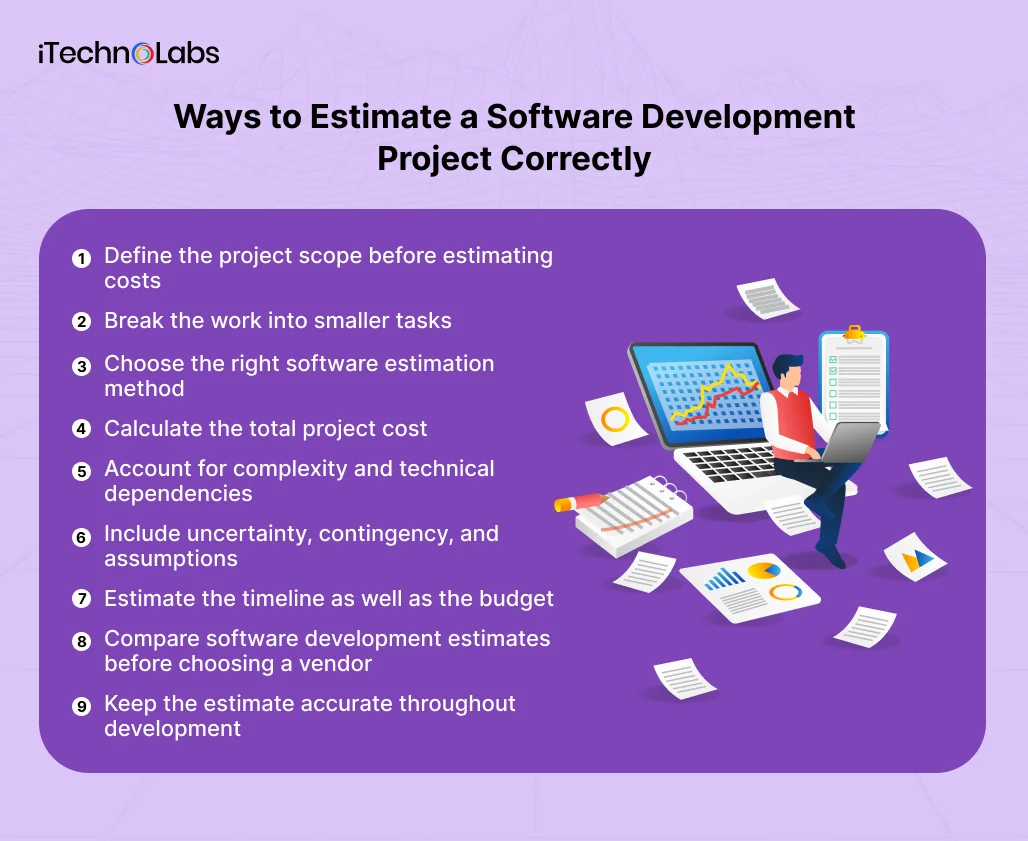
1. Define the project scope before estimating costs
Start by describing the business problem the software must solve. Avoid beginning with a long list of features before you have established the intended outcome.
Answer these questions:
- What problem are you trying to solve?
- Who will use the software?
- What should users be able to accomplish?
- Which systems must connect to it?
- What information will the software store or process?
- What security, privacy, and performance requirements apply?
- What must be included in the first release, and what can wait?
Next, separate essential requirements from optional improvements.
Suppose you want to build an inventory management platform. Product records, stock updates, user access, and inventory reports may be essential to the first release. Predictive purchasing recommendations or advanced analytics might be deferred until the core workflow is working.
This distinction helps control the scope without sacrificing the business outcome. It also gives developers a more consistent basis for estimating the same project.
Document the agreed scope, major deliverables, acceptance criteria, and known exclusions. If an important requirement is still uncertain, record it as an open question rather than allowing it to disappear inside the estimate.
2. Break the work into smaller tasks
Use a work breakdown structure, or WBS, to divide the project into components that can be estimated and reviewed individually.
A typical custom software project may include:
| Work area | Activities to estimate |
| Discovery and planning | Requirements workshops, scope definition, technical assessment |
| UX and UI design | User journeys, wireframes, interface design, design reviews |
| Architecture | Data models, system structure, technology selection |
| Development | Frontend, backend, APIs, business logic, integrations |
| Quality assurance | Functional testing, regression testing, security checks |
| Deployment | Environment setup, release preparation, production launch |
| Project management | Planning, coordination, reporting, stakeholder reviews |
| Post-launch support | Bug fixes, monitoring, maintenance, agreed support services |
Breaking the work into smaller units makes missing tasks easier to identify. It also allows a business owner to understand why one proposal costs more than another.
For example, a vendor that includes integration testing, deployment preparation, and project management may quote a higher total than one that excludes these activities. The difference is not necessarily a higher development rate. The two proposals may simply cover different amounts of work.
3. Choose the right software estimation method
The right software estimation method depends on project scope, available historical data, and technical complexity. Teams can combine methods to improve their estimates.
Bottom-up estimation breaks the project into smaller tasks, estimates each task, and combines the results. It works best when requirements are reasonably clear.
Analogous estimation uses a similar completed project as a reference. Adjust the estimate for differences in scope, integrations, technology, security, and complexity.
Parametric estimation applies a model to measurable inputs, such as software size or functionality. It is most useful when reliable historical data supports the model.
Three-point estimation accounts for uncertainty by estimating optimistic, most likely, and pessimistic scenarios. A common PERT formula calculates a weighted estimate:
E = (O + 4M + P) / 6
Here, O represents the optimistic estimate, M the most likely estimate, and P the pessimistic estimate.
No method guarantees accuracy. Validate assumptions, consider dependencies, and account for risks before finalizing the estimate.
4. Calculate the total project cost
Once the work has been estimated, translate the effort into a budget using the agreed team structure and commercial model.
Estimated labour cost = Σ (Estimated hours for each role × Hourly rate for that role)
The total project budget must then account for any additional costs not included in that labour calculation.
Consider this illustrative example.
| Role | Estimated hours | Illustrative rate | Estimated cost |
| Business analyst | 40 | $80/hour | $3,200 |
| UI/UX designer | 60 | $75/hour | $4,500 |
| Developer | 240 | $85/hour | $20,400 |
| QA engineer | 80 | $65/hour | $5,200 |
| Project manager | 40 | $80/hour | $3,200 |
| Total | 460 | $36,500 |
These figures are hypothetical examples created to demonstrate the calculation. They are not iTechnolabs rates, market averages, or a quote for a real project. They exclude any additional costs not represented in the table.
Before approving a budget, check whether the estimate includes:
- Third-party software licences and subscription fees.
- Cloud hosting and infrastructure.
- External API usage or integration charges.
- Data migration and initial data cleanup.
- Security testing and compliance-related work.
- Deployment and release support.
- Maintenance, monitoring, and post-launch support.
A labour estimate is not automatically a complete project budget. Ask the development partner to distinguish one-time delivery costs from recurring operating costs.
5. Account for complexity and technical dependencies
Software cost estimates depend on characteristics such as functionality, complexity, technology, and risk.
Two projects with similar feature counts can require very different levels of effort.
The main factors to assess include:
- Integrations. Connecting to an established CRM or payment provider may differ substantially from connecting to a legacy system with limited documentation.
- Data requirements. Migrating inconsistent historical records can require additional analysis, transformation, validation, and testing.
- Security and access control. Sensitive information, complex user permissions, audit requirements, and security testing affect the work involved.
- Platform choices. Building separate native mobile applications, a cross-platform application, and a responsive web application can lead to different implementation and testing needs.
- Performance and scale. High transaction volumes, strict response time requirements, and complex data processing may require additional architecture and testing.
- Legacy systems. Existing software can introduce dependencies that are difficult to assess until the code, infrastructure, and interfaces have been reviewed.
Ask your development partner to identify the largest technical uncertainties before finalising the estimate. Where appropriate, a discovery phase or technical proof of concept can reduce uncertainty before the main development commitment.
6. Include uncertainty, contingency, and assumptions
The US Government Accountability Office’s Cost Estimating and Assessment Guide explains the importance of documenting assumptions and evaluating how changes in assumptions affect estimated cost and schedule.
A software estimate should make uncertainty visible rather than hide it inside a single number.
Common sources of uncertainty include:
- Requirements that have not been approved.
- Third-party integrations that have not been tested.
- Dependencies on client-supplied data or infrastructure.
- Unconfirmed security or compliance requirements.
- Unavailable stakeholders or delayed approvals.
- New technologies that the team has limited experience with.
Maintain a risk register that records each risk, its potential effect, its likelihood where it can be assessed, its mitigation, and the person responsible for resolving it.
You should also ask how contingency has been calculated. A contingency allowance should reflect identified uncertainty and the maturity of the estimate. Avoid applying an arbitrary percentage without explaining what it covers.
For example, if integration requirements are not yet confirmed, document the uncertainty and agree on a process for resolving it. Do not present an unverified integration assumption as a guaranteed fixed cost.
7. Estimate the timeline as well as the budget
Project effort and calendar duration are related, but they are not interchangeable.
A task estimated at 100 hours does not automatically take 100 consecutive hours on the calendar. The schedule depends on team availability, task dependencies, reviews, approvals, and work that can happen in parallel.
Ask for a milestone-based schedule that identifies:
- Requirements approval.
- Design sign-off.
- Development milestones.
- Integration and testing.
- User acceptance testing.
- Deployment and release.
- Post-launch support, where included.
Identify which milestones depend on your team. If your operations staff must approve workflows or provide data, include those responsibilities in the schedule.
Also ask what happens when the scope changes. New features, delayed approvals, and changed integrations may affect both the budget and the delivery date.
A credible timeline should explain its dependencies rather than promise a launch date without showing how the work will be completed.

8. Compare software development estimates before choosing a vendor
Request proposals based on the same scope document. This makes the differences between vendors easier to evaluate.
Use this checklist when reviewing each proposal.
Vendor estimate review
0 of 8
- The scope and deliverables are clearly defined
- Included work and exclusions are documented
- The cost breakdown covers all relevant work areas
- Key assumptions and technical dependencies are listed
- Testing, deployment, and acceptance criteria are specified
- The payment schedule and change request process are clear
- Maintenance, support, and recurring costs are addressed
- The timeline identifies milestones and client responsibilities
The lowest quoted price is not always the lowest total cost of ownership. A proposal that omits necessary work may lead to additional charges, delayed delivery, or a product that does not meet the agreed requirements.
Compare the scope, the assumptions, the team’s relevant experience, the quality assurance approach, and the commercial terms before making a decision.
9. Keep the estimate accurate throughout development
An estimate is a forecast based on the information available at a particular point in time. As the team learns more about the requirements, actual effort, and technical constraints, the forecast may need to change.
Establish a process for reviewing estimates throughout the project.
- Record the original scope, assumptions, budget, and timeline.
- Track actual effort against planned effort at agreed milestones.
- Document newly discovered requirements and risks.
- Assess the impact of each proposed change on cost and schedule.
- Obtain approval before committing to additional work.
- Update the forecast and communicate material changes to stakeholders.
This process helps you distinguish a genuine estimation problem from a legitimate scope change. It also gives you better information for future budgeting decisions.
Plan Your Software Project with iTechnolabs
iTechnolabs provides custom software development services for businesses looking to build new digital products, modernise existing systems, and improve business workflows. The company also offers mobile app development and AI development services to support different technology requirements.
Choosing a development partner involves more than comparing prices. You need a clear understanding of the technical approach, project scope, delivery expectations, and resources required to achieve your goals.
If you are planning a new software product or upgrading an existing platform, iTechnolabs can help you discuss your requirements and explore an appropriate development approach for your business.
Conclusion
Accurate software project estimation gives you greater control over your budget, timeline, and project scope. By defining requirements, breaking work into manageable tasks, accounting for technical risks, and reviewing assumptions, you can make informed decisions before development begins. The goal is not simply to predict a final cost. It is to understand what your investment covers and how to manage changes without losing sight of your business objectives.
Before approving a proposal, make sure the estimate clearly outlines deliverables, exclusions, milestones, testing, and ongoing costs. A well-documented estimate gives your team a practical foundation for planning and helps you evaluate development partners with confidence.

FAQs
1. What is software project estimation?
Software project estimation is the process of forecasting the effort, resources, schedule, and cost needed to develop or maintain software. It considers the project scope, complexity, technology, dependencies, and risks. A useful estimate documents its assumptions and exclusions so stakeholders can understand what the proposed budget and timeline actually cover.
2. How do you estimate the cost of a software development project?
Start by defining the scope and breaking the work into tasks such as discovery, design, development, testing, and deployment. Estimate the effort for each task, apply the relevant role rates, and include additional costs such as hosting, licences, and maintenance. Review the assumptions and risks before approving the budget.
3. Which software estimation method is best?
No single estimation method is best for every project. Bottom-up estimation works well when tasks are defined, while analogous estimation uses comparable projects and parametric estimation uses measurable inputs and historical relationships. Teams can combine methods to cross-check the result and investigate differences before committing to a budget.
4. What factors affect a software development estimate?
The main factors include feature complexity, requirements, integrations, data migration, security, technology choices, testing, team experience, and deployment needs. Ongoing support and maintenance may also affect the total budget. The impact of each factor depends on the specific project, so estimates should explain the assumptions behind their figures.
5. How can I tell whether a software development estimate is realistic?
Check whether the estimate includes a clear scope, itemised work, realistic milestones, testing, deployment, documented assumptions, and a process for handling changes. Ask the vendor to explain major cost drivers and uncertainties. Compare proposals against the same requirements rather than judging them on total price alone.
6. Should I choose a fixed price or time and materials contract?
A fixed price arrangement can suit a project with clearly defined requirements, deliverables, and acceptance criteria. Time and materials can offer more flexibility when requirements are expected to evolve, but it requires active budget monitoring. Compare how each contract handles changes, reporting, approvals, and unused or additional effort before choosing.
7. Why do software project estimates change during development?
Estimates may change when requirements evolve, integrations prove more complex than expected, technical risks emerge, or dependencies affect the schedule. Changes can also result from new business priorities. A documented change control process helps the team assess the effect on cost and delivery time before approving additional work.
8. What should I provide to get a software development estimate?
Prepare a description of the business problem, intended users, essential features, required integrations, platform preferences, security needs, and target launch date. Include any existing system documentation and budget constraints you can share. If some details remain unknown, identify them clearly so the development partner can explain what needs further discovery.