Key Takeaways
- Staff augmentation works best when you need specific skills and want to keep delivery management in-house.
- A dedicated team is a better fit when you need long-term engineering capacity without building a permanent internal team.
- Project outsourcing works best when the scope, deliverables, and ownership model are clearly defined.
- The right model depends less on team size and more on how much technical leadership, delivery ownership, and flexibility you need.
- CTOs should evaluate engagement models based on control, speed, internal capacity, project uncertainty, and long-term product plans.
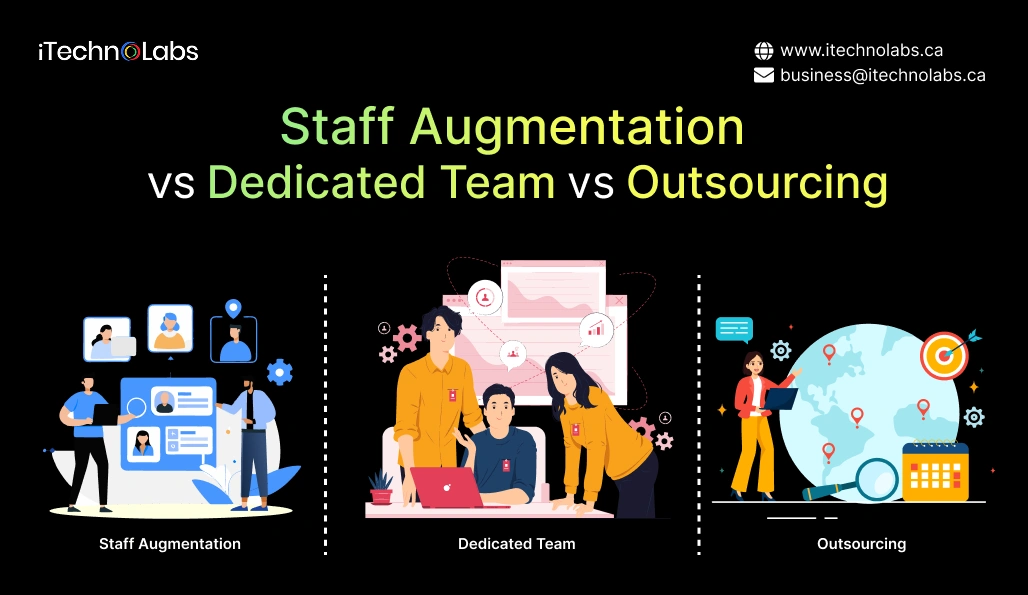
Choosing between staff augmentation, a dedicated development team, and project outsourcing comes down to one question: what do you need an external partner to own? Staff augmentation adds people to your existing team. A dedicated team provides ongoing engineering capacity. Outsourcing hands responsibility for a defined project or outcome to an external provider.
For CTOs, this decision affects far more than cost. The wrong engagement model can create management overhead, slow delivery, weaken product knowledge, or leave internal teams dependent on a vendor for critical decisions.
The right model gives you the capacity you need while matching how your organization actually builds and manages technology.
Table of Contents
- What is Staff Augmentation?
- What is a Dedicated Development Team?
- What is Project Outsourcing?
- Staff Augmentation vs Dedicated Team vs Outsourcing
- How CTOs Should Choose the Right Engagement Model
- The Engagement Model is Not a Permanent Decision
- A Simple Decision Framework for CTOs
- Why Choose iTechnolabs for Your Development Needs?
- Final Thoughts
- FAQs
What is Staff Augmentation?
Staff augmentation means adding external developers, designers, QA engineers, or other specialists to your existing team. This model is particularly useful when you need to hire dedicated developers with specific skills without expanding your permanent workforce.
Your internal team remains responsible for product priorities, architecture, delivery, and quality, while external professionals work as an extension of the team.
When Staff Augmentation Makes Sense
The need for specialized technical talent remains a challenge for many organizations. The Linux Foundation’s 2026 State of Tech Talent Report found that 47% of organizations consider themselves understaffed in AI and ML engineering, highlighting why CTOs often look beyond permanent hiring to fill critical skills gaps.
This approach can also work well when you need specialized talent for a specific technology or product requirement, such as bringing in AI developers to support an existing engineering team.
Staff augmentation works well when you need specialized talent, such as AI developers, DevOps engineers, mobile developers, or QA specialists, while retaining direct control over delivery.
The Main Tradeoff
You gain flexibility and control, but your internal team still needs the capacity to onboard, manage, and coordinate external developers.
Ready to Build with the Right Development Partner?
Get technical expertise and development capacity to bring your vision to life
What is a Dedicated Development Team?
A dedicated team is an external engineering team assigned to your product or technology initiative for an ongoing period. Businesses often use this model as part of a broader custom software development strategy when they need sustained technical capacity.
The team may include:
- Developers
- Technical leads
- QA engineers
- UI/UX designers
- DevOps specialists
- Project or delivery managers
Unlike staff augmentation, the team operates as a more complete unit. Unlike traditional outsourcing, the relationship is usually ongoing and flexible rather than limited to a fixed project scope.
When a Dedicated Team Makes Sense
A dedicated team is often the strongest option when you need sustained engineering capacity but do not want to build the entire capability internally.
This model can work well when:
- Your product roadmap extends beyond a single project
- You need to scale engineering capacity quickly
- Permanent hiring is too slow
- You need multiple technical roles working together
- The scope is likely to evolve
- You want the team to build long-term knowledge of your product
For a CTO managing a growing product or modernization initiative, this can create a middle ground between direct hiring and handing an entire project to an external vendor.
The Main Tradeoff
A dedicated team requires a strong working relationship and clear governance.
You still need alignment on:
- Product priorities
- Architecture
- Security standards
- Delivery expectations
- Communication processes
- Ownership and documentation
The team may handle day-to-day delivery, but the engagement should not operate without technical oversight from your organization.
What is Project Outsourcing?
Project outsourcing means assigning responsibility for a defined project or deliverable to an external development company.
The engagement is usually structured around an agreed scope, timeline, budget, and set of deliverables.
For organizations building a larger digital product, outsourcing can also provide access to end-to-end custom software development services, from planning and development through testing and deployment.
- An MVP
- A mobile application
- A legacy system modernization project
- An internal business platform
- A specific software module
- A UX redesign and implementation
The external provider takes greater responsibility for planning and delivering the agreed outcome.
When Project Outsourcing Makes Sense
Outsourcing works best when the problem is relatively well defined, and you want a partner to take responsibility for execution.
It can be a good fit when:
- You have a specific project with clear goals
- Your internal team lacks delivery capacity
- You need an external team to manage execution
- You do not want to build or manage a larger engineering team
- The project has defined milestones and deliverables
External IT delivery remains an important part of technology strategies. Whitelane Research’s 2026 UK and Ireland IT Sourcing Study found that 32% of organizations expect to increase spending on external IT providers over the next two years.
The Main Tradeoff
Outsourcing becomes more difficult when requirements are highly uncertain.
If the scope changes constantly, a fixed project structure can create friction around timelines, budgets, and responsibilities.
The more uncertain the product or project, the more important it becomes to choose an engagement model that supports ongoing iteration.
Staff Augmentation vs Dedicated Team vs Outsourcing
| Factor | Staff Augmentation | Dedicated Team | Project Outsourcing |
| Management | Primarily internal | Shared | Primarily external |
| Team structure | Individual specialists | Complete or semi-complete team | Provider assembles team |
| Flexibility | High | High | Depends on contract and scope |
| Internal control | High | Moderate to high | Moderate |
| Delivery ownership | Internal | Shared | External provider |
| Best for | Filling skill or capacity gaps | Long-term product development | Defined projects |
| Internal leadership required | High | Moderate | Lower |
| Product knowledge retention | Primarily internal | Builds over time | Depends on engagement |
| Scope changes | Easy to accommodate | Well suited | Can create friction |
Cost Comparison
| Factor | Staff Augmentation | Dedicated Team | Project Outsourcing |
| Typical Cost | $25 to $150+ per developer/hour | $15,000 to $60,000+/month for a small to mid-sized team | $25,000 to $250,000+ per project |
| Payment Model | Hourly or monthly per developer | Monthly team fee | Fixed price or milestone-based |
| Cost Predictability | Moderate | High for stable teams | High when scope is clearly defined |
| Additional Cost Risk | Internal management and delivery overhead | Team scaling and long-term commitment | Scope changes and change requests |
This comparison provides a starting point, but CTOs should avoid choosing a model based on a simple checklist alone.
The bigger question is where your organization needs help.
How CTOs Should Choose the Right Engagement Model
- Assess Your Internal Capacity: Start by identifying the gap. If you have strong internal technical leadership but need additional skills or capacity, staff augmentation may be enough. If you need a coordinated engineering unit, consider a dedicated team. If you need a partner to own a defined outcome, outsourcing may be a better fit.
- Consider How Defined the Work Is: Clearly defined projects are easier to outsource. Products with evolving requirements and ongoing roadmaps usually need more flexibility, making staff augmentation or a dedicated team a stronger choice.
- Decide How Much Control You Need: Staff augmentation gives you the most direct control. Dedicated teams involve shared governance. Outsourcing gives the provider greater delivery responsibility.
- Consider the Duration: Staff augmentation can solve temporary skill gaps. Dedicated teams are better suited to ongoing product development. Outsourcing works well for projects with a clear beginning and end.
- Evaluate Management Overhead: Every external model requires oversight. Before choosing one, decide who will own technical decisions, priorities, architecture, security, and delivery. The right model should reduce your actual bottleneck, not simply add more people.
The Engagement Model is Not a Permanent Decision
CTOs should not assume they must use one model forever.
A company might:
- Start with project outsourcing to build an MVP
- Move to a dedicated team as the product grows
- Use staff augmentation to add specialized skills
- Transition knowledge and critical capabilities internally over time
The best engagement model can change as the product, team, and business mature.
That is why the decision should be based on the current gap and the next stage of the technology roadmap.
A Simple Decision Framework for CTOs
Ask these five questions:
1. Do we have internal technical leadership to manage external developers?
If yes, staff augmentation may work well.
2. Do we need an ongoing team rather than individual specialists?
If yes, consider a dedicated team.
3. Is the project clearly defined with specific deliverables?
If yes, project outsourcing may be appropriate.
4. Do we need flexibility as requirements change?
If yes, a dedicated team or staff augmentation is usually easier to adapt.
5. Who should own delivery accountability?
If your organization wants to retain it, staff augmentation gives you the most direct control. If you need a partner to carry more responsibility, a dedicated team or outsourcing model may be a better fit.
Why Choose iTechnolabs for Your Development Needs?
Choosing the right engagement model is only part of the decision. You also need a technology partner that can adapt to your product, team, and delivery requirements.
At iTechnolabs, we help businesses hire skilled developers, build dedicated development teams, and deliver end-to-end technology solutions. Our approach is built around your project requirements, internal capabilities, and long-term goals.
Whether you need additional expertise, ongoing development capacity, or a team to take ownership of a project, we can help you find the right way forward.
Final Thoughts
Staff augmentation, dedicated teams, and outsourcing solve different problems.
- Staff augmentation helps when you need people.
- A dedicated team helps when you need sustained engineering capacity.
- Outsourcing helps when you need a defined outcome delivered by an external partner.
The right choice depends on your internal leadership capacity, project uncertainty, roadmap, and the level of delivery responsibility you want to retain.
For CTOs, the goal should not be to find the cheapest engagement model or the one with the most developers. The goal is to choose a structure that gives your organization the right balance of control, expertise, flexibility, and accountability.

FAQs
What is the main difference between staff augmentation and a dedicated team?
Staff augmentation adds individual specialists to your existing team, while a dedicated team provides a more complete engineering unit that works on your product over time. Staff augmentation requires more direct internal management. A dedicated team can take on more coordinated delivery responsibility while remaining focused on your organization.
Is a dedicated development team better than outsourcing?
Neither model is always better. A dedicated team is generally better suited to ongoing product development and changing requirements. Project outsourcing works well when the scope and expected outcomes are clearly defined. The right choice depends on how much flexibility, control, and delivery ownership your organization needs.
Does staff augmentation require internal technical leadership?
Yes. Staff augmentation works best when your organization has technical leaders who can manage priorities, architecture, and delivery. External developers can add capacity and skills, but they still need direction and integration into your existing engineering processes.
Which engagement model gives CTOs the most control?
Staff augmentation generally provides the most direct control because the external professionals work within your existing management and development structure. A dedicated team involves shared governance, while project outsourcing gives the external provider greater responsibility for managing and delivering the agreed scope.
Which model is best for a long-term product roadmap?
A dedicated team is often a strong option for a long-term product roadmap because the team can build product knowledge over time and adapt as priorities change. Staff augmentation may also work if your internal organization has the capacity to manage the team directly.
Can a company use more than one engagement model?
Yes. Many organizations use different models for different needs. For example, a company may use a dedicated team for core product development while adding specialists through staff augmentation or outsourcing a separate, well-defined project to another delivery partner.