Key Takeaways
- Custom supply chain software can connect fragmented business systems and establish a more consistent view of operational data.
- Define business requirements and integration priorities before choosing a technology stack.
- Treat security, access controls, data quality, and system reliability as core architectural requirements.
- Compare ready-made software, custom development, and hybrid approaches against operational needs and total ownership costs.
- Begin with measurable business objectives, validate the highest priority workflows, and expand in planned stages.
Supply chain software development helps enterprises connect procurement, inventory, warehousing, transportation, supplier management, and order fulfilment through software designed around their operating processes. For enterprise technology leaders, the objective is to create a reliable flow of information across existing systems, improve operational visibility, and support better decisions without introducing unnecessary complexity or risk.
Table of Contents
- What Is Supply Chain Software Development?
- Why Do Enterprises Invest in Supply Chain Software?
- Essential Features of Supply Chain Management Software
- Choosing the Right Software Development Approach
- Architecture and Integration Considerations
- Security and Reliability in Supply Chain Software
- The Supply Chain Software Development Process
- How to Evaluate a Supply Chain Software Development Partner
- Why Choose iTechnolabs for Supply Chain Software Development?
- Conclusion
- FAQs
What Is Supply Chain Software Development?
Supply chain software development is the process of designing, building, integrating, and maintaining digital systems that manage the movement of products, information, and transactions across a supply network. Depending on business requirements, these systems can support procurement, inventory control, warehouse operations, shipment tracking, supplier collaboration, demand planning, and performance reporting.
For an enterprise CTO, the challenge is rarely just building another application. The challenge is deciding how operational data should move between existing platforms, where decisions should be automated, and how the resulting system will stay secure and maintainable as business requirements change.
Why Do Enterprises Invest in Supply Chain Software?
1. Limited visibility across systems
When warehouse, purchasing, finance, and logistics teams use disconnected systems, reconciling information becomes difficult. A shared operational view can help teams identify discrepancies, investigate delays, and make decisions using consistent information.
2. Manual processes and operational delays
Repeated data entry, spreadsheet-based approvals, and manual status updates create opportunities for errors and delays. Workflow automation can reduce repetitive work while preserving approval steps for transactions that require human oversight.
3. Complex supplier and logistics coordination
Enterprise supply networks may involve multiple suppliers, carriers, warehouses, and business units. Software can provide common workflows for purchase orders, delivery updates, exceptions, and supplier communications.
4. Growing integration requirements
Expanding operations can introduce additional ERP platforms, warehouse management systems, ecommerce applications, and third-party logistics providers. A planned integration architecture helps control how these systems exchange information and handle failures.
5. Risk and traceability requirements
GS1’s Global Traceability Standard provides a framework for identifying products, capturing relevant events, and sharing traceability information across supply chain partners. Its approach can inform systems that need to track product movement, location, and history.
Essential Features of Supply Chain Management Software
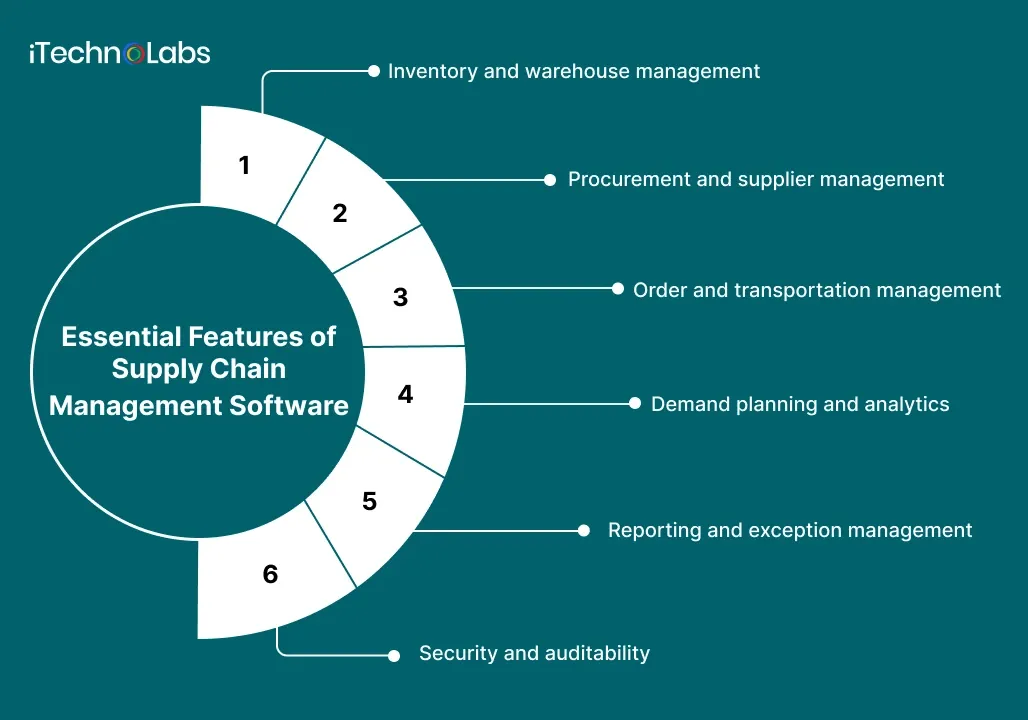
Feature selection should follow operational priorities rather than a long list of capabilities that may never be used.
1. Inventory and warehouse management
Track stock levels, stock movements, warehouse locations, receipts, dispatches, and inventory adjustments. Where required, support barcode scanning, batch identification, and multiple warehouse locations.
2. Procurement and supplier management
Manage supplier records, purchase requisitions, purchase orders, approval workflows, delivery commitments, and supplier performance information. Define who can create, approve, modify, and close transactions.
3. Order and transportation management
Coordinate order status, dispatch planning, carrier information, shipment milestones, delivery exceptions, and proof of delivery. Integration with external logistics providers depends on the data and interfaces they make available.
4. Demand planning and analytics
Combine relevant sales history, inventory records, lead times, and other approved data to support planning. Forecasting models should be evaluated against suitable historical data and business metrics before teams rely on their outputs.
5. Reporting and exception management
Provide role-specific dashboards for inventory discrepancies, delayed shipments, pending approvals, supplier issues, and fulfilment status. Alerts should direct attention to actionable exceptions instead of generating unnecessary notifications.
6. Security and auditability
Implement role-based access, secure authentication, appropriate encryption, audit logs, backup procedures, and controlled access to sensitive supplier and transaction data. Requirements should reflect the organisation’s risk profile and applicable obligations.
Choosing the Right Software Development Approach
Enterprise buyers should compare three practical approaches before committing to a build strategy.
| Approach | Best suited to | Main consideration |
| Ready-made software | Standard workflows that closely match existing product capabilities | Configuration limits, licensing, and vendor dependency |
| Custom development | Distinct workflows, specialised integrations, or differentiated business requirements | Initial investment, delivery risk, and ongoing ownership |
| Hybrid approach | Existing enterprise platforms that need targeted extensions or connected applications | Integration complexity and responsibility across vendors |
Custom development is not automatically the best option. If an established platform meets most requirements, configuring it and adding targeted integrations may be more appropriate than replacing it.
Before deciding, assess functional fit, integration support, data ownership, security requirements, customisation limits, upgrade processes, vendor exit options, and total cost of ownership.
Architecture and Integration Considerations
The architecture should reflect business workflows, transaction volumes, reliability requirements, and the capabilities of systems already in use.
Establish clear system boundaries
Decide which platform owns each important record. For example, the ERP may own financial transactions while the warehouse system manages physical stock movements. Avoid allowing multiple applications to update the same data independently without defined ownership rules.
Design dependable integrations
Document APIs, data formats, authentication, retry behaviour, error handling, and reconciliation procedures. Use asynchronous messaging where workflows benefit from processing events independently, and synchronous APIs where an immediate response is required.
Plan for data quality
Define consistent identifiers for products, suppliers, locations, orders, and shipments. Establish validation rules and processes for duplicate records, missing fields, conflicting updates, and failed synchronisation.
For traceability use cases, review applicable industry standards. GS1’s EPCIS standard supports sharing visibility event data, including information about the what, when, where, and why of events.
Build for maintainability
Select a technology stack the organisation can support over time. Modular services, documented interfaces, automated testing, monitoring, and controlled deployment processes can help teams change individual components without unnecessarily disrupting connected operations.
Security and Reliability in Supply Chain Software
The US National Institute of Standards and Technology guides cybersecurity supply chain risk management through its Cybersecurity Framework 2.0 Quick Start Guide. The guide addresses establishing a risk management capability and communicating cybersecurity requirements to suppliers.
Apply that risk-based approach to the software project by identifying sensitive data, external dependencies, privileged users, and critical business processes.
Key controls should include:
- Role-based permissions and least privilege access.
- Secure API authentication and management of integration credentials.
- Encryption in transit and at rest where appropriate.
- Audit trails for important changes and approvals.
- Backup restoration tests and documented recovery procedures.
- Dependency management, vulnerability assessment, and controlled releases.
- Monitoring for integration failures, unusual activity, and processing backlogs.
Define recovery objectives and service expectations according to business impact. A delayed dashboard refresh and a failed shipment transaction do not necessarily carry the same operational consequences.
The Supply Chain Software Development Process
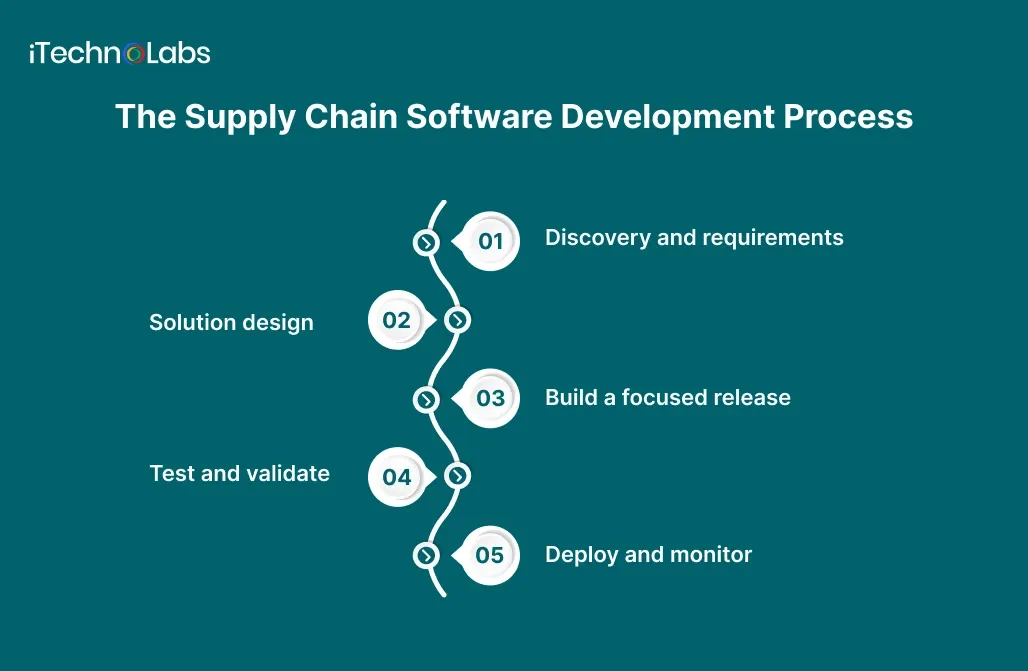
A staged delivery process gives enterprise stakeholders opportunities to validate requirements and manage risk before expanding the system’s scope.
Stage 1: Discovery and requirements
Map current workflows, stakeholders, pain points, system dependencies, and business objectives. Record measurable baseline indicators, such as order processing time, inventory discrepancy rates, or the frequency of manual reconciliations, where reliable data is available.
Stage 2: Solution design
Define system boundaries, integration contracts, data ownership, security controls, deployment requirements, and acceptance criteria. Review the design with operations, security, infrastructure, and business teams.
Stage 3: Build a focused release
Prioritise the workflows with the clearest business value. Develop the required interfaces, integrations, reporting, and exception handling, while documenting limitations that will be addressed in later releases.
Stage 4: Test and validate
Test business workflows, integration failures, access permissions, performance, data migration, and recovery procedures. Use representative scenarios and obtain acceptance from the people who will operate the system.
Stage 5: Deploy and monitor
Release through a controlled rollout, prepare user training, monitor production behaviour, and establish support ownership. Measure outcomes against the agreed baseline before deciding which capabilities to expand.
How to Evaluate a Supply Chain Software Development Partner
Enterprise technology leaders should assess a development partner against evidence, delivery practices, and its ability to work within the existing technology environment.
Ask prospective partners:
- How will you assess our current systems before proposing an architecture?
- How will you document integrations, data ownership, and failure handling?
- What security practices, testing controls, and release procedures will you apply?
- How will we review progress, approve milestones, and manage scope changes?
- Who will own the source code, documentation, infrastructure, and ongoing maintenance?
- How will you measure whether the software meets the agreed business objectives?
Request relevant project evidence where available. Evaluate the proposed team, technical reasoning, delivery plan, communication process, and support arrangements rather than relying on broad capability claims.
Why Choose iTechnolabs for Supply Chain Software Development?
iTechnolabs provides custom software development services for businesses looking to build, modernise, and integrate digital products. Its stated company credentials include ISO 27001:2013 and ISO 9001:2015 certifications, alongside experience delivering more than 500 apps. These credentials provide relevant context when evaluating a potential development partner.
When planning a supply chain software project, work with a development team that understands your existing architecture, operational workflows, integration dependencies, and security requirements.
At iTechnolabs, the focus is on translating business requirements into practical software development plans. Depending on your project scope, this can include:
- Custom software development: Applications designed around your operational workflows and business requirements.
- System integration: Connecting existing platforms through appropriate APIs and integration architecture.
- AI integration: Evaluating suitable applications for forecasting, anomaly detection, and operational decision support.
- Security-focused engineering: Considering access controls, data protection, testing, and maintenance throughout development.
- Planned delivery: Defining project scope, technical requirements, milestones, and acceptance criteria before implementation.
If your organisation is evaluating a new supply chain platform or modernising disconnected systems, start with a technical discussion about your requirements, current infrastructure, and priorities.
Conclusion
Supply chain software development is not simply about digitising existing processes. It is about connecting business systems, improving data visibility, reducing manual work, and giving teams the information they need to make informed operational decisions. The right approach depends on your current infrastructure, integration requirements, security priorities, and long-term business objectives.
Before investing in a new platform, assess your existing systems, identify the most pressing operational challenges, and define measurable outcomes for the project. Whether you need a custom application, targeted integrations, or an extension of your current enterprise software, a clear development roadmap can help control complexity and support future growth.
FAQs
1. What is supply chain software development?
Supply chain software development involves creating or adapting digital systems for procurement, inventory, warehousing, logistics, supplier coordination, and related operations. The scope may include a new application, integrations between existing systems, or enhancements to an established enterprise platform. The right approach depends on operational requirements, existing technology, and measurable business objectives.
2. How do you choose between custom and ready-made supply chain software?
Compare functional fit, integration requirements, security, configuration limits, licensing, data ownership, and long-term maintenance. Ready-made software may suit standard processes, while custom development can address distinctive workflows. A hybrid approach may work when existing enterprise systems already cover core functions but lack specific capabilities or connections.
3. Which integrations should an enterprise supply chain platform support?
Common integration candidates include ERP, warehouse management, procurement, finance, ecommerce, transportation, carrier tracking, and supplier systems. Not every project needs every connection. Prioritise integrations based on business workflows, data ownership, available APIs, transaction requirements, and the operational impact of delayed or failed data exchange.
4. How long does supply chain software development take?
Delivery time depends on scope, integration complexity, data migration, security requirements, and stakeholder availability. A focused release may be delivered sooner than a platform spanning multiple business units and legacy systems. Establish a project-specific timeline after discovery, architecture review, dependency assessment, and agreement on acceptance criteria.
5. How can supply chain software improve operational visibility?
A connected platform can consolidate relevant information about inventory, orders, shipments, suppliers, and operational exceptions. Visibility improves when data is timely, accurate, and consistently defined across systems. Dashboards alone cannot resolve poor source data, so integration quality, ownership rules, and reconciliation procedures remain essential.
6. What security controls should supply chain software include?
Consider role-based access, secure authentication, protected integration credentials, encryption, audit logs, backup and recovery testing, vulnerability management, and monitoring. Controls should reflect data sensitivity and operational risk. Enterprise teams should also assess third-party dependencies and define security responsibilities across vendors and internal teams.
7. Can AI be used in supply chain software?
AI techniques can be applied to use cases such as demand forecasting, anomaly detection, document processing, and decision support. Their suitability depends on data quality, evaluation methods, operational constraints, and the consequences of incorrect predictions. Validate performance against agreed metrics and retain human review for consequential decisions where appropriate.
8. How should an enterprise measure project success?
Establish baseline metrics before development and select indicators tied to the original business problem. Possible measures include order processing time, inventory record accuracy, manual reconciliation effort, shipment exception resolution, and system availability. Agree on definitions, data sources, reporting frequency, and ownership so that post-launch results can be evaluated consistently.