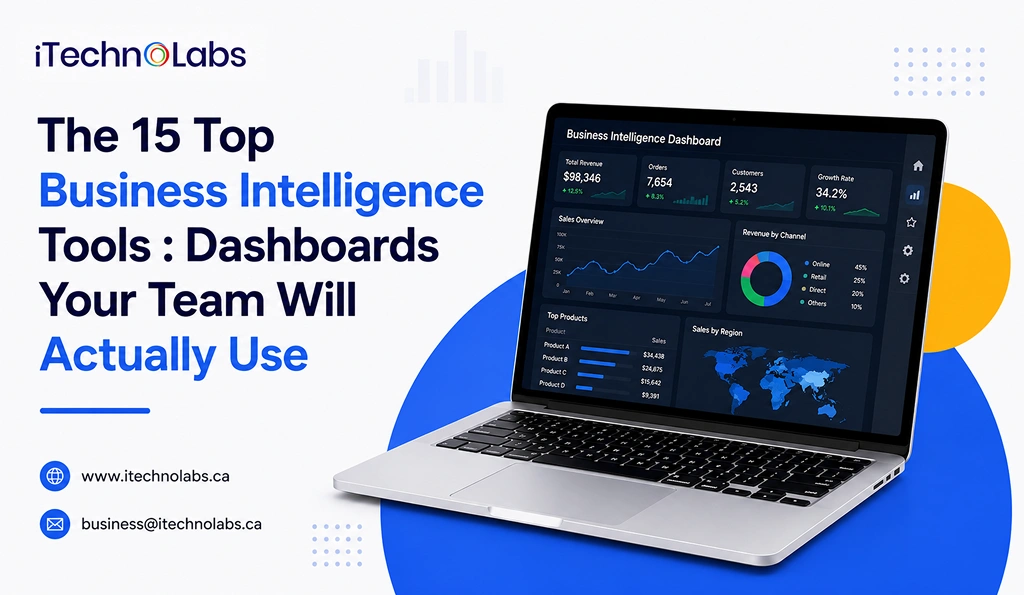
In the current era of data-driven businesses, companies are accumulating large volumes of data through various channels like customer interactions, sales activities, marketing campaigns, operations, and financial transactions. Though gathering data is just the beginning. The true challenge is to convert this data into valuable insights that can enable better decision-making. That is why business intelligence tools are extremely important.
The popularity of business intelligence solutions is growing at a very fast pace. Based on the latest industry reports, the global market for business intelligence is expected to be around $55 billion in 2026, largely because of increased spending on analytics, cloud computing, and AI-based decision-making. And, over and over, 78% of global corporations have already deployed at least one BI or analytics platform, and 84% of them regard business intelligence and analytics as a must-have for their digital transformation strategies. Apart from that, companies with strong BI capabilities make decisions 2.5 times faster and enjoy quite a bit higher profits from their analytics investments.
Today’s business intelligence (BI) software enables organizations not only to collect and analyze data but also to visualize and distribute it quickly through highly interactive dashboards and reports. With businesses increasingly demanding live analytics to drive their decisions, picking the proper BI tool is a must for staying ahead in today’s cutthroat world. This article will introduce the 15 best business intelligence tools of 2026, highlighting their main features and advantages as well as their best-suited scenarios.
TL;DR
- Business intelligence tools convert data into actionable business insights.
- AI-powered analytics enhance decision-making speed and accuracy significantly.
- Real-time dashboards improve visibility across organizational operations instantly.
- Cloud-based BI platforms offer scalability, flexibility, and accessibility.
- Choosing the right tool depends on business requirements.
Key Takeaways
- Business intelligence tools enable businesses to turn raw data into actionable knowledge that can be used for creating strategies, improving the efficiency of operations, and increasing revenue.
- Today’s BI software offers up-to-the-minute dashboards, automatic generation of reports, and highly engaging visual aids to support quick, fact-based decisions.
- Incorporating AI and machine learning features is gradually becoming a must-have among top business intelligence tools.
- With business intelligence solutions based on the cloud, organizations can benefit from higher scalability, the ability to work from anywhere, and easier deployment methods.
- Besides the features, an organization should check the ability of the BI platform to integrate with other systems, evaluate ease of use, security aspects, and scalability options while making the decision.
Table of Contents
- What Are Business Intelligence Tools?
- Top 15 Business Intelligence Tools at a Glance
- Key Factors to Consider When Choosing Business Intelligence Tools
- Why Businesses Need Business Intelligence Tools
- Future Trends in Business Intelligence Tools
- Why Choose iTechnolabs for Business Intelligence Development?
- Conclusion
- FAQs
What Are Business Intelligence Tools?
Business Intelligence technology allows companies to collect, analyze, understand, and deliver data from different sources. It can involve transforming plain raw data into clear information that is displayed in the form of graphs, dashboards, or reports that will allow companies to react faster and more efficiently.
Nowadays, the actual Business Intelligence platforms may also include newer technologies such as artificial intelligence, machine learning, predictive analysis, and real-time reporting to spot any trends, review performance, or identify any opportunities. It is then possible to provide access to this data to the whole company so as to enhance their efficiency, decision-making process, and data-driven culture.
Key Capabilities of Business Intelligence Tools
- Data integration: BI tools collect data from multiple sources, such as databases, cloud applications, spreadsheets, CRM systems, ERP systems, and third-party services, and make it possible to create a central repository of data to analyze.
- Interactive dashboards and reporting: Users are able to build their own interactive dashboards and reports to continuously track key business performance, metrics, and trends.
- Real-time analytics: The modern BI tools empower organizations with live data streams, allowing businesses to monitor their operations and key performance indicators and quickly adapt to changes in business circumstances.
- Data visualization: Use of powerful tools like charts, graphs, maps, and heatmaps to simplify the interpretation and comprehension of complex data.
- Self-service analytics: Business users gain the ability to explore the data themselves, create reports, and get access to insights, thus reducing the dependency on IT teams or data analysts.
- Predictive and advanced analytics: Use of AI and machine learning enables organizations to make informed business decisions, including anticipating trends, predicting consumer behavior, identifying risks, and optimizing strategy.
- KPI tracking: Businesses can visualize their key performance indicators with the help of BI tools and determine the degree to which they are fulfilling their business objectives.
- Collaboration and data sharing: Sharing dashboards, reports, and insights across departments can help in the effective communication and alignment of tasks at the organizational level.
- Mobile access: Most BI solutions come with a mobile version, allowing access to reports and dashboards anytime, anywhere.
- Data governance and security: High-end BI solutions are incorporated with strong security features, role-based access controls, compliance monitoring, and governance tools to ensure the security of sensitive information.
As businesses continue to embrace digital transformation, business intelligence platforms have become indispensable to help organizations turn their raw data into strategic advantages. The BI platforms empower organizations with the tools and functionalities to optimize performance, improve customer experience, mitigate risk, and attain continuous growth through accurate, timely, and actionable insights.
Top 15 Business Intelligence Tools at a Glance
Discover the 15 top business intelligence tools in 2026 that will help organizations translate data into intelligent decisions. Consider leading BI platforms, grasp the key characteristics, and select the ideal reporting analytics, data visualization, and real-time decision-making business intelligence tool to improve business performance and fuel growth.
| Business Intelligence Tool | Best For | Key Strength |
| Microsoft Power BI | Businesses of all sizes | Microsoft ecosystem integration |
| Tableau | Data visualization | Interactive dashboards and visual analytics |
| Qlik Sense | Self-service analytics | Associative data exploration |
| Looker | Cloud-based analytics | Data modeling and embedded analytics |
| SAP BusinessObjects | Large enterprises | Enterprise reporting and governance |
| IBM Cognos Analytics | Advanced analytics | AI-powered insights and reporting |
| Sisense | Embedded BI | Customizable analytics applications |
| Domo | Real-time business monitoring | Live dashboards and automation |
| Zoho Analytics | Small and medium businesses | Affordable self-service BI |
| Oracle Analytics Cloud | Enterprise organizations | AI and predictive analytics |
| Yellowfin BI | Collaborative analytics | Data storytelling and automated insights |
| ThoughtSpot | Search-driven analytics | Natural language data exploration |
| MicroStrategy | Enterprise-scale deployments | High-performance analytics and security |
| AWS QuickSight | AWS users | Serverless cloud analytics |
| TIBCO Spotfire | Advanced analytics and forecasting | Predictive analytics and data science integration |
1. Microsoft Power BI
In 2026, Microsoft Power BI is still considered the top business intelligence tool by many users due to its excellent data visualization, reporting, and analytical features. It is one of the best BI tools that helps companies to get value from the data they have by producing meaningful insights. Power BI users can easily connect to more than a hundred different types of data sources, build highly interactive dashboards, and carry on report generation in real-time. Besides, it is extremely well integrated with other Microsoft products like Microsoft 365, Excel, Azure, and Dynamics 365. Because of this, it represents a perfect option for those companies that are already working within the Microsoft environment.
Adding on to that, Power BI uses artificial intelligence and machine learning, for instance, identifying latent patterns, forecasting future results, and streamlining data analysis tasks. Offering both online and on-premises installation modes, this software is capable of meeting the requirements of organizations regardless of their size.
Key Features
- Interactive and customizable dashboards
- AI-powered analytics and insights
- Real-time reporting and monitoring
- Advanced data modeling and transformation
- Seamless integration with Microsoft 365 and Azure
- Self-service business intelligence capabilities
- Mobile access for on-the-go analytics
- Enterprise-grade security and governance
Pros
- User-friendly interface with drag-and-drop functionality
- Strong integration with Microsoft products
- Affordable pricing compared to many competitors
- Extensive data connectivity options
- Regular updates and feature enhancements
Cons
- Advanced features may require technical expertise
- Performance can slow with extremely large datasets
- Some capabilities require premium licensing
Best For
Organizations already using Microsoft products and services that need a scalable, cost-effective, and feature-rich business intelligence solution.
2. Tableau
Tableau is among the leading business intelligence tools currently on the market, known for its sophisticated data visualization capabilities and user-friendly interface. Business users with no technical knowledge can easily use the platform to transform datasets into interactive dashboards, charts, and reports. Tableau’s intuitive, drag-and-drop interface empowers analysts and users to explore data, discover insights and trends, and share their findings with the wider business.
As a Salesforce product, Tableau is integrated with advanced analytics that utilize artificial intelligence. Businesses can connect data from various sources, perform real-time analytics, and collaborate across the enterprise on visual reports to drive data-informed decision-making.
Key Features
- Drag-and-drop analytics interface
- Advanced data visualizations and dashboards
- Real-time data exploration
- AI-driven insights and recommendations
- Mobile accessibility and reporting
- Extensive data source connectivity
- Self-service analytics capabilities
- Cloud and on-premises deployment options
Pros
- Industry-leading data visualization features
- User-friendly interface for non-technical users
- Strong community support and learning resources
- Excellent dashboard customization options
- Supports large and complex datasets
Cons
- Higher pricing compared to some competitors
- Advanced features can have a learning curve
- Performance may vary with very large data volumes
Best For
Businesses focused on visual storytelling, interactive analytics, and advanced data exploration.
3. Qlik Sense
Qlik Sense is a 2nd-generation and high-end business intelligence tool that makes a difference due to its superior, associative analytics engine, which discovers obscure data relationships. While existing query-based BI tools confine you to a pre-defined journey or dashboards, Qlik Sense allows you to discover insights by interacting with your data the way you like it.
This tool integrates the capabilities of self-service BI with AI suggestions and interactive dashboards to help businesses to achieve better decision-making. Qlik Sense supports deployment in the cloud, hybrid, or on-premises.
Key Features
- Associative analytics engine
- Self-service data exploration
- Interactive dashboards and visualizations
- AI-assisted insights and recommendations
- Real-time analytics capabilities
- Data integration and preparation tools
- Embedded analytics functionality
- Multi-cloud deployment support
Pros
- Unique associative data discovery approach
- Strong data integration capabilities
- Flexible deployment options
- AI-powered analytics features
- Excellent scalability for growing organizations
Cons
- The interface may require training for new users
- Advanced customization can be complex
- Premium features may increase overall costs
Best For
Organizations seeking flexible self-service analytics, deep data exploration, and the ability to uncover hidden relationships across multiple data sources.
4. Looker
Looker is a cloud-based business intelligence tool that helps companies explore, analyze, and share large-scale data. It was bought by Google Cloud. Looker helps businesses personalize their analytics experiences and establish a single reliable source of data throughout their data environment. Through its robust modeling component, it is possible for the organizations to define business metrics consistently, which leads to accurate reporting and decision-making at various levels.
The platform caters to businesses that prioritize cloud in their work and allows integration with the leading cloud data warehouses without any interruptions. Embedded analytics, live reporting, and collaboration tools are some of the features of Looker that enable organizations to rely on data for their decisions while ensuring proper governance and data uniformity.
Key Features
- Cloud-native architecture
- Advanced data modeling with LookML
- Embedded analytics capabilities
- Real-time reporting and dashboards
- Collaborative data exploration
- Integration with major cloud databases
- Self-service analytics
- Centralized metric management
Pros
- Strong cloud infrastructure support
- Excellent data governance capabilities
- Highly customizable analytics experiences
- Seamless Google Cloud integration
- Supports large-scale enterprise deployments
Cons
- Can be expensive for smaller organizations
- Requires technical knowledge for data modeling
- Learning curve for LookML development
Best For
Companies operating in cloud-first environments that require scalable analytics, centralized data governance, and custom data experiences.
5. SAP BusinessObjects
SAP BusinessObjects is a mature business intelligence platform that has been around for quite some time. Its primary aim is to assist organizations in handling their reporting, analytics, and data visualization needs effectively at a large scale. Being a platform of choice for many big enterprises across the globe, it comes with a rich set of reporting features, engaging dashboards, and sophisticated analytics instruments that help businesses carry out their operations smoothly.
BusinessObjects allows enterprises to retrieve and study data from various sources without compromising their data governance and security standards. Having a strong reporting foundation, it is mainly beneficial for businesses that are in need of getting their operational, financial, and compliance reports done in a very detailed manner.
Key Features
- Enterprise-grade reporting and analytics
- Interactive dashboard creation
- Advanced data visualization tools
- Predictive analytics capabilities
- Comprehensive data governance features
- Ad hoc query and analysis tools
- Multi-source data integration
- Enterprise security and compliance controls
Pros
- Powerful enterprise reporting functionality
- Strong governance and security features
- Highly scalable for large organizations
- Extensive integration with SAP products
- Reliable performance for complex reporting needs
Cons
- Interface can feel outdated compared to newer BI tools
- Implementation may be time-consuming
- Requires specialized expertise for administration
Best For
Large enterprises with complex reporting requirements, strict compliance needs, and existing investments in SAP technologies.
6. IBM Cognos Analytics
IBM Cognos Analytics is an all-inclusive BI platform that includes standard reporting abilities along with AI and Machine Learning capabilities. Targeted towards the enterprises that need deeper analytics, Cognos helps organizations to automate their data preparation process, identify unrecognized trends, and obtain recommendations from their data via its AI-enabled analytical abilities.
Users are empowered to build interactive dashboards, carry out advanced reports, and interrogate data via natural language queries. By simplifying complex analytic functions, IBM Cognos Analytics is a versatile BI tool for both technical and non-technical users.
Key Features
- AI-powered recommendations and insights
- Automated data preparation
- Interactive dashboards and visualizations
- Advanced reporting capabilities
- Natural language querying
- Predictive analytics functionality
- Self-service business intelligence
- Enterprise-grade security and governance
Pros
- Strong AI and machine learning capabilities
- Comprehensive reporting features
- Robust enterprise security
- Supports complex data environments
- Natural language search simplifies analysis
Cons
- Can be complex for first-time users
- Higher implementation costs for smaller organizations
- Advanced customization may require technical expertise
Best For
Enterprises require sophisticated analytics, AI-driven insights, and enterprise-level reporting capabilities.
7. Sisense
Sisense is a next-generation business intelligence platform offering the simplest path for business data analysis, thanks to its embedded analytics, custom dashboards, and scalable infrastructure. The platform makes analytics more accessible for employees and customers by embedding them into business applications, products, and workflows.
The platform’s flexible architecture and strong data processing features allow for data volume analysis and the generation of real-time business insights from multiple sources. Embedded analytics has made Sisense a common pick in the market, particularly for software providers building analytic solutions for customers.
Key Features
- Embedded business intelligence
- Customizable dashboards and reports
- Advanced analytics capabilities
- Multi-source data integration
- Cloud and hybrid deployment options
- Real-time data monitoring
- White-label analytics solutions
- API-driven customization
Pros
- Excellent embedded analytics capabilities
- Highly customizable platform
- Strong scalability for growing businesses
- Supports complex data integrations
- Flexible deployment options
Cons
- Advanced features may require technical expertise
- Initial setup can be time-intensive
- Pricing may be higher for smaller teams
Best For
Businesses developing customer-facing analytics applications, SaaS platforms, and organizations seeking embedded business intelligence solutions.
8. Domo
Domo is a cloud-native business intelligence software that offers real-time data access and analytics to help businesses quickly respond to customers’ needs. It integrates data from hundreds of sources and converts them into interactive BI dashboards that give the users an instant overview of the company’s performance. The mobile-first design of the platform enables executives to keep track of essential figures and act promptly wherever they are.
Apart from business intelligence features, Domo has workflow automation and AI/ML-driven analytics, which help businesses increase productivity and efficiency. Its intuitive design ensures that even non-technical users can easily work with the software.
Key Features
- Real-time dashboards and reporting
- Mobile-first analytics experience
- Extensive data integration capabilities
- Predictive analytics tools
- Workflow automation
- Customizable visualizations
- Cloud-native architecture
- Team collaboration features
Pros
- Strong real-time monitoring capabilities
- Excellent mobile experience
- Easy-to-use dashboard interface
- Broad range of data connectors
- Built-in workflow automation
Cons
- Premium pricing may not suit smaller businesses
- Advanced customizations can require training
- Large-scale deployments may increase costs
Best For
Organizations require real-time business monitoring, operational visibility, and rapid decision-making capabilities.
Suggested Article: Role of AI in Business Intelligence
9. Zoho Analytics
Zoho Analytics is an efficient and economical business intelligence platform that makes it easier for businesses to convert raw data into valuable insights through interactive dashboards and reports. It grants self-service analytics features to end users so that they can compose their own visualizations and dissect data even if they lack the technical skills.
Being equipped with features like AI-enabled help, report generation automation, and compatibility with various data sources, among others, Zoho Analytics stands out as an excellent choice for small and medium enterprises that desire access to top-notch functionalities at a reasonable price. Besides that, it connects effortlessly not only with a range of Zoho applications but also with a great number of third-party software programs.
Key Features
- Self-service business intelligence
- Automated reporting and scheduling
- AI-powered analytics assistant
- Data blending from multiple sources
- Custom dashboards and visualizations
- Drag-and-drop report builder
- Mobile analytics access
- Extensive application integrations
Pros
- Cost-effective pricing structure
- User-friendly interface
- Strong integration with Zoho products
- AI-powered insights and recommendations
- Suitable for growing businesses
Cons
- Advanced analytics features are less robust than those of some enterprise competitors.
- Dashboard customization can have limitations
- Performance may vary with extremely large datasets
Best For
Small and medium-sized businesses seeking affordable, easy-to-use business intelligence tools with strong reporting and visualization capabilities.
10. Oracle Analytics Cloud
Oracle Analytics Cloud is a comprehensive analytics and business intelligence platform that brings together data visualization, machine learning, artificial intelligence, and predictive analytics capabilities all within a single cloud environment. It assists organizations in discovering more profound insights from data while still offering high-level security and governance features. Being a scalable solution, Oracle Analytics Cloud allows companies to perform deep analyses on vast amounts of structured and unstructured data, design highly interactive dashboards, and take advantage of AI-based suggestions to make more informed decisions.
The platform’s tight integration with Oracle applications and databases makes it a great option for organizations that have already committed to the Oracle ecosystem.
Key Features
- AI-driven analytics and insights
- Interactive data visualization
- Predictive modeling and forecasting
- Enterprise-grade security and compliance
- Cloud-native scalability
- Automated data preparation
- Natural language analytics
- Integration with Oracle applications
Pros
- Powerful AI and machine learning capabilities
- Strong enterprise security framework
- Excellent scalability for large organizations
- Deep integration with Oracle technologies
- Advanced predictive analytics tools
Cons
- Can be costly for smaller businesses
- Advanced functionality may require specialized training
- Best value achieved within Oracle environments
Best For
Organizations are already using Oracle solutions that require advanced analytics, predictive modeling, and enterprise-grade business intelligence capabilities.
11. Yellowfin BI
Yellowfin BI is a contemporary business intelligence tool that focuses on teamwork, automatic insights, and data storytelling. It is made to assist organizations in getting better at making decisions through insights sharing, and Yellowfin also allows people to turn complicated data into fun stories, which are simple to remember and take action on.
The tool offers a mix of classic reports and dashboards alongside the latest analytics that automatically detect new trends, unexpected changes, and business opportunities. The collaborative setting promotes team discussions of insights right inside the dashboards and, because of this, helps organizations in creating a more powerful data-driven culture.
Key Features
- Automated insights and anomaly detection
- Collaborative dashboards and reporting
- Data storytelling capabilities
- Embedded analytics functionality
- Mobile accessibility
- Interactive data visualizations
- Automated business monitoring
- Team collaboration tools
Pros
- Strong focus on data storytelling
- Excellent collaboration features
- Automated insight generation
- User-friendly interface
- Flexible deployment options
Cons
- Smaller ecosystem compared to major BI vendors
- Advanced customizations may require expertise
- Limited brand recognition in some markets
Best For
Teams seeking enhanced collaboration around data, automated insights, and effective communication of business intelligence across departments.
12. ThoughtSpot
ThoughtSpot is an advanced business intelligence platform that changes the method users work with data with a search-driven analytics experience. Besides traditional dashboards and reports, users can ask questions in everyday language and get relevant insights, charts, and visualizations in a flash.
ThoughtSpot is fueled by AI and machine learning—it helps companies open up data to everyone and at the same time, supports first-time users to independently explore the data. Besides its cloud native architecture, the user-friendly interface of ThoughtSpot serves to open up analytics to everyone in a company.
Key Features
- Search-based analytics
- AI-powered insights and recommendations
- Interactive dashboards
- Real-time reporting
- Cloud-native architecture
- Natural language querying
- Self-service analytics
- Embedded analytics capabilities
Pros
- Extremely user-friendly search interface
- Strong AI-driven analytics capabilities
- Reduces dependence on technical teams
- Fast access to business insights
- Excellent scalability
Cons
- Premium pricing for advanced features
- Search experience may require data optimization
- Less dashboard customization than some competitors
Best For
Organizations are looking for self-service analytics, natural language data exploration, and broader access to business intelligence across teams.
13. MicroStrategy
MicroStrategy is a business intelligence platform built to support enterprise-level analytics, reporting, and data management. Its strength lies in its performance, scalability, and top-notch security features. MicroStrategy enables firms to work with enormous datasets and, meanwhile, supply decision-makers with the essential insights.
MicroStrategy’s distinctive HyperIntelligence tool supplies relevant information straight into the user’s ordinary business software, Because of this limiting the frequency of changing the systems. When matched with mobile analytics, cloud options, and hard-hitting governance at the enterprise level, MicroStrategy remains a favored pick by firms with a complex data environment.
Key Features
- Enterprise reporting and analytics
- HyperIntelligence capabilities
- Mobile analytics and dashboards
- Cloud and hybrid deployment
- Advanced security and governance
- AI-assisted analytics
- Large-scale data processing
- Interactive visualizations
Pros
- Highly scalable enterprise platform
- Strong security and governance controls
- Unique HyperIntelligence functionality
- Excellent performance with large datasets
- Comprehensive reporting capabilities
Cons
- Steeper learning curve than many BI tools
- Higher implementation and licensing costs
- Best suited for larger organizations
Best For
Large enterprises manage extensive datasets, complex reporting requirements, and enterprise-wide analytics initiatives.
14. AWS QuickSight
AWS QuickSight is a cloud-native business intelligence service developed by Amazon Web Services to assist organizations in creating interactive dashboards, visualizations, and reports at scale. As a serverless architecture, QuickSight does not require infrastructure management while it delivers fast and secure business insight access.
The platform uses machine learning features to detect patterns, pinpoint anomalies, and produce predictive insights without human intervention. Besides, its distinctive pay-per-session pricing offers a very attractive cost structure for companies that want to expose analytics to many users without incurring large licensing fees.
Key Features
- Serverless architecture
- Machine learning-powered insights
- Interactive dashboards and visualizations
- Pay-per-session pricing model
- Cloud-native analytics
- Real-time reporting capabilities
- Integration with AWS services
- Embedded analytics support
Pros
- Cost-effective pricing structure
- No infrastructure management required
- Seamless integration with the AWS ecosystem
- Scalable for businesses of all sizes
- Built-in machine learning features
Cons
- Best suited for AWS-centric environments
- Limited customization compared to some competitors
- Advanced features may require AWS expertise
Best For
AWS-based businesses seeking scalable, cloud-native analytics with flexible pricing and seamless integration across Amazon Web Services.
15. TIBCO Spotfire
TIBCO Spotfire is a high-end platform for analytics and business intelligence that brings together impressive data visualization, predictive analytics, and data science capabilities all in one place. With its analytical techniques, the platform helps enterprises identify potential opportunities, predict future behaviors, and make prompt decisions.
Spotfire is highly recognized for allowing clients to get any kind of analytics at the instant, and its adequate visualization of geographic data enables users to examine complex data relying on interactive dashboards and powerful visual exploration options. Alongside its many other features, Spotfire’s connection with data science processes and machine learning makes it a brilliant choice for firms needing more insights than the usual BI.
Key Features
- Predictive analytics and forecasting
- Real-time monitoring and analytics
- Interactive data visualizations
- Geographic mapping and location intelligence
- Data science and machine learning integration
- Advanced statistical analysis
- Self-service analytics
- Enterprise reporting capabilities
Pros
- Strong predictive analytics functionality
- Excellent data visualization tools
- Advanced statistical and forecasting capabilities
- Robust geographic mapping features
- Supports complex analytical workflows
Cons
- Steeper learning curve for new users
- Higher cost compared to entry-level BI tools
- Advanced features may require specialized expertise
Best For
Organizations require advanced analytics, predictive modeling, forecasting, and data science integration to support complex business decision-making processes.
Key Factors to Consider When Choosing Business Intelligence Tools
With different business intelligence tools being offered in the market, choosing the correct one might be quite a task. Your perfect BI platform must truly reflect the vision of the company, the technical needs, the budget, and also the plans of growing in the future growth. Business intelligence tools, if appropriately selected, empower user decision-making processes, enable smooth operations, and allow businesses to get maximum returns from their data investments. It is worth considering that there are quite a few essential points that businesses need to focus on before making a purchase decision.
1. Ease of Use
A good business intelligence platform will be intuitive and accessible for tech-savvy users as well as non-technical ones. Friendly user interfaces, drag-and-drop features, and self-service analytics empower employees of different departments to make reports, dive into data, and come up with insights with minimal support from the IT teams. The more a tool is user-friendly, the quicker companies can promote its use and see a payoff of their investment.
2. Data Integration
Modern businesses depend on data from various sources, such as CRM systems, ERP platforms, cloud applications, spreadsheets, and third-party services. A BI tool must have powerful integration capabilities to enable smooth data connection across all relevant sources. Good integration features guarantee data integrity and deliver a single picture of business performance.
3. Scalability
One of the consequences of organizational expansion is the increase in data volumes and analytics demands. It is important that the selected business intelligence platform has the capacity to scale adequately without facing performance issues. Growing a user base, incorporating new data sources, or managing bigger datasets – the scalable BI tools not only safeguard analytics investments but also foster long-term business development.
4. Security and Compliance
Data security is a very important factor, in particular for those organizations, a big part of which involves handling customer, financial, or other types of sensitive information. When choosing your platform, focus on those that offer enterprise-level security features, such as role-based access control, encryption of data, audit trails, and compliance with various industry regulations. With the help of good governance features, we not only safeguard our valuable business data but also we ensure that the company remains compliant with different rules and regulations.
5. Customization and Flexibility
Each organization has its own set of reporting needs and objectives. Customizable business intelligence tools give users the freedom to design their dashboards, reports, visualizations, and workflows based on individual preferences. And customization features guarantee that decision-makers get the right information in the way that best helps them make decisions.
6. Cost and Total Cost of Ownership
Business intelligence vendors charge significantly varied prices. Beyond the actual cost of licenses, companies will need to factor in installation costs, training, technical support, hardware purchases, and maintenance costs. The better a company understands the true cost of ownership, the more likely it is to select a solution capable of providing value over time without forcing it into debt.
7. Analytics and AI Capabilities
Given the rise of artificial intelligence in BI tools, businesses ought to check if functions like predictive analytics, automated insights, machine learning models, and natural language querying are integrated. Advanced analytical functionalities can really improve decision-making and reveal opportunities that plain reporting can miss.
8. Deployment Options
The decision whether to deploy using a cloud-based, on-premises, or hybrid model should also be based on the needs of the business. Cloud-based BI systems are usually highly flexible and scalable, whereas on-premises systems offer higher data control and security.
9. Collaboration Features
Collaborative intelligence—This means it should be possible to collaborate through shared dashboards, distributed reports, comments, and team-based analytics. It is through collaborative features that companies can drive their businesses with data.
10. Vendor Support and Community
Dependable vendor assistance, comprehensive instructions, training materials, and lively user forums might play a huge part in the achievement of a BI deployment. Picking a vendor with a robust help desk and uninterrupted product development guarantees firms get the most out of their BI platform.
Taking these factors into consideration, companies are able to choose a BI solution that will not only satisfy their existing needs but also help facilitate their growth and innovation and gain a competitive edge in the future.
Why Businesses Need Business Intelligence Tools
Nowadays, companies generate a huge amount of data through their activities with customer sales, marketing, and even internal operations. But, most of the time, if they don’t have the right tools, this data is not used to its full potential. Business intelligence tools support companies in turning raw data into insight that can be acted upon. This way, empowering leaders to make better decisions, spot changes, and boost their performance overall.
By giving up-to-date access to important figures, BI systems enable businesses to optimize their workflows, reveal areas for expansion, improve customer service, and keep their edge in the market. With data becoming a more and more precious resource, business intelligence tools are a must for enhancing productivity, coming up with new ideas, and ensuring a successful business in the long run.
Key Benefits of Business Intelligence Tools
- Make faster and more informed decisions
- Improve operational efficiency and productivity
- Identify new growth opportunities and market trends
- Monitor business performance in real time
- Increase profitability through data-driven strategies
Future Trends in Business Intelligence Tools
The business intelligence field is changing very fast. Companies want quicker, smarter, and easier ways to work with data. Artificial intelligence, cloud computing, machine learning, and automation are the main drivers of business transformation in collecting, interpreting, and applying information. Because data production is increasing, business intelligence tools are getting better, more predictive, and more approachable.
Companies that decide to make use of new BI tech will soon be able to receive timely, actionable insights, increase their operational performance, and stay ahead of their competition in a world in which everything is more and more data-based. The trends below will be the factors deciding the business intelligence tools of 2026 and beyond.
1. AI-Powered Analytics and Automation
Increasingly, artificial intelligence is woven into the fabric of new business intelligence tools. With AI-supported analytics, pattern recognition, anomaly detection, idea generation, and finding secret insights become possible even without doing a load of manual analysis. Besides, automation greatly simplifies data prep, reporting, and visualization aspects, etc., so companies can concentrate on strategy rather than monotonous chores.
2. Natural Language Querying
Natural language processing (NLP) tools are the main reason data analysis is becoming less and less exclusive for technically skilled people. For example, rather than composing sophisticated reports or coding queries, people simply state their questions in everyday language and get answers, charts, and visuals provided on the spot. Thanks to this feature, data access is being democratized, and decision-making is going on at a higher speed throughout the company.
3. Predictive and Prescriptive Analytics
Historical data analysis has been the main focus of traditional BI tools, yet the future belongs to predictive and prescriptive analytics. By leveraging machine learning algorithms, predictive analytics can forecast future trends, customer behavior, and business outcomes. While prescriptive analytics is one step ahead, it suggests the particular actions that the organizations must take to attain the desired results and reduce the risks.
4. Embedded Business Intelligence
Embedded BI is gaining popularity as more and more organizations are looking at fusing analytics seamlessly with business software, customer portals, and daily operations. By incorporating visualizations and data discoveries in the very systems that the employees use, companies will be able to give the users data tailored to where and when they make decisions, which in turn leads to enhanced productivity and better experiences for the users.
5. Real-Time Data Processing
Real-time insights are becoming more and more necessary as businesses are functioning in very dynamic environments. Tomorrow’s business intelligence applications will possess great real-time data processing abilities that will help organizations to not only to keep an eye on their operations and measure their performance but also to react to any changes in the market without delay.
6. Augmented Analytics
Augmented analytics is a method that combines artificial intelligence, machine learning, and natural language technologies in an effort to automate data discovery and the generation of insightful information. These solutions assist users in finding meaningful data at a higher pace and minimizing the difficulty of traditional analytics processes. It has been predicted that augmented analytics will be a regular aspect of the top BI platforms.
7. Cloud-Native BI Platforms
The traditional on-premises implementation of business intelligence solutions is progressively being substituted with cloud-based systems. BI solutions in the cloud (native BI systems) are more adaptable and easier to access while lowering costs related to hardware and maintenance. They make analytical tools and data available remotely from any location, enabling remote business processes and allowing scaling up/down with demand.
8. Enhanced Data Governance and Security
With the tightening of regulations on data privacy and the rising menace of cybercrimes, organizations are focusing more on data governance and security. Advanced security features, compliance management, role-based access control, and data quality monitoring are some of the aspects that future BI platforms will upgrade to ensure trust and compliance.
9. Self-Service Analytics Expansion
Businesses are allowing more and more people within their companies to review and analyze data by themselves, without having to resort to a specialist data group. The business intelligence tools of the future will increasingly support these self-service analytic capabilities, making sophisticated reporting and data exploration capabilities available to a wide range of users.
10. Integration of Data Science and Business Intelligence
BI and data science lines are becoming blurry. Newer BI platforms will soon incorporate ML models, statistical analysis, and data science workflows into analytics solutions, bridging the divide and providing a seamless journey from descriptive reporting to predictive and prescriptive decision-making.
11. The Future of Business Intelligence
Intelligent automation, real-time decision-making, and wider data accessibility will determine the future of business intelligence. Such organizations that embrace these advanced technologies will be able to access well-grounded insights more rapidly, boost the efficiency of their operations, upgrade the experience of their customers, and come up with more informed strategic plans. Besides, the ongoing technological advancement will only make the business intelligence tools more indispensable in helping companies make the most of their data and promote their continuous expansion.
Why Choose iTechnolabs for Business Intelligence Development?
Deciding on the perfect business intelligence platform is just the beginning of your journey towards making data the center of your decision-making process. To really get the most out of your BI tools, you will require a trustworthy technology partner who can come up with a blueprint, roll out, and fine-tune your analytics solutions tailored to your business needs. iTechnolabs is helping businesses change their complicated data into understandable insights through their tailor-made business intelligence and analytics services.
Having deep expertise in data integration, dashboard development, reporting automation, and advanced analytics, iTechnolabs has made it possible for businesses to develop powerful BI ecosystems that facilitate informed decision-making and sustainable growth. Further, the company’s team collaborates closely with clients to grasp their goals, determine the essential KPIs, and create solutions that yield tangible business benefits.
1. Expertise Across Leading BI Platforms
iTechnolabs has a track record of handling an extensive variety of business intelligence tools such as Power BI, Tableau, Qlik Sense, Looker, Zoho Analytics, and other high-level analytics platforms. This knowledge ensures that companies choose and put into practice the tool that most closely aligns with their objectives and existing systems.
2. Customized Dashboard Development
We know every organization has different reporting needs. iTechnolabs builds interactive, custom dashboards to give users real-time insight into key business performance indicators and allow decision-makers to act quickly and efficiently.
3. Seamless Data Integration
The world of modern business depends on various systems and applications. iTechnolabs is a firm that assists organizations by consolidating the data from CRM systems, ERP systems, cloud applications, databases, and third-party tools into one central analytics platform to provide a holistic business perspective.
4. Advanced Analytics and Reporting
In addition to traditional reporting, iTechnolabs also uses sophisticated analysis solutions that enable organizations to understand the trends, predict what may occur, and find new growth areas. The solutions team develops custom reports and presentations to support particular business needs.
5. Scalable and Future-Ready Solutions
As businesses grow, their data requirements become more complex. iTechnolabs develops scalable BI solutions that can accommodate increasing data volumes, additional users, and evolving business needs without compromising performance.
6. Enhanced Data Security and Governance
Data security is a critical component of any business intelligence strategy. iTechnolabs follows industry best practices to implement secure data architectures, access controls, governance policies, and compliance-focused analytics solutions.
7. Cost-Effective Implementation
Using tried and tested techniques coupled with experience from the field, iTechnolabs ensures your business reduces implementation headaches, increases deployment speed, and gets a greater ROI from your BI investments.
8. Ongoing Support and Optimization
BI is not a project; it is a continuing process. iTechnolabs offers maintenance, ongoing support, performance tuning, and feature upgrades. This way, your analytics environment stays at optimal performance and in line with the business objectives.
9. Transform Data Into Business Growth
If this is your first foray into BI implementation or your existing analytics stack needs improvement, iTechnolabs provides custom business intelligence solutions designed to unlock your organization’s data capabilities. Strategic planning, frictionless integration, and advanced analytics empower your organization to make smarter decisions, optimize processes, and accelerate sustained growth.
Also, read: Artificial General Intelligence (AGI): Future of AI in 2026
Conclusion
Business intelligence tools have become a cornerstone of modern business strategy, enabling organizations to transform complex data into actionable insights. From real-time dashboards and interactive reporting to AI-powered analytics and predictive forecasting, today’s BI platforms help businesses make faster, smarter, and more data-driven decisions. Whether you’re a startup, growing business, or large enterprise, investing in the right business intelligence solution can improve operational efficiency, enhance customer experiences, and uncover new growth opportunities.
The 15 business intelligence tools featured in this guide offer a variety of capabilities to meet different organizational needs. By carefully evaluating factors such as scalability, integration, security, ease of use, and cost, businesses can select a platform that aligns with their goals. Partnering with an experienced BI development company like iTechnolabs can further streamline implementation, maximize ROI, and ensure your organization fully leverages the power of data to drive long-term success.
FAQs
1. What are business intelligence tools?
Business intelligence tools are software solutions that help organizations collect, analyze, visualize, and report data from multiple sources. They transform raw data into actionable insights through dashboards, reports, and analytics, enabling better business decision-making.
2. Which is the best business intelligence tool in 2026?
The best business intelligence tool depends on your business needs. Microsoft Power BI is popular for its affordability and Microsoft integration. Tableau excels in data visualization, while Qlik Sense, Looker, and ThoughtSpot offer advanced analytics and self-service capabilities.
3. What features should I look for in a business intelligence tool?
Key features to consider include data integration, interactive dashboards, real-time analytics, AI-powered insights, self-service reporting, scalability, security, mobile accessibility, and customization options that align with your business goals.
4. Are business intelligence tools suitable for small businesses?
Yes. Many business intelligence platforms, such as Zoho Analytics and Microsoft Power BI, offer affordable pricing and user-friendly features that make them suitable for small and medium-sized businesses looking to improve decision-making through data analysis.
5. Why should businesses partner with a BI development company?
A BI development company helps organizations successfully implement, customize, and optimize business intelligence solutions. They provide expertise in data integration, dashboard development, reporting automation, and advanced analytics, ensuring businesses maximize the value of their BI investments.