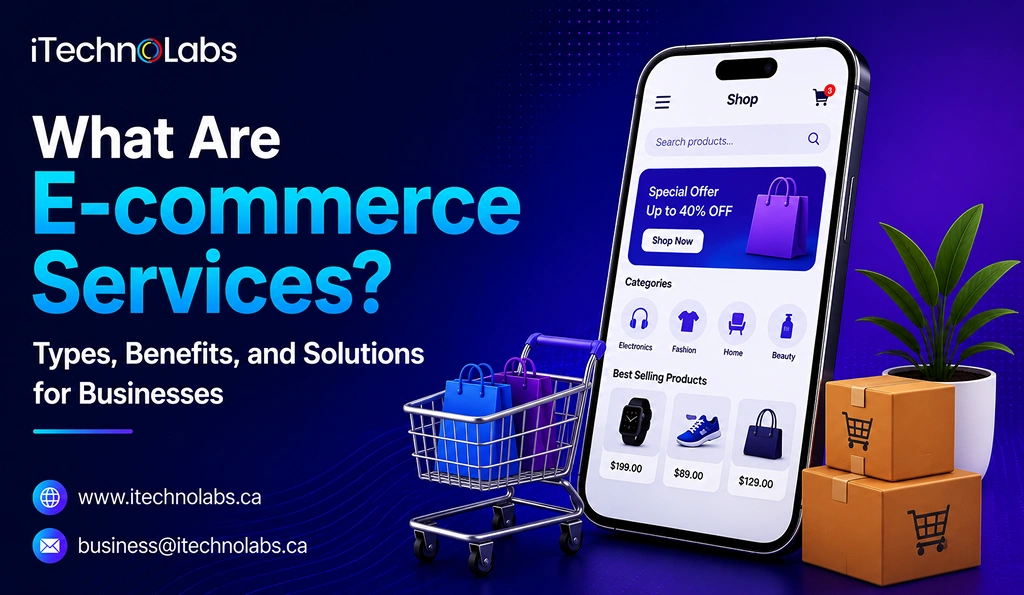
A website by itself is not enough to run an online business, and in today’s competitive and complex environment, online businesses need a full ecosystem of tools, technologies, and support services to run online sales. And this is the purpose of e-commerce services. By observing the massive expansion of online shopping, we can understand the strategic value of these services. In 2025, the worldwide sales of e-commerce will amount to roughly $6.4 trillion, while more than 3 billion people around the globe will have shopped online.
Also, e-commerce would be responsible for over 20% of all total retail sales, considering digital commerce as the single most important channel for growth. Whether you are creating a new Web-based business, entering new markets, or enhancing customer experiences, e-commerce services streamline all parts of the online buying process.
From creating a website and payment processing to managing inventories and offering support to customers, e-commerce services can help you sell products and services online. Companies offering comprehensive e-commerce services are well-equipped to tap into the rising demand for online products, boost customer satisfaction, and expand with ease.
TL;DR
- E-commerce services help businesses sell products and services online.
- They streamline payments, inventory management, shipping, and support.
- E-commerce solutions improve customer experiences and operational efficiency.
- Businesses use them to scale online growth and revenue.
- Modern e-commerce services enable secure, seamless digital transactions.
Key Points
- E-commerce services are the enabling tools, technologies, and infrastructure required to build, maintain, and scale a business online.
- Some basic services offered are website design/development, payment gateways, inventory tracking, order processing, customer service applications, etc.
- These services are essential to help automate many tasks of a business, lowering costs and increasing the efficiency of their digital sales.
- More advanced services allow businesses to enrich their customers’ online experience through faster checkouts, tailored buying experiences, and quick response support.
- Ultimately, by taking advantage of these online services, businesses are given the opportunity to successfully grow their online ventures, access worldwide markets, and create higher levels of online sales.
Table of Contents
- What Are E-commerce Services?
- Why Are E-commerce Services Important?
- Types of E-commerce Services
- Key Features of E-commerce Services
- Benefits of E-commerce Services
- Industries That Benefit from E-commerce Services
- How to Choose the Right E-commerce Service Provider
- Future Trends in E-commerce Services
- Why Choose iTechnolabs for E-commerce Services?
- Conclusion
- FAQs
What Are E-commerce Services?
E-commerce services are the technological services, tools, and expertise necessary to create, maintain, and grow an online selling business. E-commerce services underpin the framework of conducting business on the Internet and support the entire process a consumer experiences when shopping.
At their basic level, e-commerce services offer ease for companies trying to sell on the web. Their main functions involve building a web presence or an application (web or mobile site); processing online transactions using a payment gateway; managing inventory and orders; aiding in the delivery process; assisting in managing customer relationships; protecting against fraud or hackers, and integrating with other services for digital advertising, to name a few. Collectively, these services build a complex, streamlined business model to easily sell products online.
With the continued growth of online retail, e-commerce services have been a necessity for both small and large businesses. They aid companies by automating day-to-day operations, reducing costs, minimizing errors, and tracking important data. When an organization is either creating its first web store or already running a business through an advanced online portal or marketplace, these e-commerce services are what keep it alive and growing within the new market.
To explain in its simplest form, e-commerce services are all of the solutions and provisions that allow for online purchasing to be a successful endeavor for the seller. These services help to present products and items effectively, collect payment properly, monitor inventory in a timely manner, ensure orders arrive on time and correct, and aid customers when they may be having issues with their shopping experience.
Why Are E-commerce Services Important?
Shopping online is becoming more popular every day, and at the same time, customers’ expectations are rising exponentially. Today, the customer is looking for a website that loads really fast, a payment method that is secure, a personalized shopping experience, being able to track the order in real time, and finally, the 24 / 7 response from the support team. The businesses that do not take into account or overlook any of these expectations end up having not only a high cart abandonment rate but also low customer retention, and not to mention, the loss of revenue opportunities.
Using e-commerce services is the right way to get the necessary tools and the setup that are needed to fulfill what I just said mentioned, while at the same time securing the smooth and efficient flow of business operations. Having the right solutions implemented, businesses can not only automate their processes and at the same time, enhance customer experiences, but also be able to stay one step ahead of their competitors in the digital marketplace.
Key Benefits of E-commerce Services
- Simplify Online Operations – Automate essential processes such as inventory tracking, order management, and payment processing.
- Improve Customer Satisfaction – Deliver seamless shopping experiences with faster checkouts, accurate order fulfillment, and responsive support.
- Reduce Manual Workloads – Minimize repetitive tasks through automation, allowing teams to focus on strategic business growth.
- Increase Sales Opportunities – Reach wider audiences, improve conversion rates, and support multiple sales channels.
- Enable Business Scalability – Handle growing traffic, product catalogs, and transaction volumes without operational disruptions.
- Enhance Data Security – Protect sensitive customer and payment information through advanced security measures and compliance standards.
In addition to operational advantages, e-commerce solutions offer rich business intelligence capabilities. Analytics and reporting services enable organizations to monitor customer behavior, track the success of their marketing campaigns, discover trends in their sales, and make informed business decisions.
In the end, e-commerce solutions free businesses to concentrate on growth and innovation rather than on labor-intensive technical processes. Local or global in scope, companies that utilize robust e-commerce platforms can better serve their customers and guarantee their business longevity.
Types of E-commerce Services
E-commerce solutions include various services that assist companies in establishing, operating, enhancing, and expanding their online business. Every service is essential for providing flawless shopping experiences, increasing operational efficiency, and boosting sales.
1. E-commerce Website Development
E-commerce website development services mainly concentrate on designing visually appealing, easy-to-navigate, and efficient online stores. They account for a tailored website design, the formation of a product catalog, shopping cart features, checkout systems with high levels of security, and a responsive web design that works well with various devices. An appropriately developed e-commerce website acts as the cornerstone of a thriving online business by offering consumers an enjoyable and seamless shopping experience.
2. Mobile Commerce (mCommerce) Development
With the rise of mobile shopping, breaking into the market with a mobile-first strategy must be a priority for businesses if they want to satisfy customers. mCommerce development services, or mobile commerce, focus on the development of a mobile app, creating a responsive web design, integrating mobile payment services, sending push notifications, and using the location-based features. Such tools will help make sure that your customers will always be able to comfortably look through the catalog and make a purchase even on mobile devices and tablets.
3. Payment Gateway Integration
Payment gateway integration enables businesses to accept online payments securely and efficiently. These services support various payment methods, including credit and debit cards, digital wallets, bank transfers, and buy-now-pay-later options. A reliable payment gateway helps build customer trust while reducing transaction failures and security risks.
4. Inventory Management Services
Keeping a close eye on inventory is critical for ensuring that products remain in stock and are not oversold. Inventory management services offer such benefits as up-to-the-minute stock levels, automatic inventory updates, demand planning and forecasting, low-stock notifications, and multi-channel inventory synchronization. These services assist businesses with managing their stock levels.
5. Order Management Solutions
Order management services automate the end-to-end order process, from order confirmation and shipment to delivery. Services such as order processing, tracking, invoicing, returns management, and customer notifications fall under order management systems. Order management services improve order accuracy and efficiency in the fulfillment process, thereby enhancing the customer experience and overcoming operational hurdles.
6. Shipping and Logistics Integration
Shipping and logistical services bridge the gap between e-commerce stores and shipping companies or fulfillment centers. These platforms provide features like automated shipping cost estimation, creation of shipping labels, order tracking, updates on deliveries, and warehousing functionalities. Streamlined logistics integration not only ensures prompt delivery of the products to customers but also helps in lowering the shipping expenses.
7. Customer Support Services
Excellent customer service ensures customers’ loyalty and encourages repeat purchases. Services provided by e-commerce customer support include live chat, chatbots driven by Artificial Intelligence, helpdesk software, ticket-managing platforms, email support, and self-help knowledge bases. All these are to enable companies effectively and rapidly to find solutions for customers’ problems.
8. E-commerce Testing and Quality Assurance
Testing and quality assurance services are critical steps that guarantee the proper functioning of e-commerce sites and apps at the time of launch, as well as during updates. Service offerings typically cover performance, security, usability, compatibility tests, and bug detection. Extensive testing acts as a safeguard to avoid any technical problems that might lead to deteriorated user experience and decreased sales.
9. Marketing and Analytics Services
Marketing and analytics services enable companies to attract customers, track their performance, and adjust their sales strategies effectively. These tools consist of SEO, email marketing integration, social media marketing tools, conversion tracking, customer behavior analysis, and performance reporting dashboards. Using data-driven insights, businesses will be able to boost customer engagement, raise conversion rates, and maximize their ROI.
10. Security and Fraud Prevention Services
The security services are meant to safeguard an e-commerce site along with customer information from being attacked and compromised by cyber attackers, fraudulent actions, and unauthorized access. Some security services offered include SSL certification, data encryption, fraud detection systems, authentication, compliance management, and frequent security checks. With proper security measures, customer confidence can be built up and compliance with rules ensured.
11. Marketplace Integration Services
Marketplace integration services help businesses sell on numerous marketplaces, including Amazon, eBay, Walmart, and other online platforms. They provide product listings, stock levels, pricing, orders, etc., to be synchronized across channels, helping businesses extend their market reach.
12. E-commerce Maintenance and Support
Continuously providing maintenance and support services guarantees the upkeep of security, updates, and perfect functionality of e-commerce platforms. Among these services are this: updating the software, fine-tuning performance, eliminating bugs, installing security patches, enhancing features, and providing technical support. With routine maintenance, a company can continuously deliver a nice and dependable shopping journey.
Through the integration of the mentioned e-commerce services, companies are able to develop a strong digital commerce environment that helps in increasing the business, enhancing the customer experience, and contributing to the long-term success of the business in the highly competitive online marketplace.
Key Features of E-commerce Services
E-commerce services are a bundle of different features that collectively offer the customer a smooth online shopping journey. Such features enable businesses to not only manage their products but also to process transactions, fulfill orders, and give outstanding customer support, all while maintaining security and operational efficiency.
1. Product Catalog Management
Using a product catalog manager will allow you to display your products in an organized way. It will allow a shop owner to add the product descriptions, pictures, prices, categories, and stock numbers. When a client finds an item in the catalog, he will be able to view and compare the product’s info easily.
2. Shopping Cart Functionality
The shopping cart, another key component in any e-commerce website, gives users the ability to place and order products in their cart, to adjust the quantities of items ordered, to keep track of items for a future purchase, and to check on items in their cart before making their purchase.
3. Secure Checkout
A secure checkout feature allows customers to finish purchases both quickly and securely. A checkout feature comprises secure processing of payments, display of order summaries, gathering of shipping details, and confirmation pages. By creating a smoother checkout, the number of dropped carts may be reduced.
4. Payment Gateway Integration
With payment gateway integration, it is possible to accept various payment methods such as credit cards, debit cards, e-wallets, and bank transfers. The security in payment processing will safeguard the sensitive transaction details and provide a comfortable payment experience for customers.
5. Inventory Tracking
Inventory tracking is one of the ways businesses keep an eye on their stock levels around the clock. It also keeps changing the number of product availabilities, giving alarms for low stock, and stopping overselling. Good inventory management is what makes sure that customers can get the products that are in stock; at the same time, it also helps businesses keep their stocks at the best levels.
6. Order Management
Order management systems handle the whole order completion process in a very efficient manner, starting from order confirmation until delivery of the product. Such systems can easily automate ordering, invoicing, delivery tracking, refund handling, and customer communication. Smooth order handling leads to more accurate operations and happier customers.
7. Shipping Integration
Shipping integration enables online stores to link up with shipping and delivery companies. It includes automated shipping costs, shipping label creation, shipping tracking, and delivery management. This system allows for faster and more reliable order processing and allows customers a higher level of transparency.
8. Customer Account Management
Customer account functionality is the ability to create profiles, save shipping information, track orders, manage preferences, and view purchase history. Customer accounts that are personalized provide a better user experience. They not only make shopping easier but also encourage customers to buy again because the shopping experience is more tailored.
9. Analytics and Reporting Dashboard
With analytical and reporting tools, one can gain insights into store performance, customer behavior, sales patterns, marketing effectiveness, and much more data to leverage opportunities and improve strategies to gain more customer engagement.
10. Security and Data Protection
Security features protect customer information, payment details, and business data from cyber threats. These measures include SSL encryption, secure authentication, fraud detection systems, data backups, and compliance with industry regulations. Strong security practices help build trust and maintain the integrity of the online store.
Together, these features form the foundation of a successful e-commerce platform. By combining efficient operations, secure transactions, and customer-focused experiences, e-commerce services help businesses improve performance, increase sales, and achieve sustainable growth in the digital marketplace.
Benefits of E-commerce Services
The tools and solutions that e-commerce services offer businesses help them operate successfully in a growingly digital world. E-commerce services streamline businesses’ operations, enhance customer experiences, and permit businesses to grow, among the many benefits they offer organizations.
1. Global Market Reach
The great advantage of using an e-commerce service is that the scope of business is no longer limited by boundaries. Whereas a brick-and-mortar shop could only market its products and services to clients within a particular area, now an online shop is capable of marketing to customers living in different cities, states, and even nations without ever having to establish its presence there. New markets can thus be discovered.
2. Improved Operational Efficiency
E-commerce solutions not only remove the hours spent on doing business tasks manually but also streamline your back-office processes. With them, things like updating inventory levels, processing orders, confirming payments, sending shipping notifications, and reaching out to customers can be taken care of automatically. In addition, besides just ensuring that the tasks are done accurately, reducing the costs of operations, and allowing teams to focus on business development rather than on repetitive administrative tasks, this automation will help you get a lot of other benefits as well.
3. Enhanced Customer Experience
Today’s consumers want a quick, efficient, and convenient buying and shopping experience. E-commerce services offer intuitive websites, a smooth buying experience with a user-friendly mobile experience, secure payment processes, and tailored recommendations for products, as well as rapid customer service to ensure smooth purchasing processes and promote repeat purchases.
4. Better Data and Business Insights
Data is incredibly important in any business environment, and the services of e-commerce firms provide analytics that can help in decision-making for businesses to understand consumer behavior and sales performance. Businesses may analyze website traffic, view conversion rates, see what products perform best, and analyze their marketing efforts. This information can be utilized to help a business make smarter decisions, refine its operations, and build better strategies.
5. Scalability and Business Growth
Usually, the more a business develops, the more complicated its operational needs get. E-commerce platforms are made to expand together with the growth of businesses by enabling support for bigger product catalogs, heavier website traffic, larger transaction volumes, and wider customer bases. This ability to scale up makes sure that businesses can keep on growing without pausing for major disruptions or performance issues.
6. Increased Revenue Opportunities
With round-the-clock services that enable customers to shop for goods and services anytime, e-commerce businesses make additional sales possibilities available. Digital marketing, personalized discounts, product bundling, and upselling are some of the techniques that businesses can use for higher conversion rates and more sales per customer. Besides, reaching global audiences and facilitating smooth buying experiences is what typically leads to higher income and more stable profits over time.
7. Stronger Customer Engagement
Businesses can also foster and sustain communication with customers on their e-commerce site, taking the communication through email marketing, loyalty schemes, targeted offers, and integrated social media links, and use these engagement strategies to foster stronger customer relations and brand loyalty over time
8. Enhanced Security and Trust
Security is a paramount element for any kind of commerce over the internet. E-commerce sites include extra security measures such as SSL Encryption, secure payment gateways, and fraud protection, as well as compliance with the required standards. Security measures play an important role in securing valuable customer data and ensuring customer trust for any kind of business relationship.
9. Competitive Advantage
Companies that invest in state-of-the-art e-commerce services are able to react faster to trends in the market, the demands of customers, as well as to changes in the behavior of consumers. Digital capabilities at an advanced level enable enterprises to offer enhanced shopping experiences, run their businesses more efficiently, and be ahead of rivals even in a changing and fast-paced market.
In general, e-commerce services give businesses the ability to simplify their work, raise customer satisfaction, widen their market, and achieve growth that can be maintained over time. Taking advantage of suitable e-commerce solutions will allow companies to prepare themselves for a successful long-term future in the digital economy.
Suggested Article: E-commerce Development Cost in Canada
Industries That Benefit from E-commerce Services
E-commerce has, in addition, modified and affected how operations are conducted in business. Businesses operating in various industries were able to improve their operational process when they were able to provide their products online, meet their consumers, and increase revenue via the usage of e-commerce. Whether selling physical or digital goods or even services, businesses can utilize e-commerce solutions to help enhance their efficiency.
- Retail and Fashion: E-commerce services help retail and fashion brands in displaying their products, managing inventory, handling orders, and delivering personalized shopping experiences, which enhances customer engagement and sales.
- Electronics: E-commerce platforms enable electronics businesses to manage a vast product catalog, facilitate the listing of detailed specifications, manage the order fulfillment process, and facilitate comparison shopping.
- Grocery and Food Delivery: Online grocery stores and food delivery businesses utilize e-commerce solutions in managing the stock, orders, deliveries, and tracking for all transactions and shipments.
- Healthcare and Pharmacies: Healthcare providers leverage e-commerce solutions for online consultations, appointment booking, prescription refills, and selling medical products over secure platforms.
- Wholesale and Distribution: Wholesalers and distributors can easily manage bulk orders, automate control over inventory, and facilitate custom pricing and efficient B2B transactions through e-commerce platforms.
- Subscription-Based Businesses: E-commerce solutions assist subscription businesses in managing recurring payments, accounts of users, automatic renewals, and billing for all subscriptions.
- Digital Products and Services: Businesses that offer products and services like software, eBooks, online tools, and digital downloads utilize e-commerce platforms to enable payments and instant product delivery with security and efficiency.
- Education and Training: Educational organizations and training providers can make the sale of their online courses, learning materials, certifications, and membership programs through e-commerce services.
- B2B Commerce: The business clients of e-commerce platforms, B2B businesses, can streamline procurement, account management of companies, bulk order facilities, and automate business transactions.
- Online Marketplaces: Multi-vendor marketplaces can make use of e-commerce solutions to bring together buyers and sellers, manage vendors, process payments, and efficiently operate the marketplace.
No matter what market is that you’re in, e-commerce services are essential as it’s technology and the underlying framework to improve your processes, enhance customer experience, and broaden market reach, as well as business sustainability.
How to Choose the Right E-commerce Service Provider
To make sure your e-commerce business succeeds, it’s important to pick the correct e-commerce service provider. A service provider will create a user-friendly purchasing process and can support the long-term success of your business. Since there are a lot of providers, it is vital to research them well before making a decision.
1. Industry Expertise and Proven Experience
Pick a firm that not only has plenty of experience in e-commerce development but also understands your sector really well. They will be able to assist you in overcoming obstacles, applying good production methods, and producing custom solutions that meet the requirements of your business.
2. Customization and Scalability
Try to find a provider who has experience in designing bespoke and scalable e-commerce solutions, in line with your business needs, and growing product lines and customer base.
3. Security and Technology Integration
A strong vendor will take care of security by using secure processing and keeping client information protected by relevant standards, as well as by allowing smooth integration with your existing business instruments like CRM, payment gateways, ERP, and more.
4. Mobile Optimization and User Experience
A good provider would have a focus on responsiveness, load times, and user experience. Being mobile-friendly will boost interaction and user satisfaction.
5. Ongoing Support and Long-Term Value
Find a partner who offers ongoing maintenance, technical support, performance optimization, and updates. Take into consideration what you get for what you pay, as opposed to initial pricing.
By measuring each of these aspects, you can select an e-commerce service provider that will help your business to grow for the long-term and provide an enhanced customer experience along with valuable business worth.
Future Trends in E-commerce Services
Moving forward, technological innovation and changing consumer expectations will shape the future of e-commerce services toward increased automation and personalization. Companies that invest in these developing trends will be able to increase consumer satisfaction, boost operating efficiency, and remain competitive in today’s digital world.
1. AI-Powered Automation and Personalization
AI will further reshape the way we experience e-commerce by allowing businesses to automate customer service interactions, optimize product recommendations, manage inventory, and optimize marketing strategies. Customers will receive personalized experiences, which will boost engagement and drive sales.
2. Growth of Mobile and Voice Commerce
Customers are using their phones and voice assistants for shopping more and more. So companies will concentrate on giving mobile-first experiences and enabling shoppers to use voice for their purchases. It will be a must for online retailers to speed up mobile checkout and optimize for voice search.
3. Expansion of Social Commerce
Social media is becoming a sales channel in its own right. Businesses will use built-in commerce functionalities on social media sites, enabling users to purchase their goods on their favorite social networks without ever having to leave the site or app.
4. Augmented Reality (AR) Shopping Experiences
The customers will be able to virtually try on products, see what furniture looks like in their houses, and interact with it before the purchase. Such an immersive experience can strengthen customer confidence and decrease returns.
5. Enhanced Security and Digital Payments
E-commerce services of the future will implement enhanced security procedures, utilize technologies for fraud detection and prevention, and offer versatile payment methods like electronic wallets, contactless payments, and biometric verification to guarantee the safety of transactions.
Going after these trends, enterprises will have the possibility to remain competitive, upgrade the client experience, and discover new avenues of growth in the ever-changing digital market.
Why Choose iTechnolabs for E-commerce Services?
Selecting the appropriate e-commerce development partner is essential to the success of an online business. iTechnolabs will work with the business’s technical requirements and industry know-how to deliver a scalable e-commerce platform that meets the consumer’s demands.
1. Custom E-commerce Solutions
iTechnolabs develops tailored e-commerce platforms designed to match your business goals, industry requirements, and customer expectations.
2. Experienced Development Team
With a team of skilled developers and designers, iTechnolabs delivers high-quality e-commerce solutions backed by industry expertise.
3. Secure and Scalable Platforms
The company builds secure, future-ready e-commerce stores that can handle growing traffic, transactions, and product catalogs.
4. Seamless Integration Capabilities
iTechnolabs integrates payment gateways, CRM systems, shipping providers, and other essential tools to streamline business operations.
5. End-to-End Support
From planning and development to maintenance and optimization, iTechnolabs provides comprehensive support throughout your e-commerce journey.
Also, read: Do’s and Don’ts While Hiring The Best eCommerce Website Developers
Conclusion
E-commerce services are the very essence of flourishing online shops. They bring together website creation, handling payments, stock management, delivery, customer care, data analysis, and protection in a single platform, allowing smooth selling on the web.
If you are a company just starting out with an online shop or a big business looking for new ways to go digital, then investing in proper e-commerce services will most probably support you in enhancing customers’ experiences, simplifying your company operations, and steadily growing.
FAQs
1. What are e-commerce services?
E-commerce services are a package of services, technologies, and solutions that help companies to build, operate, and expand an online store. Usually, the package of services contains website development, payment gateways, inventory management, order processing, shipping services, support, and statistics.
2. Why are e-commerce services important?
E-commerce services aid organizations in business streamlining, customer satisfaction, automation of repetitive work, and enhanced sales generation. They also facilitate a framework for the handling of all business transactions in a secure manner, as well as assisting in expanding business operations efficiently.
3. Which industries benefit from e-commerce services?
E-commerce services are used across numerous sectors and markets, including fashion, retail, electronics, food delivery, healthcare, online marketplaces, wholesale, subscriptions, education, etc. Every business that wants to sell goods or services online is able to use e-commerce solutions.
4. Can e-commerce services be customized for specific business needs?
Yes. The majority of e-commerce platforms can be configured to address specific business needs. Businesses are free to extend the platform’s functionality, integrating third-party add-ons, payment methods, workflows, and branding.
5. What is the primary goal of e-commerce services?
The primary aim of e-commerce services is to give companies the chance to sell products and/or services online more effectively. Services can enhance the customer experience, streamline operations, generate more sales, and enable long-term business success.