Key Takeaways
- Artificial general intelligence (AGI) means a machine that can learn almost any mental task a person can, without engineers rebuilding it for each new job.
- Nothing available in 2026 meets that bar. The best chatbots write and talk well, yet they still fail simple picture puzzles most people solve with a little thought.
- Google DeepMind’s researchers placed the leading chatbots on the first of five rungs toward AGI, a level they call “Emerging.”
- In the largest survey of its kind, 2,778 researchers gave even odds that machines will beat people at every task by 2047.
- You don’t have to wait for AGI. The tools out there now already save teams hours on support and paperwork, as long as each one is built around one clear job.
Artificial general intelligence (AGI) is a machine that could pick up almost any mental task a person can do and learn it on the job, without engineers rebuilding it each time. It doesn’t exist yet. The chatbots and tools you use in 2026 are good at a narrow set of jobs and get lost outside them.
If you run a startup, you’ve probably heard one person say AGI is two years away and another say it’s fifty. They can’t both be right. When 2,778 researchers were surveyed in late 2023, they gave even odds that machines would beat people at every task by 2047. That’s 13 years sooner than a similar survey found in 2022. This guide explains what AGI means and how close we are. It ends with what that should change, if anything, about the product you’re planning.
Table of Contents
- How Would You Explain Artificial General Intelligence to a Friend?
- How Is AGI Different From the Tools You Use Today?
- What Are the Levels of AGI?
- Has Anyone Built AGI Yet, ChatGPT Included?
- What Would a Machine Need to Become AGI?
- How Would Anyone Know AGI Had Arrived?
- How Long Until AGI Shows Up?
- What Could AGI Be Used For?
- What Could Go Wrong With AGI?
- What Does AGI Mean for Your Product Plans Today?
- What Are the Most Common Myths About AGI?
- Why Choose iTechnolabs to Build Your Next Smart Feature?
- What’s the Takeaway on Artificial General Intelligence?
- Frequently Asked Questions
How Would You Explain Artificial General Intelligence to a Friend?
Picture software that picks up a new job the way you would, by watching and having a go. The people building it still can’t agree on where the finish line is.
Cast your mind back to the sharpest person you ever hired. You showed them the invoicing routine on Monday. By Thursday they’d worked out the shipping process on their own, and a month later they were spotting problems nobody asked them to look for. People call that general intelligence.
Most software can’t do that. A program that reads X-rays can’t plan a delivery route. A chess program that beats every grandmaster alive can’t chat with you about the weather. Each one was built for a single job and stays inside it.
An AGI system would carry what it learned in one area over to another. Hand it something unfamiliar and it would muddle through, a bit like you do with a strange hotel coffee machine at 6 a.m. When the rules shifted, it would adjust by itself and nobody would have to call in an engineer.
Ask five experts what counts as AGI and you’ll hear five answers, so it’s no surprise the headlines are all over the place. OpenAI’s charter puts it as “highly autonomous systems that outperform humans at most economically valuable work.” In everyday terms, that’s machines that can do most paid jobs better than people can. Google DeepMind’s researchers took a different route in their Levels of AGI paper. They judge a system on how well it performs across many kinds of tasks, and they say how it works inside doesn’t matter. Those two yardsticks can give very different answers to “are we there yet?”
How Is AGI Different From the Tools You Use Today?
Today’s tools are specialists. AGI would be a generalist, and superintelligence, the step after it, would outdo people at almost everything.
| Today’s single-job tools | AGI | Superintelligence (ASI) | |
| What it can do | One job or one family of jobs | Most mental tasks a person can do | Nearly every mental task, better than the best human |
| How it learns | Engineers train it on a huge pile of examples, then retrain it to learn anything new | Keeps learning from experience, like a person | Would improve faster than people could follow |
| Examples | Spam filters, map apps, voice assistants, ChatGPT | None yet | None, outside research papers and films |
| Does it exist? | Yes, everywhere | No | No |
You’ll also run into the terms “weak AI” and “strong AI.” Weak AI is another name for today’s single-job tools. Strong AI usually means AGI, though some people add that a strong AI would also need to be self-aware. Google DeepMind’s team doesn’t count that as a requirement. Their paper says reaching AGI wouldn’t mean a machine thinks like us or has feelings.

What Are the Levels of AGI?
Google DeepMind grades machines a bit like a school report, from “unskilled” up to “better than every human.” AGI sits on the all-round track, and nothing has climbed far up it yet.
If you’ve shopped for a car lately, you’ve probably seen driver help sold in levels, from plain cruise control up to a car that drives itself. Google DeepMind’s Levels of AGI paper uses the same trick for machines. A system gets marked on how well it does a task, and separately on how wide a spread of tasks it can take on. The examples in the table are the ones the authors picked back in 2023.
| Level | Name | Compared with skilled adults | Single-job example | All-round (AGI) example |
| 0 | No AI | Not applicable | A calculator | None |
| 1 | Emerging | As good as, or a bit better than, an unskilled person | Basic programs that follow fixed if-this-then-that rules | ChatGPT, Bard, Llama 2 |
| 2 | Competent | Better than at least half of skilled adults | Smart speakers like Siri and Alexa | Not reached |
| 3 | Expert | Better than 90% of skilled adults | Grammar checkers like Grammarly | Not reached |
| 4 | Virtuoso | Better than 99% of skilled adults | Deep Blue at chess, AlphaGo at Go | Not reached |
| 5 | Superhuman | Better than every person | AlphaFold, which predicts the shapes of proteins | Not reached (this would be superintelligence) |
Look at how the right-hand column stops at Level 1. A machine can be superhuman at one job, like working out protein shapes, and still score close to nothing on general smarts. Closing that gap is what AGI research is about.
Has Anyone Built AGI Yet, ChatGPT Included?
Not yet. Chatbots have come a long way since 2023, though a picture puzzle a ten-year-old could crack will still stump them.
You can see why people wonder. A 2026 chatbot will write working code for you, or sit up with you at midnight going through your tax return. Some tests even put it ahead of most humans, which makes it fair to ask why nobody has declared victory.
The ARC puzzles help explain it. Each one shows a few small colored grids that follow a hidden rule. You work out the rule and apply it to a new grid. Most people get there with a bit of thought. A review of results published in March 2026 found that, as of February 2026, the best systems scored about 93% on the first and easiest set. On the second set they fell to 68.8%. On the newest set, where every puzzle is a little game you have to explore, they managed 13%. People scored close to perfect on all three.
Scores keep moving, and the ARC Prize 2026 contest is running with $2 million in prizes and results due in December. Still, a high score on one kind of test doesn’t settle the question. A machine can get good at a puzzle type by seeing thousands of similar ones, while a person can face a brand-new puzzle and still crack it.
So for now the answer is no. Today’s models are very capable specialists with an unusually wide range, and somebody still has to check their work.
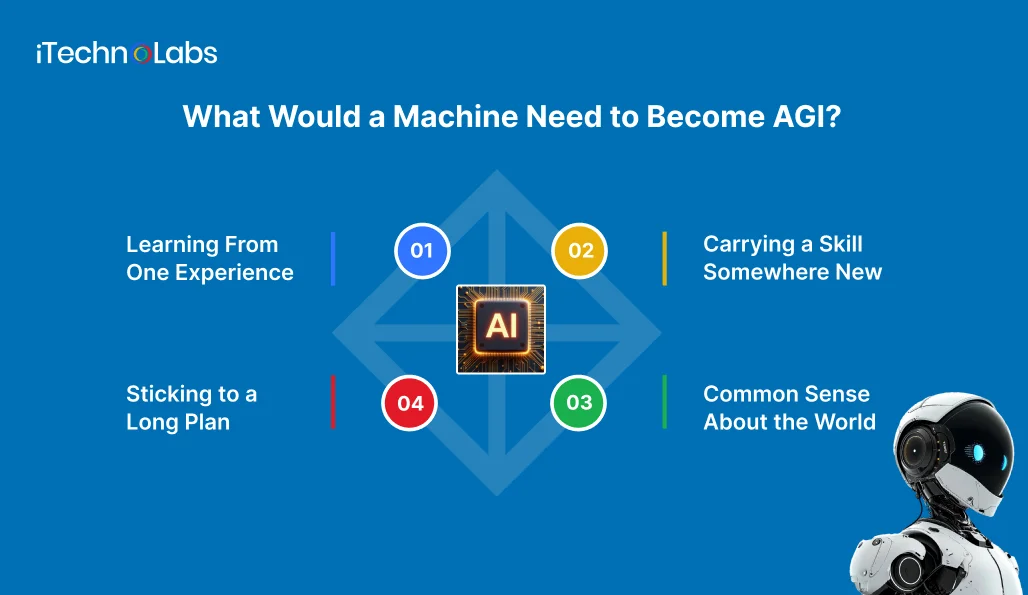
What Would a Machine Need to Become AGI?
Funny enough, it’s the stuff toddlers pick up without anyone teaching them. Getting a machine to learn something in one go, and to show a bit of common sense, has turned out far harder than teaching it chess.
Learning From One Experience
A kid touches a hot stove once and never does it again. Today’s systems learn from enormous piles of examples, and most of them stop learning once they’re released. If one gets a fact wrong, its makers often have to retrain it, which is slow and costly.
Carrying a Skill Somewhere New
Once you can ride a bike, a scooter takes you about ten minutes. People move skills from one area to another all day long. Machines still struggle with this, and it’s probably the single biggest thing separating them from general intelligence.
Common Sense About the World
A tipped glass spills. The corner shop is shut at 3 a.m., and a crying customer probably isn’t in the mood for an upsell. You’ve never read those rules anywhere. Machines miss them so often because nobody ever wrote them down.
Sticking to a Long Plan
Planning a wedding takes hundreds of steps over months, and half of them change along the way. Today’s tools are good for the next step. They’re much weaker at keeping a long plan on track when the venue cancels.
How Would Anyone Know AGI Had Arrived?
There’s no single pass mark. Researchers have suggested several tests over the years, and each one has a weak spot.
| Test | Who suggested it | What the machine has to do | Its weak spot |
| Turing test | Alan Turing, in a 1950 paper | Chat by text so well that a judge can’t tell it from a person | Fooling someone in a chat isn’t the same as being able to do things |
| Coffee test | Steve Wozniak, Apple co-founder | Walk into a stranger’s home and make a cup of coffee | Needs a robot body and only checks one chore |
| College student test | Researcher Ben Goertzel | Enroll at a university, take classes and earn a degree | Takes years to run |
| Employment test | Computer scientist Nils Nilsson | Do real jobs as well as the people who hold them | Which jobs, and how many, is open to debate |
| ARC puzzles | The ARC Prize team | Solve picture puzzles it has never seen before | Still only puzzles, far from everyday work |
Today’s chatbots show why the Turing test fell out of favor. A chatbot can keep you talking happily for an hour and then flunk those grid puzzles. That’s pushed most researchers toward judging a system on a whole bundle of tests.
How Long Until AGI Shows Up?
There’s no firm date. In the largest survey of researchers the odds hit 50-50 around 2047, and some scientists doubt we’ll ever get there.
The 2023 Expert Survey on Progress in AI asked 2,778 researchers who’d published at top research conferences. The question was when machines would beat people at every task, working on their own and more cheaply than human workers. Their answers put a one-in-ten chance on 2027 and a coin-flip chance on 2047. When a similar group was asked in 2022, that coin-flip year came out as 2060, so within twelve months the guess jumped 13 years earlier.
The same researchers were far more cautious about jobs. They gave even odds that every human occupation could be fully handed to machines only by 2116. Being able to do a task isn’t the same as replacing a whole job. Part of that gap is likely cost and laws, and people often want a person on the other side of the table.
Some experts sit much further out. MIT roboticist Rodney Brooks, quoted by McKinsey, doesn’t expect AGI before the year 2300. The 2027 marker from the survey is now only months away, and nothing tested so far comes close to beating people at every task.
What Could AGI Be Used For?
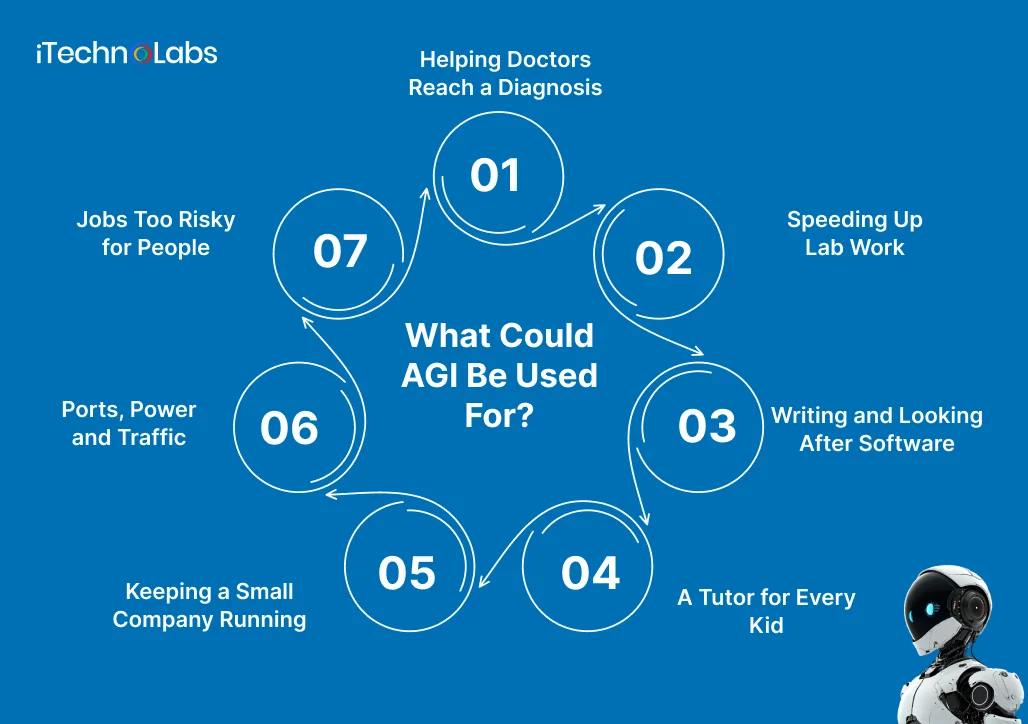
None of this is on sale yet. Each example below sketches a job today’s tools only half do, and what a general system might add.
Helping Doctors Reach a Diagnosis
Plenty of hospitals already run software that circles a suspicious spot on a scan, or warns staff when a patient’s numbers look like an infection brewing. Every one of those programs has a single trick. Now imagine one system looking at the scans alongside the blood tests, the family history and last month’s research papers, then telling the doctor what it thinks is going on and why. Drug research could change too. The system might design an experiment, look at what came back and tweak the next one, with no scientist rewriting instructions between rounds.
Speeding Up Lab Work
Science is slow partly because nobody can read everything. A general system could notice that a forgotten chemistry result from decades ago answers a question a biology team is stuck on today. Picture a battery lab where the machine suggests a new material in the evening, tests it on a computer overnight and has a better version waiting when the team gets in.
Writing and Looking After Software
Coding helpers in 2026 are decent at small pieces when you spell out exactly what you want. Where they slip is the stuff nobody mentioned, such as keeping customer data locked away or catching a payment that goes through twice. An AGI could run the whole project. It would ask the right questions up front and sketch how the parts connect before writing and testing anything. Once the app was live, it would spot its own bugs and fix them. Most companies would pay a lot for an engineer like that.
A Tutor for Every Kid
Imagine a tutor that works out exactly why your daughter keeps getting fractions wrong. Maybe she’s shaky on division. Maybe she misreads the question, or tests make her freeze up. A good human tutor figures that out and changes tack, and a general system could do the same for every child in a school at once. Most learning apps today march every kid down the same path, which is fine until yours falls off it.
Keeping a Small Company Running
Take a 40-person business with its accounts in one program, its support inbox in another and its stock levels in a spreadsheet nobody trusts. Today each of those needs its own tool and often its own consultant. A general system could see the whole picture at once. It might notice a supplier running late and work out that it’ll squeeze cash flow next month, then have the customer emails and a reorder plan drafted before the owner’s had coffee.
Ports, Power and Traffic
Big networks break in ways that are hard to see coming. A storm shuts one port, and three weeks later there’s an empty shelf in a supermarket on another continent. Software that understood the whole chain could move shipments around the problem as it happened. The same kind of system could keep a city’s electricity balanced on a heatwave afternoon, or retime traffic lights when a crash blocks a main road.
Jobs Too Risky for People
Put a general mind inside a capable robot and you could send it where people shouldn’t go, like a flooded mine or the seabed under an oil platform. Space is the dream case. Messages from Earth can take minutes to arrive, and a machine that thinks for itself wouldn’t sit idle waiting for them.
Plenty of this is possible in a smaller form right now. Sorting documents and answering customers are two jobs single-purpose tools already do well, provided each one is built for a clear task. If there’s a process like that in your business, an experienced AI development company can tell you what’s realistic with what exists today.
What Could Go Wrong With AGI?
People who study this mostly worry about a machine chasing the wrong goal, and about humans putting it to bad use. Jobs and slow-moving laws are on the list too.
The wrong-goal problem is easiest to see with an example. Say you ask a very capable assistant to “cut customer complaints in half.” The lazy way to hit that number is to make complaints harder to file. You’d never mean that, and a person on your team would know it. A machine might not. Researchers call this the alignment problem, which in plain terms means making sure the system wants what we want.
Misuse is the more immediate worry. Tools far short of AGI already help scammers write convincing emails and fake voices. Give a criminal gang something far smarter and they could run those scams on millions of people at once. Worse, it might hunt for holes in a bank’s systems or a power company’s network faster than the people guarding them can plug the gaps.
Machines learn from human records, so they pick up our unfairness too. Train a hiring tool on ten years of old decisions and it can quietly repeat whatever bias was baked into them.
Then there’s work. Even optimistic forecasts expect jobs to shift unevenly, with some roles changing fast and others barely at all. Governments are still writing rules for today’s tools, and very few have said anything concrete about AGI.
What Does AGI Mean for Your Product Plans Today?
Don’t wait for it. Build with the tools that work now, and set things up so you can swap in better ones later.
Plenty of founders hold off on smart features because they figure something far better is around the corner. The trouble is you’d be waiting on a date nobody can predict, while competitors ship and learn from real customers. The founders who get ahead usually do something closer to this.
- Pick one painful job. Answering the same support questions over and over is a good place to start, and so is pulling details out of invoices. Today’s tools do well when the task is narrow and clearly defined.
- Keep the “brain” swappable. Build your product so the part that does the thinking can be replaced when a better option arrives. That way an upgrade becomes a small update and you don’t rebuild your app every year.
- Get your records in order. Clean, organized data about your customers and past work is what any future system will learn from, so it pays off whatever comes next.
- Keep a person checking anything that touches money or health. That check costs little, and it catches the mistakes that would cost you a lot.
Want to test an idea before committing a full budget? A small first version through MVP development services puts it in front of real users in weeks. For features that write, summarize or answer questions, generative AI development services are the natural starting point.
What Are the Most Common Myths About AGI?
Most of what people believe about AGI comes from films and old headlines. A few popular claims don’t hold up once you check them.
| Myth | What’s true |
| “AGI would have to be conscious.” | Google DeepMind’s paper says reaching AGI doesn’t require a machine to have feelings or think like a person. It’s about what the system can do. |
| “AGI means humanoid robots.” | AGI is about the mind. It could run on an ordinary computer with no body at all, though some researchers think a body would help it learn. |
| “Passing the Turing test proves AGI.” | Chatbots can hold convincing conversations and still fail picture puzzles people solve easily. |
| “GPT-4 has 100 trillion parameters, so AGI must be close.” | That number was never confirmed. OpenAI’s GPT-4 technical report says it chose not to share the model’s size, and size alone doesn’t make a system general. |
| “AGI will either show up overnight or never.” | The Levels of AGI scale treats it as a ladder. Systems can sit on lower rungs for years as they improve step by step. |
| “Once AGI arrives, every job disappears.” | The same researchers who expect AGI-like abilities by 2047 put full automation of all jobs around 2116. |
Why Choose iTechnolabs to Build Your Next Smart Feature?
We build with the tools that work today and set up your product so it can move to better ones later. Outside auditors check our security and quality processes.
iTechnolabs holds ISO 27001:2013 certification for information security and ISO 9001:2015 for quality management. That matters the moment your app starts holding customer records or taking payments. Our team of 300+ developers has delivered 500+ apps used by more than 50,000 people. We work from offices in Markham, Calgary and Ottawa in Canada, plus Sheridan, Wyoming in the US.
We don’t sell AGI promises. iTechnolabs’ development team starts by finding the one job in your business where today’s tools can save real time. We build that, test it with your users and design it so the thinking part can be upgraded as better options appear. Every piece of generated code goes through the same review and testing as code our developers write by hand.
What’s the Takeaway on Artificial General Intelligence?
Artificial general intelligence is a machine that could learn almost any mental task the way a person does, carrying skills from one job to the next without being rebuilt. Serious money is going into it, and it still isn’t here.
Google DeepMind’s own scale puts today’s best chatbots on the first rung of five. Puzzle tests built to measure general learning still show a wide gap between machines and people. The largest survey of researchers gives even odds of machines beating us at every task by 2047, and some respected scientists think it’ll take centuries.
For a founder, the useful lesson is about timing. Waiting for AGI means waiting on a date nobody can name. The tools available now already cut hours from support and paperwork. They work best when you aim them at one clear job and keep a person checking the results. Build for that, and keep the thinking part of your product easy to swap. Should AGI turn up in your working lifetime, you’ll be in a good spot to plug it in, and in the meantime you’ll have been shipping something customers pay for.

Frequently Asked Questions
Does AGI exist yet?
No. As of 2026, no system can learn almost any mental task the way a person can. Today’s chatbots are impressive at language and some exams, but they still fail simple puzzles people solve easily. Google DeepMind’s researchers rank the leading chatbots at the first of five levels on the path to AGI.
What is the difference between AGI and ASI?
AGI would match a skilled person across most mental tasks, learning new ones on the job. ASI, or artificial superintelligence, would go further and beat the best humans at nearly everything. Neither exists. ASI is the top level on Google DeepMind’s scale, and most researchers treat it as a step that would come after AGI.
Is ChatGPT AGI?
No. ChatGPT is a very capable language tool, but it can’t keep learning from experience the way a person does. It also struggles with brand-new kinds of puzzles. Google DeepMind’s researchers placed it at the “Emerging” level, the first rung on their five-step scale toward artificial general intelligence. It still needs people to check its work.
What is an example of artificial general intelligence?
There isn’t a real one yet. Picture one system that could diagnose a patient, plan a product launch and tutor a child in maths, learning each task as it goes. Films like 2001: A Space Odyssey show fictional versions, but nothing built so far comes close to that range.
Who is building AGI?
Several large research labs say AGI is their goal, including OpenAI, Google DeepMind and Anthropic. Plenty of universities and smaller groups are chasing it as well. OpenAI’s charter states its mission openly, and Google DeepMind has published a scale to track progress. No one has announced a system that meets the bar.
Will AGI replace jobs?
It would likely change many jobs, but not all at once. In the largest survey of researchers, respondents gave even odds of machines beating people at every task by 2047. They put full automation of all jobs much later, around 2116. Cost, laws and people’s preference for human help all slow the shift.
What is strong AI vs weak AI?
Weak AI is another name for today’s single-job tools, like spam filters and chatbots. When people say strong AI, they usually mean AGI, a machine with all-round intelligence that can learn any mental task. Some people also expect strong AI to be self-aware, though Google DeepMind’s researchers say that isn’t required for AGI.
How should startups prepare for AGI?
Don’t wait for it. Pick one painful task in your business and solve it with tools available now. Build your product so the